15 Aug 2018 | Focolare Worldwide
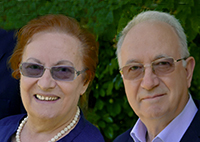 They attended all the World Meetings of Families, since the one held in Rome in1994. And at this year’s gathering in Dublin, they will share their testimony at the Pastoral Congress. They are Anna and Alberto Friso, once responsible for New Families, a branch of the Focolare Movement. They speak to Vatican news about the challenges faced by Christian families in today’s world, and of their expectations for the Meeting in Dublin which will have as its main theme Pope Francis’s apostolic exhortation Amoris laetitia (The Joy of Love). You paricipated as a family in all the World Meetings – a full quarter of a century! What has changed over the past 25 years for Christian families, in your opinion? Anna: The accent put on the new generations, the fact of no longer believing in “forever.” The challenge we must embrace is to get young people to perceive that love is an essential component of life and that it is a wellspring of happiness that married people bring. Turning to marriage doesn’t mean losing your freedom, but obtaining the possibility of a happy life! Alberto: Two things in particular characterize today’s society: individualism and relativism. There seems to be a lack of coesion in front of these two tendencies, the unity of the couple. This has meant that we Christians, we Christian families have to look deeper into God’s plan to see in what way He has called us to live in his image and likeness. As a family that has given such a long witness of Christian living, what would you feel like saying to a young couple that is stepping into marriage concerning eternal love? Alberto: What we feel like saying is: Keep in mind that the love between you that you felt in the first moments you felt these sentiments growing, is of extraordinary importance – eternal! It’s a spark of the deep value that will lie at the basis of your life, for the rest of your life, even when the storms come, and, it’s God’s love. Therefore, it’s not the two of you that get married, but the three of you, because Jesus will be with you! And, thank God, this means answers. The young people themselves become testimonies of this! Anna: The challenge is to not allow yourself be challenged by the dominating culture that focuses on feelings, personal rights that prevail over the other’s rights, or even over the value of the couple itself. God’s plan for marriage has this seal of happiness that it is possible bring to fulfillment precisely because it’s a very part of the person’s destiny, part of the DNA of every human being! In Dublin, The Joy of Love will obviously play an important role. What is this post-synodal exhortation giving to Christian families, and not only Christian? Alberto: Most particularly, it urges us to give witness to Christianity especially through the way we live, the way we give witness to God’s love. When it comes to the world, it’s not so much that we have to defend a ideas, ways of thinking, or a particular value; we have to give witness to the fact that God is Love and that love lies in the depths of the human heart, even hearts that are going through the darkest crises. Anna: We’ve experienced this so so much, precisely because of its luminosity and also its concreteness that doesn’t come to terms with the doctrine, but is able to comprehend and give a hand to those who have been wounded by life. And to these people, most especially, it is able to offer the hope of finding a way to happiness even in the midst of problems. Its beauty lies in its being a hymn to love. Inside this document we can see all of the Church’s tenderness. I believe that it is really a gift for new generations of newlyweds. Source: Vatican News, August 10, 2018
14 Aug 2018 | Non categorizzato
«Mary is not easily understood even though she is greatly loved. In a heart that is far from God, one is more likely to find devotion to her than to Jesus. She is universally loved. And the reason is this: it is Mary’s nature to be Mother. Mothers, in general, are not “understood,” especially by younger children; they are “loved.” And not infrequently, indeed often, one hears that an eighty-year-old man dies saying as his last word: “mother.” A mother is more the object of the heart’s intuition than of the mind’s speculation. She is more poetry than philosophy, because she is too real and profound, close to the human heart. So it is with Mary, the Mother of mothers, who the sum of all the affection, goodness, and mercy of all the mothers in the world cannot manage to equal. Jesus, in a certain sense, confronts us more: his divine and splendid works are too different from ours to be confused with them. Indeed they are a sign of contradiction. Mary is peaceful like nature, pure, serene, clear, temperate, beautiful — that nature which is distant from the world, in the mountains, in the open countryside, by the sea, in the blue sky or the starry heavens. She is strong, vigorous, harmonious, consistent, unyielding, rich in hope, for in nature it is life that springs up perennially generous, adorned with the fragrant beauty of flowers, kind in the abundance of its fruits. Mary is too simple and too close to us to be “contemplated.” She is “sung” by hearts that are pure and in love, who express like this what is best in them. She brings the divine to earth as gently as a heavenly plane sloping from the dizzy heights of heaven to the infinite smallness of creatures. She is the Mother of all and of each human being, who alone knows how to burble and smile at her child in such a way that, even though it is small, each knows how to enjoy her caress and respond with its love to that love. Mary is not understood because she is too close to us. She, who was destined from eternity to bring graces, the divine jewels of her Son, to humanity, is there, near to us, and waits, always hoping for us to notice her gaze and accept her gifts. If any are fortunate enough to understand her, she carries them off to her kingdom of peace, where Jesus is King, and the Holy Spirit is the life-breath of that heaven. There, purified of our dross and illuminated in our darkness, we will contemplate her and enjoy her, an added paradise, a paradise apart. Here, let us be found worthy of being called along “her way” to avoid staying always immature in spirit, with a love that does not go beyond supplication, petition, request and self-interest, but knowing her a little, may we glorify her.» Source: Centro Chiara Lubich
13 Aug 2018 | Focolare Worldwide
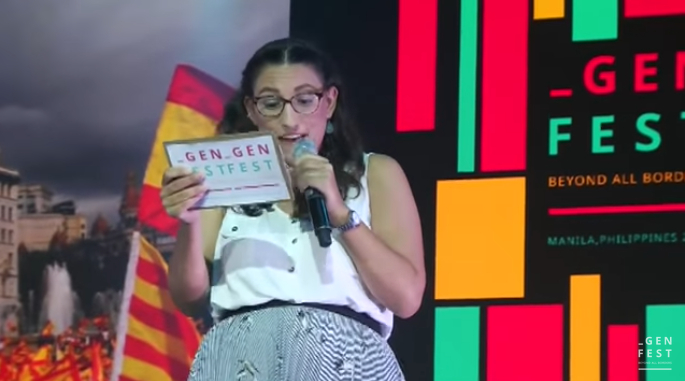
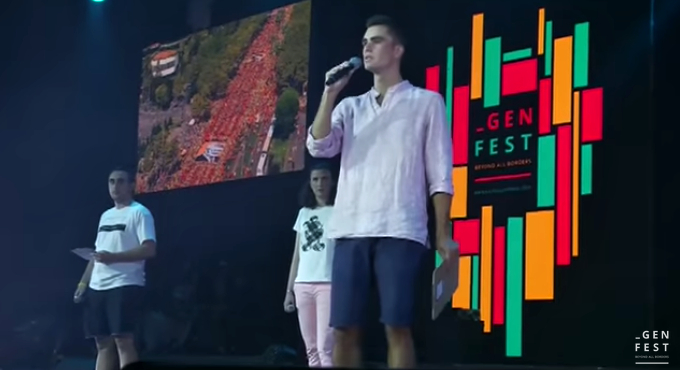 The referendum for independence held in Catalonia (Spain) on 1 October 2017, declared as illegal, gave rise to a season of strong political and social unrest and civil tension which directly involved all the sectors of the population, above all, the youth. Martì is Catalonian and comes from a city near Barcelona, but moved to Madrid for his studies. As a Gen, he shares the Focolare ideals of unity with other young people of various regions of Spain and recounted that “despite this common value, also with them in the first three months in Madrid, it had not been easy. Furthermore in the residence where I live I was maltreated because I was the only Catalonian. I held many discussions with the Gen and we continuously ended up getting angry. But one day, we decided to resolve this situation by talking among ourselves and really listening to one another. We began to see that this was the most important thing we had to do: go beyond our ideas and not foregoing dialogue amongst us, since the most important thing was to understand and respect one another. I can’t say that from then on the path was simpler, but we understood that problems are solved when we set ourselves in the condition of really listening, and not wanting to impose ourselves, the.
 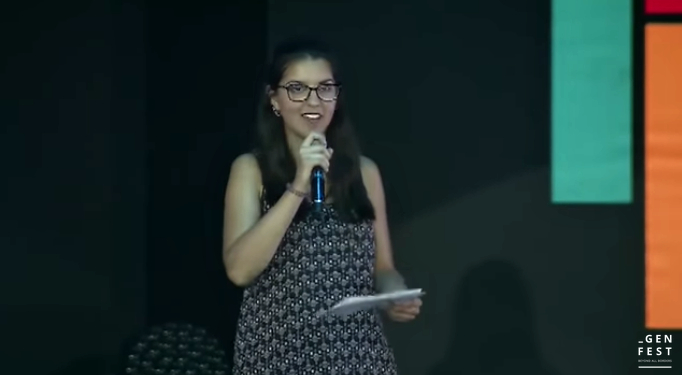 Alba is also Catalonian and recounted that the post-referendum period was a real test for her and for the other gen: on the social media some Gen had written their strong convictions about the political ideas of one or the other party, which hurt me deeply, but I didn’t stop to think whether my way of expressing myself could hurt those who do share my ideas. It was in those days that I started reflecting on what it meant for us, who often say that we are even ready to die for each other. When would we have to put this promise in practice? I felt that the time was now. So we met up with all the gen from all of Spain to clarify things even if it was not easy since we were a big group and it was impossible to say all we felt. We continued to speak with some of them, like Laura. I remember that with her the situation was delicate because I did not know how we could face the problem without hurting each other. When she proposed to make a pact, that is, of putting love before everything else, I was taken off my feet! No one had ever proposed a similar thing to me but it worked because from that moment on we managed to dialogue. The objective was not to defend our ideas, but to take care of one another, and at the same time, leave room for free expression. This experience made me see the political situation differently, and understand that what matters is not to be on the reasonable side, but that beyond the ideas there is always the person and this is more important. Still today our opinions have not changed: we think differently and this is not easy. At times we have to ask excuse, but in talking, we reach the conclusion that both the positive and negative things are part of experience. The misunderstanding now has been transformed into something greater: it is not resignation, or only respect. It is that rose which is worth more than all the thorns put together.”
https://youtu.be/YwMdvyhDJeA?t=1428
12 Aug 2018 | Focolare Worldwide
10 Aug 2018 | Non categorizzato
“Mary Most Holy is the Seat of Wisdom because she welcomed Jesus into her womb and he is the Incarnate Wisdom. With her fiat at the Annunciation, Mary consented to the divine will and Wisdom made its dwelling in her womb, making her Wisdom’s most exemplary disciples. The Virgin was blessed, not so much for having suckled the Son of God, but for having nourished herself on the wholesome milk of God’s Word.” (Pope Saint John Paul II, Angelus, September 4, 1983) In order properly to understand this sacred hymn of praise, we need to bear in mind that the Blessed Virgin Mary is speaking on the basis of her own experience, in which she was enlightened and instructed by the Holy Spirit. No one can correctly understand God or his word, unless he has received such understanding immediately from the Holy Spirit. But no one can receive it from the Holy Spirit without experiencing, proving and feeling it. In such experience the Holy Spirit instructs us as in his own school, outside of which nothing is learned except empty words and prattle. When the Holy Virgin experienced what great things God was working in her despite her insignificance, lowliness, poverty, inferiority, the Holy Spirit taught her this deep insight and wisdom, that God is kind of Lord who does nothing but exalt those of low degree and put down the mighty from their thrones…” (Martin Luther, Commentary on the Magnificat of Mary, Introduction). “The Madonna is Seat of Wisdom not because she had spoken, not because she was a Doctor of the Church, not because she was seated on the cathedra, not because she founded a university: she’s Seat of Wisdom because she gave Christ to the world, who is the Incarnate Wisdom. She accomplished a fact. The same for us: we’ll have wisdom if we live in such a way that Jesus will be in us, among us, in fact.” (Chiara Lubich, Una via nuova, Citta Nuova, 2002) “Mary doesn’t live of herself only, but from far more profound depths: the Holy Spirit in her. From him emanates not only her Son, the content and fruit of her being; from him emanates the fulfillment and the form of his very life.” (Klaus Hemmerle, Brücken zum credo)
