15 Apr 2018 | Focolare Worldwide
The military intervention in Syria on the night of Friday 13th April has become the focus of international concern. After the heartfelt appeal of the Holy Father, Maria Voce, President of the Focolare, expressed, on behalf of the members of the Movement all over the world, her closeness, solidarity and prayer for the Syrian people who have been suffering immensely for seven years now. “Since we are continually in contact with our communities in Syria,” Maria Voce said, “we cannot fail to make our own their great suffering on perceiving themselves as victims of a proxy war, caused and carried out by outside interests.” “The Movement,” the President stressed, “appeals to political leaders all over the world to return to a profound and truthful dialogue, guided by the sincere search for a peaceful solution, for the good of the Syrian people and all peoples in the Middle East.”
Rocca di Papa (Italy), 15th April 2018
13 Apr 2018 | Non categorizzato
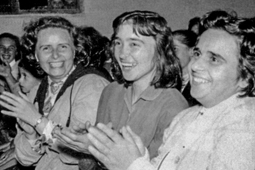
 “We’ll never be able to quantify the help that we receive from our brothers and sisters. How much courage their faith inspires in us, how much warmth their love, how much their example draws us!” Chiara Lubich (1920-2008), who wrote these words, was known as someone who drew after her hundreds and thousands of people and constructed relationships with Buddhists, Muslims. She is still being followed by people with no religious affiliation and breatheing new life into politics and economy. The friendship with the first companions of Silvia Lubich whom they knew simply as “Chiara” or Clare, played no small role. It all began with a choice of God and her consecration to Him in 1943, Trent, Italy. However, quite soon it was no longer a single “I”, but a collective subject that began to move, to act, to pray and to love: Chiara and her first companions could have ended becoming anyone, but they became beacons of light on all five continents. This story has many incredible elements, but yet it’s simple. You understand it if you open and read in chapter 13 of John’s Gospel: “I give you a new commandment, that you love one another. As I have loved you, so must you love one another” (13:34). This is a commandment that can only be lived out in the company of others. When Chiara and her companions read this Gospel passage in a bomb shelter, they looked at one another very intensely as they thought about the commitment it would be. They didn’t hesitate, but said to each other: “I’m ready to love you to the point of giving my life for you.” Chiara would later consider this the cornerstone on which the entire Focolare Movement would rest. It’s certainly not something unheard of in the history of the Church, but there might be one thing new about it. Chiara immediately conveyed to her companions whatever she was living and all that the Holy Spirit was inspiring in her. The bond among them was stronger than cement, and I would like to illustrate the qulaity of their relationship that valued and freed potentials, edifying a work that was of God.
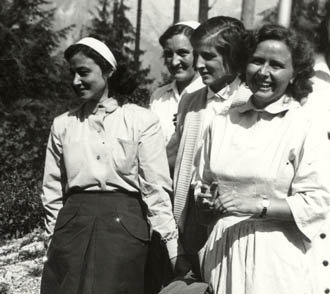
 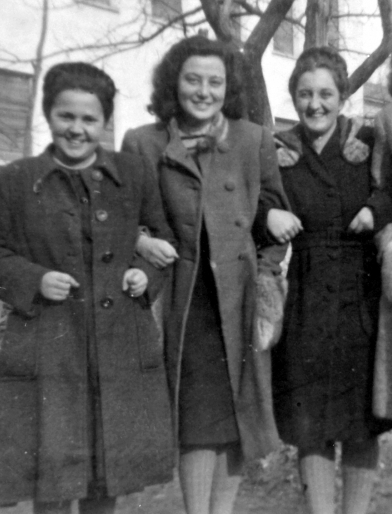 Ten years went by and it was 1954. Chiara was living with Giosi, Graziella, Natalia, Aletta, Marilen, Bruna and Eli. One day, as Chiara paused to look at them, she recalled the sentence from the book of Proverbs: “Wisdom has built her a house and set up her seven columns” (Proverbs 9:1). She was looking at the seven young women in front of her, each with her own talent, all of them united and rooted in God. These were Wisdom’s seven columns, the seven colours of the spectrum that emerge from the one light of Love. Seven interdependent aspects of love, each flowing from and into the other. Chiara entrusted Giosi with the communion of goods and the paychecks, not only the care of the poor: the red of love. To Graziella she entrusted “witness and spreading,” the orange. Natalia had been her first companion: she personified the heart of this ideal, the cry of Jesus Forsaken of love. She would carry thi secret beyond the Iron Curtain. She was the spirituality and prayer life, the yellow of the spectrum. Aletta would be remembered as the one who encouraged the members to be mindful of their health, and to form a community united in love. Chiara entrusted her with the green, Creation and physical life. To Marilen, who lived for fifteen years in the midst of a Cameroon forest, Chiara entrusted the blue: harmony and the home. Bruna was a bit of an intellectual and Chiara saw her as the one who could develop the aspect of studies: the indigo. Eli was always at Chiara’s side and helped to make sure that all the members around the world were living as one. She was entrusted with the aspect of unity and the means of communication, the violet. Some other of her first companions would also have special tasks: Dori, Ginettta, Gis, Valeria, Lia, Silvana and Palmira.
1959: Lia, Marilen, Bruna
13 Apr 2018 | Focolare Worldwide
Syria is a martyred nation due to its civil war and constant tensions. Many people have lost their job and forced to spend all their savings in order to survive and pay for medical assistance. Doctors, teachers and other trained personnel have emigrated abroad. Those who have remained have most likely lost their homes and forced into already overcrowded neighbourhoods. The areas that are more in urgent need of help in view of future reconstruction are those dealing with financial support services, education and health care. Program activities: 1. Education and Training support in Homs and Damascus: After-school programs, tutoring, morning tea and supply of teaching materials for 220 students; 2. EHIS School for the Deaf in Aleppo: Lessons in the classroom and extra-curricular activities for 75 children; 3. Professional course in Aleppo: Traditional Syrian crafts; 4. Social and health care in Homs and Kafarbo: Access to medical care for cancer patients (chemotherapy and other treatments), financial assistance for surgical procedures, support for patients suffering from kidney failure, financial support for other medical services (radiology, blood tests etc) and counselling; 5. Family income support in Kafarbo, Homs, Aleppo and Damascus: Monthly financial subsidies for food, rent, home repairs, medical assistance. The carrying out of the activities guarantees employment for about 70 people, including teachers, social workers, trainers and assistants and involves about 50 volunteers. Places Kafarbo – Homs – Aleppo – Damascus Beneficiaries 200 families for income support 114 men and women for medical assistance 295 young people for assistance with education and training Costs of the program Total cost: € 293.138,33 Total contributions required by AMU: € 241.586,20 To support the program, please send donations to: Azione per un Mondo Unito ONLUS (AMU) Bank: Banca Popolare Etica IBAN: IT58 S050 1803 2000 0001 1204 344 SWIFT/BIC code: CCRTIT2T Azione per Famiglie Nuove ONLUS (AFN) Bank: Banca Prossima IBAN:IT55 K033 5901 6001 0000 0001 060 SWIFT/BIC code: BCITITMX Description: Emergenza Syria Program Donations made out to Emergency Syria on either bank account will be administered jointly by AMU & AFN
12 Apr 2018 | Focolare Worldwide
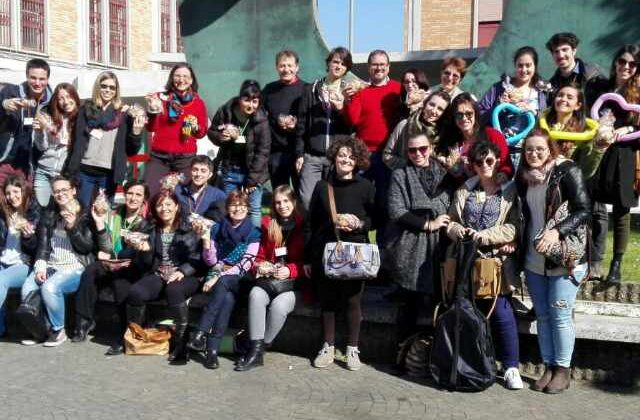
“For nearly three years we Young People For A United World, here in Rome, have been working with the prison adminstration and the G9 Committee, a group of eight prisoners from an un-named department of the prison of Rebibbia, who, although they don’t have children of their own, have been engaged in promoting opportunities for other prisoners to meet with their families. Raffaele Natalucci and another twenty-nine young people from Rome share their story. “Three times a year we set up stands where parents and children can spend some time together, playing and colouring with their little ones. During the organized events in the grassy areas, the internal courtyard of the prison, nearly three-hundred people are able to gather, which include inmates and their families, and numerous volunteers from the local area. During one of those events a detainee shared his experience with us: “Being deprived of your freedom, estranges you from reality. Staying in a cell, between four walls, one’s horizon also begins to shrink. Those that had benefited from special permits said that it was difficult to look far into the horizon. The opportunity to do jobs inside the prison means a lot to me. Before, I spent my energy on illegal activity, but that turned out to be like eating an ice-cream cone that was melting in the sun. But to work at organizing sport events or projects that benefit the inmates is a hundred times better than any salary.” Raffaele continues: “As Young People For Unity, we’re having a very powerful human experience: the order from the prison guards to leave every piece of personal property behind resounds, every time, like an invitation to also abandon every prejudice, going beyond the barriers between the outside world and the prison world, to build authentic relationships with the people in jail, to the point that they now refer to us as the “External Committee”. We’ve launched a “Project on Legality” with a series of thematic gatherings outside the prison. In full sync with the instructors, inmates and experts, we’ve chosen to explore several topics, such as interpersonal relationships, integration among cultures, a legality of “us”, the rediscovery of one’s attitudes and re-insertion into professional life.” On Father’s Day, March 19th, we invited psychologist, Ezio Aceti, to speak on parenthood, to some seventy inmates in the prison theatre. The presenation was focused on the needs and expectations of the child. “Take note of the other person’s thoughts, talk honestly about oneself, show a positive image,” he explained. “These are the necessary prerequisites so that the encounter between detainies and their children will bear fruit.” During the roundtable conference, one detainee asked: “What can a father with a life sentence say to his daughter?” “That her father made a mistake, but is doing all he can,” was the answer. “If his daughter finds that integrity and the courage to get up again, that will be the image she has of her father.” “Parenthood is keeping a bond going. You must transmit a feeling of belonging to your children. Then they will have a positive experience and will remember their father who is in prison.” Lastly, the psychologist strongly encouraged the detainees: “Raising a child does not mean not making mistakes, but putting everything into it in spite of the mistakes. That will teach your children tolerance. You can be good fathers even if you’ve made mistakes. Deep down all of us feel discouraged, but there’s another voice in our hearts that tells us: Get up, begin again. It doesn’t matter how many times you’ve gone wrong, but how many times you’ve got up again. The miracle is that by always getting up again, a change will take place.”
