1 Jan 2017 | Non categorizzato
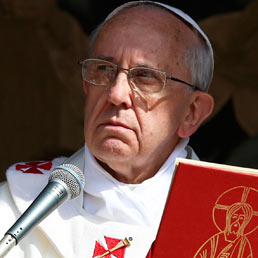
While the last century knew the devastation of two deadly World Wars, the threat of nuclear war and a great number of other conflicts, today, sadly, we find ourselves engaged in a horrifying world war fought piecemeal. […] wars in different countries and continents; terrorism, organized crime and unforeseen acts of violence; the abuses suffered by migrants and victims of human trafficking; and the devastation of the environment. […]Violence is not the cure for our broken world. Countering violence with violence leads at best to forced migrations and enormous suffering, because vast amounts of resources are diverted to military ends and away from the everyday needs of young people, families experiencing hardship, the elderly, the infirm and the great majority of people in our world. At worst, it can lead to the death, physical and spiritual, of many people, if not of all. To be true followers of Jesus today also includes embracing his teaching about nonviolence. […] When Mother Teresa received the Nobel Peace Prize in 1979, she clearly stated her own message of active nonviolence: ‘We in our family don’t need bombs and guns, to destroy to bring peace – just get together, love one another… And we will be able to overcome all the evil that is in the world.’ […] She bowed down before those who were spent, left to die on the side of the road, seeing in them their God-given dignity; she made her voice heard before the powers of this world, so that they might recognize their guilt for the crimes – the crimes! – of poverty they created. […]The decisive and consistent practice of nonviolence has produced impressive results. The achievements of Mahatma Gandhi and Khan Abdul Ghaffar Khan in the liberation of India, and of Dr Martin Luther King Jr in combating racial discrimination will never be forgotten. Women in particular are often leaders of nonviolence, as for example, was Leymah Gbowee and the thousands of Liberian women, who organized pray-ins and nonviolent protest that resulted in high-level peace talks to end the second civil war in Liberia. Such efforts on behalf of the victims of injustice and violence are not the legacy of the Catholic Church alone, but are typical of many religious traditions, for which “compassion and nonviolence are essential elements pointing to the way of life. I emphatically reaffirm that “no religion is terrorist. Violence profanes the name of God. Let us never tire of repeating: The name of God cannot be used to justify violence. Peace alone is holy. Peace alone is holy, not war! If violence has its source in the human heart, then it is fundamental that nonviolence be practised before all else within families. This is part of that joy of love which I described last March in my Exhortation Amoris Laetitia, in the wake of two years of reflection by the Church on marriage and the family. The family is the indispensable crucible in which spouses, parents and children, brothers and sisters, learn to communicate and to show generous concern for one another, and in which frictions and even conflicts have to be resolved not by force but by dialogue, respect, concern for the good of the other, mercy and forgiveness. I plead for disarmament and for the prohibition and abolition of nuclear weapons: nuclear deterrence and the threat of mutual assured destruction are incapable of grounding such an ethics. I plead with equal urgency for an end to domestic violence and to the abuse of women and children. In 2017, may we dedicate ourselves prayerfully and actively to banishing violence from our hearts, words and deeds, and to becoming nonviolent people and to building nonviolent communities that care for our common home. Nothing is impossible if we turn to God in prayer. Everyone can be an artisan of peace” Read the whole message.
31 Dec 2016 | Non categorizzato
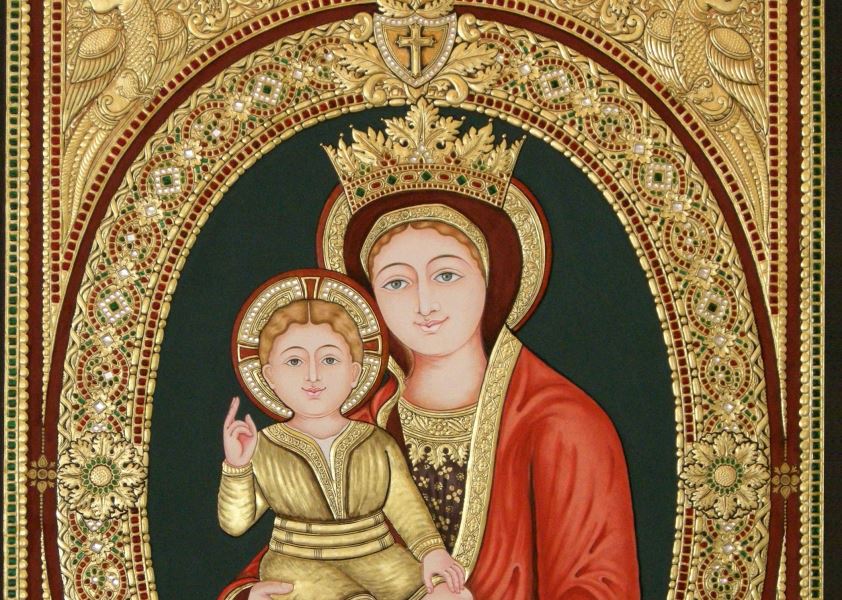
(…) History is all about wars and when we were children at school we almost learned that wars are good and holy, almost as if this is what protects our own land. (…) But if we hear the appeals of the Popes echoing in our hearts (…) we would hear their dread of war in the world and how their words, whether called for or not, appealed to leaders to try to appease anger and self-interest and to avert the terrible tragedy of war, through which everything is lost, while everything is gained by peace. This is because history is a succession of fratricidal conflicts between peoples who are brothers and sisters and who have been given a piece of land to cultivate and live on by the one Lord of the world. He blesses peace because he embodied peace. We see how one by one the Lord is conquering the hearts of his children of all nations, of all languages, transforming them into children of Love, Joy, Peace, Courage, and Strength. So we hope that the Lord will have mercy on this divided and wild world, on these peoples locked up in their own shell contemplating their own beauty – which is special for them – yet limited and inadequate, clinging on with clenched teeth to their own treasures, even those goods that could help other peoples where many are dying of hunger, and that he will break down the barriers and let charity flow continuously between one land and another, in a torrential flow of spiritual and material goods. We hope that the Lord will establish a new order in the world. He alone can make humanity a family and cultivate what is distinctive among peoples, so that the splendor of each people, placed at the service of the others, may shine out with the one light of life that beautifies the earthly homeland and makes it the waiting room of the eternal Homeland. Perhaps what I am saying sounds like a dream. Nonetheless – apart from the fact that if mutual love is the relationship among Christians, then the relationship among Christian nations cannot be other than mutual love because of the unchanging logic of the Gospel – there is a bond that already unites people strongly, proclaimed by the voice of the people and of all peoples, the people’s voice which so often is God’s voice. This hidden and protected bond in the heart of every nation is Mary. Who could take from the Brazilians the thought that Mary is the Queen of their land? And who would deny to the Portuguese that Mary is “Our Lady of Fatima”? Who would not allow the French the “beautiful little Lady of Lourdes”? Or the Poles Our Lady of Czestochowa? Or not let the English see their land as the “dowry of Mary”? And who could deny that Mary is the “Castellana of Italy” (…) All Christian nations have already proclaimed her their Queen, theirs and their children’s. But one thing is missing, and Mary cannot do it, so we have to help her. We need to collaborate so that Catholic peoples, united like many brothers and sisters, might go to her and together recognize her as Mother and Queen. We can enthrone her if, through our conversion, our prayers, and actions, we remove the veil that still covers her crown, (…) and lay down the piece of the world that is in our hands … at the feet of the greatest Queen that Heaven and earth can know. She is Queen of peoples, Queen of Saints, Queen of Angels, because when she was on earth she was able to sacrifice herself completely, the Handmaid of the Lord, and teach her children the way of unity, of embracing all peoples, so that earth might become as it is in Heaven. From Essential Writings p 222-233
30 Dec 2016 | Focolare Worldwide, Senza categoria
Download brochure with program Streaming event 11 March, 16:00-18:30 (CET, UTC+1)
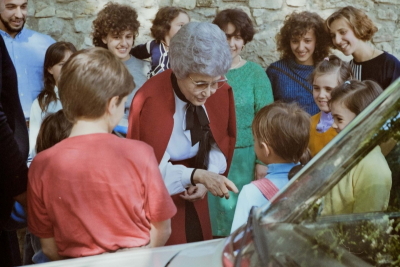
A path of life and thought to be shared throughout the year, at all latitudes. 50 years after its founding, there will be, in 2017 various local events and initiatives in various countries worldwide. A roadmap of life and thought in various phases will highlight the anthropological and universal value of the family in the perspective of “universal brotherhood,” and testify to the richness of social and cultural diversity, together with the ideal of unity concretised in family life. The central event will be held in Loppiano from 10 -12 March 2017. About 800 people from all over the world are expected to attend. The families will immerse themselves fully in the reality of the international town of the Focolare, and bear witness to Chiara’s dream in all the continents. In the morning there will be workshops for adults, youth, teenagers and children, held in collaboration with the parish movement, the gen3 and gen4 centres, the no-profit AFN and AMU. In the afternoon the meeting in the Auditorium will be aired via live streaming and will highlight the experts of family themes, who will be participating in the Cultural Seminar to be held at the Sophia University (10 -11 March 2017). This seminar with its characteristic universal outlook will give rise to the future Study Center on the family, with the objective of enhancing the contribution of the spirituality of unity to the family in the challenges it has to face today. For information: www.famiglienuove.org famiglienuove@focolare.org
30 Dec 2016 | Non categorizzato
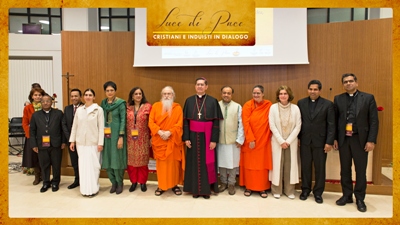
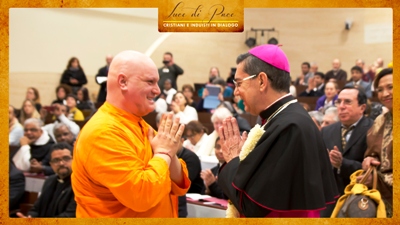 “So is craving, so is anger, they arise from the Rajas, the passion of the senses that devours everything” (Bhagavad Gita, 3:37)[1]. These words were chosen by Paramahamsa Svami Yogananda Ghiri, honorary president of the Italian Hindu Union (UII), in his welcome speech at the first Christian-Hindu Conference that crowded the main hall of the Pontifical Gregorian University on December 6, 20016. The conference was opened by Cardinal Jean-Louis Tauran, president of the Pontifical Council for Interreligious Dialogue. He was the promoter of the event in collaboration with the UII, the Italian Bishops Conference, Religions for Peace and the Focolare Movement. The cardinal expressed his joy for this moment of dialogue that was so promising and hopeful: “With our interior light that consumes and illumines, we will be able to direct our every step along the path of Peace.” Christians and Hindus were equally represented by 300 people who were animated by a desire for communion and understanding. Like emblems, a Lamp and Crucifix adorned the hall, both symbols of light. Light and Peace was the title of the day spent in dialogue and in the search of Peace. The words of Bishop Paul Gallagher, Secretary for [Vatican] Relations with States, were quite meaningful. After recalling the many conflicts around the world, he appealed to the international community to “overcome the logic of individualism, competition and the desire to be first” and asked that as soon as possible an “ethic of solidarity” be promoted. The presentation by Dr Naso from Sapienza University of Rome was also very significant. After presenting the data on the conflicts that had begun for religious reasons, he recalled that in many cases it was precisely the faith communities that became mediators in the peace process: in Norther Ireland, South Africa and Mozambique…. This makes one hope that “religions can really play a constructive role in conflict situations.” The report by Hindu psychologist Sangita Dubey on cultural differences and on the effects of migration on the psyche due to the different diet, language and mentality was lively and supported with personal experiences. “The challenge of dialogue,” stressed Svamini Hamsananda Ghiri (UII) in his presentation of the Hindu perspective, “is fear, indifference, fundamentalism and suspiscion of the other;” to pursue the common good it is necessary to “see the other as a brother and sister because they are generated by a Father God.” Paul Trianni, the University of St. Anselm, who was asked to give a Christian perspective, he concludes: “When two ancient civilizations encounter one another, two such profound spiritualities, they cannot but recognize the great wealth.” Two experiences of dialogue helped gave substance to the words that had been said: Fr Cesare Bovinelli, Camaldolese monk, recalled the great harmony that existed when it came to themes of environment at Assisi. A young person from the Focolare, Aileen Carneiro of India, described the many activities that were carried out between Hindu and Christian youth. Particularly striking was the synergy with the Ghandian Shanti Ashram group of Coimbatore, who started a project for solving poverty, following the approach of the Economy of Communion. Aileen explained that the dialogue of life must be held up, putting into practice the Golden Rule: “Do to others as you would have them do to you.” La Conferenza si è conclusa con uno spazio culturale di poesie, canti e danze sacre indù, in cui l’arte è diventata ulteriore motivo di comunione, degna cornice alla lettura delThe conference ended with presentation of poetry, Hindu sacred dance and song, in which art became a catalyst of communion, a worthy context for the reading of the Joint Statement. Anna Friso [1] (Our translation from Italian)
29 Dec 2016 | Non categorizzato
