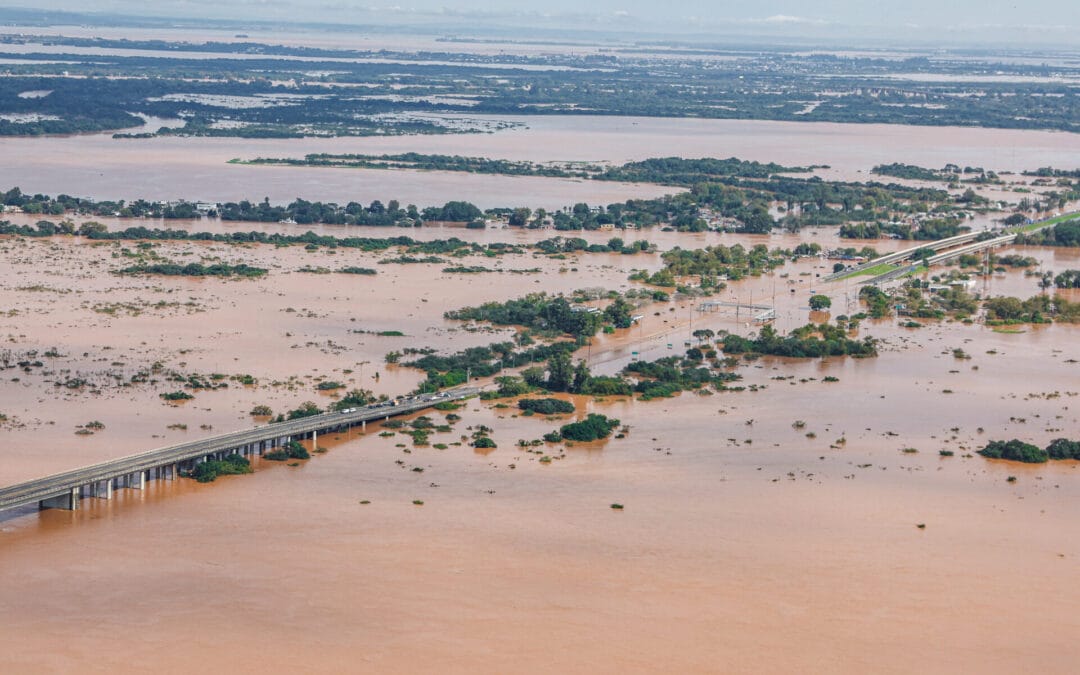
The heavy rains that have been lashing the south of Brazil since early May 2024 have caused heavy flooding and landslides in 425 municipalities in the state of Rio Grande do Sul, directly affecting 1.5 million people and, so far, causing 108 deaths and almost 130 missing.According to the latest official report, 232,675 people are still displaced from their homes, of whom 65,573 are taken in shelters.The most worrying situation is in the metropolitan area of Porto Alegre, where entire cities and neighbourhoods have been under water since Friday 2 May, with water supply problems and power outages. According to weather forecasts, heavy rains are expected in the coming days, which will further worsen the situation of this natural disaster.
The Emergency Coordination of the Focolare Movement has launched an extraordinary fundraising campaign in support of the population of the State of Rio Grande del Sud, Brazil, through Action for a United World ETS (AMU) and Action for New Families ONLUS (AFN). The contributions transferred will be jointly managed by AMU and AFN in coordination with the Focolare Movement in Brazil in order to provide the people affected by the heavy flooding with basic necessities for food, medical care, and housing. In Brazil you can donate to the following account: Banco do Brasil Agência: 2665-4 Conta Corrente: 39.322-3 Pix: acaoemergencial@anpecom.com.br Associação Nacional por uma Economia de Comunhão CNPJ: 07.638.735/0001-94 From other countries you can donate online AMU: https://www.amu-it.eu/campagne/emergenza-inondazioni-in-brasile/ AFN: https://afnonlus.org/#donaora
or by bank transfer to the following accounts: Action for a United World ETS (AMU) IBAN: IT 58 S 05018 03200 000011204344 at Banca Popolare Etica Codice SWIFT/BIC: ETICIT22XXX Action for New Families ONLUS (AFN) IBAN: IT 92 J 05018 03200 000016978561 at Banca Popolare Etica Codice SWIFT/BIC: ETICIT22XXX Reason for payment: Flooding emergency in Brazil
Tax benefits are available for such donations in many EU countries and in other countries around the world, according to different local regulations.Italian contributors will be able to obtain deductions and allowances from income, according to the rules for non-profit organisations(more…)
In an environment which is as fragmented and divided as the one we live in, we are often called to go towards the unknown, towards the peripheries. We are called to go out, sometimes even outside of ourselves, to enter the wounds of humanity. This is the testimony that comes to us from the neighbourhood of Yungay in Santiago, Chile.
“Dare to be one” is the title of the Conference of Bishops from various Churches, friends of the Focolare Movement, which took place from 27 February to 1 March in Augsburg. The meeting also commemorated an important anniversary in the journey of reconciliation: precisely in Augsburg 25 years ago, the signing of the historic Joint Declaration on Justification. https://youtu.be/8kBoqmRmHP4
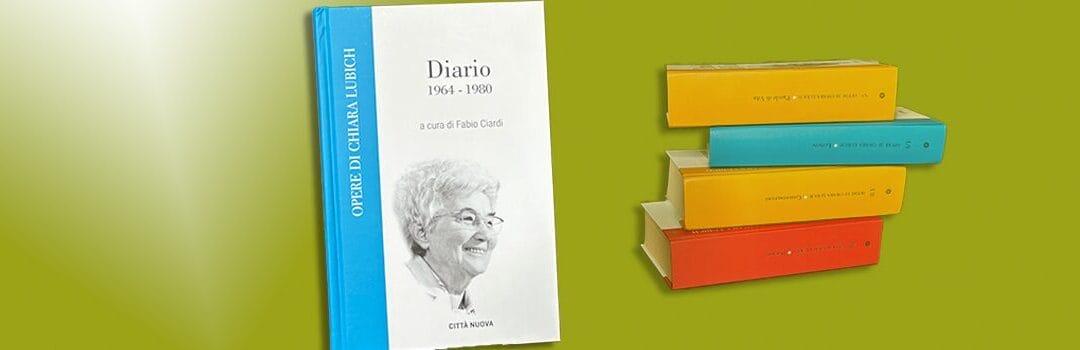
Città Nuova publishing house, in collaboration with the Chiara Lubich Centre, recently published “Diario 1964 – 1980” by Chiara Lubich, edited by Fr. Fabio Ciardi, OMI. Fr. Fabio Ciardi introduced the content of the new book of Chiara Lubich’s Diaries saying, “The Diary is an extremely valuable resource, which allows you to cross the threshold of external events (the ‘external life’) and to penetrate the way in which they are lived (the ‘intimate life’)”. The book is part of the “Works of Chiara Lubich” series. Fr. Fabio told us that even though 5 volumes of this series have already been published and fifteen are in the pipeline, “It is not the complete works because that would require an immense amount of work. Future books include Chiara’s main written works ranging from an introductory first volume that will be a historical biography, followed by her letters, public speeches, what we call founding speeches and then her more informal talks or conversations.” Fr. Fabio added, “The letters and diaries are perhaps the most intimate part of Chiara, the aspect that reveals most about her. When you give speech, it is an elaborate, prepared and revised text. When I access her correspondence or her Diary, there are no filters there. It is a direct grafting with Chiara’s soul. Her Diary and letters are those pages that allow us to have an immediate, direct, unfiltered relationship with her.” Fr. Fabio continued, “Chiara Lubich’s diary is quite special because it didn’t start as a personal diary, but as a way to involve all the members of the Movement in her travels. (…) . At first it started with a description of what happened, so it is a descriptive diary but it soon became an intimate diary. Because what she wanted to communicate was not simply the facts she was experiencing but how she was experiencing them”. The Diaries cover sixteen years and, to help the reader better place and understand Chiara’s texts, Fr. Ciardi made a deliberate editorial choice: “First I gave a general introduction to the entire Diary, year by year. Then I offered an introduction to that year, placing and contextualizing it in the life of the Church, in the life of the world, so that we can grasp what Chiara Lubich was experiencing but with the broader horizon of the life of the Movement, of the Church and of humanity.” For those who want to know how best to read this book and where to start, Fr. Fabio replied: “The first thing I would recommend is to open it at random and read a page. It’s sure to be addictive so then it’s like an invitation to read another page and another. Don’t worry about reading it continuously. You can open randomly and read one day, then another or one year then another. And then maybe this will make you want to follow the thread. So then start again from the beginning and slowly follow this path, which is a journey… Chiara’s path is not easy. It is a troubled journey, there are moments of trial and moments of illness. These are moments when she didn’t write in her diary which begs the question – why not? Maybe because she was living in a moment of darkness. So retracing the whole path chronologically helps to understand this world. But for starters, maybe you can open it randomly and read here and there. Then you’ll want to read it continuously and completely”. Fr. Fabio concluded, “The diary is hers, it is personal, it is her life and this can be deduced above all from the constant conversations with God, with Jesus, with Mary and with the saints that exists in the Diary (…) She reveals her soul to us, she shows us what she has inside. And this resonated with me because it is like an invitation to go on a similar journey, to experience that same intimacy; so in the end by reading Chiara I also reflect myself not in what I am, unfortunately, but in what I feel I should be”.
Carlos Mana
Video: In dialogue with Fr. Fabio Ciardi (subtitles in English)
The Fazenda da Esperança is one of the 47 activities involved in the first phase of the next Genfest, in which young people will be invited to make a concrete commitment to some social organisations which are already operating in the various areas. La Fazenda is a therapeutic community, founded in 1983. It helps people who want to get out of addictions. https://youtu.be/wtzSXGOd7y4