14 Dec 2022 | Non categorizzato
The Evangelii Gaudium Centre (CEG) has opened the inscriptions for the Training Course for Synodality, a concrete contribution to respond to the Church’s call to walk together. The Evangelii Gaudium Centre (CEG) which is linked to the Sophia University Institute, is offering a Synodal Training Course which will begin in 2023. It is a course which has been developed in collaboration with the General Secretariat of the Synod and with other training centres and academic institutes in Italy and beyond. But why talk about synodality? Prof. Vincenzo di Pilato, Professor of Fundamental Theology at the Pugliese Theological Faculty in Italy and coordinator of the CEG, explains:
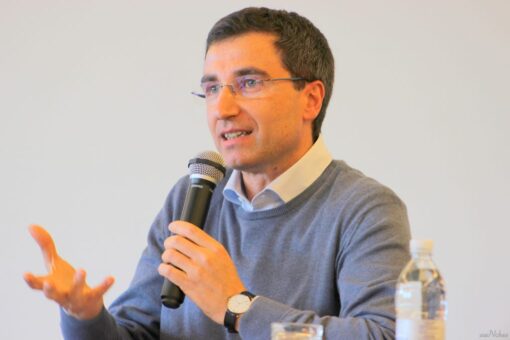
Prof. Vincenzo di Pilato
Maria Grazia Berretta
Download Flyer

6 Dec 2022 | Non categorizzato
A volume of Chiara Lubich’s works entitled “Letters” has been on sale in Italian bookshops for several months. We spoke to Florence Gillet from the Chiara Lubich Centre, a theologian and scholar of the Focolare Movement’s founder who edited the publication.
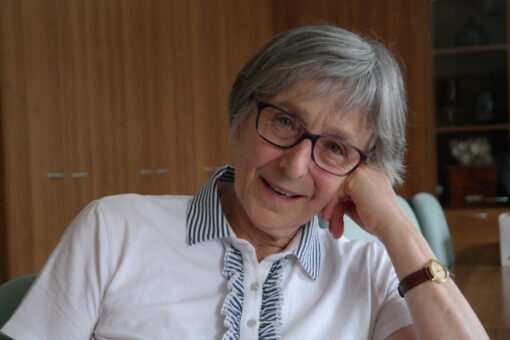
Florance Gillet
Carlos Mana
1 Dec 2022 | Non categorizzato
The World Council of Churches (WCC) hosted Focolare president Margaret Karram and co-president Jesús Moran, as well as other members of the Focolare community, on 28 November, offering a guided tour of the Ecumenical Centre, and discussing unity, reconciliation, inter-religious bridge-building, Faith and Order, and communications, among other issues of interest. WCC acting general secretary Rev. Prof. Dr Ioan Sauca expressed appreciation for the many past collaborations between the WCC and the Focolare, most recently the Focolare’s participation at the WCC 11th Assembly in Karlsruhe. Sauca said the WCC recognizes the importance of cooperation and mutual support between the WCC and the Focolare to serve together under the new paradigm of the pilgrimage of justice, reconciliation, and unity. “Christians of different churches belonging to Focolare have been part of delegations of their respective churches and in other capacities at WCC assemblies,” noted Sauca, who summarized a long history of cooperation between the two groups. “Your commitment to promoting the dialogue between Christians, Jews, and Muslims as well as your engagement in a sustained dialogue between Israelis and Palestinians are inspiring assets for the worldwide movement of Focolare and beyond,” said Sauca. Staff from the WCC and representatives from the Focolare movement also discussed past and future areas of collaboration, and shared their experiences related to unity and ecumenism. Karram shared her warmest greetings and expressed great joy to be visiting the WCC, 20 years after the last visit of Focolare founder Chiara Lubich visited the WCC. “Twenty years ago, Chiara Lubich, founder of the Focolare movement, came here at the invitation of the then-general secretary Konrad Raiser and Prof. Ioan Sauca,” said Karram. “I am very grateful to be with you all here today to commemorate this anniversary. I give praise to God because I am aware I am walking on ground that I hold sacred.” Karram assumed the WCC of the willingness and of the ability of the Focolare movement to continue walking together. “I want to add not only walking together—but we have to hold hands—not only walk together but hold hands, side-by-side. I want to promise this.” Rev. Prof. Dr Jerry Pillay WCC general secretary-elect, commended the many ways in which the Focolare community and the WCC have exchanged ideas and insights over the years. “Our collaboration has been on different levels,” he said.
Source: WWC
Full speech by Margaret Karram Photo gallery on the Focolare leadership visit to the WCC https://www.youtube.com/watch?v=-Lx8IklNEPQ&t=53s https://www.youtube.com/watch?v=q7OMciDbHA8&t=1s
22 Nov 2022 | Senza categoria
The merciful are those who are able to forgive others and often even themselves. However, mercy is not just an inner disposition, it is the way that unites us with God. His immense love for us is not a feeling but an action; the act through which each of us is ‘reborn’. Living in peace It was not the first time I had noticed trespassing on my land. I had never had any enemies and my father had taught me how to build good relationships, but on this occasion I wanted to see clearly what was going on. I asked Our Lady for help and one night I went into the orchard with another farmer. As I suspected, at a certain hour I saw my neighbour arrive with two sons armed with fruit boxes. The plan was to photograph them in the act: bewildered by the flashes, the three of them immediately ran off, leaving the harvested fruit on the ground. The next day, towards evening, our neighbour’s wife asked my wife if she would kindly destroy the photos and not press charges against her husband. As agreed, my wife replied: “I don’t know what photos you are talking about, my husband has been away for two days”. From that day on, things started to change with unusual kindness and a willingness to help with the picking… During one of the breaks, the neighbour admitted he had come to get some apples ‘to try them’ and had seen flashes. I replied: “Strange things have been happening in the village for some time. What’s important for us is to live in peace”. (V.S.E. – Italy) A real change When I retired and looked back on my life all I could see was a total failure! I never got married because my parents were against my choice of a guy who was good but not one of our ‘rank’. My relationship with my brothers and sister had almost completely broken down because of an inheritance that according to them had been unfairly divided. I could call myself rich but what a void has been created in and around me! While I was in hospital a niece came to visit me who said something that really troubled me: “The trouble with you Aunty is that you are possessed by evil. Every trace of goodness in you has disappeared”. When I was finally discharged, I looked for a priest in whom I could confide what was distressing me. When he had finished listening to me, it seemed to him that I somehow wanted to take revenge on life, on family, on everyone, so he urged me to start thinking more of other people by celebrating relatives’ birthdays with gifts, taking an interest in the neighbours’ news, writing to former students. They were small gestures but steps towards the light. In desperation I put his suggestion into practice. It is hard but I really feel something is changing. (G.I. – Spain) Friends in sickness While my mother was in hospital I got to know her roommate, Klari who was at the same stage of cancer and undergoing the same series of chemotherapies. They had become friends, but something was dividing them. As a young woman, Klari had been a communist activist and did not accept the Catholic faith my mother professed. They did not argue, but you could feel that neither of them wanted to let go of their own beliefs. Nevertheless, my mother was always available and to help Klari who had no relatives she had involved us in the family with her needs – just little things, like dealing with some paperwork for her, phoning friends, etc. When their health started to deteriorate for both of them, each reacted differently to the illness. A great peace shone out from my mother, who always remained attentive to her friend. Klari, on the other hand, became impatient and aggressive, but before she went into a coma, she thanked my mother for the way she had always been by her side. She had now become one of our family. (P.F.H. – Germany)
Edited by Maria Grazia Berretta (taken from Il Vangelo del Giorno, Città Nuova, year VIII, no.2, November-December 2022)
18 Nov 2022 | Non categorizzato
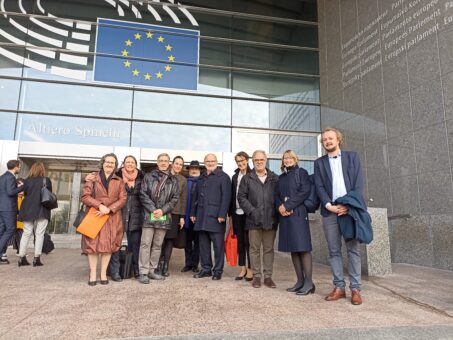
Presentation to the European Parliament in Brussels (Belgium) of a document aimed at expressing a common social ethic, which contains the shared positions of Christians and Marxists. It is the result of an eight-year journey or we could even say one which has been going on for two centuries. “A project of transversal dialogue” is how Dialop defines itself. Christians and Marxists in Europe have been working on it for some years. After a meeting in the Vatican of some representatives of the European Left with Pope Francis, it took a decisive step forward (see Dialop: Christians and Marxists working together). 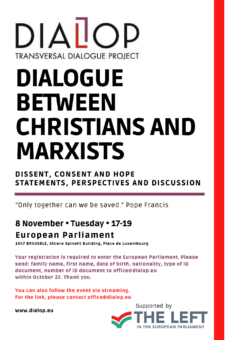 The event took place on 8th November in the Altiero Spinelli building with the presence of 40 people from 9 countries of the Union and others who followed the streaming. The presentation of the position paper, “In search of a common future in solidarity” was supported by the Left Group of the European Parliament, in collaboration with the Movement for Politics for Unity Movement and New Humanity, The document, on common positions in Socialist Christian dialogue, was written by Prof. Michael Brie, President of the Scientific Committee of the Rosa Luxemburg Foundation and by the Belgian sociologist, Prof. Bennie Callebaut of the Sophia University Institute. It analyses how, as antagonists in the past, Christianity and Marxism are faced with another wall to break down, that of wild capitalism and how they find surprising affinities in the present. In the message and in the person of Pope Francis they also find a figure who unites, a leader and a traveling companion. The paper states, “We are working on projects guided by shared visions in common struggles“. The document declines what these projects are, indicating some topics being explored: “an economy of life; a caring community; a policy of transformation in solidarity; a world in which there is room for many worlds; the dignity of every individual in a world rich in common goods; and together for peace”. The inevitable question of how, when it comes to discussion, these are expressed in practice, was formulated by Prof. Léonce Bekemans (Jean Monnet Chair, University of Padua). Walter Baier, from Transform!Europe, one of the initiators and coordinators of Dialop responded: “We work on three levels: dialogue as a cultural initiative in order to become a think tank; involving people in the work for solidarity, as happened with initiatives for migrants and refugees; arousing political involvement especially for building peace”. Marisa Matjas, Portuguese MEP of the Bloco de Esquerda, vice-president of the Party of the European Left in the European Parliament, was the hostess. She vividly remembered the words of Pope Francis to the members of the European Parliament in 2014, which were “said when we needed to hear them most”. “He spoke to us about keeping democracy alive in Europe, about employment and workers’ rights, about education, about migration, at a time when the EU was ignoring the massive movements of people coming from Syria; he also spoke about the dignity of human rights, we have many things in common that we need to work on together.” In his opening remarks on “Common paths towards a global, just and fraternal society”, the theologian Piero Coda said, “Today we need, like the food we live on, vision, spirit and covenant. It is time to hope and give hope ‘in the plural’. This is what Dialop invites us to do”. A plurality that requires wider alliances, not only the Catholic world, but the whole Christian world, with an ecumenical dimension; not only Christianity, but all religions; not only the left, but the various political ideologies that are committed to the common good and the defence of the environment. Citing the document, he said that there must be an initial effort to put aside any claim of “having the monopoly of the truth”. “Together with Marxists and Christians, a transformative and transversal social ethic must count on the contribution of other actors and traditions who are present in our continent and have different world views”, reiterated Fr Manuel Barrios Prieto, Secretary General of COMECE, recalling the concept of human fraternity, starting with the signing of the Abu Dhabi document of 2019 and the encyclical “All Brothers”. A renewed commitment to dialogue resumed in Brussels, with a momentum of inclusiveness, aware that dialogue is a ‘ work in permanent progress’.
Maria Chiara De Lorenzo
