20 Jan 2023 | Non categorizzato
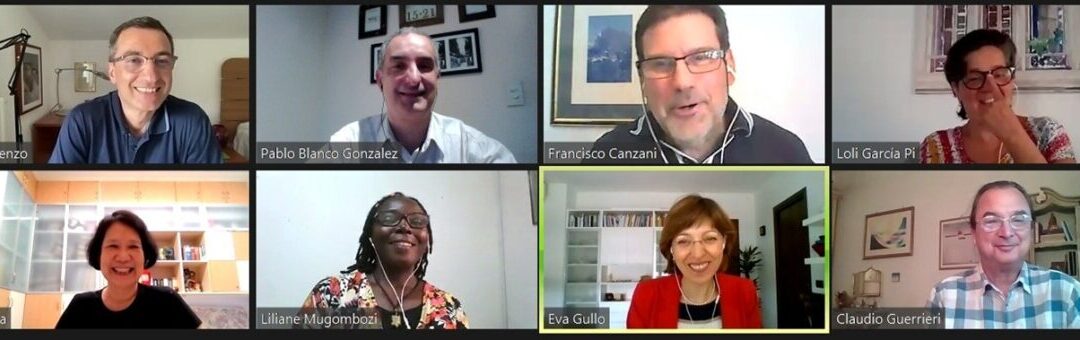
The continental stage of the Synod has begun. The Focolare Movement contributed with a worldwide reflection and study. We interviewed Francisco Canzani, Councillor of the International Focolare Centre for the aspect of “wisdom and study” and Coordinator of the Synod Commission to learn more about this contribution. What is your assessment of the work done in the Focolare Movement for the Synod? Very positive. Over 15,000 members of the Movement participated in the first stage of our synodal journey. They represent 520 communities around the world. We received 21 regional summaries that demonstrate the depth of reflection and the interest shown by Focolare in all cultures. Alongside this work within the Movement, which was in response to the Secretariat of the Synod, which specifically asked us for a contribution, many members of the Movement took part in the processes in their dioceses and parishes. The involvement of people of different Christian Churches and of faithful of different religions in the process of reflection was particularly relevant. We also received two important contributions from dialogue groups between Christians and people without religious convictions that the Movement hosts. How can this experience help us to acquire the practice of synodality within the Movement?
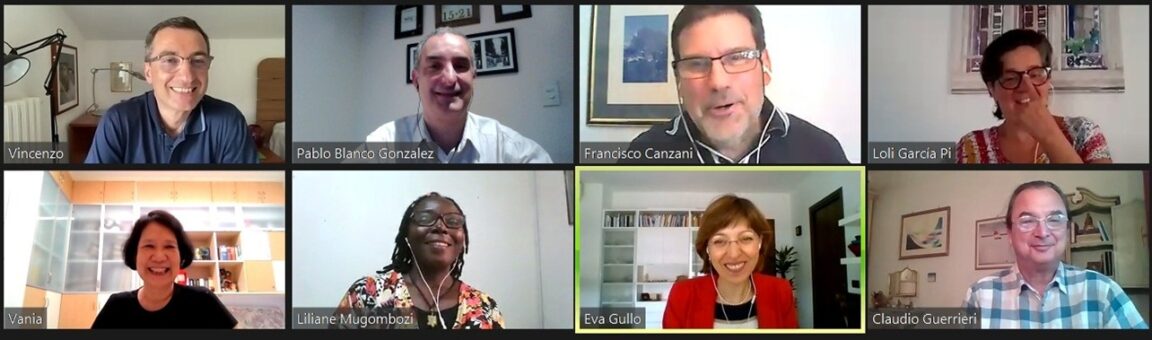
Synod path team Focolare Movement
Carlos Mana
Contribution of the Focolare Movement to the Secretariat of the Synod – Download PDF https://youtu.be/VMP7jQpoVC8
17 Jan 2023 | Senza categoria
KidsAction4Peaceis the initiative to which the youngest of the Focolare Movement join, Gen4 e Gen3, inviting children to get involved in building peace. A simple but concrete way to look at those who, at this moment, are living the suffering and injustice of war. To make a contribution, we have time from 25 to 30 January 2023 Hello everyone! We are a few children who strive to build peace at school, at home, in sport by being kind and helping those in need. How can we help our friends who are in the midst of war? Let’s ask our leaders to help people at war to build peace! Would you like to help us too?
- Make a drawing, or write a poem or letter about peace.
- Write the slogan (hashtag) #KidsAction4Peace on it (you can also ask an adult to take a photo and put it on social media with this hashtag).
- Send it between January 25 to 30 to the postal address of your head of government or You can also make more and send them to other leaders. You can find the list by country here. (January 30 is also the International School Day of Non-Violence).
- Ask at least five other children to do the same and pass this message on.
We heard that on February 9 and 10, many of these leaders will meet in Brussels, so we hope that our letters and drawings will reach their hearts. Bye!!! Sofia (12), Agnese (10), Matteo (10), Costanza (10), Nicola (9), Mattia (8), Teresa (8), Cristina (7), Anastasia (7) from Italy; Leonor (11), Margarida (9), Leonor (9), Joao (8), Leonor (8) from Portugal; Thiméo (12), Mathilde (11), Adéline (8), Aurélien (5) from Belgium https://www.youtube.com/watch?v=Oi0kJ9-z7pY
3 Jan 2023 | Non categorizzato
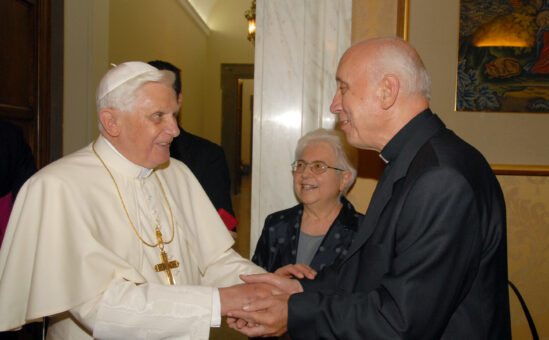
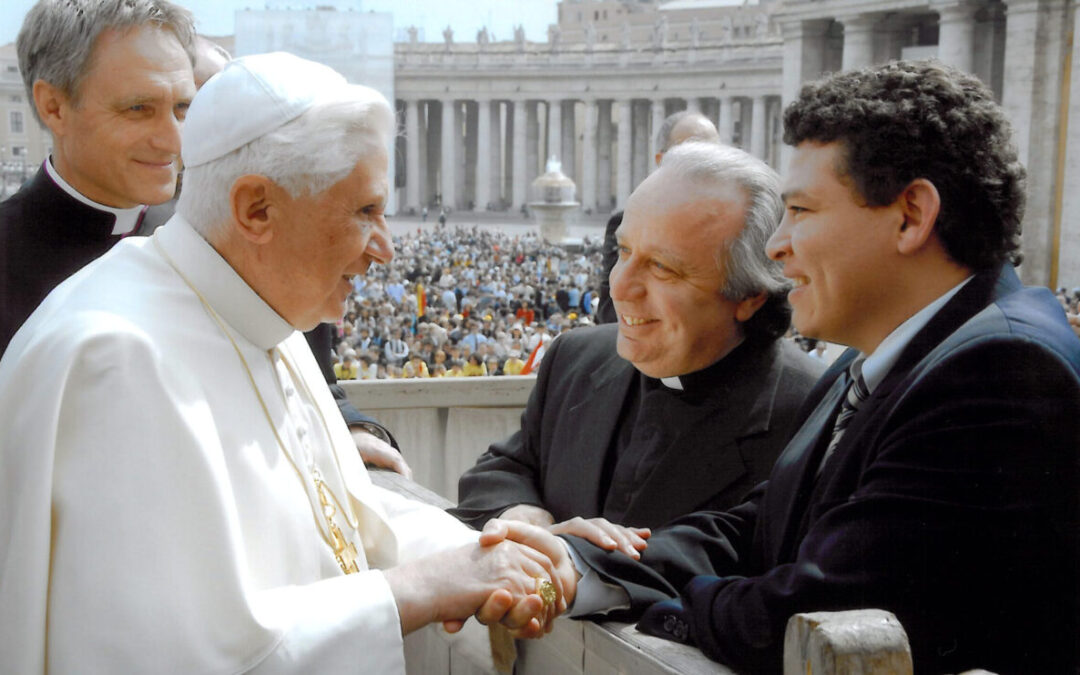
During her tenure as President of the Focolare Movement, (2008-2021), Maria Voce had the opportunity to meet Pope Ratzinger several times. She told us about her relationship with the emeritus Pope and her impression of the contribution of Pope Benedict’s pontificate to the Church and the world. “When I was received in audience in his study, it was to like going into the living room of a home, where you could talk and be welcomed with love, I would even say, with loving attention. At the same time with noble finesse, tact and delicacy”. At the news of the departure of Pope Benedict XVI, the memories of Maria Voce, former President of the Focolare Movement, immediately returned to 13th April, 2010, when, with the then Co-President of the Focolare, Fr. Giancarlo Faletti, she was received by the Pope. “It was the second year after the death of our foundress, Chiara Lubich. The Co-President and I went to consign the life of the Movement into the hands of the Pope. We realized that he was already very aware of many things. We told him about our trip to various Asian countries from which we had just returned. He was pleased to hear about our visit to China, which is an important frontier for the Church. He rejoiced at what the Movement was doing to help the process of reconciliation between the Chinese Bishops and the Pope. He gave us his blessing and encouraged us to continue on the way to holiness. Personally, I was always impressed by his fine kindness and at the same time his warm and familiar welcome. He had a great sense of harmony, perhaps due to his love for music, which was also evident in the way his study was furnished: a welcoming place like a home, sacred like a church”. 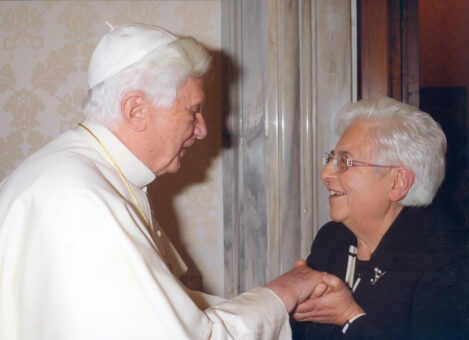 Did you meet Pope Benedict XVI as President of the Focolare on any other occasions? “In 2008 he received Co-President Faletti and I, immediately after the General Assembly of the Focolare in which we had been elected, the first after the death of our foundress. He then invited me to travel on the same train as him, with many personalities, to the “Day of reflection, dialogue and prayer for peace and justice in the world” held in Assisi on 27th October 2011, twenty five years after the first event held by Pope John Paul II in 1986. Finally, I participated in his last audience on 27th February, 2013 after the announcement of his resignation.” What are your thoughts about his decision? “When he realized that he no longer had the strength to carry out his task, he had the courage to make room for others who, in his opinion, had more strength and opportunity to do better. A choice that, as I said at the time, offered a synthesis of his theological and spiritual reflection. He highlighted the primacy of God, the sense that history is guided by him. And he directed us to grasp the signs of the times and to respond to them by having the courage to make difficult but innovative choices. He gave a clear note of hope because of “the certainty that the Church belongs to Christ”. I think I am not mistaken in stating that the Church to which Pope Benedict always looked, even in making this choice, is a “Church-communion”, the fruit of Vatican II but also a vision, “increasingly an expression of the essence of the Church” as he himself had pointed out. And that “increasingly” tells us that we have not yet fully realized it and invites each of us to work in that direction with ever greater responsibility”. The day after his election as Pontiff, Chiara Lubich wrote: “From what I know about him, since he has special gifts for understanding the light of the Spirit, he will not fail to surprise and surpass every expectation”. In your opinion, what was the most significant contribution made to the Church by Pope Benedict XVI? What is he saying to the Church of today and to what the Synod is preparing for the future? “Pope Ratzinger understood the reality of Movements in the Church as the ‘springtime of the Spirit’. His speech, when still a Cardinal, to the Congress of Movements before the big meeting of Pentecost 1998 with Pope John Paul II, is fundamental. What he said in 1969 in a series of radio lectures is also impressive, thinking of today’s times; it reveals his profound spirituality and essentiality and a vision that must have remained in his heart throughout his pontificate. He said that very difficult times were coming for the Church, that its real crisis had just begun and that it would have to deal with major upheavals. But, the then Card. Ratzinger, also said that he was very sure about what would remain in the end: not the Church of political worship, but the Church of faith. It will no longer be the dominant social force to the extent that it has been until recently. But, he concluded, the Church will have a new blossoming and will appear as the home of humanity, where life and hope can be found beyond death”.
Anna Lisa Innocenti
2 Jan 2023 | Non categorizzato
The theologian Piero Coda recalls Pope Benedict XVI and his extraordinary contribution to the journey of the Church in our time. Mons. Coda, in 1998 at the World Congress of Ecclesial Movements, the then Prefect of the Congregation for the Doctrine of the Faith, Card. Joseph Ratzinger made a historic speech about the role of ecclesial movements. What, in your opinion, are the essential points of that speech? How much have those words contributed to changing the role of movements in the Church? Yes, it was indeed an historic speech! I was attending the Congress so I heard him give it. He had great theological competence and knowledge of the history of the Church, as well as the experience of the Council and then, in his role in the Vatican, he followed its implementation at the universal level. This allowed Ratzinger to clearly identify the meaning of ecclesial movements in the mission of the Church. His central point was to recognize the action of the Holy Spirit in the Movements. Throughout the centuries, in ever new ways and in subsequent waves, the Holy Spirit renews the People of God with the gift of charisms: from St. Benedict to the Mendicant Orders in the Middle Ages, from the Company of Jesus to the Missionary Orders in the last centuries, right up to the unexpected charismatic blossoming in concomitance with the Council. Hence the affirmation of John Paul II, in tune with the teaching of Vatican II, according to which the Church is built on the co-essentiality of the “hierarchical gifts”, the ministry conferred by the sacrament of Holy Orders and of the “charismatic gifts”, the free bestowal of special graces of light and life among all the disciples of Jesus. 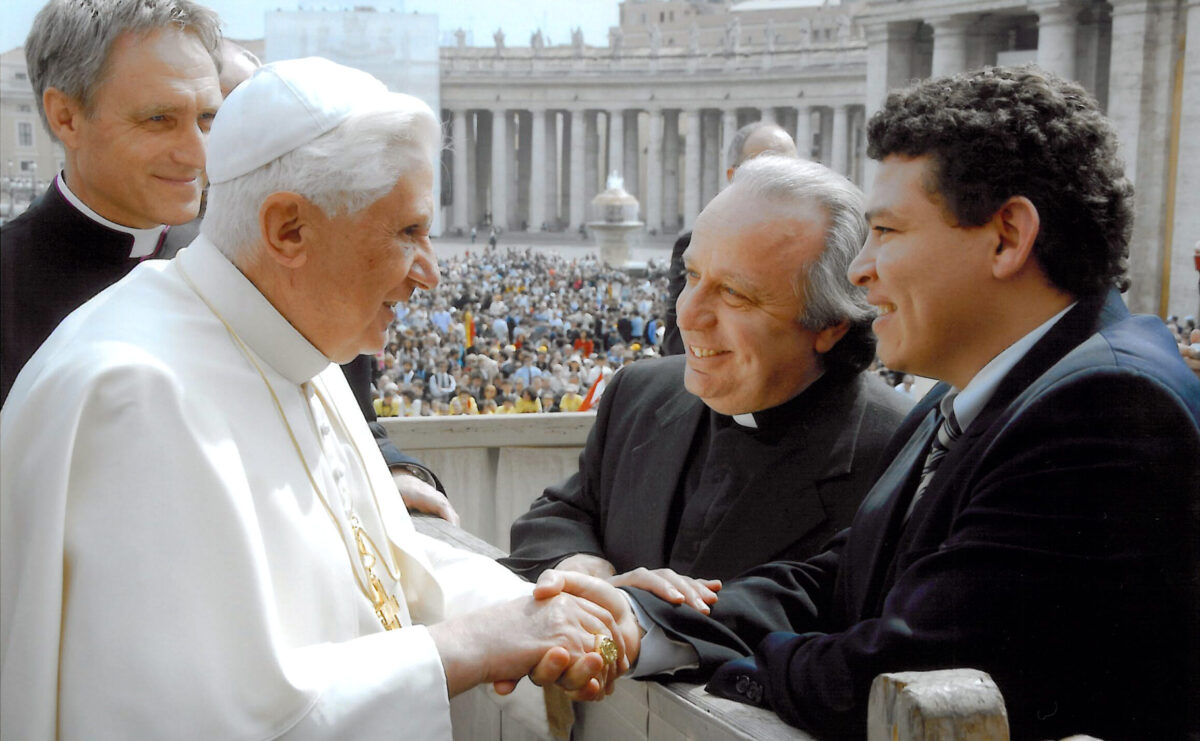 On the occasion of the death of Chiara Lubich, founder of the Focolare, Pope Benedict XVI sent a comprehensive message of condolence. What was Lubich’s relationship with him? Chiara told me personally that she was very impressed by that speech of Cardinal Ratzinger in 1998 and was always grateful for it. He visited the Mariapolis Centre in Castel Gandolfo (Rome) on 8th December, 1989 and celebrated Mass on the Feast of the Immaculate Conception. He referred to the Gospel parable and said that he could see the growth of a large tree born from a small seed, in which all the birds of the sky find rest. The first years of the pontificate of Benedict XVI coincided with the last years of Chiara’s life: she could no longer meet him in person or rejoice in the fact that, a year after her death, in the encyclical Caritas in Veritate, Pope Ratzinger mentioned the Economy of Communion. What does the thought and life of Pope Benedict XVI say to the Church of today and tomorrow, which the current Synod is helping to define? His unique contribution was to recall, with his authority as a man of God and a great theologian, a determining truth: the work of renewal put into motion by Vatican II needs to be developed in direct contact with the living nucleus of the Gospel of Jesus and in the context of the ecclesial Tradition. He stated this clearly in his magisterial speech to the Roman Curia in December 2005, the first year of his pontificate, when he defined the decisive key to interpretation of the conciliar event as being: “continuing reform”. It is no coincidence that the best-known book by the young theologian Ratzinger, which appeared in its first edition in 1968 and was translated into the main languages, bears the title Introduction to Christianity. This signalled that the launch pad for a prophetic leap forward is the faith of always, in Jesus. Nor is it insignificant that, as Pope, he dedicated three encyclicals to the theological virtues: charity, hope and faith. He strongly stressed the primacy of the first, because it evokes the very name of the God who reveals himself in Jesus. That Jesus to whom he dedicated a passionate trilogy as an invitation to the encounter with the living principle of faith, which is not a beautiful idea, but God Himself. Faithfulness, therefore, to the patrimony of faith but so that the richness and novelty of the Gospel may be released from it. This is the secret of the strength and enduring fascination of the magisterium of Benedict XVI. And you personally, what is the most beautiful memory you have of Pope Ratzinger? I met him many times, first as Cardinal and then as Pope. I always experienced his great cordiality and exquisite attention. I also had the opportunity to converse at length with him about theology, in the context of a series of seminars with other scholars, at an international level, when he was Prefect of the Doctrine of the Faith. This made me realize (with increasing gratitude to God) the extraordinary contribution of wisdom he has given to the journey of the Church in our time. In agreement with Chiara, I shared the idea of the Sophia University Institute with Pope Benedict. He exclaimed, “A wonderful thing, if you can manage it…” Finally, I remember his joyful surprise when we met him during an audience with the first group of students and Caelison, a blind student, spontaneously confided to him: “We have found the light in Sophia!”.
Stefania Tanesini
31 Dec 2022 | Non categorizzato
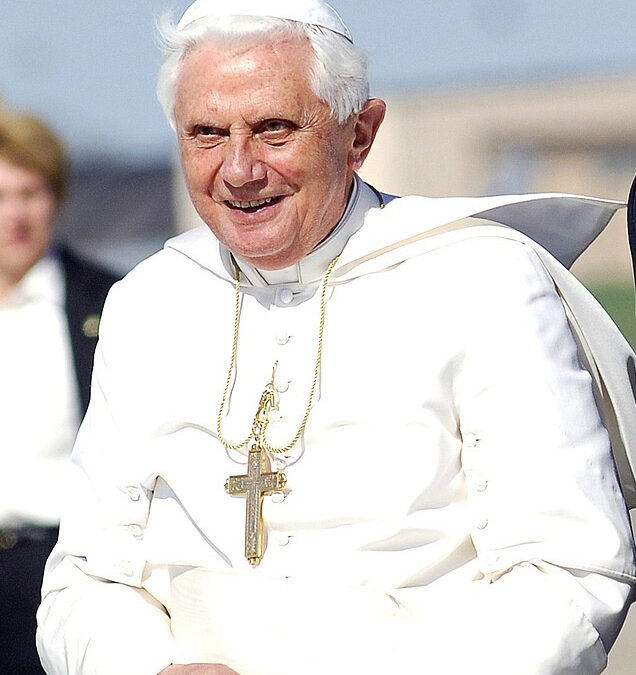
Statement by Margaret Karram, President of the Focolare Movement on the death of His Holiness, Pope Benedict XVI Respect, appreciation, and emotion fill my heart as I express deepest gratitude for the life and work of Pope Benedict XVI. I do so on my own behalf and on behalf of the Movement that he followed and accompanied with love and closeness . With the whole Church we gather around Pope Francis as we give him back to God, certain that he has already been received into the glory of Heaven and I will do so personally on the 5th January when I attend his funeral in St Peter’s Square. In May 2009, I had the privilege of welcoming Pope Benedict to Jerusalem, as I participated in various stages of his pilgrimage to the Holy Land. Two of those moments remain with me in particular: his words at the Holy Sepulchre, “Peace is possible here”. He continued, saying: “The Empty Tomb speaks to us of hope, the same hope that does not disappoint, because it is the gift of the Spirit of life.” Being able to attend a private Mass in the Apostolic Delegation in Jerusalem, celebrated by Pope Benedict XVI himself was very powerful for me. I sensed his fatherly tenderness and the greatness of his charity that was expressed in a gesture of gratitude for all that the Focolare Movement had done to help prepare for his visit. 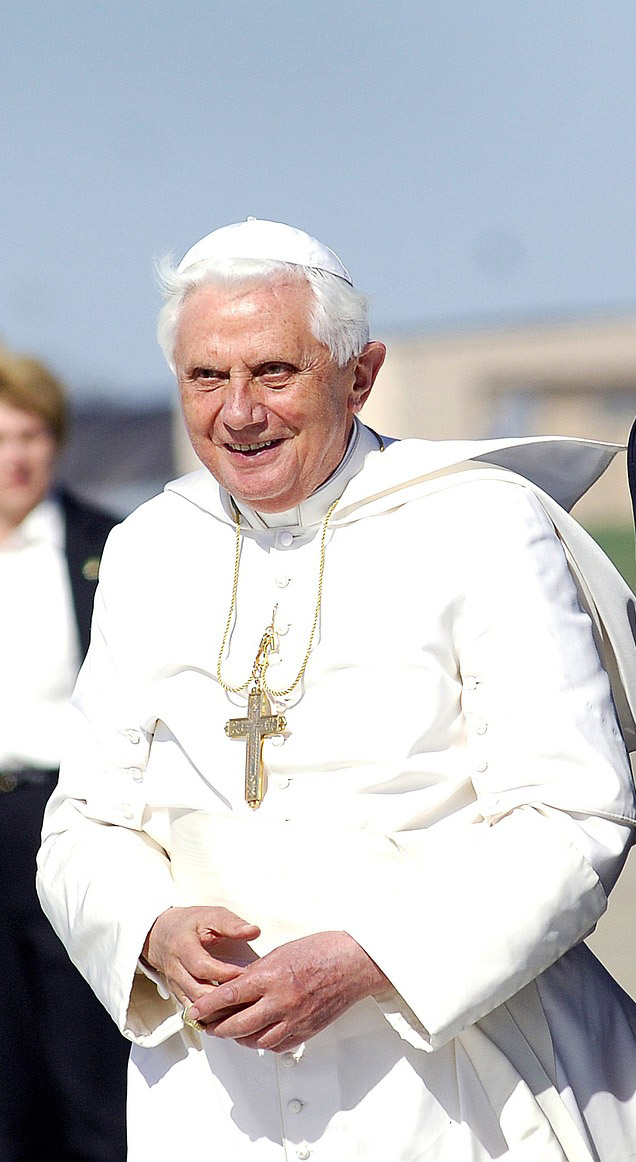 In 1989, when he was still Prefect of the Congregation for the Doctrine of the Faith, Cardinal Joseph Ratzinger was invited by Chiara Lubich for a dialogue with the focolarine gathered for their annual spiritual exercises, in which I too was participating. He answered a wide variety of questions and at one point spoke words that I have never forgotten. Concerning the future of the Church and humanity, he said: “The final word in the history of the world will be communion, becoming communion, not only among ourselves but, by being incorporated in Trinitarian love, becoming universal communion, where God is all in all”[1]. Today, as our beloved Pope Benedict XVI has returned to the house of the Father, these words of his resound within me almost like a spiritual testament. They are words of extraordinary relevance, which today shed light and hope on humanity afflicted by conflicts of which we see no end. We were nourished by his enlightened thought, that of a great theologian who, while still very young, took part in the Second Vatican Council, He conveyed and presented over the years the newness of a Church as communion, formed of knowledge of the Word and charity translated into practice. Following his election as Pope, Chiara Lubich affirmed: ‘From my personal knowledge of him, and because he has special gifts with which to grasp the light of the Spirit, he will not fail to surprise us and exceed all expectations’[2]. Let us not forget the key role he played in 1998, when Pope John Paul II invited the Ecclesial Movements and New Communities to St Peter’s Square on the feast of Pentecost. On that occasion, Cardinal Ratzinger gave a very significant lecture entitled: “The Ecclesial Movements: a Theological Reflection on their Place in the Church”, in which he outlined the profile of the movements and new communities and their essential relationship with the Church. Some parts of his talk continue to be a great light for me and for the Movement, enabling us to be instruments of communion in the Church and Christ’s outreached arms towards humanity. He said: “(…) the Holy Spirit is quite plainly at work in the Church and is lavishing new gifts on her in our time too, gifts through which she relives the joy of her youth (cf. Ps 42:4 Vulgate). Gratitude for the many people, young and old, who accept God’s call and joyfully enter into the service of the Gospel without looking back. Gratitude for the bishops who open themselves up to the new movements, create room for them in their local Churches, struggle patiently with them in order to overcome their one-sidedness and guide them to the right form.”[3] Together with the whole Church, I thank God for the gift that Pope Benedict XVI has been for our time and I pray that we will know how to grasp and translate into life the depth of his theological thought, his faithfulness to the Gospel and the courage of a life of witness that can lead the Church on the paths of truth, fraternity and peace.
Margaret Karram President Focolare Movemente
[1] Cardinal Joseph Ratzinger’s visit to the meeting of the women focolarini, answers to questions. Castel Gandolfo, 8th December 1989. Chiara Lubich Archive, in the General Archives of the Focolare Movement. [2] Statement by Chiara Lubich in the Focolare Movement’s Press Release of 20th April 2005 [3] “Ecclesial Movements, a theological reflection on their place in the Church,” Joseph Cardinal Ratzinger. Proceedings of the World Congress of the Ecclesial Movements Rome, 27-29 May 1998.
