![Politics as a vocation]()
26 Sep 2018 | Non categorizzato
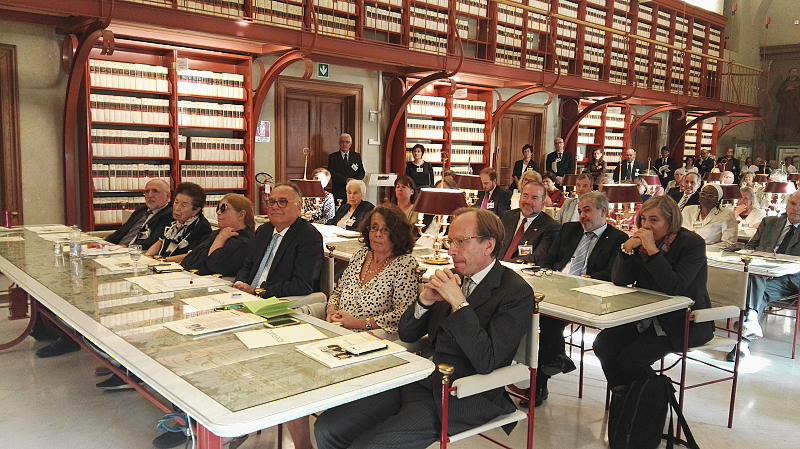 The event saw the participation of members of the Italian parliament and the European Parliament, ambassadors, teachers, academics and many people who knew Giordani also through his writings. Promoted by the Focolare Movement with the Chiara Lubich Center, Igino Giordani Center and the political Movement for unity, for years now universities of the five continents, associations and local entities, have been supporting and sharing the fundaments of the cultural, social and political project, which are based on the vital encounter between Chiara Lubich and Giordani. We can thus say that the meeting in Rome was the expression of a long partnership and synergy amongst many. Upon opening the convention, Donato Falmi, Co-Director of the Focolare in Rome, read the greeting and message of the President of the Italian Republic to the Focolare President, Maria Voce: “…in expressing my appreciation for this initiative, aimed at nurturing the example of men and women who worked to promote the universal values of peace, brotherhood and solidarity, President Mattarella is conveying to you and the entire Focolare Movement, his best regards and greetings.” “I had the fortune of meeting Igino Giordani because in my youth,” affirmed Steni Di Piazza, Senator of Palermo. “I met the young people of the Focolare, and attended educational congresses with them. In July 1979, I met Igino Giordani and he told me that when he met Chiara, he felt something new. After many years I understood that with that phrase, Giordani was referring to politics in the fraternal cooperation and dignity of all the members. And maybe the vocation to politics began to grow in me after that meeting with Igino.” “This is a good moment to discuss and commemorate that 18 September of 70 years ago, in order to try to highlight those values that marked such an occasion,” underlined Stefano Fassina, Congressman of Rome. “Politics as a vocation should be felt and lived by every citizen, since every citizen is called to be responsible for the public good.”
 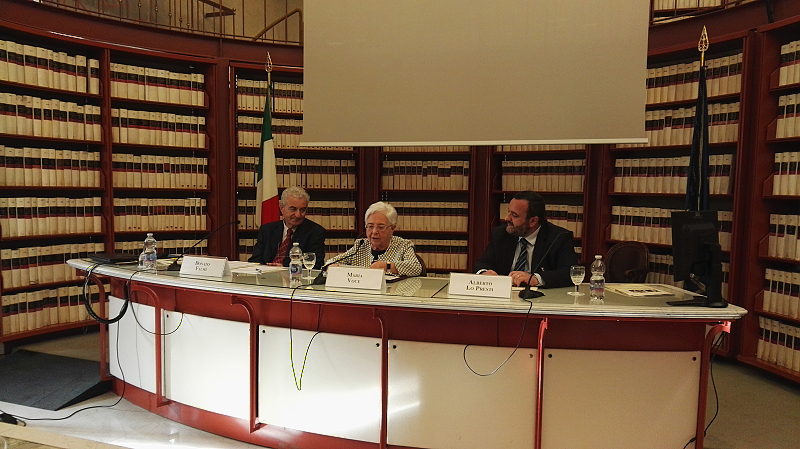 Going back to 18 September 1948, Giordani recounts the meeting with Chiara in his Memoirs: “I felt something new in the first words of that young lady. There was a note of deep and secure conviction which arose from a supernatural sentiment. So suddenly my curiosity was aroused and a fire inside me started to burn…” In that encounter Chiara brought with her the Ideal of unity. “She simply spoke about the divine adventure that had started a few years earlier in Trent, which already triggered the birth of a new Christian community,” Maria Voce affirmed in her speech. “From the beginning, the first focolare women and then the men, nurtured themselves on the Light of this Ideal, as also Igino Giordani, who Chiara spiritually fed through a prolific correspondence.” In the era of Catholic politics, Giordani was a leader. He not only worked in the Parliament but also in the Vatican. But the meeting with Chiara transformed him deeply. “He discovered unity in a new way, as the principle and value of human relationships, especially in politics,” stated the political scientist, Alberto Lo Presti. “That is, he understood that all the partial truths he had believed were decisive in doing good politics, were fulfilled in unity. (…) Unity is the banner of his political vocation.” Rocco Pezzimenti, Professor of the History of political doctrines in the Lumsa University of Rome reminds us of Giordani’s two publications: the first, published in 1949 entitled Dehumanism and the second, published in the 1960s, entitled The Two Cities, both of rare and also prophetic depth. Giordani clearly says that from St. Augustine, he acquired a fundamental characteristic: politics is not an improvised event. What occurs in politics is first developed interiorly.” “If there is a theme we should reflect on today, starting from that encounter between Igino and Chiara,” recalled Marina Sereni, former vice president of the House of Representatives – “it is precisely unity in politics today. And politics is a vocation if it centers on the Common Good, with those values which are not the property of one party, but which target unity.” Her words were shared by Beatrice Lorenzin, former Minister for Health, who affirmed how “Igino and Chiara were two masters in the history of the Italian Republic and who initiated something extraordinary. We need these reference points to help us make a dynamic and not hypocritical analysis.” Lastly, four testimonials. “The first time I heard about Giordani was in the summer of 1946,”recalls Congresswoman, Rosa Russo Iervolino, “when my parents were elected in the constituent assembly. Giordani’s interventions in the chamber were always respectful of the others but at the same time harsh in making the truth emerge. Giordani was so humble that his humility almost hid his intelligence which was dynamic and always popped up in other ways.”
 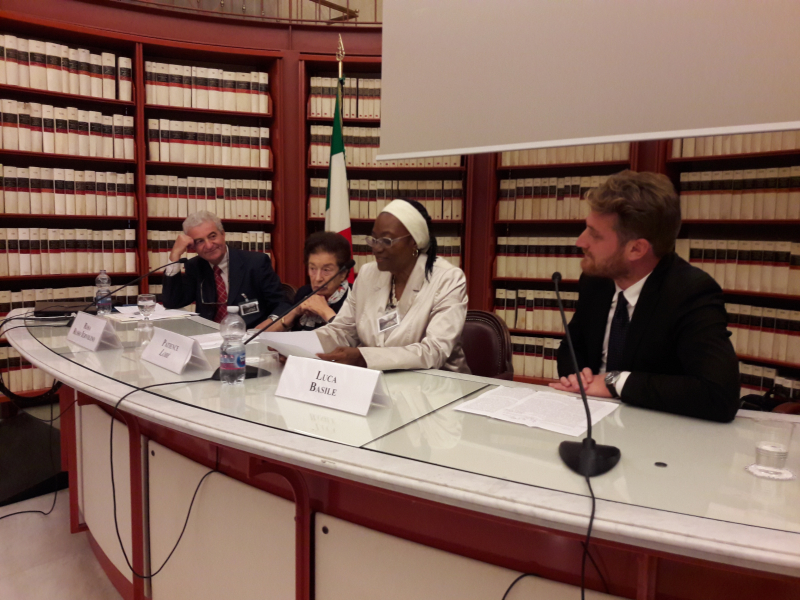 The following intervention was by Patience Lobe, first Cameroon woman to have been appointed in the Ministry as the Director of Public Works: “From the Focolare spirituality I learned coherence between life and words, and the importance of loving and serving the others. Having Chiara, a woman, as a model, gave me strength and courage, without ever making compromises. Chiara has opened my soul and intelligence to the Gospel.” To conclude, Luca Basile, President of the Town Council of Arzano in the province of Naples: “Thanks to the Focolare, I was able to live important experiences like cultural exchange and using it as a stimulus to my political commitment in the territory. My two predecessors resigned because the town council was dissolved due to mafia infiltration. You can fully understand how difficult it is to operate in such a territory, but we cannot lose hope when we have Chiara and Igino as our models.” “To implement what was generated from the encounter between Chiara Lubich and Giordani, we need to take upon us what the Country and humanity are going through,” affirmed Letizia De Torre, international coordinator of the Movement for Unity in Politics (MPPU). “May our commitment, imbued with the charism of Chiara Lubich, offer in a complex world, amazing possibilities for unity.” Lorenzo Russo
26 Sep 2018 | Non categorizzato
The International Day established by the UN in 2013 reminds us of the necessity to totally eliminate nuclear weapons, to achieve the fundamental objective of peace and security. Atomic weapons, in fact, continue to represent an unacceptable menace to the world population. The date chosen by the UN recalls the evening of 26 September 1983, when the Soviet Colonel, Stanislav Petrov decided correctly, to retain as an error, the missile alarms from the Unites States that appeared on the screens, despite the contrary opinion of the technicians. Petrov chose, in the span of a few minutes, to not follow the procedure that would have led to the reaction of the Soviet Union with the launching of its own atomic bombs. The man who saved the world from a real nuclear holocaust, died in absolute anonymity in 2017, in a town not far from Moscow.
25 Sep 2018 | Non categorizzato
A cloudy and humid day, and a sensation of emptiness. Only the day before I had celebrated my birthday, and made an ambitious wish: do all I can to make the new year shine as never before, imbuing each thing with love. I knew I would have had to start over again a thousand times, but I wanted to give my utmost. It was a sign of gratitude to Jesus for the gift of life. Not an isolated gift, but an intention valid for the entire year. He himself would have helped me. And yet, while going to an appointment, I felt that the cloudy sky was also inside me. I had allowed to silently creep into my heart a judgment of a brother who had once again disappointed me. It didn’t matter whether I was right or not. Inside me, charity was missing. I felt it with pain and I asked myself how I had gotten to that point. I came across a boy I often met. Dirty, stinky, with the usual bottle in hand. He was barefoot and shivering from the cold. He looked at me without a word. I greeted him courteously, thinking that in that way I was doing all I could, and continued my path. In that moment the Parable of the Good Samaritan came to mind. “Am I also like that Pharisee? Or do I let myself be challenged by that boy’s countenance of abandonment? I took off my sweater and went back. “Do you feel cold? “Yes, very” he answered. “Try on my sweater, let’s see if it fits.” He was so bewildered, but I almost didn’t dare touch him, since his hands really needed a good wash. “C’mon, try it on.” The size was perfect and his face seemed like that of a child on Christmas Eve. I greeted him and continued along my way, certainly feeling a bit cold, but happy. While waiting to meet my friend, a subtle voice spoke inside me. “What you did was nice, but what about that judgment you have?” “But Jesus – I answered – that person may not even have noticed it….” “But I did notice, I was in him.” One by one the arguments and excuses that came to mind were erased. Going home I decided to call him. A serene conversation, without any hard feeling on his part. Full unity was re-established, even if, to tell the truth, something inside me had snapped. A great, unmistakable peace invaded me. Two hours later, the doorbell rang. It was a dear friend, returning from his hometown with a gift for my birthday: a sweater! It was Jesus who was saying: “Raise the stakes!” From: “La vida se hace camino”, Urs Kerber, Ciudad Nueva Ed., Buenos Aires 2016, pp 41-42
23 Sep 2018 | Focolare Worldwide
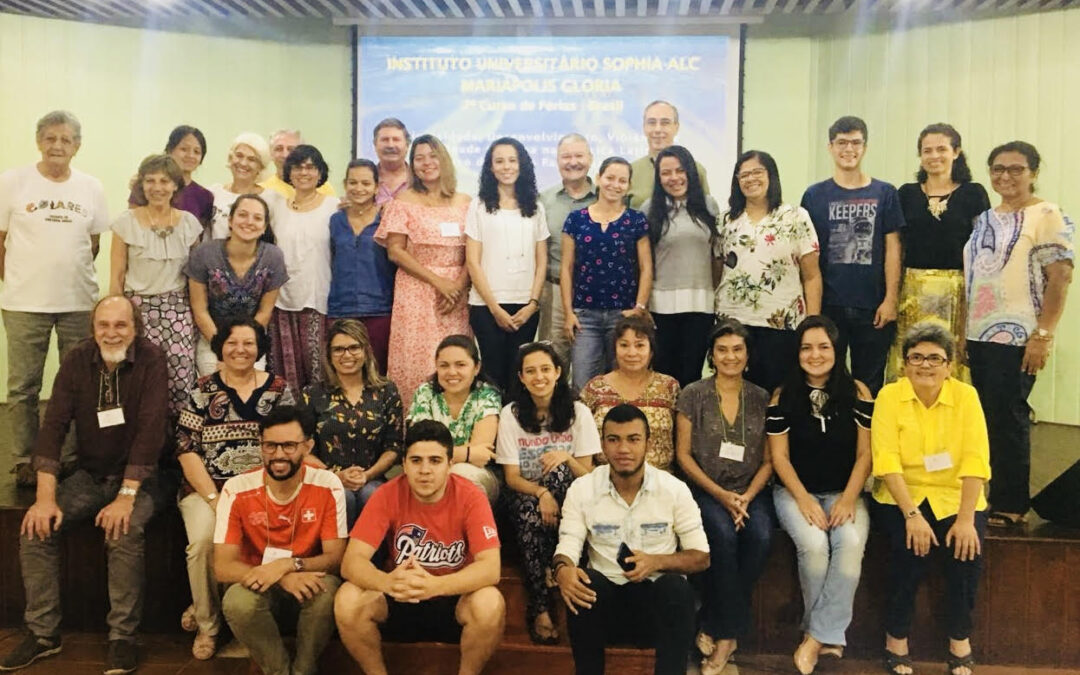
 It is an immense territory that many describe with superlatives. It includes eight countries, from the Andes mountain chain, to the Atlantic Ocean, to the highlands of Brazil. It is the planet’s largest rain forest, unique in its dense, impenetrable vegetation that holds countless animal species. Thousands of miles of rivers cross it, including the immense Amazon River (which is around 6,400 kilometers long). Many cities have sprung up alongside it, such as Manaus and Belem in Brazil and Iquitos and Puerto Maldonado in Peru. When you hear Amazon Forest you think of the “lungs of the world,” although today it is a lung that is seriously threatened by deforestation and urbanization, which year after year shrink its borders and contaminate its purity. This symbolic and cultural image that the Amazon region is usually known by, as well as its traditional character linked to its exotic nature and rich natural resources, seemed far away this summer. The “Curso de Férias” (holiday course), promoted by Sophia University Institute and ALC (the promotion agency for the institute in Latin America and the Caribbean), was held July 22–28. It was entitled “Diversity, development, violence and human mobility in Latin America: the case of the Amazon region.” The course mostly emphasized an interdisciplinary approach. It included subjects such as biodiversity, socio-diversity, the lives of local populations (indigenous, those of African origin, “ribeirinhos” who live along the river, and many others), sustainable methods in agriculture, the meeting of various forms of religion, as well as the challenges of urbanization, violence and vested interests in agribusiness.
 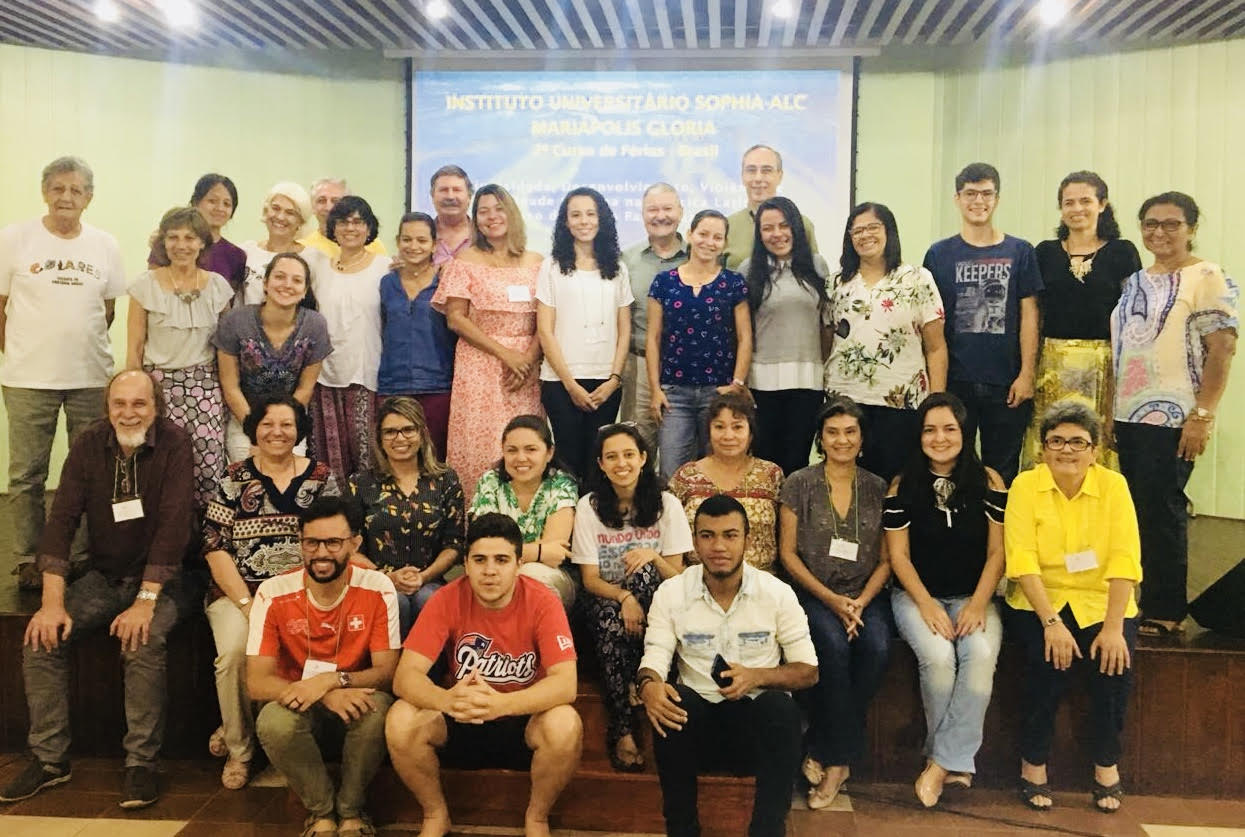 “We don’t speak of the forest; we are the forest. We don’t speak of the Amazon; we are the Amazon,” said Marcia Wayna Kambeba, from India, who was among those participating. Fifty students signed up: university students from various programs as well as teachers. The aim of the course was to invite those present to raise their knowledge of the history of the Amazon, and the responsibility of us all to face the complex reality of the region, and the cultural and historical trajectories that have been woven together there. And the importance of a respectful dialogue between the vision as the world sees it and the various religions present. “The Amazon should not only be seen only through the lens of economic interests and for its rich natural resources,” declared Belisa Amaral, a journalism student in Belem. “The world needs to explore its culture, beauty and people – rich and wise people who love this region, who defend its language, customs and identity despite being threatened widely.” “It was a real and true laboratory of humanity, researching alternatives to resolve – or at least reduce – the social and environmental problems that exist,” says Marcelo Rizzo, from Sao Paulo, an expert in human rights. For him the course was a chance to lift his knowledge and a “greater empathy for indigenous people and their culture, on questions about the Amazon, and about the environment in general.”
