28 Aug 2018 | Non categorizzato
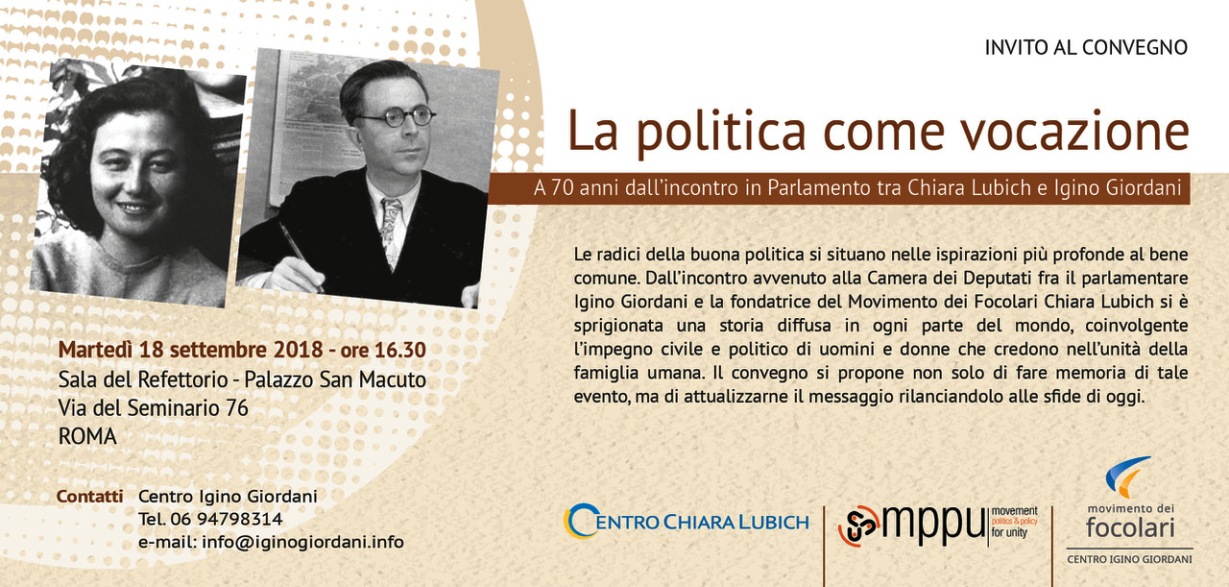 Politics as a vocation 70 years from the encounter between Chiara Lubich and Igino Giordani in Parliament. The roots of good politics lie in the deepest aspirations for common good. From the encounter at the House of Representatives between Igino Giordani and the founder of the Focolare Movement, Chiara Lubich, ensued a story that spread to every part of the world, involving the civil and political commitment of men and women who believe in the unity of the human family. The convention aims not only to commemorate this event but to actualize its message, and relaunch it to meet the challenges of today. Tuesday, 18 September 2018 – 4.30 pm Sala del Refettorio – Palazzo Dan Macuto Via del Seminario 76 ROME Contacts: Centro Igino Giordani Tel. 06/94798314 Email: info@iginogiordani.info
27 Aug 2018 | Non categorizzato, Word of
for ages 4-8 | for ages 9-17 | Print | Audio
The Word of Life this month comes from a text attributed to the disciple James, who was a prominent figure in the Church in Jerusalem. He exhorted Christians saying there should be coherence between what they believed and what they did. The first paragraph of the letter highlights an essential condition that makes this possible. Christians needed to be free from all wickedness in order to welcome God’s word and be guided by it on the journey toward fulfilling their Christian vocation. The word of God has a creative power that produces fruits of goodness in both the individual and in the community. It builds relationships founded on love between each of us and God and among us all. James says this word has already been “planted” in us. “Humbly welcome the word that has been planted in you and is able to save your souls.” One place where God clearly speaks to us is the Bible, and for Christians the Gospels are especially important. We can welcome God’s word by reading Scripture with love, and we see its fruits when we put it into practice. We can also listen to God in the depths of our hearts, where we often experience an influx of many voices and words. These might be slogans, or refer to choices we might make, or people to admire or maybe worries or fears. How can we recognize God’s word and leave room for it to live in us? We need to make ourselves still and surrender to God’s call, so as to listen freely and courageously to his voice which is usually gentle and quiet. God’s voice asks us to avoid being closed in on ourselves and to venture onto the path of encounter and dialogue with him and with others. It also calls on us to work so that human coexistence can become more harmonious and we can be increasingly ready to recognize one another as brothers and sisters. “Humbly welcome the word that has been planted in you and is able to save your souls.” How can this be? It is surely because, from the very beginning, God stated clearly that humankind was created in his “image.” In fact, every human being is a “you” in relation to God. Every person is called into existence to share in God’s life of love and fellowship. In addition, for Christians the sacrament of baptism incorporates us into Christ, the word of God who entered into human history. God has, therefore, sown the seed of his word in every person. This word calls them to do what is good; it calls them to justice, self-giving and fellowship. When the word is welcomed and cultivated in our own “soil,” it produces life and fruit. “Humbly welcome the word that has been planted in you and is able to save your souls.” In fact, the word of God can transform our daily life into the story of our liberation from the darkness of personal and social evil. However, we need to accept the word personally and consciously, even if it is an ongoing process and we are imperfect and fragile. Our thoughts and feelings will become more like those of Jesus himself. Our faith and hope in God’s love will grow stronger, and we will notice other people’s needs and help them. Chiara Lubich explained this in 1992: “We saw a profound unity between Jesus’ love for the Father and his love for his brothers and sisters. There was total coherence between his words and his life, and this fascinated and attracted everyone. “We too should be like him, accepting his words with childlike simplicity and putting them into practice. His words shine out in their purity, strength and completeness. By living them, we become the kind of disciples he wants us to be, disciples who are equal to their teacher, like Jesus spread throughout the world. What greater and more beautiful adventure could there be?” Letizia Magri soundcloud.com/…/word-of-life-september-2018
27 Aug 2018 | Focolare Worldwide
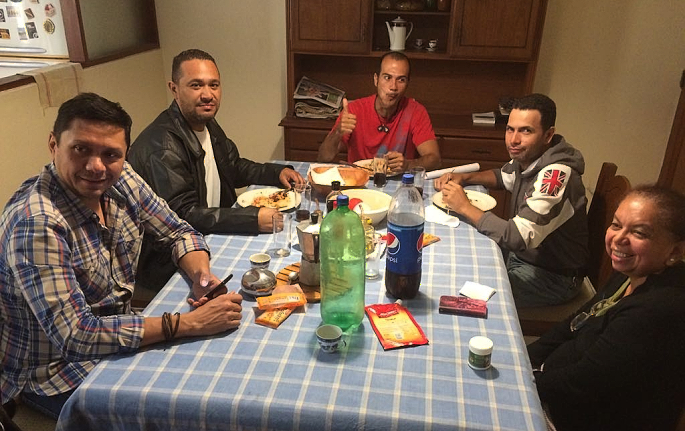
“According to reliable sources, on the 11th of August alone 5,100 Venezuelans crossed the border between Ecuador and Peru, a record that exceeds last May when in 3,700 new arrivals arrived in one day. This is why Ecuador has declared a state of migratory emergency.” Roggero, born in Venezuela of Italian parents, knows Latin America where he lived for almost 40 years before moving to the Peruvian capital in 2015. Not only are Brazil, Colombia, Ecuador and Peru grappling with an epochal exodus, but also more distant countries like Chile, Argentina and even Uruguay and, according to many observers, it threatens to provoke one of the greatest humanitarian crises in recent decades. The new rules of entry into Ecuador and Peru a few days ago imposed on Venezuelan citizens to show a passport, which is impossible to obtain these days. “This is something hard to understand if you aren’t experiencing it for yourself. The Venezuelans who have fled to Peru may have already reached the quota of 400 thousand people. They fled from a country in the grip of a very serious crisis where everything is lacking, and I’m here to find a job and keep together the rest of the family that’s been left in Venezuela at the cost of great sacrifice. They are willing to do anything, they often go hungry; they spend even 3-4 hours a day on the bus to earn just a few dollars. Many sleep on the floor and suffer from cold because they do not even have a blanket and shower with cold water. But at least they know that the family members who went to stay in Venezuela (wife, children, brothers, grandparents …) have a roof over their heads and can somehow survive with the few dollars that come from abroad. Meanwhile, the Focolare community has been trying to welcome people, relatives or friends, who keep arriving. “What is important for us,” says Silvano, is that they find a family atmosphere. Then, if we can share some food, jackets, medicines, a blanket or some help in obtaining a temporary residence permit, even better. On August 12th we met for the third time in the Lima focolare with the Fiore Center one of our operations offices. We were 23 people, two thirds of whom were Venezuelan. First, those who wanted could attend Mass. Then we offered lunch on two large tables. Before leaving, we saw a video presentation of Chiara Lubich, because most of the people did not know the Movement. An always moving moment is when we distribute clothes that the local community collects for us. We also laughed a lot when one of the people was wearing his coat, which he picked up by accident. This unusual happiness concealed some very harsh realities and all kinds of painful stories of the journey from Venezuela. Talking and listening to them has been a liberation for them. To somebody in emergency we could offer, in the meantime, some washing machine tours. To some others we were able to offer a few turns of our washing machines for their laundry. Two rocker friends of one of the guests showed up by chance and left deeply moved by the relationship they had seen among all of us. They called us “quality people”. It seems that this definition, in the rocket world, at least in Venezuela, is the highest possible compliment. And it was not over yet: from the one you would least expect came an invitation to say a final prayer. All of us in a circle joined hands and offered a prayer that was very meaningful! That same evening we learned that the UN estimates that 2.3 million Venezuelans have already fled the country since the beginning of the crisis. So we still have a lot of work to do – and for quite a while. “
26 Aug 2018 | Focolare Worldwide
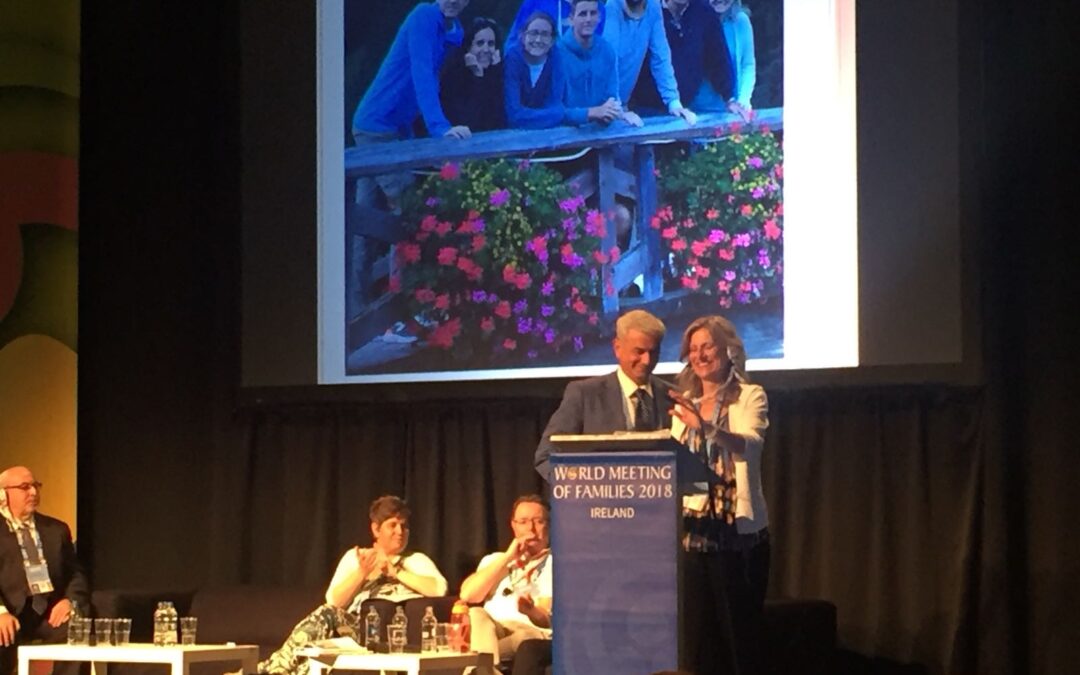
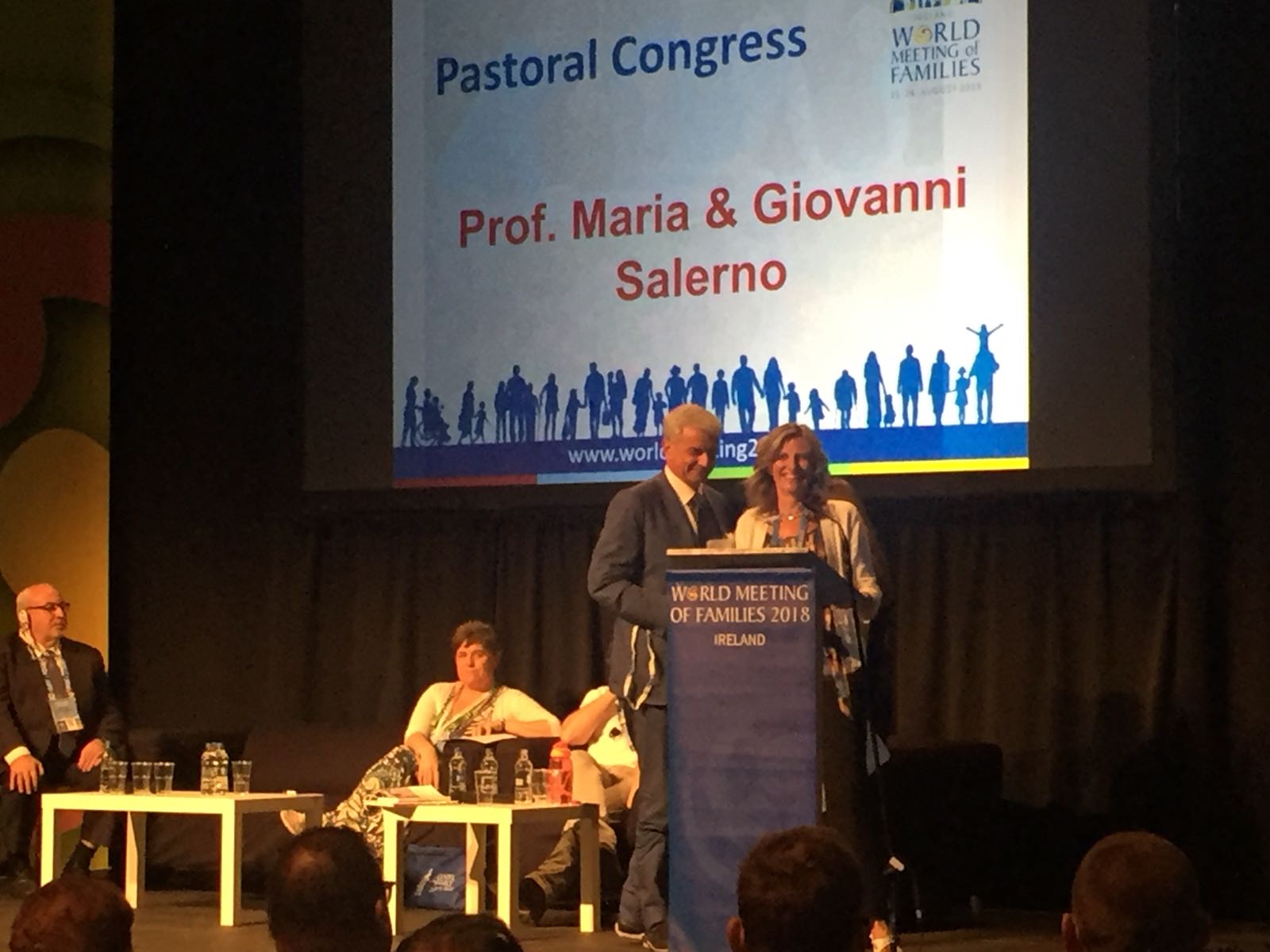 Married for 31 years, with five children and a granddaughter on the way, Gianni and Maria Salerno would have many stories to tell, along with practical advice on raising children. But for their panel on “Joy and the challenges of parents raising children in today’s world,” which is the main topic of the meeting in Dublin, they bring to the table the patrimony of the life and experience that has matured for many years in the Focolare’s New Families Movement. Some of the topics that will be discussed are: the role of technology in the family, the relationship with the faith, the multiple connections with work, the economy and environment. It is a “family of families,” which draws on the spirituality of unity of Chiara Lubich as a compass that marks north on the sometimes wearisome journey of life. “We’d like to emphasize several “key terms” that seem useful for the relationship with our children and are liveable anywhere in every the country of the world, regardless of culture. The first is detachment. Our children are not ours, they’re God’s children. This attitude allows us to seek what is best for them, to respect their freedom and to discover God’s plan for their happiness. Another important word is accompany, to them feel our nearness so that they can face difficulties without feeling all alone. Thus they can learn commitment, through an ongoing training of the will. Then, there is a phrase that has always been fundamental in our experience and in the experience of many other families from around the world with whom we are in contact: start again. When you make a mistake, when there’s a problem, or love is lacking, we can always put a period and begin again, asking forgiveness if we’ve overdone it when correcting one of our children, which for parents is often an opportunity to unload rather than educate.”
 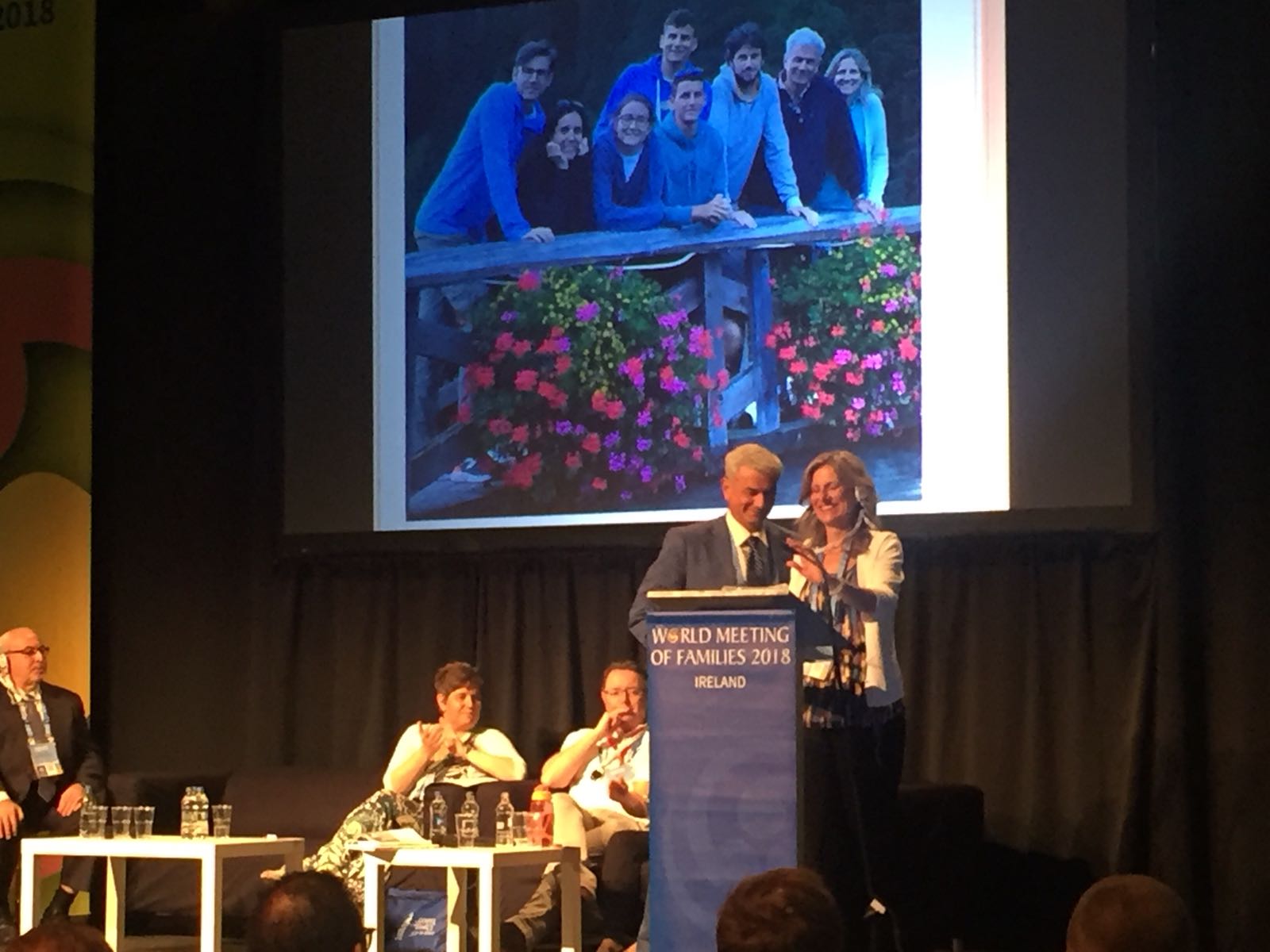 “We should always try to immerse ourselves in what our children are going through. We use a popular phrase to express our desire to listen deeply and be open: walk in their shoes for a while before giving any quick answers. Example, sharing and dialogue are indispensable in a family. You have to be able to talk about anything in a family and parents are the ones who must prove it, using their antennas to catch the non-verbal messages that children send – especially teenagers – which are often provocations. Then we need to give our time to them. How much effort this involves, perhaps at night after a long day’s work, especially when our thoughts don’t coincide. We have to allow ourselves to challenge them without any fear of them or their ‘world,’ even when worries of all kinds arise within us: about their health, the friends they choose, school and the future. When this happens we try to hold on to a valuable piece of advice: be occupied, not preoccupied so as to avoid letting our anxiety make them even more insecure or less free. In the end, what we can always do is to pray for them, entrusting them to God’s love. There are cases in which children become rebellious and reject the relationship with the parents, taking on violent behaviours, making questionable choices that are sometimes grave and serious. This causes suffering and destabilizes the family. The wound of having failed at educating our children really burns and makes us wonder: where did we go wrong? Also in these cases we have to remember that we are parents forever and that the door of our hearts is always open. It’s not easy, but we can follow the example of Jesus crucified and abandoned who offered his pain and transformed it into Love. Like him, we can also consume our pain by continuing to love our children concretely, along with all the other neighbours who come our way, in the awareness that, in the end, Love will triumph.”
24 Aug 2018 | Non categorizzato
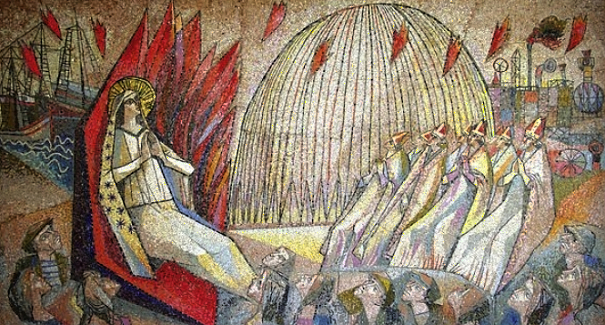
Mosaic by Paolo Scirpa (International Centre of the Focolare Movement, Rocca di Papa, Italy)
