6 Nov 2023 | Non categorizzato
A journey of knowledge and discovery to be made together on a daily basis and in a great spirit of acceptance, while coping with the many challenges that the world presents. We talked about this with Antonio Salimbeni and Rita Moussallem, the leaders of the Center for Interreligious Dialogue (CDI). In the world landscape that is undergoing a profound transformation toward an increasingly multicultural and multi-religious society, the Focolare Movement promotes dialogue among religions, so that the religious pluralism of humanity may not be the cause of divisions and wars, but contribute to fraternity and peace. Antonio Salimbeni and Rita Moussallem, leaders of the Center for Interreligious Dialogue (CDI), answer some questions. In light of what is affecting the world today, particularly the new conflicts that are being added to existing ones, what contribution can interfaith dialogue make to building one big human family? In the face of the heartbreaking and shocking events of recent weeks, we feel dismay and deep sorrow as well as a sense of bewilderment. Religion is often instrumentalized by political powers. We realize how ideologies, religious nationalism and any form of polarization always lead to conflict. Dialogue can help purify our approach, deepen our knowledge of the other, and focus our engagement on the essence of our religions, which is our relationship with God, Love and Mercy. Dialogue can raise the level of our relationships to a deep spiritual dimension and push us to live the deepest human values, to work together to spread Goodness and fraternity. How does the Focolare Movement pursue its commitment in this area? The Focolare Movement, founded on a profound spirituality centered on unity and fraternity among all, discovered its vocation to interreligious dialogue more than five decades ago. Since then, it has established – including through its Center for Interreligious Dialogue (CDI) and its centers present in various countries – intense and fraternal relationships with thousands of faithful and numerous institutions, associations, movements and organizations of the most diverse religions in the conviction that friendship among people of different faiths is a vital potential for building universal brotherhood. It is a dialogue among brothers. A dialogue sustained by listening, sharing and collaboration. It is a dialogue that makes us discover diversity, whatever it may be, as a gift. Whoever is close to me,” said Chiara Lubich, founder of the Movement, “was created as a gift for me, and I was created as a gift for whoever is close to me: her formula for a fraternal world. What are the next scheduled appointments? What are the issues to be addressed and the goals? An idea has been maturing for the past few months, which is to organize an interfaith conference for fraternity next June 2024. This becomes even more urgent and necessary in light of the growing crisis that intensifies divisions in humanity. It is an event that aims to contribute to reconciliation efforts with innovative actions at the global level and to walk the path of dialogue and fraternity by strengthening relations and cooperation among people of different faiths. The conference will kick off on May 29 and end on June 5, 2024. It will consist of several moments that will have as a common denominator the theme of peace among people and with creation. There will be two open days, one in Castel Gandolfo in collaboration with FaithInvest organization and one in Assisi together with the Laudato Si Movement, to celebrate the importance and commitment of different faiths in the custody of our common home. In this urgent endeavor we are partnering with Consulus, a global innovation consulting firm with its presence in the Americas, Europe and Asia, as our global knowledge partner.
Maria Grazia Berretta
26 Oct 2023 | Non categorizzato
The phrase “Render to Caesar what is Caesar’s and to God what is God’s” (Mt 22:21) contains an imminent request to live out our faith radically and this is what loving really means: to do the will of God who gives us everything and to do it wholeheartedly; recognizing His voice amid the deafening noise of the world and choosing it as the best way forward in everyday life. With the poor in the peripheries Moved by the situation of squalor and poverty of many families in our area and stimulated by the Word of God, a group of us submitted a proposal to the religious and civil authorities and took action to dedicate ourselves to children in particular in the peripheries. First, some mothers who lived in huts offered to help us for families even poorer than themselves. Our service started by registering and weighing children from zero to five years old, educating mothers on alternative feeding (low cost and high nutritional value), vaccinations, breastfeeding and education. It was only a first step to dealing with more serious problems: unemployment, alcoholism, abandonment, hunger, lack of housing, drugs, poverty. Every weekend, we go with our families to help those who live in the huts to offer them, in cooperation with other Christians, better living conditions. Our communion of goods contributes to improving the quality of life of these children so that they don’t just survive but can have a dignified life. (M.N. – Brazil) An unexpected job Some time ago, a couple with five children came to live in our town. The father was out of work and had to move house for health reasons. His profession was compatible with my husband’s and we had been promised an important job, so we decided to hire him in our company. However, a few months later, the work we were expecting didn’t come through and we began to worry about the future. At that time, the Word of the Gospel that we were trying to live invited us to pray because, the commentary said, there are two temptations: “The presumption of managing on our own and the fear of not making it. Whereas Jesus assures us that the heavenly Father will ensure that we have the strength of the Spirit if we watch and ask Him with faith.” So we turned to Him with faith, entrusting him with the new situation, sure that he would look after it. The next day, my husband unexpectedly received an important job. Since then, we have always had work and the newcomer continues to work with us. (M.R. – Switzerland) The loan During the first trimester of school, I had shared my scholarship with another student who could not afford a canteen card because he came from a very poor family. At the beginning of the second trimester, he told me that his parents needed money urgently and he asked me to lend him a certain amount. I had set that sum aside for books and food, but out of friendship I decided to oblige him. Then I didn’t see him around for a few days, while previously he always came to talk to me. I started to worry and even get angry. Then, suddenly, the Gospel came to my aid with the thought that it is right to help a neighbour who is worse off than me. When I calmed down, I went to visit him at his house. As soon as we met, he told me that he hadn’t shown up again because he was ashamed of not yet having the money to pay me back and he didn’t know what to do. I reassured him, saying that he could pay me back whenever it was possible and that otherwise it would be fine anyway: the most important thing was that we should remain friends. (J.B. – Africa)
compiled by Maria Grazia Berretta
(taken from “The Gospel of the Day”, Città Nuova, year IX – no.1 September-October 2023)
20 Oct 2023 | Non categorizzato
“In our everyday relationships, we try to live experiences of brotherhood, build unity and establish bonds of reciprocity. But what is the origin of that spark of light that pushes us to risk and reach out to others? Chiara Lubich suggests an answer through an episode from her life.” Now let’s pass on to the second aspect: outreach. The subject is very vast. We’ll limit ourselves to certain ideas given in some of the letters of the early days of the Movement. Reading just a few of these pages about this aspect, we can understand that: “The first inspiring spark was love.” Yes, it was love. A spark was enkindled, it spread light all around and burst into flames, setting the world on fire. Love reaches out; love in and of itself bears witness. Even when you speak your words should be backed up by the witness of your love. First, you have to love, expressed in concrete experiences, and then share your experiences. This is how the first Christians acted. One episode has always remained deeply impressed on my heart. I think this is very beautiful. In it lies the secret of our outreach, the required point of departure. “As I was walking along the streets of Einsiedeln, I saw many people of various religious orders passing by” – because there’s a beautiful shrine there. (Among these), I was especially impressed by the little Sisters of Charles de Foucauld. They rode by on their bicycles, wearing peasant scarves and they looked so full of life. The lively expression on their faces reminded me of their founder, Foucauld, who, they say, cried out the Gospel with his whole life. In fact, those Sisters seemed to say: ‘Blessed are the poor in spirit, blessed are they who mourn’. Not the beatitudes that the world would like to hear, but the scandal of the Gospel. At that moment, I too felt a great desire to give my witness, also externally. But the answer didn’t come to me. At a certain point I met up with one of my companions, Natalia, and I told her: ‘You know, I saw how those Sisters had an effect on me. Their apostolate wasn’t with words, but by the way they dressed… and I wished we could do the same. But how can people know God through looking at us? Oh, yes, I know! ‘By this everyone will know that you are my disciples, if you have love for one another’ (Jn 13:35).” Therefore, mutual love was our uniform.
Chiara Lubich
https://youtu.be/TPjeaq6W–w
28 Sep 2023 | Non categorizzato
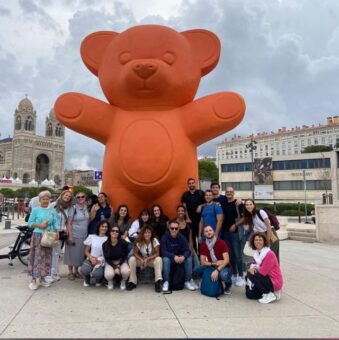
Marseille (France), a city which is a mosaic of peoples and cultures, was the backdrop to the recent “Recontres Méditerranéennes”. It was an event that, through dialogue, traced new pathways of hope for the future. At the General Audience of 27th September 2023, Pope Francis focused his meditation on his recent Apostolic Journey to Marseille, for the conclusion of the “Rencontres Méditerranéennes” (Mediterranean Meetings) that took place from 17th-24th September 2023. He said:
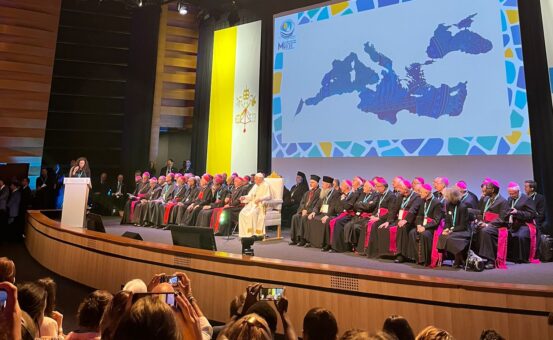
Foto: © Chiara Barbaccia
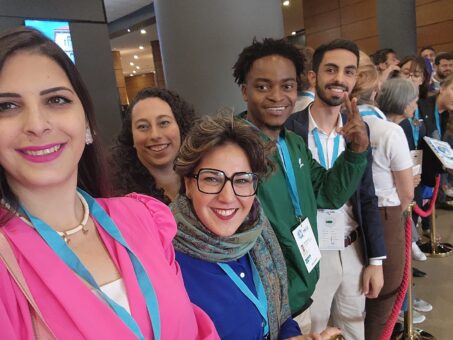
Foto: © Chiara Barbaccia
Maria Grazia Berretta
25 Sep 2023 | Non categorizzato
Looking at the gestures of love performed by others sometimes generates a pull, like magnets, attracts us, softens our hearts and awakens in us a desire to “join in,” to do the same. It is something that does not go unnoticed, capable of truly impacting many. Poems for mother With my mother, there had never been an easy relationship. She used to criticize my faith, calling me deluded. After leaving home, I maintained a relationship more with my father, who wisely knew how to balance the situation. One day he called me: my mother was in the hospital for a serious illness. As I went to visit her, I thought of what could give her joy. I knew she loved the poems of Attila József, so I got one of his audiobooks. My mother was no longer herself, transformed by her sorrow. But as soon as she began to listen to those poems, her eyes became as bright as if she was dreaming. My subsequent visits thus became a discovery or rediscovery of our national poet, but it was a great joy for me to see that she had involved other sick people in reading or listening to the poems. Because of this act of her charity toward them, I felt as if I was getting acquainted with another person: “You taught me that you have to love everyone,” she commented. And me? I was by her when she breathed her last serene and hopeful breath. (L.M.L. – Hungary) Three times a day In the usual expenditures of our family budget, we had included a sum to be made available to those in need. Only that a particular day we could not get it out because there were many expenses. It was a real disappointment for us. At this point our two little sons came with their wallets and, in front of us, poured the entire contents, all their savings, onto the table. The episode was followed up when Grandma came to visit us and the children told her what they had done. And she, looking at us puzzled, “But how, you help others when you are also in need?” Before we could react, clearing the air was the youngest who said, “But Grandma, we eat three times a day!” With that sentence, serenity returned, and a few days later Grandma also returned with an envelope in her hand: “This is my contribution that I put together with yours… After all, I too eat three times a day!” (L.R. – Italy)
Edited by Maria Grazia Berretta
(taken from The Gospel of the Day, Città Nuova, Year IX – No. 1 September-October 2023)
