10 Feb 2023 | Non categorizzato
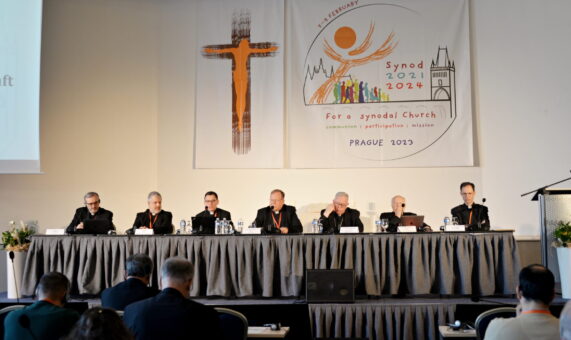
The primacy of listening, a shared journey open to dialogue and encounter, the challenges of secularization, of lasting peace, of welcoming the many diversities of humanity are at the centre of this phase. Margaret Karram, President of the Focolare is one of the participants at the European Synodal Continental Assembly. “We gather in Prague, a city that can be considered a bridge between East and West, but which also expresses a warning for Europe. Today, just over thirty years after the fall of the Berlin Wall which marked the end of the world divided into opposing blocs, we have another war in the heart of Europe. We feel close to our Ukrainian siblings, in the hope that Russian aggression will end and that true peace and reconciliation will be found on our continent.” 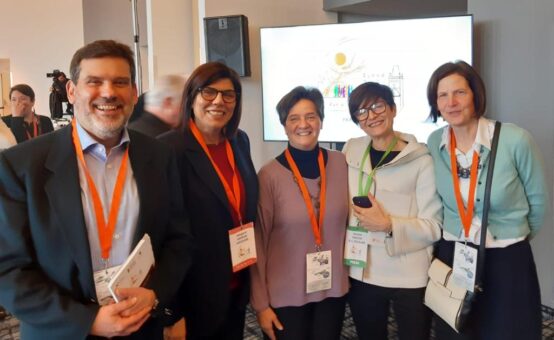 These are the words of Gintaras Grušas, Archbishop of Vilnius (Lithuania), President of the Council of European Episcopal Conferences (CCEE), in his opening speech at the European Synodal Continental Assembly. Solidarity with the Turkish and Syrian populations affected by the terrible earthquake was also expressed immediately. The meeting is taking place in the capital of the Czech Republic, from 5th-12th February, with the participation of 200 delegates from the 39 European Episcopal Conferences, from 45 countries. There were also 44 “guests” including Margaret Karram, President of the Focolare Movement. Cardinal Mario Grech, Secretary General of the Synod, offered a realistic perspective of this phase of the journey saying, “We are all learners in synodality.” The Church in Europe met to experience a journey of sharing, more necessary than ever today, to get to know each other and to break down prejudices.
 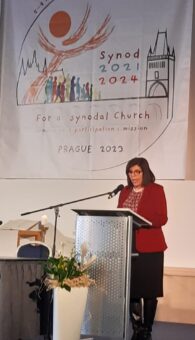 The Voice of the Churches in Europe The sessions dedicated to the experience of the synodal journey of the various Episcopal conferences gave a glimpse into the life of the Churches in Europe. From Albania where today Christians are confronted with the need to learn to dialogue with people of different religions to Belgium, where secularization has reached every social sphere. The invitation is to know how to grasp the signs of the times, giving space to the laity, avoiding every form of clericalism, every yielding to attitudes of abuse and power. In Belarus, the synodal journey brought to light the need for formation in dialogue for both the clergy and the laity in order to have a greater impact on society. Bulgaria, a country with a very small percentage of Catholics, told of a synodal path animated by a strong ecumenical spirit. This was shared by several countries of Eastern Europe, while from France came a resolute invitation to listen, to the centrality of the victims of abuse in the Church and to a path of purification in spiritual life to rediscover fidelity to Christ and to be a welcoming Church for all. The Churches of Great Britain and Wales emphasized the need for ongoing formation in the life of faith and evangelization. Transversal issues There are many transversal issues for the Churches of the old continent: from the scourge of abuse, to the formation of the clergy so that they regain the trust of the people of God and rise to the challenges of today’s de-Christianized and secularized society, to the question of women in the Church, to the urgency of the transmission of the faith today, but with a language and modality suited to the times. But there is one common question for all: what does it mean for the Church in Europe to be “inclusive”? How can it also embrace those people who live complex moral situations with respect to Church doctrine, such as divorced people or LGBTQ+ people? The answers can only come from a patient journey of communion. In her input, Margaret Karram said, “I believe that the response that the Church in Europe can offer today is the gift of that evangelical love that comes to us from Christ himself and is at the heart of dialogue and encounter. As a Focolare Movement we commit ourselves to this path to which the Pope is calling us.” For the Church in Europe, the synodal days in Prague are a real life experiment in synodality, which highlight the need to continue on this path. The final document, the result of these working days, will include all the requests, challenges and proposals and, together with those of the other 6 continental assemblies, will be sent to the central commission of the Synod.
Stefania Tanesini
26 Jan 2023 | Non categorizzato
One of the greatest sufferings for human beings is to feel worthless when faced with the realities of life, to accept that at times we cannot do anything. To be an instrument in God’s hands means to make ourselves available, rediscover our own value in letting someone else do something, and learn the art of entrusting ourselves to others. A bit of prudence As head of a department in my company, one day I noticed that my typically peaceful colleague had an aggressive attitude. When I invited him to talk, he confided in me his problems with his wife, who had turned out to be violent to the point of laying hands on him. She continually demanded more and more money from him. This was what was behind his working overtime. Since then, my colleague started phoning me outside work when things were going badly, certain that he would find a listening ear. However, when I realised that I had become a kind of safe haven for him, I felt the need to talk to my husband about it, out of Christian prudence. After helping me to understand that for that man I might not just be a friend, but the ideal of a woman, my husband put forth an idea that turned out to be a winner. We invited over the colleague’s family using the excuse of a birthday. After trusting in God, and thanks to the atmosphere created by our children’s games and prizes, the relationship established with the other couple gave hope for a change in their situation. (G.T., Portugal) Goodbye bicycle For some time now I have had to put my beloved bicycle, my companion on so many journeys, to rest in the garage. The fact is that, because of my bifocals, I am now forced to walk. To be honest, it has cost me a bit personally. The bike was very useful, because I could put my shopping and other things in the basket, which I now have to carry by hand. Luckily I live in a small town where everything I need is close by. That said, I have discovered an advantage of going without two wheels, beyond that of avoiding falls, which are so disastrous when one has reached a certain age. Walking gives me the opportunity to meet many people, have a chat… and there is always something sad or joyful to share. In short, everything is an expression of God’s love, if we are willing to do his will. Better to try to go to heaven without a bicycle than to go faster… and where then? (Marianna, Italy)
Edited by Maria Grazia Berretta.
From “Il Vangelo del Giorno”, Città Nuova, year IX, no.1, January–February 2023
25 Jan 2023 | Non categorizzato
As the Week of Prayer for Christian Unity concludes, here’s an experience of synodality, dialogue and bonding with brothers from various churches in Bari, Italy. It was a step forward to get to know each other and to walk together. For some years my husband Giulio and I have been following ecumenical dialogue with other movements within our diocese and on behalf of the Focolare Movement. Some time ago we received a letter from Cardinal Kock, Prefect of the Pontifical Council for the Promotion of Christian Unity, and Cardinal Grech, Secretary General of the Synod of Bishops, on the need to involve brothers and sisters of other churches at the synodal tables. These are moments in small groups, organised to articulate reflections and proposals on the way forward for our diocesan church, for the occasion of the synod launched in October 2021. I seized the opportunity and went to see Father Alfredo, our bishop’s delegate for ecumenical and interreligious dialogue, inviting him to consider this proposal. Later he contacted me to invite me to participate in a course for table facilitators in the diocese, which was very interesting. The next step was to start visualising our meeting with our Christian brothers and sisters, and then gradually make it come to life. We looked for a suitable room and involved friends from other movements in the preparation. Each of them knew people from other churches, who in turn became facilitators themselves. We set the dates, and in the morning we went together with my family to prepare the room to make it welcoming. We set six tables with coloured tablecloths, posters, coloured markers, as well as chocolates, drinks, glasses, etc. We didn’t know how many people would come, so we wanted to make sure and put six chairs per table. In the early afternoon our guests arrived. In the end there were 38 people from 9 different churches, and we had to add 2 chairs. It was a wonderful experience. We entered as strangers and left as family, with the desire to get to know each other more so that we could pray together and live fraternal charity. There was great enthusiasm at the discovery of being able to be together, with the joy of being one people of God.
Rita and Giulio Seller
24 Jan 2023 | Non categorizzato
Building unity beyond age-old prejudices, distrust and rifts. Generating, day after day, a dialogue that has become a way of life. This is the daily life of the Focolare community in Great Britain, whose members belong to various Christian Churches. https://www.youtube.com/watch?v=TJWtzhL2tew&list=PL9YsVtizqrYsxCVExqFc_vvuzCKyNbr43&index=2
18 Jan 2023 | Non categorizzato
The first annual prize of the Chiara Badano Foundation is underway Do you like helping others? Do you have an idea about a solidarity project and can’t wait to get going? Well, there’s an initiative in which you might be interested. On 29th October, 2022, during the anniversary of the birth of Blessed Chiara Luce Badano, the Foundation that keeps her memory alive established the Solidarity Prize. It is an annual event to promote solidarity projects around the world. Since childhood, Chiara Luce demonstrated her passion for the most needy, the weakest, the marginalized of society, the elderly and in particular children. This is why the Chiara Badano Foundation decided to establish this award. The objective is to support and encourage projects to promote positive actions aimed at the weakest sections of the population (the elderly, people with disabilities, immigrants…) and actions aimed at combating exploitation and violence against women and children, new poverty and for the protection of the planet. Each year the prize will identify an innovative project of social importance, with the aim of disseminating its contents to make it available to everyone. The idea is to support the project with a financial contribution of 2,000 euro, to promote it through effective communication on social media and open it up to new forms of support. Organizations and groups, even informal ones, can apply for the prize. They should be composed mostly of young people under 30 years of age, who have a project that promotes and furthers the culture and practice of solidarity. The deadline for submission of projects (20th January 2023) has been extended to 20th February. For more info read the announcement. The Chiara Badano Foundation also promotes the Art Prize, an initiative to give young people the opportunity to express through artistic talents, how much Chiara Luce’s lifestyle has fascinated and inspired them. The call for tenders for the sixth edition will be launched in March 2023. www.chiarabadano.org
Lorenzo Russo
