7 Apr 2022 | Non categorizzato
Focolare Movement in the world Around the world, wherever there’s a group, however small, of people taking the spirituality of unity to heart, you’ll find local Focolare communities striving to live in the spirit of the first Christian communities. French philosopher, Emmanuel Mounier (1905-1950), leading exponent of the movement known as personalism, said, “The primitive experience of the person is the experience of the second person. The ‘thou’, including the ‘we’ precedes the ‘I’, or at least accompanies it”. In essence this means: being community. And because we “are” community, we must “create” and work on building community. The challenge in these our own times, is to strive to go beyond individualism and look around ourselves, to strengthen ties with the people sharing our geographical space, be it in a city, in our local quarter, or our place of work or education. It’s the same challenge that every Focolare group strives to meet in different parts of the world, from large cities to small towns or villages and rural areas around the planet. I’ll never forget how encouraged I felt a while back when I visited a small town in the heart of the Argentine countryside. I’d been invited to visit a center for children with disabilities. While there I soon experienced being in the presence of a lively commuity, united by strong ties like a family. You could see it wherever you looked in the township: in the sporting club, the parish, the townhall, the school. You could see it among the adults, the youth, the children, all together. And I’ve seen the same kind of thing in my contacts with other parts of the world too. In the province of Namibe in Angola, local Focolare communities unite for different activities, spurred on by the challenges identified during the Movement’s General Assembly in 2021, and the call to reach out towards the cry of suffering humanity, in whom we recognize the face of Jesus Forsaken. Once a month, members of the community work together to prepare a good meal to share among those most in need. They do this in collaboration with the local church, and the action has expanded to include collection and distribution of clothing and household items to people who really need them. Another group – this time the youth – support a center for over 30 street children aged from 5 to 17 years. Every month they organize a collection of food and household items. Other young people, responding to the Cry of the Planet, collect plastic mineral water bottles (consumed and discarded everywhere in the city streets). They pass them on to local people who, in these difficult economic times, manage to earn something from them. The young collectors mobilize their families, friends and colleagues to save their own empty bottles and contribute to this project. The community of Tombwa, in another part of Angola, has chosen to organize a project of clean-up and refuse-collection in the city, protecting and taking care of the trees too. Moving our attention to the Netherlands, to the southern region of Limburgo, Peter Gerrickens (Volonteer of God) explains, “In late November 2019 we visited a nearby city where we knew they offered regular meals to the most needy residents, because we wanted to start the same kind of activity in our own parish”. Unfortunately, just as they were about to launch this action, the Covid pandemic hit, so they were not allowed to set up a dining hall as planned. Instead, they began distributing packed meals. Focolare member Maria Juhasz is one of the team. She reflects, “It’s not just about giving out food, we want to give something more. This is much more than a charitable activity”. Over the year, the number of meals they provide increased to 400 per day, far too many for the original group to manage on their own. But when they looked around, they soon found reinforcements! Members of the Salvation Army and the Community of Sant’Egidio brought their valuable practical expertise to contribute to the successful continuation of the project. The support of providence is never lacking, in various forms. Some local businesses contribute their excess products. One shop, in particular, delivers large quantities of fruit and vegetables every week. Peter and Maria continue, “One evening every fortnight we hold a prayer meeting together. Everyone is welcome: our friends who receive the meals, the kitchen volunteers, the delivery teams, everyone. Among us are Christians from all different churches, people of other religions and some without any particular religious faith”. Once a week they also serve coffee in the public square alongside the parish church and the parish priest is always available for anyone who wants to talk with him. “We know everyone carries many worries and sufferings which can’t be resolved with a meal,” admits Peter. “Our friends are grateful for the food they receive but equally for our prayers when we can remember a friend who has passed away or a newly-born grandchild. It’s important to give food, but it’s equally important to build true friendships and to recognize Jesus in the other person. This is our starting point, creating contact, entering in dialogue, person to person, and to discover each one’s need. Some people come along just for a chat. For example, one man after eating the meal thanked us for having listened to him because he felt no-one in his family listened any more.” Currently around 2,000 people receive food every week. But the community is not stopping here. A new project is underway, sponsored by the town of Heerlen, to set up a professional skills centre for youth from disadvantaged backgrounds who will receive catering training while assisting in the preparation of these meals. “The Word of Life sustains us in all our challenges,” conclude the project team. “We hope we are truly giving food to Jesus: ‘When I was hungry you gave me to eat’…”. We could continue to travel the world and find local Focolare communities forming wherever two or three have taken the spirituality of unity to heart. Drawing inspiration from the first Christian communities, they strive to be a living testimony of mutual love. “By this everyone will know that you are my disciples, if you have love for one another.” (John 13,35). Together they contribute to the transformation of their own environment, with a particular focus on the most disadvantaged.
Carlos Mana
School local community To reflect on the potential of the local community in expressing preferential love for those who are suffering the most, and to witness to the Gospel alive in different expressions of the Church and in the world today, the local leaders (or local “pivots”) of Focolare communities around the world are holding a School from 7th to 10th April 2022. Participants will link in for two hours each day from hundreds of points around the world, sharing in a “glocal” experience: being deeply rooted in their own local situation while at the same time being part of an extended global family.
5 Apr 2022 | Non categorizzato
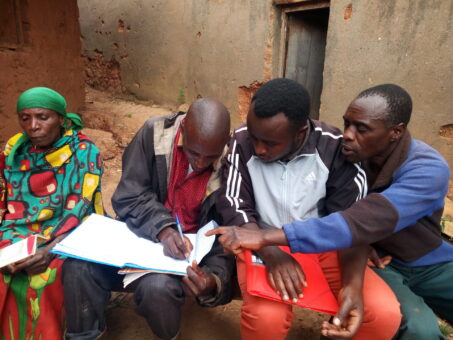
The story of Rose from Burundi who, thanks to a community microcredit project, has opened up her own restaurant. Rose lives in Burundi and has six children. A few years ago she opened her own restaurant where she prepares meals which she also delivers to customers beyond her village. Thanks to this activity she has been able to send her children to school and even pay a number of employees a salary. 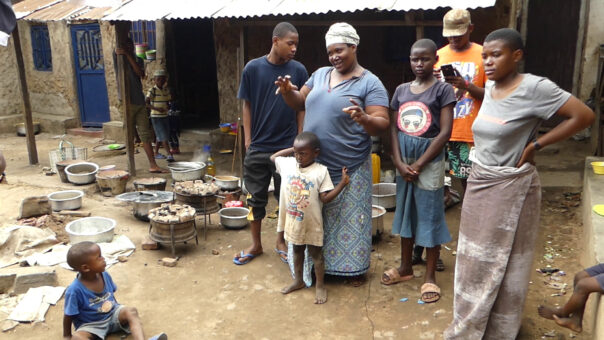 Thirteen years ago, however, the situation was very different. Rose did not understand the meaning of the word “savings” and struggled to manage her family’s finances. Everything changed when she got to know the “It can be done!” project, facilitated by AMU, Azione per un Mondo Unito, and Casobu, a Burundian NGO and local partner. “Through this project,” explains Rose, “we learned how to save money. I was put in touch with a group of people who, like me, needed money to improve their situation. When I received the first loan I immediately bought some clothes because I didn’t know how to make a proper investment. Then I said to myself: how can I take the money without having a concrete project? So I decided to buy pots, dishes and pans. And that’s how I opened my restaurant.” “It can be done!” is a project based on community microcredit, a methodology through which groups of people get together and self-finance by putting their savings into a common fund. In this way the group can grant small loans to individual members enabling them to meet certain expenses and supporting them in starting up or managing small income-generating activities. As Emanuela Castellano, who manages the project on behalf of AMU, explained: “Community microcredit projects are based on a participatory approach which aims to empower group members so that the project can go ahead and grow. Funds raised and our support are used to raise awareness within the communities, train and accompany group members but the money put in common is theirs. The project’s main feature is the call for reciprocity whereby each person can contribute to developing the community. So the “You can do it!” project also seeks to provide support for activities that are growing and in need of more substantial funding for expansion.” Since Rose heard about the project she has been able to realise her dream of opening a business that would enable her to support her children and put them through school. The number of clients has increased over time, and now she can even pay five employees to help her. They, too, have plans for the future. One of them would like to buy a goat, another a plot of land. Initially every dream seems difficult to realize, especially in a country like Burundi. It is the second most densely populated country in Africa and one of the top five countries in the world with the highest rate of poverty. Here, one in two families, around 4.6 million people, suffers from food insecurity and 56% of children under 5 are malnourished. In such a complex landscape, Rose’s restaurant is truly the realization of a dream, and can also become a sign of hope for her children and employees to realize their dreams. The “It can be done!” project does just that. It provides hope for others, like Rose, to realise their dreams and look forward to a better future.
Laura Salerno
https://www.youtube.com/watch?v=t0W6a2khA3Q
4 Apr 2022 | Non categorizzato
Peace is about people, each and every one of us. It is something we all have to build, always and in all circumstances. This is not an easy or obvious commitment, especially today. In a talk she gave in 1978, Chiara presented us with a tough challenge. “Love your enemies…” This is indeed a strong statement. In fact, it turns our way of thinking and acting upside down and makes us change the direction our life is going in. Let’s not hide the fact that we all have enemies, enemies of one kind or another, even small ones. … It might be our next-door neighbour, or the meddlesome, unpleasant lady I try to avoid whenever I meet her on the stairs. My enemy could be a relative who wronged my father thirty years ago, and so I never spoke to him again … It could be the boy sitting at the desk behind you at school and you never looked him in the eye again after he reported you to the teacher. Perhaps it is the girl you were dating who suddenly dropped you to go out with another guy … The enemy could be the salesperson who tricked you … And then there are the politicians who don’t share our views and so we consider them enemies. Today some people even consider the government itself as their enemy and willingly resort to violence towards those who represent it. In addition, there are, and have always been, people who see priests as their enemies and hate the Church. However, all these people, and many others whom we might call our enemies, should be loved. Loved!? Yes, loved! And don’t think you can manage that just by changing a hateful feeling to a kindlier attitude. There’s more to it than that! Listen to what Jesus says: “Love your enemies, do good to those who hate you, bless those who curse you, pray for those who abuse you.” Lk 6:27-28 Do you see? Jesus wants us to overcome evil with good. He wants love to be expressed in concrete gestures. We might wonder why Jesus gave a command of this kind. The fact is that he wants to shape our conduct according to that of God, his Father, who “makes his sun rise on the evil and on the good and sends rain on the righteous and on the unrighteous.” Mt 5:45. This is how things stand. We are not alone in this world. We have a Father and we need to be like him. What is more, God has a right to expect this kind of behaviour from us because he loved us first, while we were his “enemies.” While we were still immersed in wrongdoing, He sent us his Son, who died in that terrible way for each one of us. Perhaps we too need to sort out some difficult situation, especially since we will be judged according to how we judge others. In fact, we are the ones who will give God the measure with which he will have to measure us. Don’t we ask God to, “Forgive us our trespasses as we forgive those who trespass against us”? (Mt 6:12). So, let’s love our enemies! Only by acting in this way can unity be recomposed, barriers removed, and a community built up. Do you think this is too hard and burdensome? Does the mere thought of it stop us sleeping at night? Take courage! It’s not the end of the world. All that’s needed is a little effort on our part, then God does the other ninety-nine percent and… our hearts will be flooded with joy.
Chiara Lubich
(Chiara Lubich, in Parole di Vita, [Words of Life] Città Nuova, 2017, pp. 105-108) https://www.youtube.com/watch?v=vJbs06gE8dE
1 Apr 2022 | Non categorizzato
Educa is a project that has offered 25 young people in Guatemala training in computer programming and web design. Some of the scholarship holders come from indigenous ethnic groups and want to put the technical skills they have acquired at the service especially of the women in their communities. The aim is to enhance their culture and help women to excel, so that there are equal opportunities for all. https://www.youtube.com/watch?v=qAQb1XlAH1Y
28 Mar 2022 | Non categorizzato
How can we ensure that our daily efforts, our work and our relationships become a means of building a united world? One way is to see the people we meet every day with new eyes, being ready not to judge but rather to trust, hope and believe always. We need to acquire a merciful outlook. Mercy is a virtue that the times we live in ask of us with our neighbours both near and far. God’s great plan for humanity is universal fraternity. A fraternity that is stronger than the inevitable divisions, tensions and hard feelings that so easily creep into relationships due to misunderstandings and mistakes. Families often break up because they cannot forgive each other. Old hatreds maintain the division between relatives, social groups, and peoples. At times there are even those who teach people not to forget the wrongs they have suffered and who cultivate feelings of revenge… And a dull resentment poisons the soul and gnaws at the heart. Some people think that forgiveness is a weakness. Instead, it is the manifestation of the greatest courage. It is true love, the most genuine love, because it is the most selfless. “If you love those who love you, what merit have you?” – says Jesus – everyone knows how to do that: “Love your enemies”[1]. We are asked to learn from him and to have the love of a father, of a mother, a merciful love towards all those who come our way, especially towards those who do something wrong. Moreover, to those who are called to live a spirituality of communion and fellowship, that is, the Christian spirituality, the New Testament asks for something more: “Forgive one another”[2]. We could almost say that mutual love requires that we make a pact with one another to be ready to forgive one another always. This is the only way we can contribute towards universal fraternity. These words not only invite us to forgive, but they remind us that forgiving others is the condition for receiving forgiveness ourselves. God listens to us and forgives us according to how much we forgive others. … Actually, a heart hardened by hatred is not even capable of recognizing and accepting the merciful love of God. … Precautionary measures are needed. So, every morning, in relation to the people around me, whether at home or at school, at work or in a shop, I’m ready to overlook anything I don’t like about their way of doing things. I try not to judge them, but I want to trust them, always hoping, always believing. I approach every person with this complete amnesty in my heart, with universal forgiveness. I do not remember their faults at all, and I cover everything with love. Throughout the day, then, if I have been unkind or impatient, I try to make up for it by apologizing or showing some sign of friendship. Then, when I pray to the Father, especially when I ask him to forgive my mistakes, I am sure that my prayer will be granted. I’ll be able to say with complete trust: “Forgive us our debts, as we forgive our debtors.” [3]
Chiara Lubich
(Chiara Lubich, in Parole di Vita, [Words of Life] Città Nuova, 2017, p. 667) [1] Cf. Mt 5:42-47 [2] Col 3:13 [3] Mt 6:12.
