20 Sep 2021 | Non categorizzato
On 17th September 1948, Chiara Lubich met Igino Giordani, whom she later called Foco, for the first time, in Rome, Italy. She was a Franciscan tertiary and was accompanied by some religious from the various Franciscan families. Giordani was 54 years old and already successful in the political and cultural fields when he met 28-year-old Chiara Lubich and recognised her charism. Giordani immediately joined the Focolare and, because of his contribution to the development of the Movement, Chiara Lubich considered him a co-founder. Here is the story of that meeting from Giordani’s diary. “Seeing a Conventual, a Friar Minor, a Capuchin and a man and a woman from the Third Order of Saint Francis united and in agreement, seemed to me already a miracle of unity, and I said so. The young lady spoke; (…) and at the first words I felt something new. There was an unusual quality in that voice: the quality of a deep and sure conviction born of a life in touch with God. (…) When, after half an hour, she had finished speaking, I was caught up in an enchanted atmosphere, as if in a cloud of light and happiness; and I would have liked that voice to continue. It was the voice that, without realising it, I had been waiting for. It put holiness within reach of all; it removed the barriers that separate the lay world from the mystical life. It brought out the treasures of a castle to which only a few were admitted. It brought God closer: it made him feel like a Father, a brother, a friend, close to humanity.(…) Something happened within me. It happened that my juxtaposed pieces of culture began to move and become animated, joining together to form a living body, nourished by a generous blood: the blood with which Saint Catherine burned? Love had entered and taken hold of my ideas, drawing them into an orbit of joy. What had happened was that the idea of God had given way to the love of God, the ideal image to the living God. In Chiara I had found not someone who spoke of God, but someone who spoke with God: a daughter who, in love, conversed with the Father. (…) Everything was illuminated. Pain took on a salvific meaning, or was resolved into love. Life appeared as an adorable design of God’s will and every moment of it became full and had its own beauty. Nature and history unfolded in rich patterns of harmony and wisdom. And to live this new life, to be born in God, I did not have to renounce my doctrines: I only had to place them in the flame of charity, so that they might be enlivened. Through my neighbour, I began to live God. Grace flowed freely, the barriers between supernature and nature collapsed. Existence became a whole adventure, consciously lived in union with the Creator, who is life”.
Igino Giordani
(Igino Giordani, Memorie di un cristiano ingenuo, [Memoirs of a naïve Christian] Rome, 1984, pp. 147-154).
18 Sep 2021 | Senza categoria
People living in the Focolare Movement’s little town of Victoria in Man, Ivory Coast, have shown great tenacity during the pandemic. Covid 19 did not stop the activities of the Health Centre or the Nutritional Centre. The Movement’s extraordinary Communion of Goods has helped to support many people in need. Monica Padovani is an Italian focolarina, 53 years old, who has lived in Africa for twenty years. She has been working in the little town in Man for two years as a professional educator and activities coordinator at the Focolare’s Supplementary Nutrition Centre (CNSF). Before the pandemic she had shown great courage in rescuing and bringing new life to this project; when covid hit, her ingenuity and boldness enabled it to remain the “beating heart” of the area.. The creation of a workshop for the production of masks which could not be found on the market ensured indispensable services for the sick at the CNSF and the adjoining Medical Centre, and the financial aid received was essential for their continuation.. How has Victoria been affected by this emergency and how has it continued to be a chain of love during this time? There have been many challenges this year but we are really happy to be able to say that we have overcome many of them. The restrictive measures taken in the country at the beginning of the pandemic made it possible to contain the spread of the disease in the area surrounding the capital, Abidjian. In Man, where our little town is located, the consequences are mainly of an economic and social nature and have unfortunately affected an already fragile situation, making a particular impact on the poorest sectors of the population. Fortunately, the activities of the Health Centre and the Nutrition Centre have continued, albeit at a slower pace, and the aid received has supported various emergency activities, also allowing the employment of an additional nurse. With a strengthened team, cases of child malnutrition have been better addressed, a large number of mothers in need have been supported and concrete responses to the various challenges have been made. Helping seems to have been your way of “embracing” others. Is there any experience that is particularly close to your heart? Each case is unique but among the many, the one of the little girl born prematurely was particularly moving. After the birth, the baby weighed just one kg and the parents were referred to a paediatric department with the urgent need for a thermal cot. Due to various difficulties, it was not possible to meet this need and it was at the CNSF that they received first aid. The baby and her mother were helped to feed for the first time and they were assured of a calm and peaceful environment where they could stay warm and be carefully monitored. Thanks to these small gestures, the little girl is healthy; she has gained strength and weight and will soon celebrate her first birthday. Has the verb ‘to nourish’ taken on new meanings during the pandemic? The term “nourish”, in our daily experience at CNSF, certainly has a broader meaning. It is certainly about food, prevention and the fight against malnutrition. However, ‘feeding’ is also about giving what that person really needs at that moment, such as advice, encouragement, special attention. That’s what Covid emphasised: more attention to the other person. This is how we have understood that things that are often ‘simple’ in our eyes can be vital for others.
Maria Grazia Berretta
17 Sep 2021 | Non categorizzato
This is a call to us, too – to have an open mind and heart in order to recognize and care for the needs of others; to use our talents, our time, for the common good at home and beyond. It is an invitation to put ourselves last in order to be first, to encourage everyone toward the inevitable future: universal brotherhood. Listening for hours Loving a neighbour sometimes means simply listening… even for hours! It happened to me this morning, when around 9:30am a friend who spends most of the year abroad came to visit me. He told me about his father who had recently passed away, his caregiver, various family problems, and about how abroad, in order not to miss Sunday Mass, he travels two hours each way to reach the chapel where it is celebrated in Italian… It was after 12 noon when we said our goodbyes. Only then did I realize how much time I had spent listening to him. (Umberto, Italy) Kitchen competition Each time I came home from work, I would always see how tired my wife was. I asked God how I could help her, and one evening, during dinner, I came up with the idea of a weeklong competition in the kitchen. Each of us had to prepare a different dinner (together with my grandmother there are exactly seven of us). Even our third son, a teenager who was typically content with things as they are, got hooked on the competition. Once the week had passed, one of our daughters suggested we continue, even giving grades. Here it became even more fun. With great joy I noticed my wife relieved and happy to see her children in action. Once, talking about it among ourselves, she told me that she was discovering new and unexpected sides of our kids. (B., Slovakia) That look said it all I had retired earlier than I had planned to be near my wife, who had been feeling ill for some time. Unfortunately, she was suffering from a degenerative disease. Day after day I saw her abilities diminish, her speech, her movements… Where was the wonderful woman with whom I had dreamed of a happy life, a large and beautiful family, a commitment to be an open home for all? Now she was there, motionless. She moved her eyes, and that look said it all. My faith was not a living one, partly because, as a philosophy teacher, I know the tricks of the mind and how it deceives us. But since the conversation with my wife had become silent, I sensed that she was happy if I prayed beside her, for her, with her. Two months ago she passed away in silence. She left behind so much good, which both I and our children cannot quantify. She sowed a seed of light in us. When the illness initially appeared, she had said: “Life is now uphill. I would like to walk it with you. But God asks me to know how to say thank you with my life.” (P., Italy)
Edited by Maria Grazia Berretta. From ‘Il Vangelo del Giorno’, Città Nuova, year VII, n.4, September–October 2021
13 Sep 2021 | Non categorizzato
Not only freedom and equality. Twenty years after the collapse of the Twin Towers, Chiara Lubich’s comments on the attack that changed the fate of the world are more relevant than ever, reminding us of the only possible way to peace. On the day after September 11 [2001], many of us felt the need to reflect deeply on the causes, but above all to work towards a true, responsible and definitive alternative to terrorism and war. … Today, whether we are in New York or Bogota, in Rome or Nairobi, in London or Baghdad, many of us are asking if it is possible to live in a world of peoples that are free, equal and united; peoples that not only respect one another’s identity but are also mindful of each other’s particular needs. … In many places around the world today, a cry of forsakenness rises up from millions of refugees, millions of people who are hungry, millions of people who are exploited, millions of workless people who are excluded and seemingly “cut off” from the body politic. It is this separation, and not only the hardships and economic difficulties, which makes them even poorer and increases their desperation. … Considering the challenges of the present and future of humanity, liberty and equality by themselves are not enough. Our experience teaches us, and we believe that there is need for a third, long forgotten factor in political thought and practice: fraternity. Fraternity can generate projects and action in the complex political, economic, cultural and social fabric of our world. Fraternity brings peoples out of their isolation and opens the door to development for those who are still excluded. Fraternity shows the way to peacefully resolving differences and relegates war to history books. Fraternity in action allows us to dream and even hope for some kind of sharing of goods between rich countries and poor countries, since the scandalous economic inequality in today’s world is one of the main causes of terrorism. The deeply felt need for peace in humanity today shows that fraternity is not only a value, not only a method, but is a global paradigm for political development. This is why a world that is ever more interdependent needs politicians, businesspeople, intellectuals and artists who put fraternity – as a tool for unity – at the centre of their thought and action.
Chiara Lubich
(Chiara Lubich, Message for the first World Interdependence Day, Philadelphia, USA, 12 September 2003 in Discorsi in ambito civile ed ecclesiale, [Talks given in civil and ecclesial contexts] edited by Vera Araujo, Città Nuova, Roma, 2020, pp. 111-113)
11 Sep 2021 | Non categorizzato
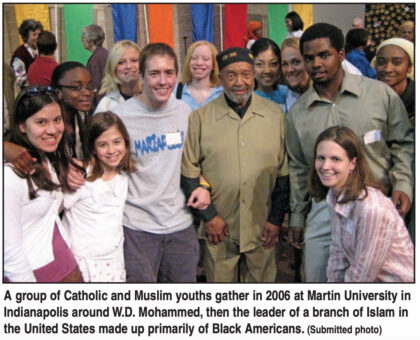
Solidarity shared on 9/11 by Catholics, Muslims in Indianapolis (USA) continues In the days following the terrorist attacks of Sept. 11, 2001, many American Muslims experienced an angry and sometimes violent backlash from their fellow Americans because the men who hijacked the airliners that day had been Muslim extremists. The Nur-Allah Islamic Center in Indianapolis had multiple bombing threats made against it in the days after 9/11. So, when the Muslims of the center gathered for prayer on the Friday after the attacks, they knew that they could become the victims of an attack themselves. But they weren’t alone. 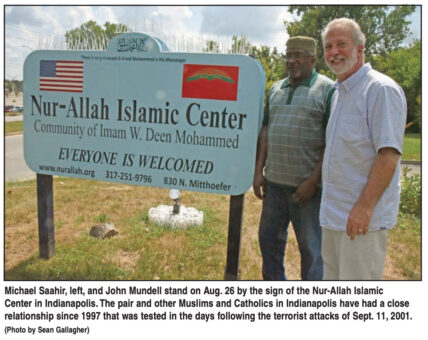 Joining them that day were some of their Catholic friends who were members of Focolare, an international lay ecclesial movement in the Church that, among other things, promotes greater unity in the broader human family. “It was a very emotionally moving experience,” said Nur-Allah member David Shaheed, who has also served as a Marion County judge since 1996. “They felt connected to us. They felt that we were friends and neighbors. They put their lives at risk to be with us at such a historically tumultuous and scary time.” John Mundell, a member of St. Pius X Parish on 9/11, was part of the Focolare group that came to Nur-Allah on Sept. 14, 2001. “That experience was probably one of the most sacred moments of my life,” he said. “When we walked in as a group and they saw us, you could tell by the look on their faces that they realized that what we had established was real. There was nothing fake or superficial about it.” The Focolare members knew that choosing to stand with their friends at Nur-Allah after bombing threats had been made against their center potentially put their lives in danger. But their mutual relationship was important enough to them that they accepted that risk. “Our Catholic faith called us to be there with them,” said Mundell, now a member of Our Lady of Lourdes Parish in Indianapolis. “This was where the rubber met the road. In your gut, you know what the right thing to do is, but you then have to say, ‘Yes, we’re doing it.’ ” Thankfully, no attacks happened on that day. But some members of Nur-Allah so appreciated the solidarity shown to them by their Catholic friends that they joined them for Mass two days later at St. Pius X Church. “It was reciprocal love,” said Mundell. “You reached out in love and then received this kind of wave [of love] back. It was a sacred feeling. Somehow there was the presence of God in this relationship we had established.” That relationship had started in 1997 and followed the example of Chiara Lubich, the Italian foundress of Focolare, who had reached out to W.D. Muhammed, the leader of a branch of Islam in the United States made up primarily of Black Americans. In the years that followed the start of the relationship in Indianapolis, the members of Focolare and Nur-Allah hosted meetings of Catholics and Muslims that drew people from across the Midwest. One had taken place in Indianapolis less than two months before 9/11. But the events of that day quickly deepened their relationship in ways that they could not have imagined. “There are times when God calls us to unity through pain,” said Michael Saahir, the resident imam of Nur-Allah. That, for him, is an enduring lesson of 9/11, one that he is concerned is being forgotten as the years pass. “Too often, when the pain subsides, we forget,” Saahir said. “We tend to forget too easily. Or we don’t even take time to study the lessons that come from it. And the oneness of the human family is the main one.” In recent years, members of Focolare in Indianapolis have become more aware of the pain experienced by their Black Muslim friends because of their race. “We’re not perfect as Americans, as Catholics in embracing this idea of universal brotherhood and sisterhood,” Mundell said. “We have a long way to go. There’s a racial aspect that we need to continue to work on and listen to.” Focolare and Nur-Allah members are making efforts so that the lessons of 9/11 and other lessons are remembered. In the months and years that have followed that day, people from both faith communities have been invited to parishes across and beyond the archdiocese and to universities to speak about their interreligious experience and relationship. When Mundell started receiving these invitations, he began to recognize a significance to the simple personal bonds that had been created with his Muslim friends in 1997. “It made us realize the uniqueness of that relationship and that it was no longer meant for just us,” he said. “It was meant to be shared with everyone.” “People need to see a model or example,” said Saahir. “I’m grateful that our relationship with Focolare is a model, not just for Muslims and Catholics, but for anyone to see that this is doable and has longevity.” Mundell and Saahir hope that the longevity of the relationship between their two communities will continue into the next generation. “It’s like passing on your faith,” Mundell said. “The next generation has to take it on as their own. They have to have their own experience. “This is something that we’ll be doing for the rest of our lives. The relationships have to be continually renewed and rebuilt”.
By Sean Gallagher for “The Criterion”, 3 September 2021
Serving the Church in Central and Southern Indiana Since 1960
