21 Jun 2021 | Non categorizzato
Before each daily action we can discover which face of Jesus Forsaken we can love through it. This is what Chiara Lubich suggests so as to carry out well and perfectly all that we have to do To love Jesus Forsaken. It is this name that touches upon so many aspects of our individual and collective life, that I would also like to expound on a bit today. To be more precise, I would like to tell you something about a particular way of loving Jesus Forsaken, who is the gateway and road to our holiness. (…) Wherever we look, we have the marvellous opportunity to love Him, to comfort Him, to find solutions to specific problems which are all expressions of Him. And this is a great grace. Through our work, we are always in contact with Him, with Jesus Forsaken, and by loving Him we can become saints. However, there are different ways to love Him. We can love Him greatly, or we can love Him a little. And this means that with our love for Him we can contribute towards our holiness in a great way or in a little way. Saints have searched for and are searching for that love which renders the most benefit for the glory of God. Are we writing our personal life story in order to share our experience? Let’s do it well, very well, listening with great love to the voice inside of us which sheds light on our past and present, a light which others would appreciate hearing about because it is attractive. Let’s pay close attention to what that voice suggests to us and to what corrections it makes. Let’s pour our greatest efforts into everything we do. Let’s continue to correct our work until that voice has no more to tell us. We must never mistreat the Work of God. We must never carry out imperfect works. Therefore, let’s do everything well, very well. (…) for every work that we carry out , let’s try to discover which countenance of Jesus Forsaken we can love in doing so, and then accomplish it perfectly. Therefore, perfect actions out of love for Jesus Forsaken. This is the way to build our holiness, our great holiness.
Chiara Lubich
(In a conference call, Loppiano February 20th,1986)
19 Jun 2021 | Focolare Worldwide
The testimony of the volunteers of the “Casa de los Niños” in Cochabamba (Bolivia), a project inspired by the spirituality of unity, committed to tirelessly caring for those infected by COVID-19 and bringing consolation to the dying. We returned to the streets of our city slightly reckless and very naive. This virus is frightening everyone and encouraging us to isolate ourselves from one another but we understand how important and necessary what is urgently required of us which is why we never back down especially as we are taking the necessary precautions. The tests we carry out every week continue to give us negative results. Perhaps someone is extending a merciful hand over our naivety. 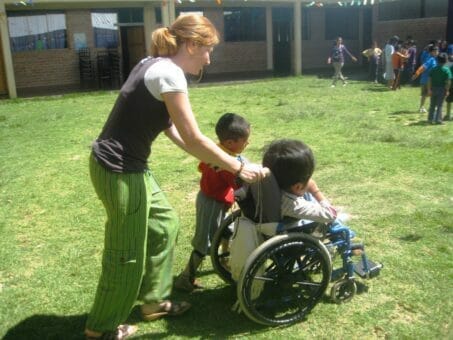 The cold season has now begun here and Covid-19 infections have increased dramatically reaching unprecedented figures. Public hospitals are collapsing under the strain. People are dying in cars, waiting for beds to become available… Even in the highly expensive private clinics admissions have been suspended. Oxygen is no longer available, and there are long queues for refills at the only two places able to provide this service, for a fee. A 6m3 cylinder lasts less than 5 hours! Specialist medicines are only available on the black market with each vial costing around 1,300 euros! This year those affected by the virus are much younger. We take oxygen and medicine to whoever needs it. We have permits to travel all day and every day. Our very spacious minibus has been turned into an ambulance and often, unfortunately, into a hearse at zero cost. Time is of the essence for those in need and struggling to breathe, so we too are rushing around and have no time to think about ourselves.
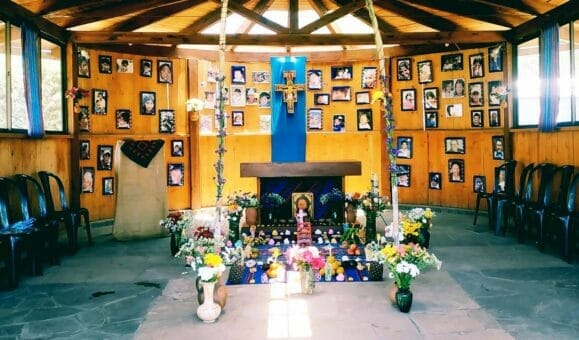
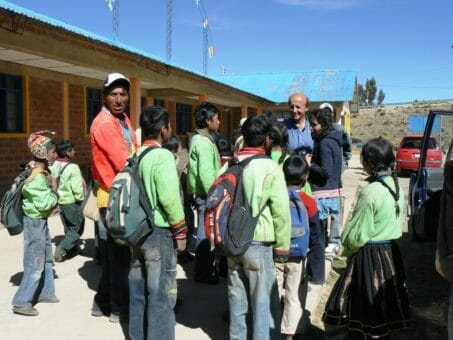 We are bringing oxygen and medicine but, to be honest, we are mainly engaged in sowing seeds of hope. We get to know those we visit for the first time but a kind of mutual complicity is immediately established that opens up possibilities for hope. Little by little, fear begins to melt away and we see people smile serenely. We also take rosary beads with us. It is not a magic charm. No. They are the prayer beads of those of us who wish to entrust the enormous afflictions and sufferings of these days, of so many of our brothers and sisters, to the heart of our Mother in Heaven. It is part of the oxygen treatment, giving air to the hearts of those who suffer! Every evening we meet for community prayers in our little town, outside on the lawn in front of the beautiful chapel which holds the stories of so many of our children who have already flown to heaven. We pray before the statue of the “Virgen de Urcupiña”, patron saint of Cochabamba, who carries Her Son in her arms. Ours is a prayer that goes straight to heaven wanting to fix the names of the many people we have visited during the day. We ask for the light from heaven that each one of them needs to illuminate the night of their pain.
The volunteers of the “Casa de los Niños” – Cochabamba (Bolivia)
17 Jun 2021 | Non categorizzato
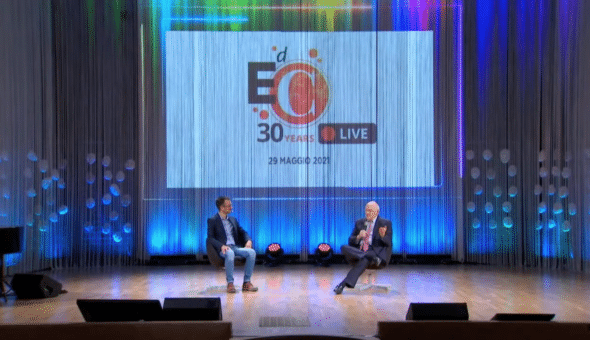
Stefano Zamagni, economist and President of the Pontifical Athenaeum for Social Sciences, recently spoke in Loppiano, Italy at the event marking the 30th anniversary of the Economy of Communion. We present an excerpt from his address in which he underlined the contribution of the Economy of Communion to the evolution of economic thought. ‘(…) I must confess that when, exactly 30 years ago, I listened to Chiara Lubich’s speech in Brazil when she launched the Economy of Communion project, I was very impressed but also shocked. Economy as a science uses many words such as wealth, income, efficiency, productivity and equity, but it does not use the word communion. I asked myself: “How could someone like Chiara whose cultural background did not include an economic element have launched an intellectual challenge of that kind?” There had to be a special charism at work and we know today that there was. This positively disturbed me. I began to reflect and asked myself: “Why, in the long history of economic thought, has this concept never been addressed?” A few years later I came across the work of Antonio Genovesi, the founder of civil economy, and I understood a whole series of connections between the Economy of Communion and civil economy. Obviously, at the beginning, there were many difficulties for the Economy of Communion. I remember that in 1994 in Ostuni in Puglia, Italy, the MEIC (Eccelsial Movement of Cultural Commitment) organised a series of cultural seminars during the summer. In a presentation chaired by a famous Italian economist, two newly graduated focolarine had the audacity to present the Economy of Communion project. This professor began to say: “This is nonsense, because it does not satisfy the criterion of rationality.” I was present and asked him: “But do you think that the gesture of the Good Samaritan satisfies the criterion of rationality? You see,” I continued, “you are a slave to a paradigm, to a way of thinking that you have sucked out of your studies without addressing the problem, because the rationality you think of is instrumental rationality, but there is also expressive rationality. Who said that instrumental rationality is superior to expressive rationality? Don’t you know that the Economy of Communion is part of the model of expressive rationality? In this case, expressive means that a charism is expressed – because charisms must be expressed and translated into historical reality.” The Economy of Communion has made it possible to recover that tradition of thought regarding civil economy that began in Naples in 1753. For example, think of the economy and the school of civil economy over which Luigino Bruni presides. In addition, the recent big “Economy of Francis” event which was really a mixture of civil economy – a paradigm, which is view of reality that is embodied in models, projects and different theories – and the economy of communion. This event took place recently, but I am sure its impact will soon become apparent. To close, I would like to use a word that has, unfortunately disappeared from use for at least a century: this word is “conation”. It was coined by Aristotle 2400 years ago. It derives from the combination of knowledge and action and means that knowledge must be put at the service of action, and action cannot be exercised and bear fruit unless it is based on knowledge. I say this because the challenge of the next 30 years, and even more, for the Economy of Communion is to strengthen the knowledge component. Up to now, priority has rightly been given to action, to achievements. But we must be aware that if action is not continually nourished by knowledge, it risks disintegrating. Chiara Lubich had a capacity for intuition and understanding, and therefore for foresight, even on subjects in which she was not a specialist. Indeed, the contribution of the Economy of Communion to the evolution of economic thought as a science has been remarkable. Luigino Bruni directs a research doctorate programme in the economy of communion and civil economy at the Lumsa (Libera Università Maria Assunta) in Rome, Italy; here in Loppiano there is the Sophia University Institute and in other universities too it is no longer forbidden to speak of Economy of Communion. I think this is a great, great outcome. (…)’ To review the live broadcast from Loppiano for the 30th anniversary of the Economy of Communion, click here
Lorenzo Russo
14 Jun 2021 | Non categorizzato
Living charity, which is the source of every virtue, brings out the figure of Christ in us, because by loving we are another Him. In spite of our love for our brothers and sisters, we still carry with us certain faults that take away something of the beauty of Christ in us. … You know how in acquiring [virtues] and in combatting their opposing vices, we, who are called by God to find our “fortune” in our neighbour, discover that it is truly by loving Him that we deny ourselves. And you know that, to improve ourselves, we do not usually aim directly at removing one fault after another. Instead, we go around the obstacles, or “change room,” as we say, by “living the others”. In this way, we place ourselves on the path of charity which is the source of every virtue. … Besides, Jesus Forsaken, to whom we have given our lives, is for us the model of all virtues. We have always said that we want to love Him not only in suffering but also in living the virtues. Charity, in fact, brings out the figure of Christ in us because when we love we are another Christ. But by loving Jesus Forsaken in living the virtues, we have the impression of chiselling that figure of Christ in us, of refining it. We notice, in fact, that despite our love for our brothers and sisters, for years we’ve still been carrying around little or larger faults, that are sometimes trivial, but which take something away from the beauty of Christ in us. … What are these faults? Everyone has their own. At times we spoil what we are doing by rushing, or we don’t do the will of God perfectly. We are distracted in prayer; we dwell on foolish things that the world enjoys; we don’t know how to moderate our appetite. We are often overcome by curiosity, or we fall into vainglory. We speak out of turn or unnecessarily. We are attached to little things, a bit dependent on television. We let our brothers and sisters serve us; we are inconsistent, and so on. What should we do? When it is a question of things that are not good, Jesus invites us to act decisively when he affirms, “ If your right eye causes you to sin, tear it out” (cf. Mt 5:29). We too, therefore, out of love for Jesus Forsaken, while continuing on the path of love, must not waver and must remain who we are, but root out our vices one by one. … I am convinced that this is even more possible on our spiritual path. Love, in fact, helps us. Love is self-denial and burns away these things too. Nonetheless, it isn’t a bad idea to focus on some of our faults and get into the habit of practising their opposite virtues. … Let’s take courage then and get to work!
Chiara Lubich
(From a telephone conference call, Rocca di Papa 21st June 1984)
11 Jun 2021 | Non categorizzato
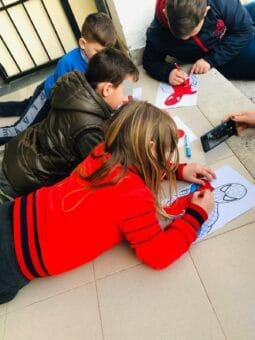
Almost two years after a powerful earthquake, the Focolare community thanks all those who donated money to support their country in a moment of enormous difficulty. And the communion of goods continues: surplus funds have been sent to others who have had to face their own emergency. At 3.54 a.m. on 26 November 2019, a powerful earthquake struck the central northern part of the Republic of Albania. Fifty-two people lost their lives and over 2,000 were injured; numerous buildings collapsed creating substantial damage. More than 4,000 people had to leave their homes. The Focolare Movement’s Emergency Coordination Team responded immediately to meet the country’s needs. During the preliminary operations, six families were identified as being most in need. Their homes had suffered substantial damage and were therefore included in the reconstruction project. Because of the pandemic, the work had to slow down considerably but all the families were able to get through the winter season in suitable housing. So far five houses have been rebuilt. The only family whose house still needs to be repaired is waiting for the necessary permits from the local council. 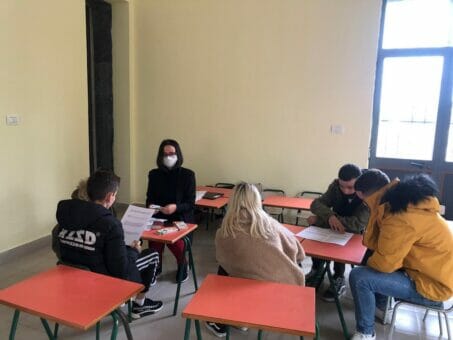 Upon receiving news of the earthquake, many members of the Focolare worldwide took action to respond to the needs of the Albanian community. A large communion of goods was organised through AMU (Action for a United World) and AFN (Action for New Families) with donations being received from many countries including Italy, Germany, Switzerland, Austria and Australia. Francesco Tortorella of AMU stressed how “the effects multiply when we move together, not as individual organisations or individual expressions of the Focolare Movement but as a single reality.” A total of €53,000 was collected, €14,000 of which has been or will be used for reconstruction projects in Albania including work on the last house which will begin once the permits have been obtained. The remaining funds were donated to the indigenous peoples of Honduras whose farmland and stilt houses were destroyed by two typhoons in 2020. “The experience of reciprocity has involved everyone on the project,” explains Francesco Tortorella, “everyone agreed that the money left over should be donated for this new emergency”. Another part of the funds was used to set up a course on emotional wellbeing for young people. After the earthquake and the pandemic, there was a great need, especially among young people, for support in managing stress and anxiety. Twenty-five young people between the ages of 14 and 24 are currently taking part on the course. Elsa Cara, a member of the Focolare and an accountant in Tirana, the capital of Albania, said: “I lost seven cousins in the earthquake. It was really hard but I wanted to do something. Thanks to donations received from the Focolare, I was able to go to Thumane, one of the places most affected by the quakes. Being an area that is predominantly Muslim, the Catholic community is very small. I decided to go there every week, to be close to the children, and offered them a catechism course. Initially everyone was suffering from shock. Now they are a united group which is happy to be on this journey. Many of them have now been baptised. All this was the result of a collaboration between the Focolare, the local Church and Caritas.” Alfred Matoshi, a lawyer in Tirana and someone who has been heavily involved in the reconstruction project, thanked all those who donated, on behalf of the whole Focolare community in Albania: “Thank you. Because of them we have been able to help families in difficulty, children on the streets without a home, people who were crying from fright. Thank you, don’t stop giving, wherever there is a need.”
Laura Salerno
