18 Mar 2021 | Non categorizzato
Considering “fratelli tutti” – as Pope Francis says – helps us broaden our horizons. “Give and it will be given to you” Father David from Kenya wrote, “I was helping a poor refugee boy I had got to know during the mission in Kakuma refugee camp in northwest Kenya by paying for his schooling but after a while I ran out of money and was no longer able to support him. I explained this difficulty to him and we said goodbye to one another. After some time, this boy sent me a message via social media asking me for help again. It was a great suffering for me not to be able to help him so I decided to sell a cow I had at my parents’ house to pay for his schooling. He was so happy to be able to go back to school again. In the new parish where I have been living for almost a year, the parishioners decided to visit me one day because they had heard that my father was not well. Among the gifts they brought were three cows. I could not believe it. It really seemed as if God wanted to say to me “a good measure, pressed down, full and overflowing will be poured into your lap”. Father David, Kenya “For my brothers and sisters in Lebanon” After the disaster of 4 August 2020 in Beirut, Lebanon, I asked myself what I could do to help this country which had already suffered so much. A few days later it would be my birthday: 40 years old. My family and friends wanted to celebrate with me, even if it was just a meal. This could be the perfect opportunity to help the people of Lebanon, I thought. So I asked all those coming to the dinner not to give me any presents but to make a donation to my project to help Beirut. At the end of the evening, I was amazed by the amount of money raised: a good 600 euros! I never imagined it would be so much, especially since there were very few guests at the dinner because of Covid restrictions. This gesture then caused a chain reaction among my friends. Emilia gave the proceeds from her graduation to another project, Francesco decided to sponsor a child in a developing country for his birthday, and then the children in the neighbourhood, when they heard about our birthday initiative, gave the proceeds of the sale of products made with recycled materials they had organised, again for Lebanon! Freely you have received, freely give… This is what we strongly believe in, always, when we receive and when we give. L., Ischia (Italy) “From a sandwich to a hundredfold for the poor”. One day I was in a sandwich shop, waiting to buy a sandwich, and I had just enough money for one. As I was coming out of the shop, I saw a lady looking at everyone who was eating. I realised she was hungry and was waiting for someone to offer her something to eat. I took out my sandwich and gave it to her. I can always eat something later, I said to myself. She was overjoyed. Then I took her to the fruit shop and asked the greengrocer if he could give her some fruit which I would pay for the next day since I had no money at that moment. The greengrocer gladly gave the lady not just one piece of fruit, but a whole bag of fruit, free of charge. I was so happy to see how a small sandwich could become a chain of the hundredfold. Mumbai (India)
Lorenzo Russo
17 Mar 2021 | Non categorizzato
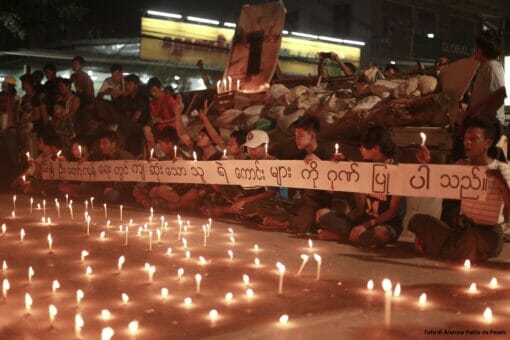
Joint Statement of SIGNIS, Pax Christi International and the Focolare Movement in Solidarity with the People of Myanmar Signis, the World Catholic Association for Communication, hears the cry of the courageous Burmese people as they nonviolently resist the Myanmar military coup overturning a legitimate and democratic election. We are joined by Pax Christi International and its members in the Asia-Pacific region who in their statement of February on the “State of Emergency” in Myanmar already expressed grave concerns about the situation in the country. Likewise, the international Focolare movement unites with us in solidarity with the Burmese people. Daily, courageous people return to the streets to protest peacefully even as soldiers beat them and shoot them, of which many young people. As a symbol of their protest, conforming to Burmese custom, a sign of the righteous anger of the people towards the military can be heard in the clatter of pots and pans banged together to protect against evil spirits, We witness the arbitrary detention on fabricated charges of members of the democratically elected government, as well as of civilian and religious leaders who have taken part in the long struggle for democracy. As truthful information is important in a democracy, we reject the disinformation campaign by Myanmar’s military justifying their actions. We call for the protection of journalists who are arrested and harassed for sharing news and information on what is happening on the ground with the rest of the world; instead they should enjoy press freedom. We deplore the extreme authoritarianism that saw fit to trample on the nation’s constitution, which in fact permitted limited democracy while maintaining much of the armed forces’ power. Despite the challenges, Myanmar was taking its first steps towards democracy, giving people hope for a new future. This hope should be restored. Above all, we listen to the message of the people of Myanmar: this coup is essentially about overthrowing them, their will. It is ultimately not about removing political opponents or supposed public order. It undoes years of patient work for the fundamental rights of citizens and crushes tenuous dreams of a free, democratic country. As Catholic organizations, we join Pope Francis and civil and religious leaders across the globe who have condemned the coup and call for “meaningful dialogue” to restore democracy. Also, we join other organizations in calling for:
- the release of Aung San Suu Kyi and other detained officials and leaders;
- the military to stop using violence and arbitrarily detention of peaceful protestors and journalists;
- justice and accountability for the atrocities committed by the army against the Rohingya people and other ethnic minorities, as well as prevention of such crimes and abuses in the future;
- members of the international community, especially in the Asia-Pacific region, to pressure the regime to step down and reestablish democracy, and not to exploit the situation for their own geopolitical interests.
We call upon the members of SIGNIS, Pax Christi International, and Focolare around the world to give voice to the cry of the Burmese people by reaching out to local and national media to report the situation, and by urging their governments to take strong diplomatic actions to oppose the coup and return democracy to Myanmar. Our mission as organizations is to promote peace. We therefore stand with the Archbishop of Yangoon, Cardinal Charles Maung Bo, President of the Asian Bishops Conferences, when he says, “Peace is possible. Peace is the only way. Democracy is the only light to that path.” Download the statement.
15 Mar 2021 | Non categorizzato
The choice to love Jesus in his abandonment on the cross and to prefer him to every other love had become like a compass for Chiara Lubich that gave direction to her life and freed her from many worries. […] We had noticed that the calling to follow Jesus Forsaken in a radical way did not happen only once, that is, only at the beginning of the Movement. In fact, from time to time, during these past years, the Lord has underlined that calling with episodes or special considerations. This happened to me in 1954. […] For the first time, a focolarino was becoming a priest, and I was going to Trent because the Archbishop there was ordaining Father Foresi. I wasn’t too well and it seemed to be wise to travel part of the way by plane. As soon as I stepped on board, a very kind flight attendant, wanting to make the trip easier for me, invited me into the cockpit. From there I was deeply struck by the beautiful panorama that could be observed, completely open in front of me because of the large windows. It was not the panorama, however, which struck me the most, but rather the brief explanation that the pilot gave me as to what is important in flying an airplane. He told me that if you want to have a good trip, you need, first of all, to set the needle of your compass in the direction of the point of arrival. Then all along the way, you must keep an eye on it to make sure that the plane does not go off course. As I was listening to this explanation, I made a comparison between an airplane trip in this world and the journey of our lives, which today I would call the Holy Journey. I had the impression of understanding that also in this instance it was necessary to decide our course at the moment of departure, that is, the pathway of our soul which is Jesus Forsaken. Then all along the journey, we need to do only one thing: to remain faithful to Him. Yes, the way to which God calls us all is this: to love Jesus Forsaken always. This means embracing all the sufferings of our lives; this means to live love by adhering always to His Will, doing away with ours. […] To love Jesus Forsaken always means to live all the virtues, which he lived very clearly in that moment in a heroic way. […] I think I can say that if we have set the needle of the compass of our souls – to use the same image – in the direction of Jesus Forsaken, we have done the best that we could do to continue and finish our Holy Journey and to do so with a certain ease. On that trip, I noticed that the pilot was very free in his movements because he had no reins, as you would need with a horse, nor steering wheel as you would need in a car. If we set the needle of our spiritual compass in the direction of Jesus Forsaken, we too will not need anything else in order to reach the goal safely. On an airplane trip, curves do not take you by surprise because the flight is in a straight line, neither do you encounter mountains because you have already reached a good altitude. In the same way, we too, on our journey, place ourselves at a certain altitude through love of Jesus Forsaken; thus, we are not frightened by unforeseen events, nor do we feel the effort of climbing. This is true because for Jesus Forsaken, surprises, efforts, and sufferings have already been foreseen and awaited. Let us set the needle of our compass in the direction of Jesus Forsaken and then let us remain faithful to Him. How? In the morning as soon as we wake up, let us direct the needle of the compass in the direction of Jesus Forsaken with our “Eccomi!” (“Here I am!”) During the day from time to time, let us glance at it; let us see if we are always on course with Jesus Forsaken. If we find that we are not, then with another “Eccomi!” (“Here I am!”) let us go back on the right course, and we will be able to continue the journey. […] If we proceed on the journey of life in the company of Jesus Forsaken, we too will be able to repeat that famous sentence of St. Clare, “Go safely, my soul, because you have a good companion for your journey. Go, because the one who has created you has always watched over you and has sanctified you. […]
Chiara Lubich
(From a telephone conference call, 5 January 1984)
14 Mar 2021 | Non categorizzato
Today, 14 March, marks the thirteenth anniversary of the death of Chiara Lubich, the founder of the Focolare Movement. Since that same date, 14 March 2008, the Focolare communities scattered across all the continents have been meeting to remember her and to pray together, remembering the legacy she entrusted to the Movement: ‘Be a family’. «If I should have to leave this world today and you were to ask me for a single word, one last word that sums up our Ideal, I would say – certain of being perfectly understood – ‘Be a family’». https://youtu.be/QKwgvxsUU2E
13 Mar 2021 | Non categorizzato
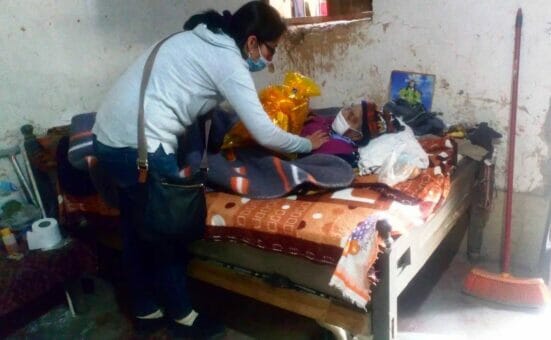
From the commitment of a small Focolare community to the most vulnerable, a Centre for the elderly has been opened in a village in the Peruvian jungle, named after the Movement’s founder. 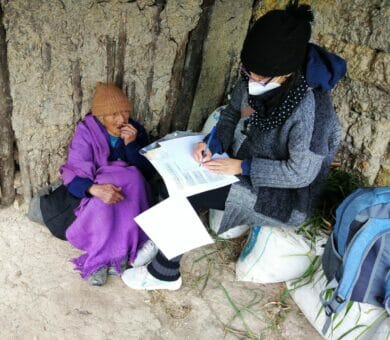 Four years ago I, Jenny, my husband, Javier, and our three daughters travelled here from Argentina to live in deepest Peru, bringing the Ideal of Unity with us. Shortly after we arrived in Lámud, a town in the middle of Amazonia, hearing that the Bishop of the Diocese was passing through, we ran to greet him and introduced ourselves as members of the Focolare Movement. “How wonderful that the focolare has arrived in Amazonia!”, he said and gave us his blessing, with his wish that we go ahead. Then we made an agreement with the parish priest who asked us to be responsible for Pastoral Care and Family Catechesis in the villages forming part of the parish. We went to the outskirts of town to understand the social reality in the area, sometimes accompanied by our daughters and discovered a hidden Lámud, one that was full of suffering. We decided to start with the least and realised that they were the elderly. Some of them did not even have a decent bed to die in. Keeping Chiara Lubich’s meditation entitled “One city is not enough” in mind, we went around the suburbs of the country looking for those who were alone, abandoned, to caress them, bring them a word of hope, food, clothes, and we asked them to pray for us as we were just beginning our adventure in these areas which were completely new to us. After a while, we began to dream of being able to give the elderly a decent home, a hot meal and, most importantly, that they would feel accompanied and no longer alone. A dream which, on the one hand seemed far away, but on the other seemed almost within reach so much so that we said to ourselves: “Yes, we can! We must do something more concrete than a simple visit.
 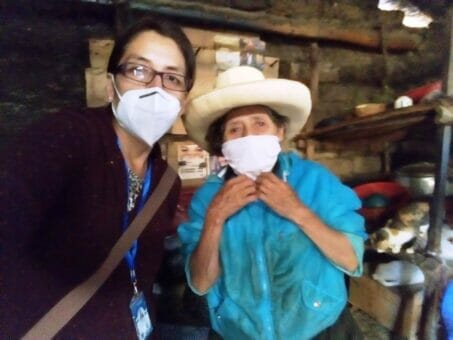 Together we drew up a plan: just a few lines but each sentence encouraged us to go ahead. We also thought about what we would call the house. We looked into each other’s eyes and decided to call it: “Hogar y Centro de Día para Adultos Mayores, Chiara Lubich” (“The Chiara Lubich Home and Day Centre for Elderly People”). Gradually, our dream started to take shape. We organised a number of events and made contact with a few people who were really enthusiastic about the project. I, Jenny, already had some experience of volunteering for different projects in Argentina and an opportunity arose for her to be employed by the Lámud District Municipality to work for the elderly! Lastly, we felt encouraged by the words of the Pope who invited us lay people to work in favour of the most vulnerable, especially during this time of pandemic. In short, there were so many beautiful coincidences that made us think that Jesus would be happy to see the birth of a Work for the least in the Peruvian wilderness, namely a dignified home for the elderly of the third age in this Amazonian province. In the meantime, we saw how everything was going ahead at a dizzying pace. So, trusting fully in God’s Providence and the power of prayer, we became increasingly aware that Jesus would not leave us on our own, and we were certain that, with our small community, we would never be alone. During that time, we signed the lease for the house and went through the legal process of setting ourselves up as a non-profit association. A group of people from the community had already joined the project on a voluntary basis. They had responded with a very strong “Yes” to committing to work for the benefit of the most vulnerable people in the village of Lámud and the Province of Luya (Dipartimento Amazonas). We started preparing the place straight away so that we could start offering the elderly one hot meal a day, provided by the municipality. And now, little by little, we are assessing each step to be taken to reach our goal of offering the elderly, who are at risk of loneliness and abandonment, food but also the possibility of permanent residence in the Centre. But more than titles, names and statutes, our desire is that the atmosphere of unity, harmony and family that Chiara Lubich left us as her legacy should reign in the house which is why the Centre bears her name. Jenny and Javier, with the community of Lámud (Dipartimento Amazonas, Peru)
Experience received and translated by Gustavo E. Clariá
