21 Sep 2020 | Non categorizzato
Not having preferences and not expecting anything in return: this is Chiara Lubich’s straightforward but revolutionary formula for a love that can change the world – today too. “So if anyone is in Christ, there is a new creation: everything old has passed away; see, everything has become new!” (2 Cor 5:17). [These words] speak … of the ‘new self’ that, through baptism and by adhering to the fruits of baptism, has been established in us and has a new way of seeing things, of behaving and of loving. … What is this love like? … Since it is a participation in the very love that is in God, which is God himself, it differs from human love in infinite ways. But there are two aspects, above all, in which it is different. Human love makes distinctions, it has preferences, it loves some brothers and sisters, for example blood relatives, people who are educated, rich, good looking, distinguished, healthy or young; it loves those who belong to a particular ethnicity or class, but it does not love others in the same way. Divine love, instead, loves everybody. It is universal. The second difference is the fact that, in human love, we love because we are loved. And even when love is beautiful, we love something of ourselves in the other person. There is always something selfish in human love, or that waits to love only when self-interest prompts us. So if we want to let our ‘new self’ live in us; if we want to let the flame of supernatural love burn in us, we too must love everybody and be the first to love. Basically, we must be like Jesus, other Jesuses. Jesus died on the cross for everybody: his love was universal. And with that death he was the first to love.
Chiara Lubich
Taken from a telephone conference call, Rocca di Papa, 8th January 1987
19 Sep 2020 | Non categorizzato
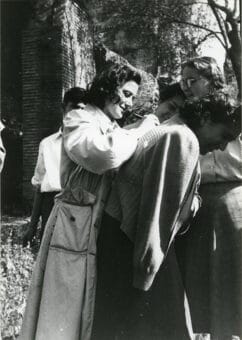
Trento, Chiara Lubich’s birthplace, will soon host a conference dedicated to the value of the Focolare founder’s texts, both spoken and written, from a linguistic and literary point of view. The event, which takes place in the Centenary of Lubich’s birth, is coordinated by an international study and research group and can be followed via web.
© CSC Audiovisivi
edited by Anna Lisa Innocenti
17 Sep 2020 | Non categorizzato
Jesus reveals that something new in the Gospel: the Father loves each of his children personally with an “overflowing” love and gives him/her the ability to enlarge their heart to their brothers and sisters. These are urgent and demanding words: to give what is ours; material goods, but also a welcome, mercy, forgiveness, and to give extensively in imitation of God. Powdered milk In a satellite city near Brasilia, there is a very poor neighbourhood where for years we have been bringing not only material aid, human promotion, but also trying to spread the good news of Jesus. It is always amazing to see how these people discover God’s love and begin to help each other, sharing what little they have with those who have even less. They even offer their own hut. Faithful to the “give and it will be given to you”, a lady to whom we had delivered powdered milk for her children told us that she shared it with her neighbour who had nothing to give her children. That same day, to her surprise and joy, she received more powdered milk. (H.I. – Brazil) The wound On certain festivals I give my four children some money to buy gifts for poor children. This year my youngest son asked me for more money: he had heard that his father was unemployed and could not give presents to his children with another woman. For me it was like a cold shower. My husband had abandoned us years earlier and the wound had remained. That night I cried a lot, I felt betrayed even by my boys. But maybe it was me who was wrong and the little one was teaching me a lesson. The next morning I increased his pocket money. Sometime later my children asked me to help their father find a job. It was the ultimate blow . They had never received a gift from him and now they were asking me to do this! Despite the painful memories, I understood that I had to put into practice Jesus’ command to love one’s enemies. It cost me but I did it. The joy I saw in the boys was indescribable. I thanked God for their generosity but also because they had given me the opportunity to remove from my heart a resentment that had tortured me for years. (C.C. – Colombia) Dismissal Some months ago, when the major computer company I work for announced the laying off of 40% of its employees, I got a real shock. Thanks to that job, we didn’t lack anything in the family, not even the extras. How were we going to meet the house payments? What about health insurance? And so on… With Jennifer and our daughters we felt more responsible about our family economy. We were ready to sell the most valuable objects and make other possible sacrifices, we assumed we would become self-employed, considering our personal skills… Above all, we entrusted ourselves to God the Father, continuing to hope. On the day of the layoffs, 6500 of my colleagues lost their jobs. I would have liked to disappear so as not to watch; but then I stayed to share that moment with those who left. I do not know how it will end for me, but one thing is certain: this trial has united us more in the family. It has created a deep bond with other couples and has opened our eyes to the problems of others. We now experience what it is that really matters in life. (Roger – USA) I forgave my son’s killer After my son was killed during a robbery, nothing made sense in my life anymore. Desperate for help, I attended a Gospel meeting. There I listened to a commentary on Jesus’ phrase: “Love your enemies”. Those words were like a rock for me. How could I forgive those who had killed my son? But in the meantime, a seed had been sown within me. As I attended that group, I felt the urge to forgive became more and more urgent. I wanted to find peace of heart. The Gospel still spoke of peace: “Blessed are the peacemakers, for they shall be called children of God”. In the midst of my family’s tragedy, the decision to forgive finally prevailed. Now I can truly call myself a “daughter of God”. Recently I was invited to meet with my son’s killer, who had been arrested. I knew him. It was hard, but grace intervened. I did not feel hatred or resentment towards him. In my heart as a mother there was only great pity and the desire to entrust him to God’s mercy. (M.A. – Venezuela)
edited by Stefania Tanesini
(taken from Il Vangelo del Giorno, Citta Nuova, year VI, n.5, September-October 2020)
16 Sep 2020 | Non categorizzato
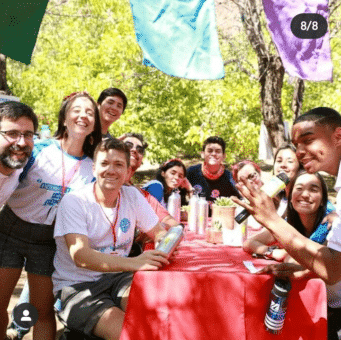
The story of Javier, a young man from Chile, starts with getting interested in the environment, an unexpected proposal and the beginning of an ecological commitment that today has reached vast proportions. I have always loved nature and had a special relationship with it. In 2017, I became aware of the serious damage that humanity is causing to the planet. “But what can a simple teenager do to change the reality of the planet?” I used to say to myself. One day, however, my aunt invited me to participate in a sustainable development forum at the headquarters of Cepal (the Economic Commission for Latin America and the Caribbean). I was surprised, but she encouraged me, saying how teenagers should take on important decisions and make their voices heard for our future. I decided to participate and got other classmates who were interested in social and environmental issues involved, with the help of the school. During the forum we were able to learn about Social Development Goals (SDS) and the actions that are being carried out in order to achieve them in some Latin American and Caribbean countries. We were also able to express our thoughts in front of the authorities present. Among the initiatives, we were impressed by “Concausa”, which is part of the America Solidale NGO. It works specifically to put an end to child poverty and trains adolescents to be true change agents. Together with two partners, we decided to propose a project at our school linked to Concausa, but we were not successful. After some time, given our interest in these issues, Concausa decided to set up a workshop in our school called “Actuators” to help us better develop our project. In classes we saw a lot of rubbish thrown on the floor, so we set out to encourage better waste management and recycling to create a pro-environmental culture. The “Eco-Education” project began. The waste was mainly tetrapacks, so we re-used them to create “eco-containers” where we could sort the waste and reuse it to make eco-blocks. Thanks to our work, many of our classmates have learned how to recycle. They have now even convinced their parents to do this in their homes. In the meantime, together with boys from the Focolare unit that I am a part of, we introduced workshops and in-depth analysis of environmental issues during our regular meetings. After a year of work with our “eco-education” project, we were chosen to represent Chile in a Concausa Continental Camp that takes place each year in our country. Project teams from all over the continent participate. I went along as well, and it was an unforgettable experience. I met people from many countries, each with their different culture. Getting to know each other made us feel the same. We were and are a family, a generation fighting for a more united and supportive future. On the last day we were invited to give a speech to officials from America Solidale, Unicef and Cepal about the different realities we have in our countries, and how we are doing our part to defend the environment. Now we continue to work together with camp participants through video calls. This is how we conceived the “1000 Actions for Change” project, which aims to spur ecological actions and mitigate the climate crisis. To achieve this, I was chosen to represent my country. Here is Javier’s testimony during the launch of the Pathway 2020–2021 “Dare to Care” campaign.
Edited by Anna Lisa Innocenti
14 Sep 2020 | Non categorizzato
Christian love is not only an inner attitude, but is shown by concrete facts, by acts that can be seen, starting simply with a smile. This is the invitation Chiara Lubich launches in the following writing. And even if during the pandemic our smile may be hidden behind a mask, there are a thousand other ways to show our love “Love one another”.[1] This is the vocation of every Christian, but we could also say it is our vocation in particular. In the last few days I was struck by what was said of the first Christians: “See how they love one another and are ready to die for one another.”[2] Therefore people could see that each of them was ready to die for the others. This might have been because in times of persecution it was not unusual for one of them to offer to die instead of another. Nonetheless, the fact remains that this measure of love among Christians could be seen. Generally speaking, we are not actually asked to die, even though we should always be ready to do so. Every act of mutual love should be based on this foundation. … May all we do show that we are ready to die for our brothers and sisters; whether it is simply a smile, or a gesture, or an act of love, a word or some advice, our appreciation, or a correction given at the right moment. May our love be seen, certainly not to show off but to make sure we have the powerful weapon of witness. We too, like the first Christians, often find ourselves in a world without God, a world that is de-Christianized. Therefore we must bear witness to Jesus.
Chiara Lubich
(Taken from a telephone conference call, Rocca di Papa, 11th May 1989) [1] Jn 13:34. [2] Tertullian, Apologeticus, 39:7.
