3 Sep 2020 | Non categorizzato
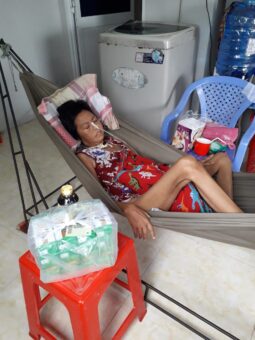
Solidarity projects initiated by the “Goccia dopo goccia” (drop by drop) Association in collaboration with other organizations operating in Southeast Asia. 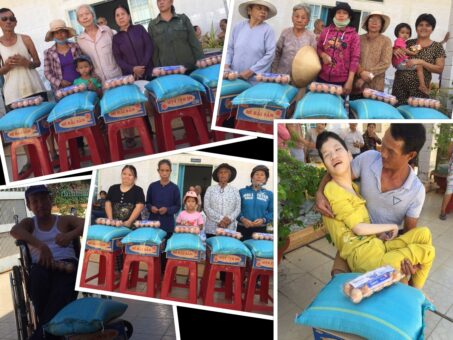 The number of victims of coronavirus around the world is still very high. But even higher is the number of people who, whilst not having contracted the virus, find themselves in conditions of extreme poverty due to the economic and social situation created by the virus; deprived, in some cases, of even the basic necessities to live. Yet even in these situations, initiatives of solidarity are multiplying which are the result of networks that are sometimes crossing national borders. In Vietnam, for example, the Long An area, south of Ho Chi Minh city, has large pockets of poverty. Here, the most vulnerable members of society have been indirectly affected by the pandemic. Many, especially among the elderly, who were living off lottery ticket sales, have had to stay in their homes, very often facing starvation. This is precisely the area where the Swiss-based association “Goccia dopo goccia” operates, coordinated by an Italian focolarino, Luigi Butori, who has lived in Asia for many years. Included amongst those who volunteer and support the project in different countries around the world are many friends of the Focolare Movement. “Goccia dopo Goaccia” has been working for some years now to implement more than 20 solidarity projects in Thailand, Myanmar and Vietnam. In Long An the association distributes about 40 rations of milk and food every month which helps many people including the elderly, those who are disabled, adults on their own, abandoned children living with grandparents and people suffering as a result of serious accidents, such as An, 14 years old, who is paralyzed and forced to live in a bed. The association has someone who intervenes at a local level whenever necessary. Thanks to these local volunteers, it tries to reach the “least of the least” bringing not only material help but also moral support that makes them feel that they are not alone in facing this dramatic period of history. For those responsible for “Goccia dopo goccia” this is a very important element of their activity: making people feel that they have not been abandoned but that there is someone who is taking care of them, starting with a smile. The Long An project has been going on for about two years and is supported with the help of schoolchildren and families in different countries around the world. They are people who send small amounts of money and who, as the name of the association says, as numerous small drops enable large quantities of help to be provided. “Goccia dopo goccia” also operates along the border between Thailand and Myanmar, with another project that supports Karen children in different villages in Mae Sot, the Mae La refugee camp and the Heavenly Home orphanage, even though during these times of pandemic, “Goccia dopo goccia” volunteers recently had to face a long journey to visit them and deliver material aid. “Three beautiful days,” they say, “during which we received much more than we gave. And finally, when Covid-19 was rapidly spreading, “Goccia dopo goccia” managed to collaborate with Caritas Singapore, Caritas Vietnam and other Associations that operate in Southeast Asia on a project aimed at distributing 1,200 food packages to families in the Binh Thanh area, in Ho Chi Minh City.
Anna Lisa Innocenti
Click here for a video about the initiative
1 Sep 2020 | Non categorizzato
The “World Day of Prayer for the Care of Creation”. The Focolare Movement supports this in two different ways – with the initiative “Time of Creation” and with a meeting in October 2020. 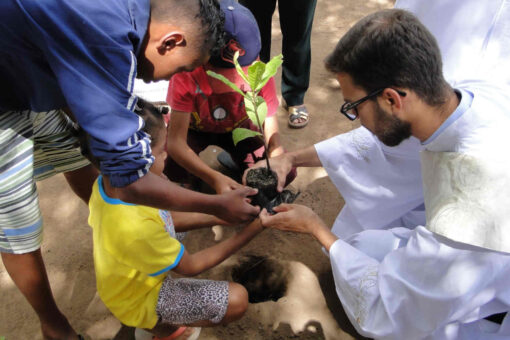 1st September is the “World Day of Prayer for the Care of Creation”. It was established by Pope Francis in 2015, the year that he launched his encyclical Laudato si. In this document, the Pope invites everyone to commit themselves to care for creation because this is our home and our most precious good. He also asks that we go beyond the current socio-economic system: we can no longer exploit planet earth as if there were unlimited natural resources. We must act quickly and find a different model of development. What can we do to be more concrete? Laudato si opens up the notion of “ecological conversion”: it speaks of change in lifestyle and trying to practise integral ecology. Therefore, the text refers not only to the environment but also to politics, economy and society. We need to start with ourselves and think about what we consume: we should choose politicians who show concern for the care of nature and who promote the production of renewable energy and decrease the use of fossil fuels. This year, the Focolare Movement is continuing to promote “Time of Creation” the annual celebration of prayer and action for our common home that begins on 1st September and ends on 4th October, the feast of St. Francis of Assisi, patron saint of ecology, greatly loved by many Christian denominations. The focolare’s global network is encouraging everyone to organize events and register them on the website. This ecumenical initiative began thirty years ago: in 1989, Dimitrios, Patriarch of the Orthodox Church of Constantinople, was instrumental in encouraging the different Christian Churches to jointly declare 1st September as “World Day of Prayer for the Care of Creation”. This year, the suggested theme is “Jubilee for the earth: new rhythms, new hope”. This theme is helpful in considering the integral relationship between the earth’s rest and ecological, economic, social and political life, particularly in the light of the far-reaching effects caused by Covid-19 pandemic. Later, from 23rd to 25th October in Castel Gandolfo, Italy, there will also be a meeting organized by EcoOne – the ecological network of the Focolare. Participants will include experts in ecology, politicians, university lecturers and representatives of organizations and associations. This meeting will examine the impact of Laudato si’ on the contemporary world and new pathways towards an integral ecology. The event aims to showcase the role that individuals and social entities can play in the care of our common home. In addition, this is also a special year because on 24th May, the fifth anniversary of the encyclical, Pope Francis announced that the coming year will be dedicated to. Laudato si . The urgency of the situation is such that it requires a concrete and immediate response involving all levels – local and regional, national and international. We need to create “a popular movement” that engages at grassroots level, an alliance between all people of good will. This is why it is important to participate in initiatives such as “Time of Creation” or the EcoOne meeting in October. As Pope Francis reminds us, “All of us can cooperate as instruments of God for the care of creation, each according to his or her own culture, experience, involvements and talents.” (LS, 14)
Lorenzo Russo
31 Aug 2020 | Non categorizzato
In many countries, restrictions imposed due to the coronavirus pandemic have also put a stop to all forms of religious gatherings for worship and prayer. However, believers’ desire to spend time with God has not diminished. What can we do? This reflection by Chiara Lubich offers an innovative solution. “And behold, I am with you always, until the end of the age” (Mt 28:20). … Jesus said these words to the disciples … (but) he was also thinking of all of us who, day after day, are living somewhat complex lives. Given that Jesus is Love incarnate, he might have thought: I’d like to be with them always, to share all their worries and give them advice; I’d like to walk down their streets with them, enter their homes and rekindle their joy with my presence. That is why he wanted to stay with us so that we can feel his nearness, his strength and his love. … If we live out what he commands, especially his new commandment, we can experience his presence even outside the walls of our churches, in the midst of a crowd, wherever there is this living presence of his, everywhere. What is asked of us is mutual love, which is made up of service and understanding, of sharing in the sufferings, anxieties and joys of our brothers and sisters. This love endures everything, forgives everything and is typical of Christianity. Let’s live like this so that everyone may have the opportunity to meet him already on this earth.
Chiara Lubich
Taken from the Word of Life for May 2002
29 Aug 2020 | Non categorizzato
The coronavirus keeps on taking away thousands of “stories” like Sher Khan’s. But his story lives on in a legacy – being one family – and in many friends like Marta and Javed. By Anita Martinez and Dalma Tímár. https://vimeo.com/430019025
26 Aug 2020 | Non categorizzato
How often does God use a person to draw someone else close to him? We should never forget him, because we too could one day become his instrument for someone. A new hope Having been in the U.S. to study, I decided to return to my country at the insistence of my parents. But I was stuck in quarantine at an institution near the border with about 500 people. I had the exact same feeling as if I were in jail. Fortunately, my phone kept me connected to the outside world. Whenever I met someone, I heard the same questions I had about what was happening. During that time I met a Salesian priest at a distance. Although he was as isolated as I was, he emanated a peace that neither I nor the others had. It was as if he was not surprised at anything. At first he celebrated mass alone in his small room, then I began to attend. In short, I returned to the sacraments and my previous life of faith, even if no longer as before. Even my girlfriend noticed that I had changed. Sometimes I think: if this transformation happened in me, can it be that it has also happened for others? A new hope is born within me: that the world that previously seemed to take it away from me can now refind its way in other directions. K., Slovakia Baby carriage I met a young Gypsy girl who was expecting a baby. She needed everything, from clothing to all the baby gear for the birth of her child. I had read in the Gospel, “Whatever you ask of the Father… he will give it to you”. That day with faith I asked Jesus during Mass for a baby carriage. Later at school, I committed myself more than ever to love my classmates and teachers. Back home in the evening, I learned from my mother that a neighbour, knowing that I help the poor, had left something for me. It was a baby carriage! I was moved by this prompt response from providence. C., Spain Blessing Working as a nurse for a month right during that period of the coronavirus, in the hospital where I served I shared the loneliness of several patients who passed to the other life without the comfort of their loved ones at their side. The strongest experience, however, was after I learned from my mother that, according to the pope’s words, even doctors and nurses were qualified to give a blessing to the deceased patients. I was able to draw a cross on the forehead and chest of several of them before filing the paperwork to confirm their deaths and send their bodies to the morgue. Joseph, Italy
Edited by Stefania Tanesini
