10 Aug 2020 | Non categorizzato
The coronavirus pandemic is a trial by fire not only for healthcare systems but also for those engaged in politics, both locally and internationally. The following excerpt from a speech by Chiara Lubich can justifiably be called a “hymn to politics”. It is a challenge for politicians and can fill the hearts of ordinary citizens with gratitude towards all those who have to make courageous decisions on a daily basis. While most of the new movements take an active interest in all that is happening in the world, one of them, the Focolare Movement, has actually given rise to a political section known as the Politics for Unity Movement. Its specific aim is precisely that of promoting fraternity in politics. … First of all, we realized that a true vocation to politics exists. Believers discern the voice of God entrusting them with this task. People without formal faith also feel called to politics when, for example, they see social needs or groups of vulnerable people asking for help. Responding to the call to enter politics is, above all, an act of fraternity. In fact, people become politically active in order to work for issues that concern the general public, to help other people, wanting their good as if it were their own. In reality, the task of love in politics is to create and safeguard the conditions that enable all other types of love to blossom: the love of young people who want to get married and who need a house and jobs; the love of those who want to study and who need schools and books; the love of those who have their own business and who need roads and railways, and clear and reliable rules…. Hence politics is the love of all loves, fostering collaboration among people, bringing together needs and resources, and enabling people to trust one another. Politics can be compared to the stem of a flower that supports and nourishes the renewed blossoming of petals in the community. In the Politics for Unity Movement, we notice that, by living out our political choices as a vocation to love, we understand that other people, who have made political choices different from our own, can be motivated by a similar vocation to love. They, too, in their own way, are part of the same design, even when they become our political opponents. Fraternity enables us to recognize their task, to respect it and help them to be faithful to it – also through constructive criticism – while we remain faithful to our own. In the Politics for Unity Movement, we believe that we should live fraternity so well as to reach the point of loving the other person’s party as we love our own. We know that neither party was born by chance, but that each was the response to an historical need within the national community. Fraternity brings out the authentic values of each side and reconnects the whole tapestry of the political design of a nation. The initiatives of the members of the Politics for Unity Movement bear witness to this. They seek to create a fraternal relationship between the majority and the opposition, both on the level of the national Parliament and in municipal authorities. Their initiatives have been formulated into laws on a national level, or into local policies that have brought greater unity to the towns and cities where they were applied. Thus, those who respond to their political vocation by beginning to live fraternity, enter into a universal dimension that opens them up to the whole of humanity. They ask themselves whether the decisions they are about to make, while serving the interests of their own nation, might be detrimental to others. Politicians of unity love other people’s countries as their own.
Chiara Lubich
From Chiara Lubich, “A United Europe for a united world”. Speech given to the European Movement, Madrid (Spain), 3rd December 2002
8 Aug 2020 | Non categorizzato
A glimpse into the experience and everyday life of Somjit Suwanmaneegul, a Buddhist, from Chiang Rai in Thailand. From his meeting with John Paul II to today. By Stefania Tanesini and Lorenzo Giovanetti. https://vimeo.com/430658900
7 Aug 2020 | Non categorizzato
Anything can happen in life: easy or difficult situations, mourning, victories or defeats, but there is a common denominator for all, a common way to deal with each situation: the relationship with God. Circumstances will always be different, but He is always present; always with us. In isolation “Tomorrow,” said the doctor, “we’ll put you in an isolation ward”. I felt like someone with a bad smell. I knew someone had died from that illness. Death! I was not afraid of the pain that comes with the last battle for life. Rather I felt the detachment from my own as sharp as a sword in my heart. I had not said goodbye to them. And now… I might never see them again. I wept. And yet, to die meant meeting Jesus whom I loved. But it seemed to me that the love given and received here on earth by so many tied me down here and the flight upwards was exhausting. I knew these people on earth, the others up there I didn’t yet know well. On the other hand I had always tried to love Jesus in every neighbour: relatives, friends, acquaintances, strangers! “It was you, Jesus, whom I loved and found in everyone, the same one that – if I die now – I will meet”. This last thought slowly gave me peace. I remained for a long time in isolation, with the ups and downs associated with the illness, but enveloped more or less by a mysterious presence with the possibility of speaking to the One who listened to me and to whom I could listen. M. – Italy Rudeness at school I don’t know if I’ve aged or the generation has definitely changed. I was talking about it with my fellow teachers and we all came to the conclusion that unfortunately there is a lack of basic education. It is not only a lack of respect towards teachers, evident also in a shameless judgmental attitude towards teachers by parents, but a complete lack of a sense of attention towards each other. In one of the most difficult classes, after a regrettable incident, I pointed out that in every culture and tradition there is a basic rule of coexistence: “Do to others what you would like to be done to you”. I asked everyone if such a rule seemed acceptable to them. After a great silence one pupil started to speak, then another one… and in the end a real dialogue was created. Since that day something has changed: almost invisibly, but something has changed. Once more I had to believe again. Young people need real, firm points of reference. C. – Spain I was tempted to emigrate… I am a specialist in infectious diseases and, due to poor health facilities, poor hygiene and very low salaries, I was tempted to emigrate like many colleagues. However, after reflecting with my wife, I decided to continue my service to my brothers and sisters in our country. With the support of Christian friends abroad, it was possible to build a health facility complete with a laboratory and guarantee specific medicines even for the poorest people. In addition to the development of productive activities to improve basic nutrition, an attempt was also made to ensure psychosocial support for the sick and their families. M.- Democratic Republic of Congo
Edited by Stefania Tanesini
5 Aug 2020 | Non categorizzato
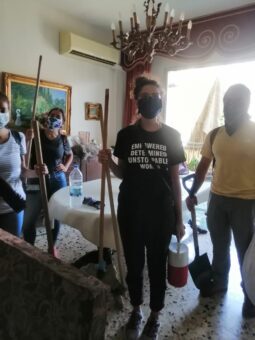
After the devastating explosion in Beirut on the evening of August 4th, the local Focolare community and the New Humanity association set to work to meet the most urgent needs of the people affected by the disaster. More than 100 dead and 4,000 injured caused by the huge explosion on Tuesday, August 4th at around 6.10 pm local time in the area near the port of the Lebanese capital Beirut. Glass doors and windows were broken up to a distance of 10 kilometres from the disaster area. The government speaks of about 300,000 people made homeless. Even before this catastrophe, the cedar country was already facing a severe economic crisis, which was further reinforced by the effects of the coronavirus pandemic. According to official sources more than 45% of the population lives in poverty and unemployment has risen to 35%. The explosion on August 4th was another major blow not only to Lebanon’s economy and infrastructure but also to the morale of a people who have suffered so much violence in recent decades. Like all humanitarian associations, the Focolare’s “New Humanity Movement ” has set to work to help those most affected. With the help of the local community of the Movement, the Mariapolis Centre “La Sorgente” in Ain Aar in Beirut has been made available for those who have lost their homes. Groups of young people and adults have made themselves available to help families and people most affected, putting together needs of different kinds: from food to cleaning materials . ________________________________________ The Emergency Coordination of the Focolare Movement, which will intervene through the AMU and AFN organizations, has been activated. For those who want to collaborate, the following current accounts have been activated:
Azione per un Mondo Unito ONLUS (AMU) IBAN: IT58 S050 1803 2000 0001 1204 344 Codice SWIFT/BIC: CCRTIT2T Banca Popolare Etica
Azione per Famiglie Nuove ONLUS (AFN) IBAN: IT11G0306909606100000001060 Codice SWIFT/BIC: BCITITMM Banca Intesa San Paolo
PURPOSE: Emergency Lebanon ————————————————————– The contributions paid on the two current accounts with this purpose will be managed jointly by AMU and AFN. There are tax benefits for these donations in many countries of the European Union and in other countries of the world, according to the various local regulations. Italian taxpayers will be provided deductions from taxable income, up to 10% of the income and with the limit of € 70,000.00 per year, with the exception of donations made in cash. ————————————————————– To stay up to date on fundraising for this Emergency visit the AMU and AFN websites.
4 Aug 2020 | Non categorizzato
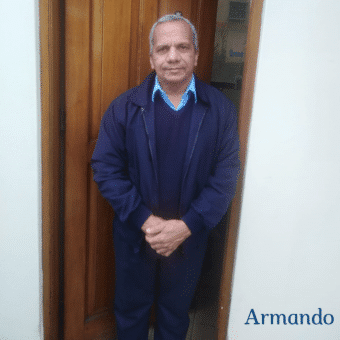
The story of Armando, a Venezuelan who emigrated with his family to Peru: lives the Ideal of unity in the Focolare community, shares his needs and experiences the power of communion that attracts God’s providence. Three years ago because of the difficult situation in Venezuela with my wife and our two children we decided to emigrate to Peru. We used to attend the meetings of the focolare in our country and there, in Peru, the Focolare community welcomed us with a temporary home , until I found a job so as to be able to pay the rent of a house. A person from the Focolare community, without knowing us, offered us his apartment for a month while he was away visiting his son who lived in another city. As soon as we got settled in, they asked us to make a list of the things we needed to share it with everyone. So coats, pots, pans, plates, cutlery, food began to arrive, but I was missing a pair of shoes that I needed urgently… At the end of the month, since I didn’t have a job yet, we moved to another temporary accommodation. We went to thank those who, without knowing us , had lent us their house. After getting to know each other better, the gentleman said: “If there’s anything else I can help you with, tell me”. We told him that we had made a list and that the only thing missing was the shoes. “Yes, I saw the WhatsApp chat ad,” he said, “unfortunately I take a size 38 …; try them on anyway (he took his shoes off) and if they fit, they are yours”. I tried them on and they were perfect. He added, “But in the ad you said you needed sports shoes”. He went to his room and brought out a pair of sports shoes: “Take these too”. That’s how the shoes I keep wearing came from providence. One evening in a meeting with some people with whom we shared Chiara Lubich’s Ideal of unity, I was able to experience once again the strength of communion, to share the successes, the failures, the joys, the needs, taking as an example the first Christian communities that “put everything in common and there was no one in need” (Acts 4: 32-36). It was a special moment: one of the participants said that two of his children had broken a computer during an argument. His first reaction was to punish them both. I felt sorry because now those kids didn’t have the computer they were using for homework. After going through the initial phase of anger, the father of the two boys called the technician to repair the computer. However, there was no way to fix it. So he called his two sons and apologized for his initial angry reaction, so that peace was restored in that family. When he finished sharing what he experienced, one of those present said he had a computer that he didn’t use: “You can have it, we’ll see how to get it to you”. For me it was yet another confirmation of the strength of communion. I asked myself: “And if the first person did not share his concern, how could the other offer a solution?” Sometimes we don’t know how to solve a problem on our own and we get stuck in our own pain; but if we take the step of sharing it in communion with others without any hidden interest, God can find the solution precisely through those around us.
A.M. Lima, Peru (collected by Gustavo E. Clariá)
