
Beyond the insecurity of jobs
“My name is Marco and I am 35 years old. Since 2008 I have been working as a substitute Catholic religion teacher. Unfortunately, due to bureaucratic reasons, I work only sporadically, on an average of about two months a year. This year I was called for three days in a school, for a week in another school after some months, and then for a few days elsewhere. On the average, it was about two months a year. In my capacity as an employee of the State I am not allowed to have two jobs and have to be available all the time when I am called to teach, since – should I refuse – I would be surpassed by others. I live with my parents and have a lot of free time, I take care of various house chores, some other commitments in the parish, and the education of youth and adults of an oratory where I coordinate the Word of Life monthly meeting; I do volunteer work in a home for the aged and am a member of the diocesan office for ecumenism and interreligious dialogue. All these activities keep me busy and active. But when work is scarce, a subtle veil of discouragement and low self-esteem grow in me, and everything always seems to become more difficult. One day, a friend, knowing about my work situation, phoned to say that he had met a student who needed tutoring in Latin and Greek. My friend knew about my educational background and was certain that I could easily fill the post. In effect, after High School I had never abandoned my knowledge of the classical languages. In fact, in order to understand the Old Testament better, I had recently even started to study biblical Jewish. Initially my first reaction was to refuse the offer, but I was given 10 days to think it over. Then, the student would have turned to other private tutors. Those who are familiar with the art of translating old languages are aware that translating for oneself or trying one’s hand in translating is one thing, and that giving private lessons to a person who needs to progress and achieve good grades on the report card, is another thing altogether. I needed a job even though this meant revising the grammar rules of Greek and Latin in ten days, and learning to teach it. To be able to succeed I would have had to drop all my other commitments for seven days and study from 8-10 hours a day. It was like a leap in the dark. And so it was: I started to study like crazy. And then, after a few days, the same friend offered me a room in his house, and even the keys to the house. Another friend who came to know about my “new job” introduced me also to his son who needed tutoring. But more than a teacher, he needed tutoring not only in Latin and Greek but also in philosophy, Italian and English literature, in short, the whole humanistic area. He was a desperate case. In fact he was a very problematic person in terms of relationships, and in the last year of high school had been given an “unclassified” grade. I entrusted myself to God and accepted to be his tutor. Today he has started to get a set of 8s and 9s and his enthusiasm is growing. Even his personal relationships have started to improve. I recently worked as substitute teacher for a month, continue to give private lessons in the afternoon and also keep up with my previous commitments.”
An ever-ardent Trent
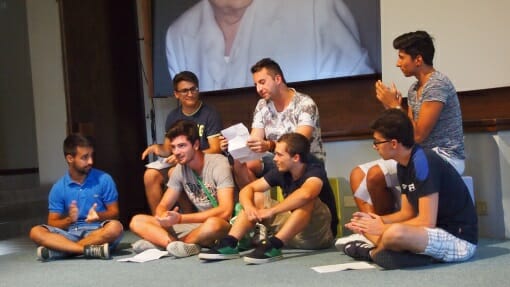
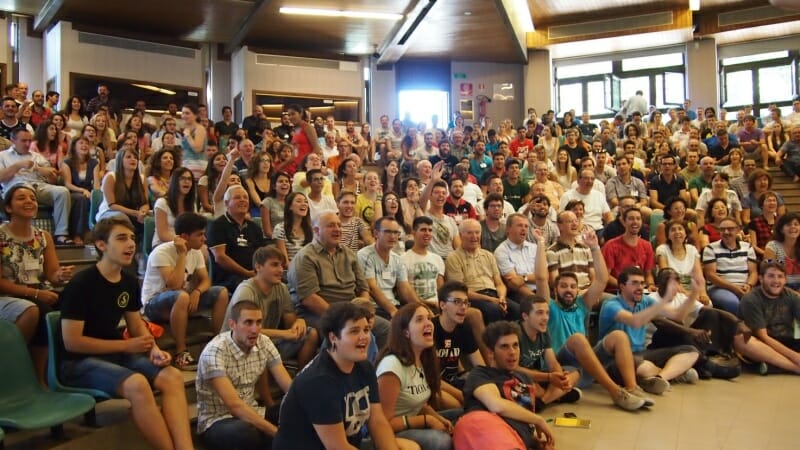 The somewhat quirky diversity of the hall at the Chiara Lubich Centre in Trent this year was a bit surprising: 250 young people between the ages of 16 and 30 from more than 20 countries; 70 priests and seminarians and some twenty adults who are all committed in living the spirituality of the Focolare at the parish or diocesan levels. What was the idea behind this meeting which was planned for the 2cnd to the 8th of August? What is the connection between the different cultural backgrounds? The first answer can be found in the title of the meeting: “Like yesterday,” and the second answer in the city of Trent itself. All of these young people and adults were gathered to reflect on the first generative seed of their own spiritual charism and to look back even physcially at the journey that has inspired the Focolare Movement from its beginnings. “The meeting opened in an atmosphere of explosive joy,’ Ludovico and Elonora recount. “The programme is meant to be an immersion in the life of those early days and the radicalness in living the Word.” The programme alternated between thematic topics and excursions to the places where the Focolare began: Piazza Cappuccini, Fiera di Primiero, Tonadico, Goccia d’Oro. “During the Mass in the Cappuchin church,” Zbyszek writes, “we declared ourselves ready with the help of Christ’s grace, to give our lives one for the other beginning from the small things of everyday life. In the place where God had sealed the pact of unity between Chiara and Igino Giordani (Foco), we also wishe to renew that mutual love which we wish to live as they did that yesterday.”
 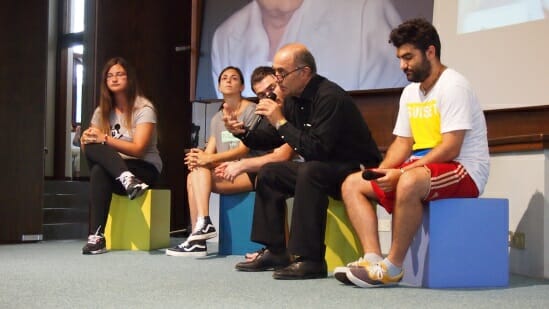 Then we had an opportunity to be enriched by presentations from experts in the fields of communication, interreligious dialogue and cooperation and development in the Action for a United World (AMU). Thanks to them we were able to reflect on communication and the challenges of our multiethnic and multi-religious society. Much time was dedicated to delving into the topics of immigration and welcoming thanks to the precious collaboration by the Cinformi Project, which presented the model of welcoming that has been proposed and applied by the city of Trent, placing itself at our service with active workshops involving two visits to refugee camps. Some of the most unforgettable moments of the meeting were spent with a hundred refugees who are waiting to see what the future will bring. Several of them came to see us at the meeting. Rita confided: “I was so struck by Lamin, a young Muslim from Ghana who had written a poem to his mother and wished to read it to everyone. It was a poem filled with nostalgia but also hope. The eyes of these people says it all and they can never forget.” At the conclusion of the meeting two goals were set – one short-term and the other long-term: the World Youth Day meeting (WYD) in Poland; and the unity of the world in accordance with Jesus’s prayer that all be one for which we wish to spend our lives. “We leave committed to becoming the ‘living Word,” Danilo and Emmanuele write and to take this “pure water from the source” into our own lands and into our daily life in our peripheries, offering it to every neighbour that goes by.”
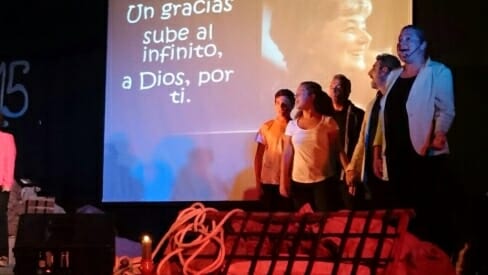
Mariapolis 2015: Paths that meet
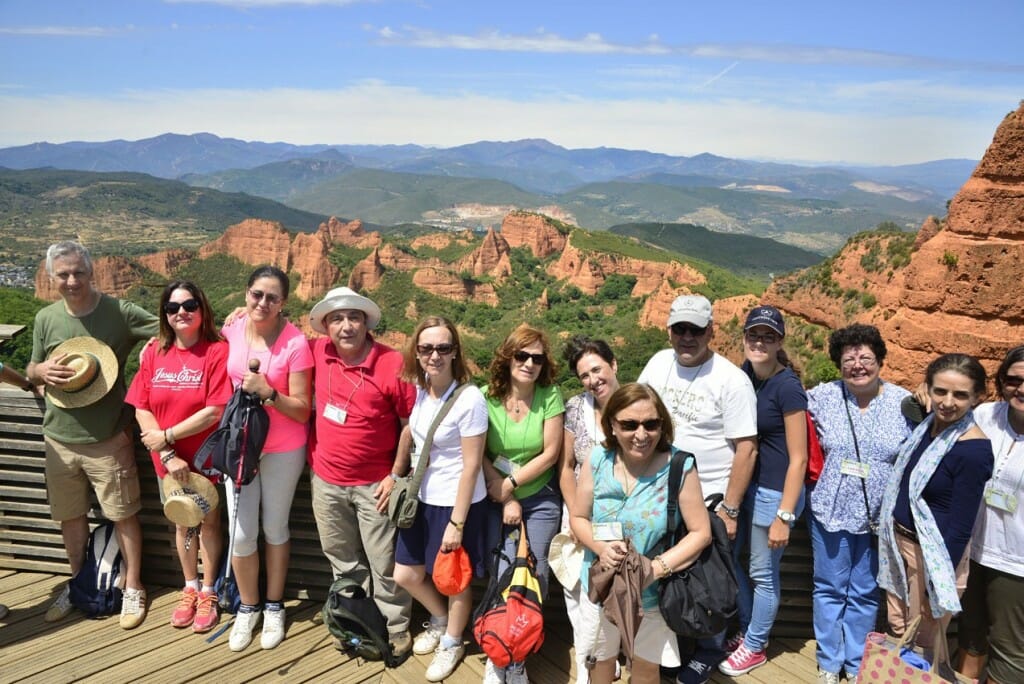 One person attending the Mariapolis in Astorga for the first time described it as a “heart to heart meeting.” It was just one of the many similar Mariapolises that are underway or have already taken place across Europe and in many other lands. The Mariapolis of August 2-6 was a peaceful “invasion” of the town by 800 people from several parts of Spain, but also from France, Italy, Germany and Brazil. During excursions to monuments and museums, at Mass celebrated in the Gothic Cathedral, or during the evening concerts with all types of music – the streets were crowded with people from the Mariapolis. And the local citizens of Astorga whose curiosity had been aroused by the fraternal spirit of those people, responded in kind. One woman stopped a girl who was walking down the street to thank her for the presence of such a joyful group in their city. The balance between periods of relaxation, formation, dialogue, listening to testimonies and play was much appreciated. It was a good mix that contributed to the objectives of the Mariapolis: to favour an encounter with oneself, God, and others. One participant observed: “It wasn’t a crescendo that began at a one level and then progressed in quality or intensity. Each day was full, complete, and totally valuable in itself.” Amongst the activities for children and teens were several marches in the city, with stops in certain streets and squares where activities were held. The Astorga Mariapolis was also on Facebook, a virtual meeting spot for both the participants and for those who could not physically attend. Many contributed photos that can still be accessed online. Some of the comments: https://www.facebook.com/mariapolisastorga2015 “This is my first Mariapolis,” Cati writes. “These days were filled with brotherhood, love and unity. My family and I thank everyone who made this wonderful event possible;” “I’m still on my way home towards Toledo,” writes Paco. “I take the opportunity to thank everyone for these past few days. I have to say that it was a Mariapolis filled with graces.” A project was proposed that would bring the Mariapolis spirit into daily life: “We’re all Mediterranean” to help inform European citizens on the drama of immigration that is taking place in our common Mediterranean Sea, from southern borders, from disadvantaged and war-torn lands, in search for better living conditions. This project, which is in harmony with the theme of this year’s Mariapolis (“Paths that meet”) involves a collection of signatures to petition the European Union for a significant change in migration policy. On the last day of the Mariapolis when the participants were asked for their evaluation of the event, everyone said they were satisfied, especially with regard to the way they felt welcomed from the moment they arrived, even those who were attending for the first time. The town of Astorga built to a human scale and with such a pleasant climate, combined so many features that helped facilitate the coming together which was the goal of the Mariapolis. For this reason the organisers of the Mariapolis write: “the Focolare Movement expresses its warm gratitude to the Diocese and Town Administration for their exquisite collaboration.”
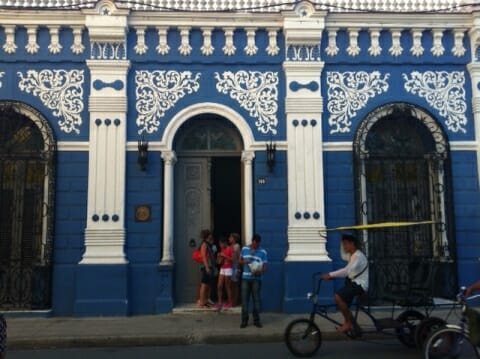
Cuba prepares to welcome Francis
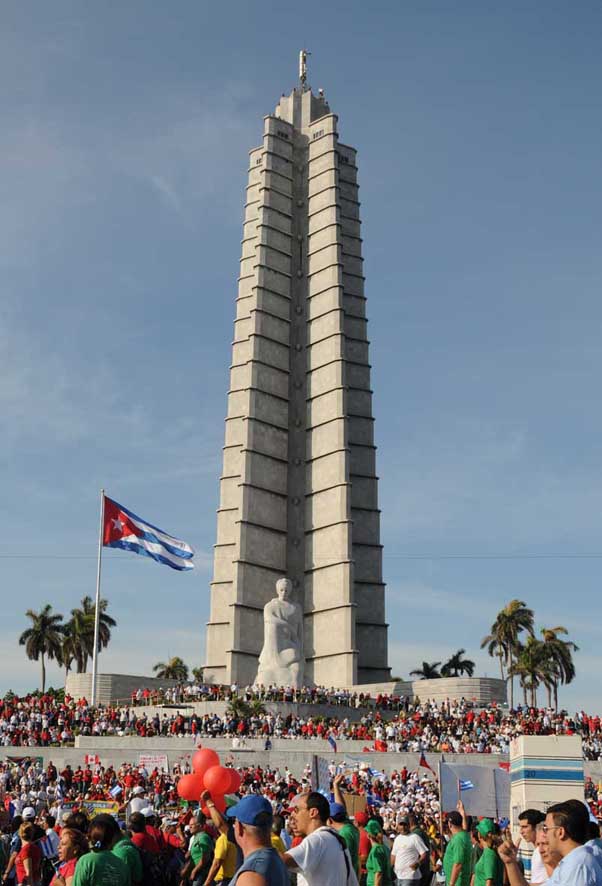
Revolution Square and José Martí Memorial
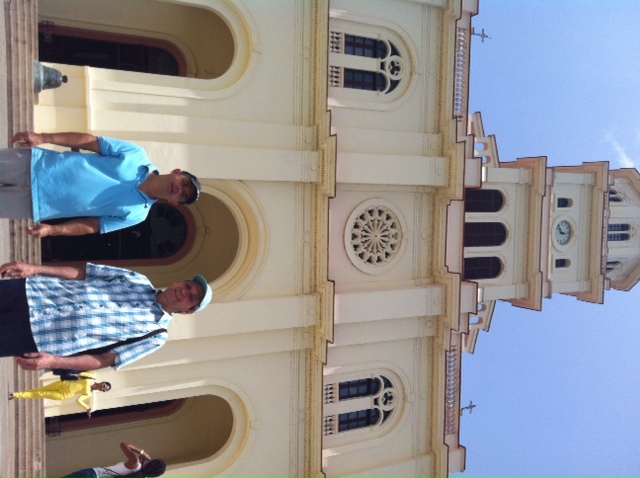
the National Shrine of the Virgin of Charity of Cobre
The Focolare Movement’s contribution. The Focolare communities across the island are trying – together with the Church – to offer its own contribution, geared mainly towards formation in fraternity in opposition to the “throw-away culture”, to privileging those in most need, promoting unity in diversity and proposing dialogue as an indispensable method for peaceful coexistence in a multicultural society. Conclusion. The message of the Cuban Catholic Bishops concludes with a prayer to the Virgin of Charity, Mother of Cuba, the One whom we invoke as Mother and Queen of Mercy, that she might take maternal care of this longed-for visit. She who has accompanied our people in good times and in bad, may she obtain a great blessing from Heaven for Cuba and her children wherever they may be, whatever they may think or believe.” From an interview with correspondent Gustavo Clariá _____________________ [1] Castellano Dennys, Sergio L. and Monterrey, Fontanella. Sin pecado concebidas, La Caridad del Cobre en las artes visuales cubanas, (Havana: Editorial UH, 2014), p. 66. (Our translation.)
The words I could never say to you
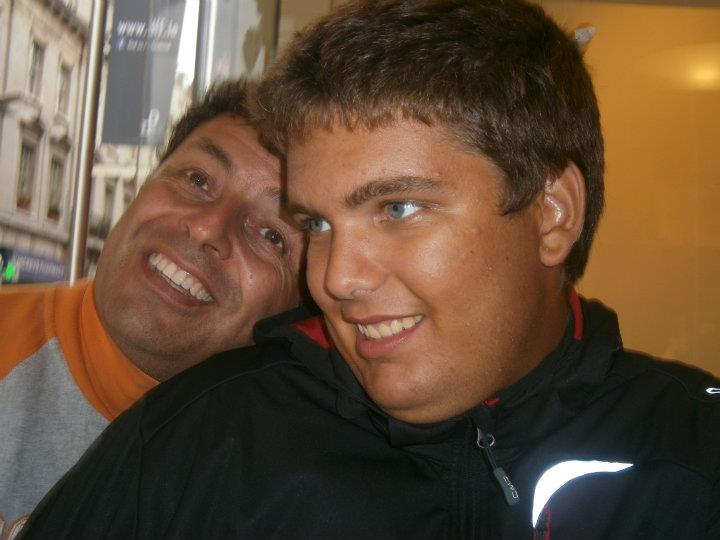
Federico with his Dad
Now that he could write, his self-esteem grew, up to when he published a book Quello che non ho mai detto (“The words I have never said”) wherein, for the first time we can see the point of view of a boy who explains his syndrome with rare and precious observations. This is how he emerged from his isolation, and finally experienced the joy of sharing his emotions. He concluded his studies in science up to secondary school certificate stage. To this day, Federico says almost nothing. “I assure you,” he wrote, ” that I am almost unable to speak verbally. I express myself with single words, and only rarely with a small phrase. I can write only in big and shaky capital letters.” And thanks to the computer, for the first time he was able to play with a friend and attend, together with his classmates, the first year of secondary school, and years later, participate “actively” in the meetings of the confirmation group. “Little by little, ” he recounts, “my laptop became an inseparable companion. With my computer and the support of a qualified person at my side, I can express my views in every situation.” Today Federico studies percussion, has many friends, helps people with autism in their families with down to earth suggestions, and has a lot of plans for the future. “Now my life has found its course,” he wrote, “thanks to the operators who taught me how to use the system, and my parents who launched themselves in this adventure with enthusiasm. Today I am happy with my life, and a great part of the merit goes to them.” But he’s not thinking just of himself: “How many autistic people could have become other Federicos if diagnosed properly and given early intervention and been greatly loved and supported?”. His dream for the future? “I wish to travel the world to meet families with infants who have a communication disorder, to try and interact with these children and to treat autism accordingly. Whenever a child needs me, I’ll be there to help.” Source: Città Nuova online