15 Jun 2015 | Focolare Worldwide
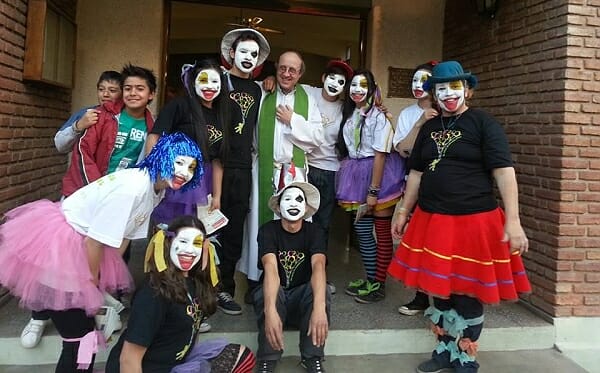
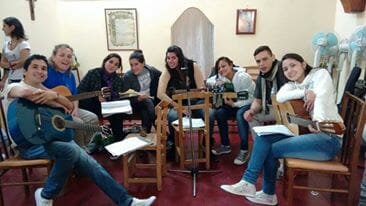
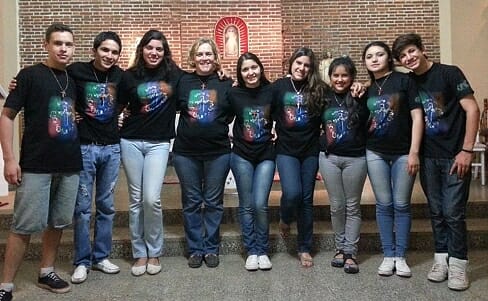 In 2011, three young people from a parish in the province of Córdoba (Argentina) were invited to a meeting in “Mariapolis Lia,” a small city of the Focolare Movement, 250 km from Buenos Aires. Participating at this meeting was a great experience for all three, a full immersion in the Gospel in action, an incentive to concretely give of themselves for others. “That meeting changed us,” says Susana. “We found that we were more enthusiastic, more welcoming, more trusting in God who we rediscovered is Love. It was a chance to grow as people but also as a group.” So much so that today there are about fifteen teens who are moving forward together with some very interesting initiatives. As an example, the “Clothing Fair,” a very useful idea for their region in which there are many families who live below the poverty line. In the parish, many items of clothing had been arriving which remained there, unused, because there was no one to bring them to those in need. So the teens took over: working hard, in a few Saturdays they had organized the location, which was a transformed basement; they had cleaned and perfumed it, thinking of those who would come to choose their clothes; they had displayed the merchandise, ironed and fixed up like new, and the result was the “Clothing fair.” At the beginning, they had thought not to ask for any compensation for the clothing, but then—thinking of the dignity of the buyers—they established prices that were accessible to everyone, without drawing attention to who was giving and who receiving, so that only love would circulate.
  “One day,” recounts one of the teens, “a mother of eight children came. Seeing those affordable prices she chose a lot of clothes, and when she went to pay, with tears in her eyes she confided to us that it was the first time she was able to buy something for her children. Another time a woman came who seemed very interested: she walked around, looking at all the clothing but without buying anything. In the end she stopped to talk for a long time with us teens. We found out later that she came back other times, too, because as she herself confided, she knew that here she would always find someone who listened to her.” Leaving after her turn at the Fair, one of the girls noticed a man on the church steps who was crying. Knowing that Jesus is concealed within every person, especially the poor, she thought of something: “If he were Jesus, would I leave him alone to cry?” She decided to approach him, and the man sorrowfully described that for days he had lived on the street, he had nothing to eat and he suffered from serious health problems. The girl returned to the Fair to call the others from the current shift to search for a place for him to stay and for some food. Afterwards, they also found him a job. In many countries in Latin America, a girl’s 15th birthday is an important date. One young girl in the group was about to arrive at this date, but her family had no means to celebrate it, inviting friends and family. Hearing about this, the teens from the group wanted to help. First, they dedicated themselves to the decorations of the hall, according to the preferences of the girl’s mother. Then, they organized themselves to serve at table. But they, too, would have wanted to participate in the party and at the dance with elegant attire. What to do? Lined up in waiters’ uniforms, they welcomed guests at the door and served them at table, and then, for the dance, they ran to change, surprising everyone, especially the birthday girl. At the end of the party, they changed back into work clothes to put everything back in place, leaving the hall clean and in order. Talk about love!
12 Jun 2015 | Focolare Worldwide
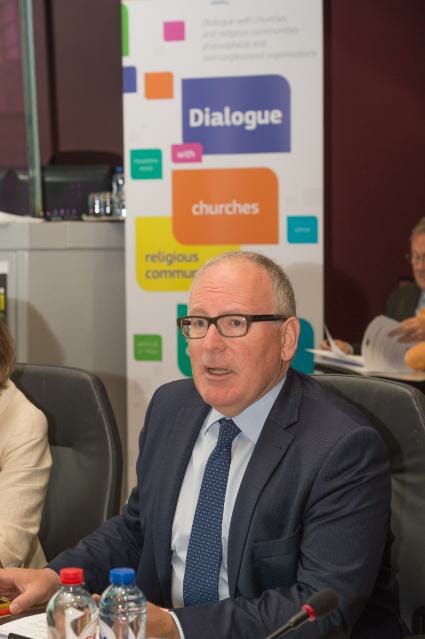
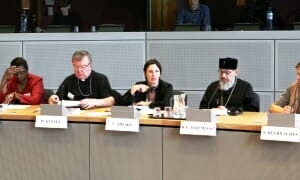 The meeting with the religious leaders will take place on 16 June at the Berlaymont Building in Brussels, seat of the European Commission. The top-level operational meeting is regularly held among the organisations of the European Union and churches, religions, philosophical associations and non-religious organizations, as provided by Art.17 of the Treaty of Lisbon. The results of the debate with the religious leaders will contribute to preparations for the European Union’s first Annual Convention on Fundamental Rights that will be held in Brussels on 1-2 October 2015 on the theme “Tolerance and respect: foresee and combat anti-Semitic and anti-Muslim phenomena in Europe.” The topic chosen for the debate, “Coexistence and acceptance of diversities,” underlines – in the words of Frans Timmermans, First Vice-President of the European Commission, that – “in our heterogeneous European societies, dialogue is essential in creating a community in which each feels at home. Living together means being able to accept the differences even in the presence of profound divergences.” Among the 15 religious leaders invited, are the Catholic Church’s representatives: Cardinal Reinhard Marx, Archbishop of Munich and President of the Episcopates’ Commission of the European Community (COMECE), and Maria Voce, President of the Focolare Movement.
Frans Timmermans, First Vice-President of the European Commission
12 Jun 2015 | Focolare Worldwide
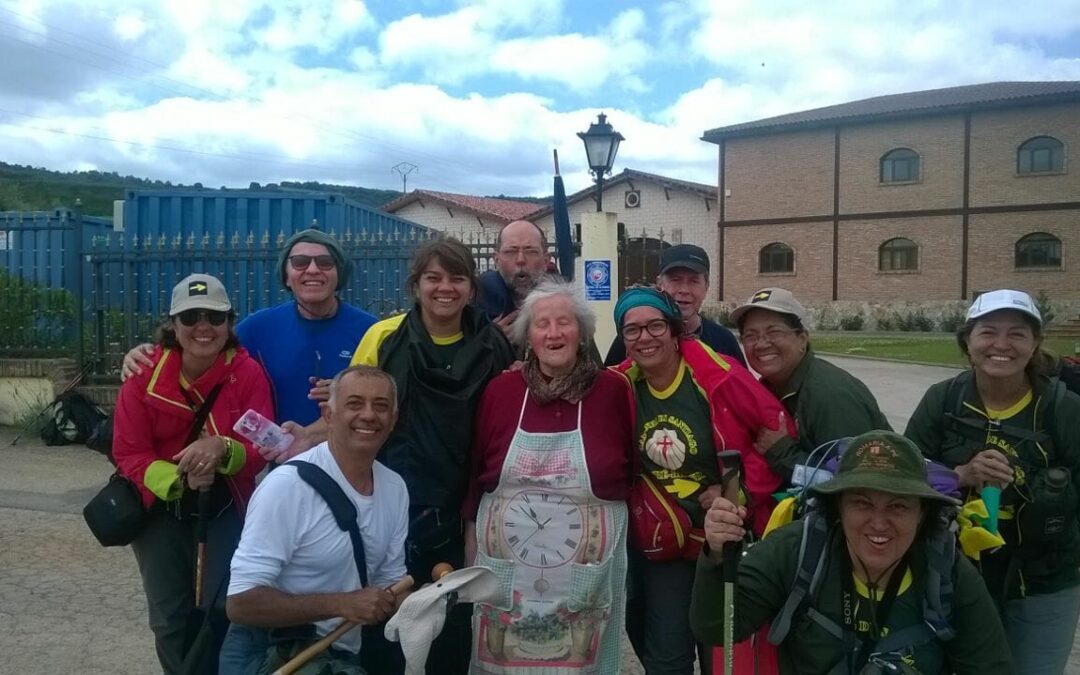
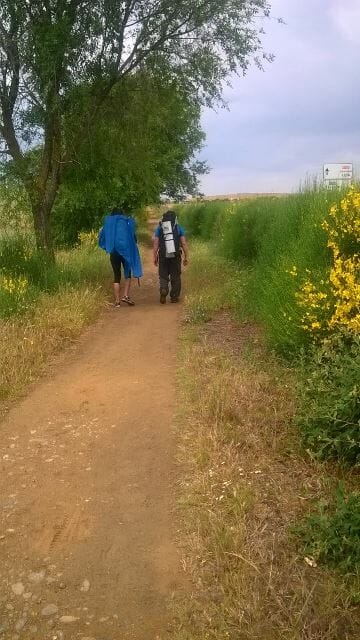 “The sun is beating down, but we need to get to the next village. Today we did another stretch with Grey from South Africa, a young television presenter. We were surprised to find people from all over the world, on the road to Campostela – from Korea, Japan, China, United States, Brazil, Canada and, naturally, Europe. Thirty years ago, only some 100 people would pass through Ronceveaux each year. The walk seems to respond to a need that is felt by the people of today. The reasons for taking the walk are many and it is interesting to share them. Peter, a 35 year old German hotel keeper from the vicinity of Monaco, sits at our table. He hasn’t gone on holiday for two years and, then, his girlfriend left him. He wants to think about life. Paul and Celine from Canada are doing the walk to give thanks for their life. Tracy from Australia is following a dream: she wants to have a great tale to tell her children and grandchildren. Antonella confided to us that she doesn’t know how to weep, she would like to get to know herself more and find her freedom. We took up El Camino 19 days ago: Bernard and Jean-Paul from Belgium and Ivo from Brazil who was frightened at the idea of having to walk 740 km. It seemed like too much. As the road stretches on you realise that the feet and legs are doing just fine, and with each new day your courage increases. Jean Paul, a married doctor, has been retired for a month. He makes frequent stops to explain the plants we find along the way. He helps us to take in the fragrances of the rich nature all around us. We are struck by the beauty of the flowers, the churches like in Burgos and in Lyon, but also in the small villages. We often turn around to enjoy the panorama behind us. Each morning we make a pact with one another to help us in the difficult moments. The walk brings us into touch with our limitations, sufferings, tiredness, thirst, hunger. . . and that can easily make us forget our neighbour.
 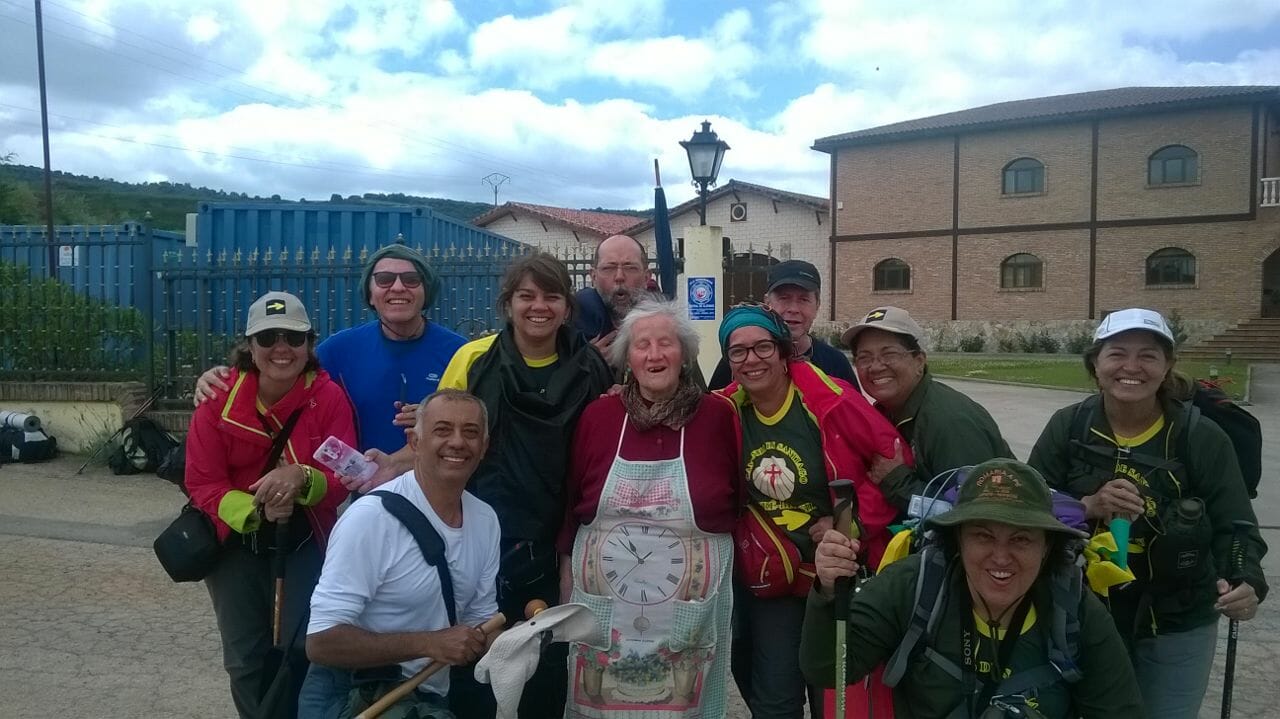 Ivo brings a lot of vitality to our little group, and others enjoy walking a few kilometres with us. They share their questions, difficulties and joys. One evening a priest told us the meaning of the word Compostela: Stars Field. We should also follow our star and be stars (light) for one another. Each day we come into touch with many hearts, but we are also touched by them. We try to open the door to God because we feel He is here amongst us through evanglical love. We have dinner with the others and pray altogether. Nicole is looking for people who would like to pray the Rosary. She recites it in Latin, Jean-Paul in French and we in Italian. Then Nicole begin to sing in Tagalo (Philippine language) and Ivo in Portuguese. Nicole recounts her story: she is on her way to entering a Religious community. Another time a policeman – Doriano – walks with us to 10 metres. He tells us he has prayed with us. This is a new experience in his life. Some cloistered nuns are also praying for us and for all the pilgrims; it is their vocation. Many wonder why we are speaking in Italian. We tell them our story, the story of Chiara Lubich and the Focolare Movement. To others we speak about the Gospel, the vocation and the journey of life. The experience of the Way of is different for every person. We are wondering what will happen when we reach the steps of St. James of Compostela. It will be a surprise like the one we will receive at the end of our lives. It will be joyful because of the journey, and having met so many people who have remained in our hearts. We wish them well with a ‘Buen camino’. Who knows when we’ll meet again?” Bernard, Jean-Paul, Ivo
11 Jun 2015 | Focolare Worldwide
The Summer School is an opportunity for international scholars and students from multiple disciplines to imagine the future – to recognize the possibilities hidden in the present and to understand the complex conditions required to navigate the possibilities. The Summer School will cultivate the skills and knowledge necessary to responsibly usher in a future of hope – a future charted with a moral compass directed by a commitment to the idea of the inherent value of the human person in the light of a culture that blossoms from the deep roots of relationships. The Summer School will encourage scholars to pursue research that informs paths to a positive future relying on epistemological questions derived by studies in economics, politics, law, theology and other technical and social science disciplines. For more information: Summer School 2015
11 Jun 2015 | Focolare Worldwide
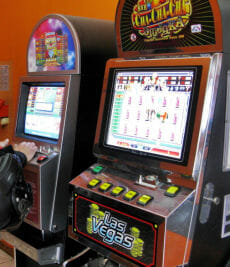
Thousands of signatures within a few short days under the title: Unity is strength. In April 2015, the Italian National Olymic Committee (CONI) launched a project for teenagers and young Italian residents of disadvantaged areas, titled: Vinvcere da grandi, meaning, becoming a winner as an adult. The news that was given with such large covereage has left a positive impression in many. The situation, which is paradoxical and painful, has created a tear in the social fabric that must be mended. Ths Focolare Movement in italy has noticed, along with many other associations in the country that fight for legality, transparency, and social justice. Universal brotherhood is also built in this way: joining together to ask the Italian National Olympic Committee to discontinue its collaboration with Lottomatica. The Focolare Movement in Italy has launched an online petition asking the Italian Government and Parliament to intervene in supporting an authentic culture of sport in the country, and a concrete commitment to the growth of young people. It is a bet that will only be paid off later, and we are conscious of the disproportion between the forces (like David and Goliath), but we are equally convinced that it is important to give a signal that goes against the trend. If you are interested in the project Stop Progetto Coni Lottomatica “Vincere da Grandi”, go to the New Humanity website.
10 Jun 2015 | Focolare Worldwide
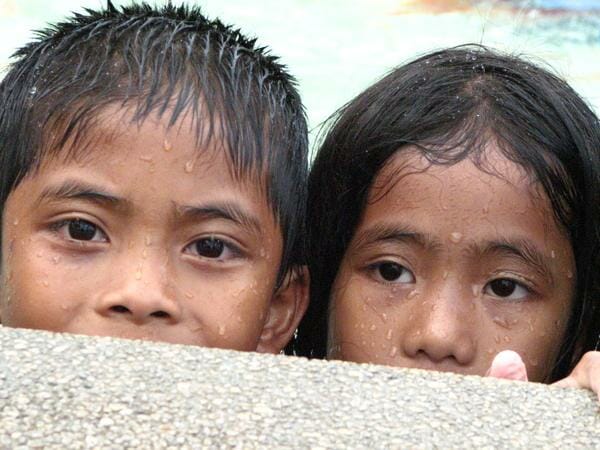
“Last year a two year old girl who is quite dear to me almost lost her life. I thought that because she had been born here, she was immediately given every medical cure and surgery. But what if she had been born in a country with less resources, how would it have gone for her? And why should she have had the good fortune of living here? Do other children not have the same right?” Thus Gabriella got to work organising a fundraising project for disadvantaged children, asking the Mayor for a public space on the main square of her town, Marcignago di Pavia, Italy. She also involved the Parish, the Diocese and the local press. “How will it turn out, I dont’know,” she admits, “I know why and for whom I’m doing this, and the only thing I can do is hope for the best!” This is but one of the many testimonies of supporters who have become involved in the #obiettivo15mila campaign of the New Families Association begun on May 24 in Rome, Italy, at the Città dell’Altra Economia. “The goal” – Association president Andrea Turatti explains – is to “give visibility to what we are already doing through on-going projects in 50 countries, and to expand our involvement, by involving others in projects of solidarity.” Solidarity projects have multiplied in many Italian cities and in several social projects that are underway around the world. With internet link-ups they have been able to present their activities: surgical clinics, nursery schools, primary schools and after-school programmes, through which children and teens receive adequate nourishment and medical care, scholastic assistance and other professional services. These programmes are inserted in wider interventions, in cooperation with national and international partnerships in favor of families and entire communities until they are able to be autonomous, and in favour of the well-being of children worldwide. “We would also like to contribute to the solidarity,” said Youn Vera who, thanks to the distance support is now attending the second year of secondary school at the Collegio Gue Pascal of Man, on the Ivory Coast. “To help out four classmates who were ill and in need of medical care, we had the idea of a garden where we could grow salad and spinach.” “Distance support is a project that does much direct good for us, not only to the ones who receive, but because it makes you grow, it puts you in contact with different people and cultures, it helps you to discover the value of sobriety and creates community,” said Vincenzo Curatolo, president of the Sad Forum which joins hundreds of associations in Italy. One example is Guido and Azzurra who together with other teenagers from the Roman quarter, tell how they have founded an association that has been operating for nearly two years, in which they carry out several activities in favour of others. The most beautiful experience has been in the Philippines, responding to the emergency in the aftermath of hurricane Hayan. Hosted by the Focolare and in cooperation with the New Families non-Profit Association they went into several barrios on the peripheries of several cities and touched with their own hands what previously had seen so distant from their daily lives and could only be seen on television. Living them out in daily life, really changed our way of thinking. Then we wanted to make a long-term commitment in supporting a girl in a wheelchair: Princess, with her sunshine smile.” Giusy, from near Pisa, Italy, tells of how one group of Focolare New Families slowly got the whole area involved, the municipal council and some 300 families. “The project was begun by me and my colleague, twenty years ago,” says Massimo Grossi of the RCS Corriere della Sera, and it has involved more than 250 journalists and printing services. Thanks to many small donations, we received 50 distance supporters for children in Africa and Asia; many small contributions that united together: this is our spirit and our strength.”
