5 Mar 2015 | Focolare Worldwide
Intensifying our prayers for peace
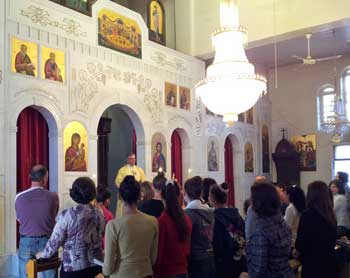
At the general audience of March 1, 2015, Pope Francis remarked that “Dramatic stories continue to arrive from Syria and Iraq concerning violence, kidnappings and damaging harassment of Christians and other groups. We wish to assure all those who are caught in those situations that we have not forgotten them, but are near to them with our insistent prayers that the intolerable brutality of which they have been victim may soon come to a halt.” The vast crowd that filled St Peter’s Square paused for a moment of deep prayer, as it remembered the two tortured countries of the Middle East.
From Syria they write: “Many surrendered to the idea that the war is a fact of life and that the hundreds of people who die every day no longer make news. The people have reached the limit of endurance and the winter is long and cold, without diesel fuel, electricity and water. The mortar fire continues to sow death in the big cities, while battles continue on the peripheries and in villages. The economy is on the ground and many families are unemployed; and legal outlets from the country are nearly closed. One Syrian bishop said that our people are humiliated and have had their human dignity insulted.”
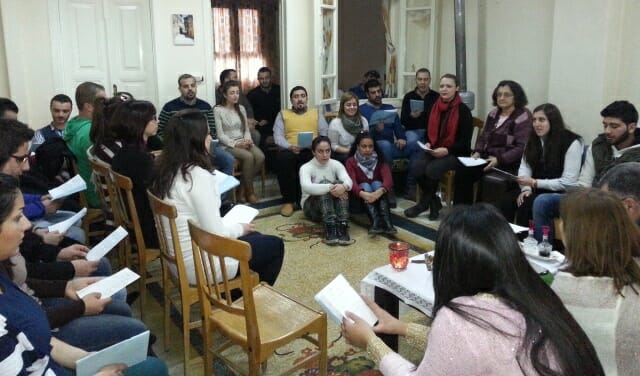 Despite the evil that is rampant in Syria, the local Focolare community continues to believe “that there can be a better future here. We continue to find strength in living the Gospel, even with courageous witness.” They know they are not alone but belong to a great family around the world that is continuing to pray for them and work for peace. “Although tiredness, after four years of war and the prospect of a dark future for the country weighs on us.”
This was the Aleppo to which the members of the men’s focolare returned on February 23, 2015. They write: “After three months away, we’ve returned to set up our Focolare Centre in Aleppo, together with Sami our married focolarino who lives with his family on the coast. He comes to stay with us once a month. Staying here is a challenge, for we are aware that Jesus in our midst, through mutual love, is the only source of hope and comfort for the local community and the people around us.”
“During our journey,” they conclude, “we stopped for a week in Damascus, at the women’s focolare. They have supported the community in our absence. Then we spent a week in the community of Kfarbo in the middle of the country. There was a lot of joy over our return: now the family is complete! We are all very grateful for the prayers of so many people around the world who are supporting us in this hard trial.”
4 Mar 2015 | Focolare Worldwide
Relive the pain of others
“Our son, Matteo, was born with a serious respiratory problem, and we spent the first six months of his life in hospital. How can I describe the anguish we experienced during his respiratory crises, or when doctors were unable come up with the therapy that would meet his needs? Yet, we never doubted the Father’s love; thanks also to the support we received from our families and many friends. Overcoming the temptation of enclosing ourselves in our problem, we were enabled to share in the worries of others with children recovering in hospital, confronting the mystery of faith and suffering with them. Matteo is much better now. Recently, we were invited by the hospital department to belong to a group that reflects on issues related to young patients (the voice of the parents is important when it comes to difficult decisions). We accepted the invitation even though it would mean reliving our own pain, in the pain of others.”
M and S, Italy
The Cube of Love
“Mum and Dad don’t really get along. They often fight. Sometimes she doesn’t give in, and he becomes angry. To help them, even though I’m the smallest, the idea came to me of doing something at home that we do in school: learning how to love one another by rolling a cardboard cube with different phrases written on its six sides. I asked Mum and Dad to play it with me. We each had to take a piece of paper, copy down and do what they had read. If they didn’t do it, I would keep score of it in my score book. Mum got the side that said: “Love everyone,” and Dad got “Love your enemies.” By playing with me they had began to love one another again.”
D H, Philippines
An unexpected child
“Our daughter, Solange, a nurse at a clinic in Rio de Janeiro, was one day approached by a girl who was insisting on being admitted to hospital at least until she gave birth. She had neither documents nor money to pay for hospital care. Solange turned to the clinic director and other doctors, and finally the girl was admitted under the responsibility of my daughter. Everything went fine. A beautiful baby girl was born, Barbara. But a few days later, the girl disappeared leaving the newborn behind. The director and doctors got angry with Solange, to which my husband and I – even though we’re not so young anymore – offered to welcome Barbara as our fifth daughter, fifteen years after the birth of our youngest.”
A – Brazil

3 Mar 2015 | Focolare Worldwide
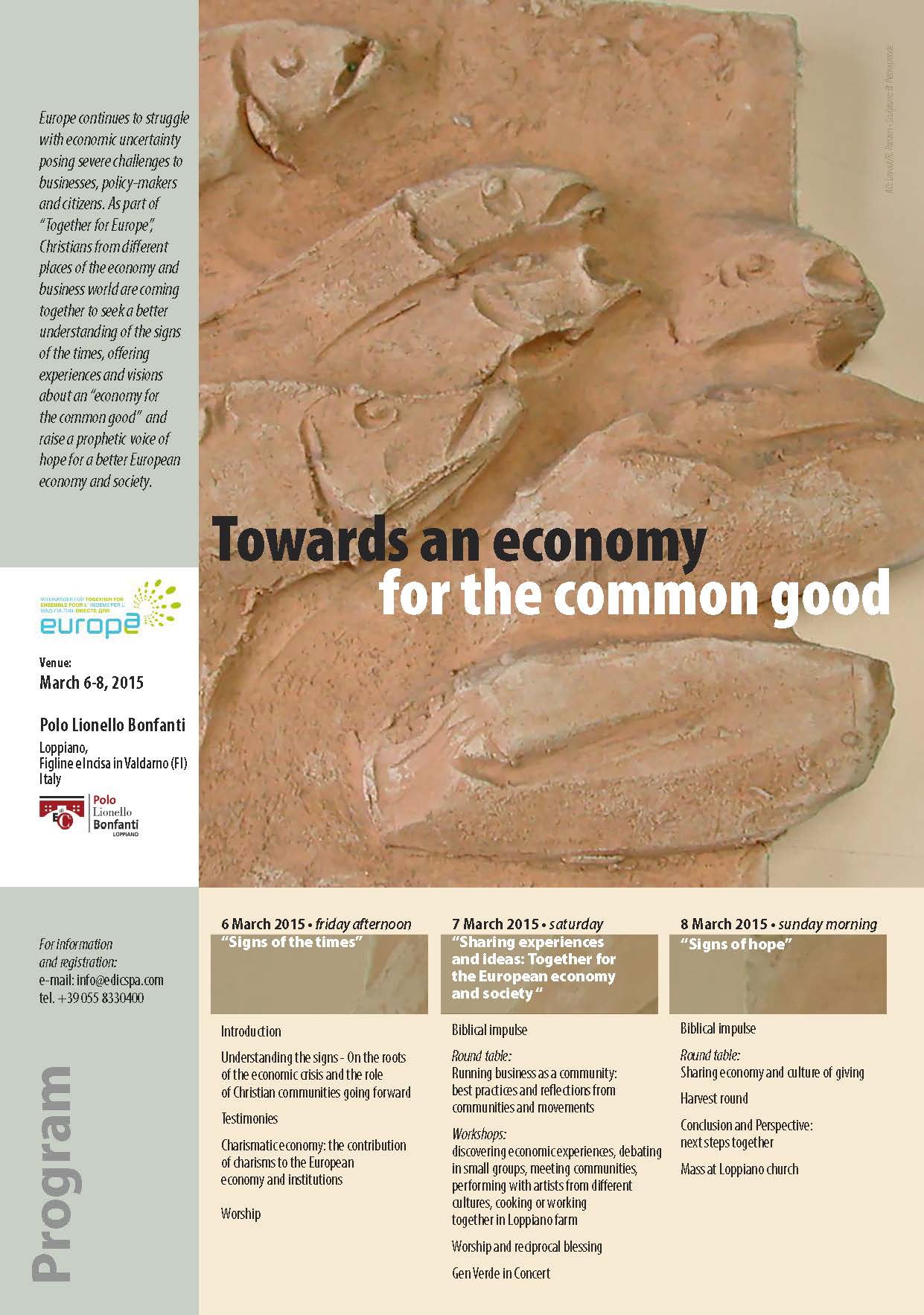 Europe continues to battle with economic uncertainty which is a real challenge for all enterprises, experts of economic policies and citizens. Christians from various economic fields and the entrepreneurial world will meet in Loppiano (close to Florence) from 6 to 8 March, to share their experiences and outlooks, so as to contribute to the diffusion of a prophetic message of hope.
«Up to now, in Europe, only the institutions have stated their opinions – affirmed Prof. Luigino Bruni. Our dream is that in the ministries for economy, there may also be Franciscans, Focolarini and people who have chosen to stand by the side of the poorest of peoples… There is need for gratuitousness. Over the last ten years these voices have been silenced. An economy without a heart, without charisms that are able to include also the poor, is an economy without a future. What do all Christian movements have to say today, about the economic plan? At the start of the millennium we set out on our journey, “Together for Europe,” with Chiara Lubich. After 15 years of working together at the level of gaining knowledge, it seems that this journey has become a working together for a different kind of economy, a different type of politics. The time has come for us to voice out our opinions. »
The idea of a convention was conceived on November 2012 in Munich, Bavaria, during the Together for Europe meeting. On that occasion, economy experts of some movements and communities of different countries and churches, made an appointment to hold a session for in-depth reflection, with the aim of giving a specific contribution in the field of economy, starting off from their own charisms.
The programme provided for a moment of reflection on the “signs of the times” we are all witnessing, with the sharing of experiences. The moments of reflection on the “signs of hope” were shared in a round table on the economy of sharing and “culture of giving.” The programme also included an experimentation work lab «of manual and not only mental work,» at the “Loppiano Prima Farm,” and an artistic workshop with the Gen Verde music group. The convention, entitled “Towards an economy for the common good” will be laid out in three work groups regarding poverty, enterprises and institutions. An expo will be installed with the works produced by each community.
Not only banks, markets and finance will be involved – Bruni continues – but contributions from the lower sectors of society, starting from from solidarity, so as to allow the involvement of the poor and excluded people. We shall attempt to pursue this path with some Catholics and Evangelicals (John XXIII, Schönstatt, Focolare, Ymca and Vineyard) acting as the preparatory committee, and with the specific aim of allowing the charisms to voice their opinions on the economic crisis Europe is undergoing.». The idea, therefore, is to give a perspective to Europe starting from the economy of reciprocity and as a gift and not only in terms of interests and profits. It will be an economy which arises from cooperatives, and the social and civic sectors.
«Europe’s economy –Prof. Bruni explains – was also created by Saints Benedict, Dominic and Francis (if we considered the the institution of the Pawnshops), not to mention the social charisms that invented the schools, hospitals, simultaneously with the world of commerce which progressed with the enterprises and the merchants. The new Europe will arise from this crisis, and to achieve a good Europe, it still needs today, the contribution of the charisms, modern charisms that speak the language of economy: there is a wealth of life in the European Christian movements that still have something to say that differs from that of the European Central Bank. We shall start with modesty, but our objective is to go to Brussels to address the institutions with our specific contribution. »
28 Feb 2015 | Focolare Worldwide
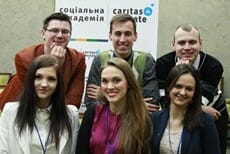
For a number of reasons it’s rather unusual for Ukrainian students to be mobile, to travel to other cities, to meet their fellows from other universities. Therefore, the winter school held in Sumy (Ukraine) from 2 to 7 February was a unique opportunity for the participants to meet and experience the cultural peculiarities of the different regions of Ukraine in a friendly environment of cooperation and mutual support. Because of this, the most important outcome of the winter school was that young people from all over Ukraine were able to meet and socialize, discuss their plans for the future, organize joint projects – and much more. Needless to say, such unity between young people of the East and the West of Ukraine is especially important in the current historical and extremely difficult times of crisis and civil war in the country. Even though after arriving in Sumy, the 42 participants declared that they were quite familiar with the topic of the winter school: “Values in Economy and Business”, by the end of the school all of them admitted that the contents of the lectures and workshops were actually all very new to them and that the illustrative examples given by the lectures provided them with a number of insights into the subject of corporate social responsibility. The school was hosted by the Ukrainian Academy of Banking, and kicked-off by its Associate Professor Petrushenko’s lecture on the ethics in business. His lecture sketched the main philosophical background of the ethics in business and introduced the major definitions of the subject matter of the social responsibility of businesses in society. The next presenter was Cristian Loza Adaui from the Friedrich-Alexander University Erlangen-Nuremberg (Germany) who gave an introduction to the Catholic social thought providing the basis for the EoC. His lecture was entitled: “The Business of Business is the Human Person” and initially it surprised and puzzled the participating students. Cristian Loza Adaui made a very deep theoretical introduction into another way of seeing business from a more humanistic and socially responsible and responsive perspective. He developed this topic further during the next day with a presentation that focused more on the practical application of the values in the context of social market economy. The presentation of Teresa Ganzon from the Philippines who shared her experience of running Bangko Kabajan, a rural financial institution based on the culture of giving and the Economy of Communion was also a new experience for the students who had never had a Skype lecture before and who admitted to be surprised by the very idea that banking could be based not only on the principles of profit maximization. In fact they could learn about a successful experience of running a financial institution that operates based on the respect for every customer as a person and taking into account his or her particular situation. Professor Tatiana Vasylieva talked about responsible social entrepreneurship in the Ukranian context, spending the entire fourth day together with the students. She invited in local representatives from banking and insurance business who spoke very openly and shared both their positive and negative experiences and presented their vision on how the main obstacles to a more socially responsible business in Ukraine could be overcome. Participating students found this lecture very interesting and engaged in a long discussion about the problems of contemporary Ukraine. Every day there were sessions of the winter school that were especially devoted to working on a number of small-group projects related to the subject of corporate social responsibility, ethics and values in business management. The representatives of the “Caritas in Veritate” Social Academy, the promoter of the school were there every day and joined in the discussions of the students’ ideas, helping them in their assigned tasks and in presenting their ideas to an external audience in an innovative manner. The last day of the winter school saw the presentations of the fruits of all the work done in groups. What turned out to be really interesting was the analysis of the controversial relationship between the traditional attitude towards the way business should be done in order to increase profits as much as possible and a social responsible entrepreneurship based on ethics and the values of the common good. All in all this winter school… was a great success.

26 Feb 2015 | Focolare Worldwide
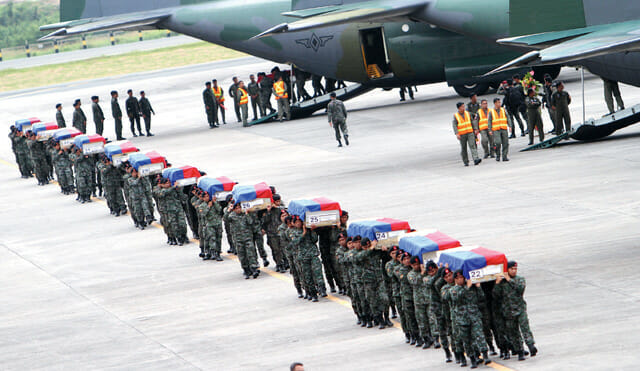 «The country is undergoing a very difficult period. In fact a police contingent sent to arrest some terrorist suspects, was attacked by the fighters of the Moro Islamic Liberation Front and 44 policemen were killed. The Parliament was just deliberating on the new peace treaty between the government and Muslims of Mindanao, with extensive grants in many fields. However, these were blocked and yesterday a video network showed the video of a wounded policeman who was repeatedly beaten to death by a militant of the Front. The indignation of the people was unimaginable!» wrote Carlo and Ding from Manila. Oscar works instead in the government’s Communications Office which therefore had to report on the event. It was not an easy task for one like him who is daily committed to living the spirituality of unity with everyone. «In my job – he wrote– I have to oversee all that happens in the Social Media. This morning I saw the video of our SAF people (policemen) killed by the Muslim rebels. I was very shocked on seeing a policeman on the ground, wounded but still alive, being hit twice on the head and another gutted out with a sickle in his chest… It was terrible, almost surreal, and I couldn’t breathe. The video also showed the rebels gather the arms and personal effects of the policemen and then continued to shoot. It was so hard to think of peace while I was watching those images. I wanted to react, do something. I was almost in tears. Then, watching the sessions of Parliament regarding the event. Some tried to blame a general for his imprecise instruction, and others accused other officers for lack of coordination. Once again I thought, how can we talk of peace? The video on the internet has already been viewed by at least four million people. Part of my work consists in seeing the possible scenarios of a way out. So I ask myself what could be the worst scenario, and I felt fear. I imagine that after seeing those images, many could be overcome by anger and seek revenge. They could see in every Muslim a possible aggressor and turn against him. “And what if a civil revolt is triggered?” I wondered. In the office, as can be imagined, my colleagues were highly emotive. I tried to listen to what God was saying to me in my heart: “More than ever we have to speak of peace. If those among us who have a better view of the situation feel these sentiments of revenge, how will the more emotive and less informed people react?” One of my colleagues suddenly said: “Peace is unpronounceable at this moment. We have to focus on the unity of all the Filipinos, beyond every religious creed. And another said “What happened was an act of violent men who cannot be identified with the entire Muslim community.” Slowly, the anger began to die down. We also remembered what a Mindanao deputy had said: “We are easily angered and influenced by our emotions, because we have not seen with our own eyes the effects a war at our doorstep would have. War is not the answer.” I was pleasantly surprised and left the meeting with a sort of peace inside. In these times, more than anything else, I think we have to work together to bring the ideal of unity to as many people as possible. The menace of war is real. The menace of our compatriots who are angry with our Muslim brothers is real. But the Gospel shows us the path of dialogue and peace. Tomorrow will be a new day for me, another day of listening to many conversations online. I will have the chance to build relationships based on trust and peace. »
23 Feb 2015 | Focolare Worldwide
 “Remember, Luigino, I created the EoC for the poor. You do well to study, but always remember the poor.” Chiara Lubich repeated these words to me many times in the ten years in which I joined her in the international commission, to coordinate the EoC.
To redeem people from the poverty they suffer (quite different from the poverty they choose) continues to be the ultimate goal of the project, the meaning of our actions. As long as there are people on earth who cannot have a decent existence for lack of resources, no economic and social system can be defined as just, and much less as being one of communion.
The types of poverty loved and alleviated by the EoC in these 23 years of life have diversified and expanded. From the favelas of São Paulo and Brazil, we immediately passed on to the favelas of many cities; then we realized, through the tenacious action of entrepreneurs like Paco Toro (Spain) that to reduce poverty we could create jobs and together with the NGO called Azione Mondo Unito (AMU; Action for a United World) we started to support the development of micro production activities in various countries of the world. Finally, we observed that the present crisis had brought back old and new types of poverty into our rich Europe, too. Among these types there is the plague of gamble, which is devastating hundreds of thousands of families, especially the poorer ones. Hence the commitment of the EoC Italy to support the Slotmob campaign, which has taken place in more than 70 cities in just one year and is changing the mentality of many people.
Furthermore, in recent years, the EoC has been spreading especially on the African continent, where the number of companies that this year have started to pay profits to support the world’s poor rose to 10, while 12 others have approached the project; there are several scholarships offered to young Africans, some of whom diligently attend the Sophia University Institute.
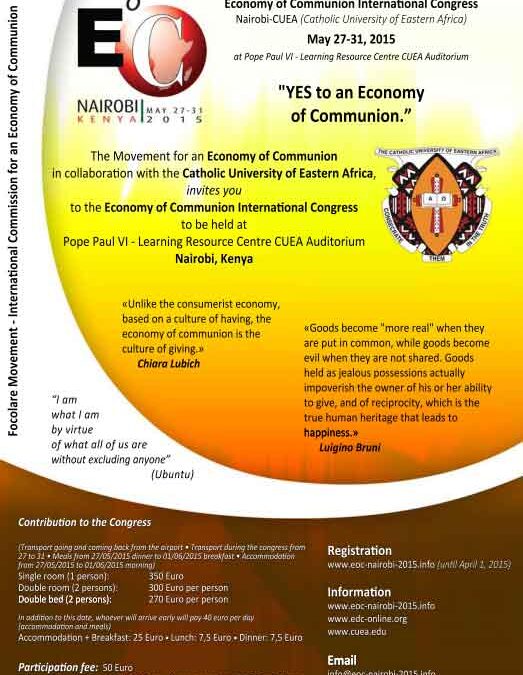
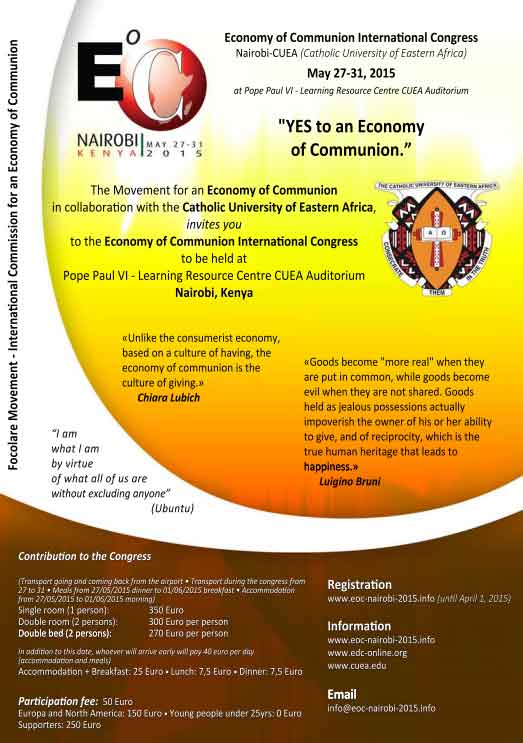
So, feeling attracted by this new and flourishing way of life, as an expression of reciprocity,  we chose Nairobi, Kenya, to be the venue of our international congress, four years after the one that was held in Brazil in 2011.
We will be in that great city from 27 to 31 May and from 22 to 26 May for the first Pan-African school for young people that will also take place there. A continent that is still suffering too much because of predatory relations that many industrialized countries have had and continue to have with it (before forgetting it and then isolating it), when feeling the danger of infection, Africa is destined to be the main protagonist of the economy and society of tomorrow.
Africa’s love of life, its youth, its ancient cultures, all these say it already in a powerful way. The EoC wants to go to Africa to love it, to learn from its culture of life, to practice communion and reciprocity. And to construct a new development model and a new economy. But we want to do this together, and in mutual esteem. At the feast of the peoples.
Luigino Bruni
EdC online
Registration: www.eoc-nairobi-2015.info
Info: info@eoc-nairobi-2015.info
