20 Feb 2015 | Focolare Worldwide
«Bishop Giovanni Martinelli is a little giant. A brave person who, despite the serious health problems besetting him for two years now, continues to “doggedly” stay on in his Libya, and with love take care of his sheep, now just a handful of Filipinos working in the hospitals as nurses and who “cannot” leave the country.
He started by saying, “I have nothing special to say – we have become orphans of the ambassador who has left. But I repeat, I have nothing to say; we are here because Jesus wants us here. I am at the service of this population, and not for any kind of power.”
How about the Catholic community? The Christian communities are still here, we are fine.”
Are you serene? “We have just celebrated Mass. God is with us, what should we fear?”
Is also Fr. Sylvester still in Bengasi? “Of course – Bishop Martinelli answered – also he says that we can stay on to be close to the people who are suffering so much.”
What do you forecast for the future? “It is very hard to make a forecast, or rather, it would be better not to since we had forecasted events that did not come about. We live day by day, or rather, moment after moment. The present moment embraces all. In that moment I encounter Jesus, my brothers, and love these people.”
What’s the situation like in Tripoli? “It seems to be quite calm, they haven’t prohibited anything. The atmosphere is serene and pacific. It is not dangerous to move around during the day. Of course we stay home in the evenings.”
Afraid? “For the moment we haven’t been threatened directly. Let’s see how things develop. They may behead us… but I am willing to deliver it on a plate, since I am here to die for my people.”
What role do you think Italy can play in this situation? “Italy has been very involved, especially the Ambassador, to keep the channels for dialogue open between the different tribes and factions. As of now Italy has taken up a propaganda for peace.”
And what about a foreign intervention? “I don’t think this is a solution.”
In 2011, when there were winds of war, you said that if this happened, Libya would risk the explosion of tribal and political divisions. Unfortunately the Europeans seemed to be certain that elective democracy would positively contaminate the country… “Prudence would have been advisable, then and now. International diplomacy should do its part to allow various pieces of Libya to assemble. We shouldn’t impose political visions that do not belong to these people.”
He then concluded: “If one comes here only with arms and without a strong will to dialogue, it would be useless. You have to come here to love the people, not to target the interests of the western world, or exploit the petrol and other resources. One must come only if pushed by the desire to dialogue with the Muslims. I am here for this, and not for anything else.»
Source: New City online
19 Feb 2015 | Focolare Worldwide
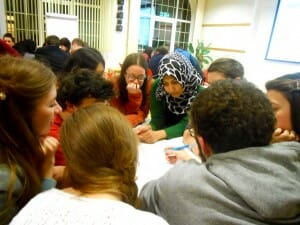
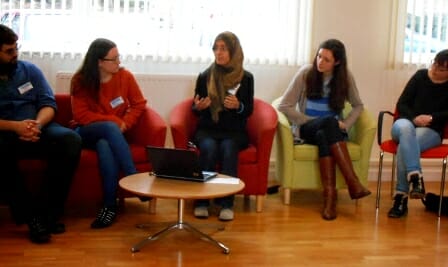 The group of 80 young Christians and Muslims. The topic: multiculturalism, religious diversity and dialogue. The question: Do you care? The format: to “Regenerate,” with two days at Hertfordshire, in a relaxed atmosphere where even burning issues were able to be discussed. The protagonists were young people from the Focolare Movement in Great Britain and Ireland and, this year, a group from the Islamic Unity Society with whom there has been growing friendship and mutual esteem, several projects, study sessions and planting peace trees. Participants listened directly to the experience of Dr Mohammad Ali Shomali, Director of the Islamic Centre of England, who spoke in video conference from Paris. He encouraged the group to “encourage opportunities of dialogue with everyone: dialogue is what characterises us as human beings. Accepting to dialogue with anyone who is different from us does not diminish us, but makes us more true to ourselves.” The honoured guest was Angela Graham who worked at BBC. Raised in Northern Ireland, she began from her own experience as she encouraged the young people to become “people of dialogue” within their own environments, trying to build bridges with people of other cultures and faiths. During the weekend of February 14-15, 2015 at the Focolare Centre for Unity which welcomed them in Welwyn Garden City there were workshops on the various topics: from interreligious dialogue to the social media; from politics to social commitment. “It’s quite striking to experience here people who are so passionate about living and working with God,” said Mohammed Mozaffari, one of the young Muslim men from the Islamic Unity Society. Lucia, from the Young for Unity group remarked: “The differences are not an obstacle, but an aid for building something together.” “Even those who had difficulty in identifying with a formal religion felt quite at ease, and builders like the rest of us,” say Nino and Mil who were among the organisers of the event. The event did not go unnoticed by civil leaders. Town Councilman, Michal Siewniak, stated: “It is encouraging to see young adults from different cultural and religious backgrounds becoming mutually involved in dialogue, and together looking for answers on how to live in harmony within a multicultural and multi-religious society.”
17 Feb 2015 | Focolare Worldwide
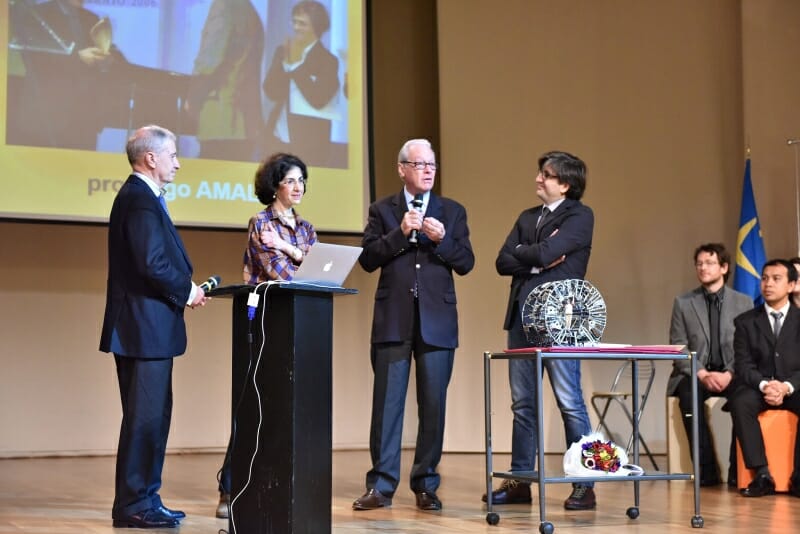
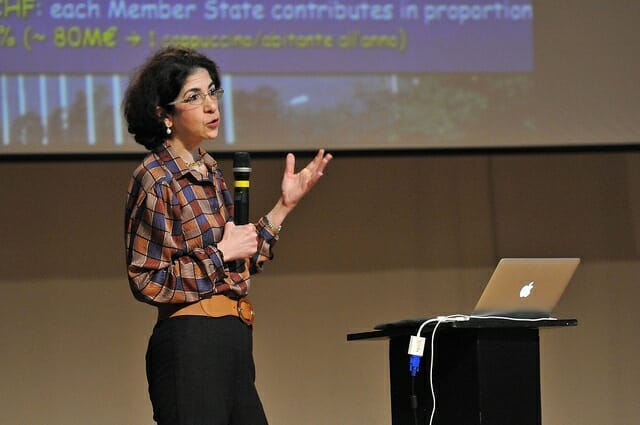
The infinitely small and infinitely big that interact to explain the universe, the application of discoveries such as the Higgs boson, in the medical, technological and social fields. Fabiola Gianotti, the next director of the CERN (European Nuclear Research Centre.) of Geneva, spoke about this on 15 February in Loppiano, before an audience of 800 people among which were scientists, enthusiasts of the scientific world, artists, friends, families and about 200 secondary school students.
In short, it seems that science has once again become fashionable in 2015, year in which people are still beset by the economic crisis, but are likewise in search of “infinite spaces that re-focus on what we are, our dignity, and mission in life,» one of those in the audience said. The merit certainly goes to scientists like Gianotti, but also to events like the awarding of the Prize, “Renata Borlone, woman of dialogue.” It was an event of great educational values, where faith and culture intertwined to bring about moments of personal and social growth.
Dr. Giannotti received innumerable messages of congratulations, among which was that from Maria Voce: «The Renata Borlone Cultural Association and Sophia University Institute (IUS) join in the general acclaim, underlining in a particular way, the values that inspire Dr. Giannotti’s life as a woman and scientist.» The Focolare President stressed “the kinship of ideals and objectives of these two figures” (Gianotti and Borlone), though in diverse fields.
«The Higgs boson is considered as the site that gives rise to all the mass of particles in the universe – affirmed Lida Ciccarelli, postulator of the cause for the beatification of Renata Borlone – Renata too was fascinated, not only by science but by all that regards humanity, and had found that site, that field which had given meaning to her life and her daily existence: God. And just as the scientist moves to lift the veil of mystery surrounding the world of science – she continued – she had found in God the revelation of the “other” who asks for love, acceptance, comprehension, and sharing of joys and sufferings, with a human heart. She lived in this divine space and those whom she encountered found a renewed dignity in discovering that they are sons of God.»
 The Prize’s third edition was intended for scientific research enthusiasts and targets to also promote dialogue with those in the academic field who commit themselves to promoting a culture that respects the dignity of the human person. The reason for the conferment of the prize to Fabiola Gianotti, was read by IUS Prof. Sergio Rondinara: “For her elevated professional qualities, her passion in scientific research and her human capacity in guiding a great number of scientists and researchers involved in the CERN’s ATLAS experiment.”
The prize statue is a work of the Chinese artist, Hung, and represents a miniature of a particle accelerator.
Dr. Giannotti’s speech was an intense and passionate exposition that captivated the audience’s attention, and she conducted them on a virtual tour of the universe of infinitely tiny, elementary particles and especially the Higgs boson, discovered at the end of 2012 thanks to the constant work of 3,000 scientists of 38 countries and the technology of the particle collider LHC (Large Hadron Collider), 27 km long, laid out at 100 meters under the ground between Switzerland and France.
«Some of you may wonder: what is so important about these particles? – the scientist said – in reality this question is intrinsically related to our lives, since if the particles did not have the masses they possess, we would not exist. If the electron did not have a mass, the atoms would not bond together and, therefore, chemistry would not exist and there would be no matter, the way we know it. So we exist also thanks to this Higgs mechanism.»
As to the applications of particle collider, she explained that these are widely used in the medical field to cure tumors. Dr. Giannotti concluded that the CERN research investigates fundamental queries on elementary particles and, therefore, on the structure and evolution of the universe, which are vital for their impact on daily life. «But the fundamental knowledge – she concluded – is in itself important because it is one of the irrevocable rights of man – beyond all the concrete applications, and is somewhat like art which is among the highest expressions of man as a knowledgeable being. And so, to negate the absolute importance of these activities would be like degenerating human nature itself.»
16 Feb 2015 | Focolare Worldwide
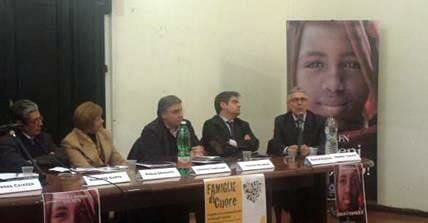
All the documents are stamped and now the child is a son or a daughter in every respect, a child upon whom to to pour all that love, which adoptive parents always have plenty of. Years of waiting and ocean-crossings did not stop them. After a first fleeting encounter in which child and parent became acquainted and some brief stays at hotels abroad, they are finally home. It is a unique and exhilarating experience to witness the completion of an adoption, however, more than a completion, it is also the beginning of an uphill journey. The first hurdle overcome, the newly diplomated parents are assailed by a thousand questions and often feel disoriented. It was for families such as these that “Families of the heart” was begun in Grazzanise, Italy, the brainchild of the Action for New Families Onlus (AFN), and with contributions from the Banco di Napoli Foundation, The project offers a one-stop free counseling service for adoptive families in a local area that provides expert advice, or simply the opportunity to meet with other families. It also provides free courses in which theoretical classes are alternated with social gatherings to promote an exchange of experiences between families, as well as the possibility of networking with other associations in the area. Adoption continues to remain a challenge because to this day still too many children are abandoned in institutions, both in the North and the South. It is a challenge that Chiara Lubich wanted to take on when, in 1967, she invited families who followed her to “empty the orphanages.” And that was how a myriad of families with or without children, opened heart and home to children who did not have a family, providing healing for their wound of abandonment. Mr and Mrs Gravante are responsible for the New Families Project in Campania. They explain: “Through this project we wish to equip families with tools that will strengthen their resources and help them to become world-families, open to the diversity of a daughter or son who comes from a faraway land with both genetic and cultural differences. It is a fascinating process but also demanding, as is retracing the life experiences of a child and helping him or her to make peace with them.” At the New Families Project – as with all authorised international adoption agencies – it is required to follow up with the family for the first three years of post-adoption, but often this time frame is not long enough. The process of the child’s integration in the new family and his or her inclusion in the social structures of an area, can require much more time. The adoptive families, far from being left on their own, need to have a relationship with other families like them, so that each day they can rediscover the value of their choice and regain their initial enthusiasm as they plan for the future, through a process that is the fruit of sharing. Stressing that this partnership is precisely what animates the association, Andrea Turatti, President of the New Families Project remarks: “We are also pleased to offer our thanks for the generous participation of the Bank of Naples in this opportunity for the territory of Naples, a region that well deserves it. In fact, of the 850 children who have found a family through the New Families Project, 180 have been welcomed into this region. And it was the maturity of this region that allowed the launching of the project that we hhope to export to the rest of Italy and beyond as a contribution to a more united society. ” For information: www.afnonlus.org
13 Feb 2015 | Focolare Worldwide
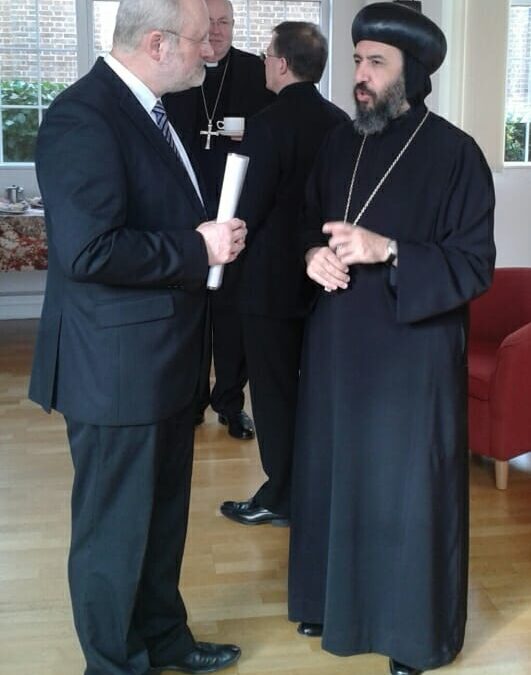
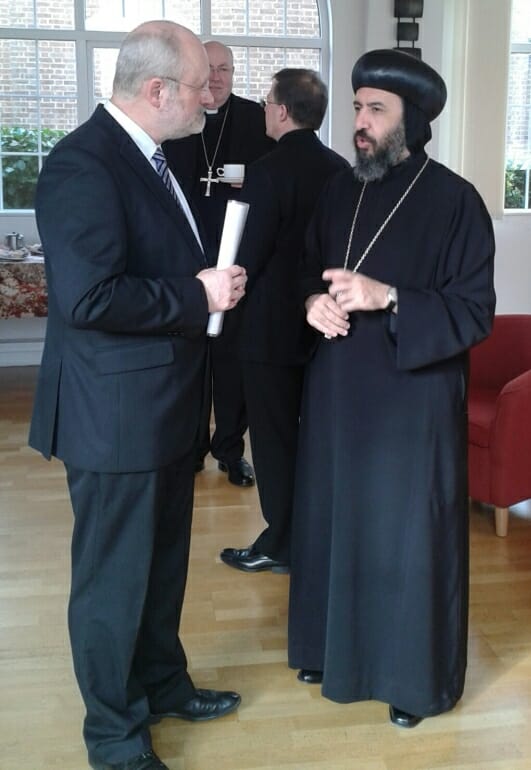 The Egyptian Churches are now celebrating – and not from 18 to 25 January as in many other countries – their Week of Prayer for the unity of Christians. Fadiah and Philippe of the Focolare Movement in Egypt tell of their participation in the various initiatives of the local Churches and how their prayer invoking the Lord’s protection over the entire Egyptian nation is central to the prayer week especially in this delicate moment. . “Receptive Ecumenism” means overturning our mentality which often conceals itself behind the way the members of the different churches deal with one another. Rev. Dr. Callan Slipper, from the Focolare Movement’s International Study Centre explained this during the ecumenical meeting at Welwyn Garden City (London) last 4 February. Slipper, who is also Regional Delegate for all the Churches in Hertfordshire County, in his speech (Chiara Lubich and convivial ecumenism: how the spirituality facilitates unity between Christians) expounded on how “instead of thinking that all would be better if the others tried to be more similar to us, and that therefore we have something to teach, we should instead, approach others to learn from them.» By going towards the others with this attitude, he said, «we would discover that we have nothing to hide, but can only admit our weaknesses and the need to be healed. This opens up a new relationship and leads us to a new conversion and deeper bond with Christ, in whom we can fully discover our true ecclesiastic identity.” Among the audience was a number of highly qualified people: 14 Catholic, Anglican and Lutheran and Coptic Orthodox Bishops coming from different parts of England together with the Secretary General of Churches Together in England, the national ecumenical organisation of the Churches of England. For them, the meeting was a “taste” of a new ecumenical methodology and a way of sharing experiences in their respective churches. During the same week, in Germany, at the Ecumenical Centre of Ottmaring, all remembered the importance of authentic Christian life that can counter the violent and liberticidal phenomena we have recently witnessed, as in the attacks in Paris. Gérard Testard, French, and member of the Executive Committee of the “Together for Europe ” network and founder of the interreligious “Efesia” initiative, was guest of honour: “Jesus’ encounter with the Samaritan woman at Jacob’s well – he said, referring to the phrase chosen for the Week of Prayer “Will you give me a drink? ” (John 4,7) – points out the way for this situation: Jesus breaks down all the barriers men have built and manifests himself as the Saviour of the world. The present-day events oblige us as Christians to work for unity, while the mission of unity goes beyond the Christian world to face the perils of unacceptable terrorism, violence, fanaticism.” Testard presented the positive experience of dialogue promoted also by the Council of Muslims of France and the French Bishops’ Conference, and “Efesia” created in 2007 in Lebanon. Christians and Muslims regularly meet on 25 March, feast of the Annunciation, since Mary is highly venerated also by Muslims. After four years the Lebanese authorities declared 25 March as a national Christian-Muslim holiday. It is historically the country’s first common feast day.»
12 Feb 2015 | Focolare Worldwide
During the General Audience of February 4, 2015 Pope Francis stated: “Brothers and sisters, when I hear the words “victory” or “defeat” I feel great sorrow, great sadness in my heart. They are not just words; the only just word is “peace”. This is the only just word. I am thinking of you, Ukrainian brothers and sisters …. Think, this is a war among Christians! You all share one baptism! You are fighting with Christians. Think about this scandal. And let us all pray, for prayer is our protest before God in times of war.”
While world diplomacy is mobilised, the facts seem to belie any prospects of peace. Yet there are people and institutions who work with courage to safeguard it, even at the risk of their own lives.
We ask Vera Fediva from the Focolare Movement and resident of Ukraine: How are the ordinary people living through this situation?
“This is a very difficult tiime for our country, filled with frustration and suffering. Nearly 5,000 civilian deaths, very many wounded and disabled, thousands of refugees and, unfortunately, we can’t foresee what the end will be. We often remember how our Movement was begun in the midst of the Second World War when everything crumbled. . . but we never would have imagined that it could happen in the twenty first century, nearly in the very heart of Europe and in such a tranquil country like Ukraine. Our community resides at Mukacevo on the western side of the country where there are no armed clashes. But psychologically it is difficult to hold up, also because many have relatives, friends, neighbours and even children who are fighting. Many have lost loved ones. We’re living in the midst of a situation in which nothing is stable. It’s difficult to plan anything. Nobody knows what will happen tomorrow. Perhaps a husband or an only son will leave for the war. We can only count on God who is Love. Just as when the Movement began. . . We do feel that it is important in such circumstances not to allow hatred into our heart, so that we can be able to forgive and even to pray for our enemies.”
As the Pope says, prayer is our protest. A year away from the beginning of the conflict, what did you do as a Focolare community and with other Christians so that this “protest” could be felt?
“For several years we have been working in defense of life at all of its stages; this allowed us to build relationships with people from several Christian Churches in our city. We held a few events together like the “March for Life” and “Family Fest”. We were encouraged by the “Ecumena” group from Kosice, Slovak Republic, which follows the spirituality of unity. Last year we organised a large “Prayer for Peace in Ukraine” event in the centre of the city, together with ten different Churches, which was largely attended by the general population. Then we continued to meet, and we shared three great moments of “Prayer for Peace” since the war began. We feel that the unity among us is particularly important now as Christians are fighting and killing one another in a war that is completely senseless. That’s our small and silent response to the Pope’s prayer, to overcome the scandal of the division and make a contribution to peace and reconciliation in our land.”
