![Guatemala: “A place of many trees”]()
18 Mar 2012 | Focolare Worldwide
 The name Guatemala comes from náhuatl Quauhtemallan, ‘place of many trees’ and its location is on the extreme north-west of Central America. The indigenous culture derives from a Mayan legacy and from the Spanish influence of the colonial period. The country has tremendous natural beauty. Its official language is Spanish and there are also 23 Mayan dialects, and the languages of the xinca and the garifuna peoples. It covers an area of 108,889 square kms and it has about 14 million inhabitants, a third of whom come from indigenous peoples. We will deal here briefly also with the countries close to Guatemala that will be involved with the trip of the president and co-president of the Focolare. The idea of a united Central America has caught on in many parts of society, in the political arena, and led to an attempt to have open borders and to discover a Central American identity. Guatemala, Belize, El Salvador, Honduras, Nicaragua are the countries of this region which is rich in its ethnic diversity. Its peoples have suffered a great deal, with more than 40 years of military dictatorship resulting in the civil wars of the 70s and 80s and of ‘internal armed conflict’, which in Nicaragua began at about the same time as the cold war in Europe. There were more the 36 years of armed struggle, with thousands of victims, genocide, persecution of the Church, summary executions, assassination of priests and catechists, among them Mgr Romero and Mgr Gerardi, devastated lands and the violation of human rights. In the 80s about 90% of the populace in Guatemala was made up of indigenous people, now it is estimated at 51%.
  In the 90s peace was consolidated and a new stage began. The postwar conditions meant that this was not easy as there was an ongoing lack of security, family breakdown and emigration by many in search of work. These difficulties have since been caught up in new problems such as drug trafficking, gang warfare and extortion. These countries are among those with the world’s lowest Human Development Index (HDI) but, despite this, their peoples maintain hope born of their faith in God, are tremendously generous and they never give up. The Ideal of unity came to these lands in the 80s and, in the midst of the remaining challenges faced by all, it contributes to dialogue among cultures and different ethnic groups and encourages a deep mutual acceptance. A small Focolare community was started in Guatamala by an Italian priest, Fr Vitale Traina. Some of its members, a short while later, went to a Mariapolis in Mexico, and when they got back they were full of enthusiasm and wished to bring this life to others. In 1981 they held two Mariapolises in Guatemala. 1986 was an important year: a focolare house was opened. Valeria Ronchetti, one of Chiara Lubich’s first companions, during a visit laid the basis for the establishment of a Mariapolis Centre and two married focolarini, Paolo and Pinella Maciotta, moved from Italy. The Ideal of unity also began to spread beyond the capital to an indigenous region near Patzun. In February 1992 the Mariapolis Centre St Mary of the Focolarini was opened. It was to become a formation centre for all the different nations of the region. With the help of AMU (Azione per un Mondo Unito, meaning Action for a United World), an NGO set up by Focolare Members, there was established a ‘School for Human Development’ close to the Mariapolis Centre. The school has helped large numbers of people learn a trade to live by. Later on the Fiore Educational Centre (an early learning centre and primary school) was established. There are at present about 3,100 members of the Movement.
  El Salvador had its first Mariapolis in 1982, with about 600 people. It was a real miracle given the extremely difficult conditions caused by the country’s civil war that had broken out two years before. It could be said that that Mariapolis marked the Movement’s consolidation as it included many people who would become core members. Today in the nation’s capital, the city of San Salvador, there are centres that coordinate the Movement’s life in the five countries of Central America.
  In Honduras apparently by a luck. Someone went to Mexico to study Catholic literature and by chance met the focolare. In June of the same year, 1981, the same person went back to Mexico together with two others in order to go to the Mariapolis. In 1982 the focolarine in Mexico started going to Honduras and, in the capital city, a decisive event for the small community living the Word of Life took place with the arrival from Italy of the Turatti family, who stayed 10 years. An key moment was in 1995, when the first Mariapolis, of about 250 people, was held. The bishop Mgr Oscar Andrés Rodríguez, now a cardinal, was present and he encouraged everyone to take the spirituality of unity everywhere. He asked Chiara Lubich several times for a centre of the Movement to be opened and his dream became real in February 2010 when the focolarine set up house in Tegucigalpa. There are now about 900 members of the Movement in Honduras. In December this year Maria Voce, in conversation with the focolarini from Guatemala, during a conference in Castelgandolfo, considering the difficult situation of the peoples where they were living, encouraged them to behave as Jesus did: ‘Jesus did not despair, because he looked within himself. That is, he looked to his relationship with God and knew that God would carry out his plan even in this situation… A plan that passes, perhaps, via the cross, via persecution, that passes today via these catechists who have been killed, via these priests who have been killed, that passes via drug traffickers, but it is part of God’s story that, despite everything, builds up humanity. It is a story with pages of light, pages of pain, beautiful moments, difficult moments, but they are God’s story.’ What needs to be done then? ‘Into this story of God we too enter, as Jesus entered in his time. What do I do in Salvador with such an immense Ideal in the face of these situations? What do I do in Guatemala with this power of Jesus within me, among us, in this situation? I do what he did. I pass though the streets, I look, but my looking is full of God and of what God is doing. So, it seems to me that it is here that our strength lies.’
![Guatemala: “A place of many trees”]()
17 Mar 2012 | Cultura, Focolare Worldwide, Focolare Worldwide, Focolari nel Mondo

Focolare website team with Giovanni Silvestri (right), President of WeCa Association
The international web portal of the Focolare Movement received a special mention in the category of institutional websites, because of its ‘rich information, providing ample space for unity, according to the charism of Chiara Lubich, and is published in 7 languages (including Chinese)’ as the citation puts it.
The ceremony took place during the workshop entitled ‘Young People, Internet and Faith Education’ run jointly by the Italian Bishops’ Conference’s national service for the pastoral care of young people and the Italian Association of Catholic Webmasters.
‘A space where anyone can feel welcomed and at home’; ‘to show people the life born of the charism of unity spread throughout the world’; ‘to put highlight the journey to unity of the whole human family, through its various dialogues with different religions and cultures.’ These are a few of the guiding principles in place since the construction of the new version of focolare.org. Hence it was a welcome surprise to hear the citation for the prize, which has come a year after the new site went online. What was said will be a stimulus to continue faithful to the Focolare’s basic values.
There are about 15,000 Italian Catholic websites and WeCa, recognized in the Italian Bishops’ Conference’s Directory of Social Communications as ‘the first European initiative of its kind – as they themselves point out – which is intended to unite, in a living community and in continuous synergy, the knowledge and experience of Catholic Webmasters.’
WebCattolici website report (Italian): “Premiati i migliori siti cattolici italiani 2012”
![Guatemala: “A place of many trees”]()
16 Mar 2012 | Focolare Worldwide
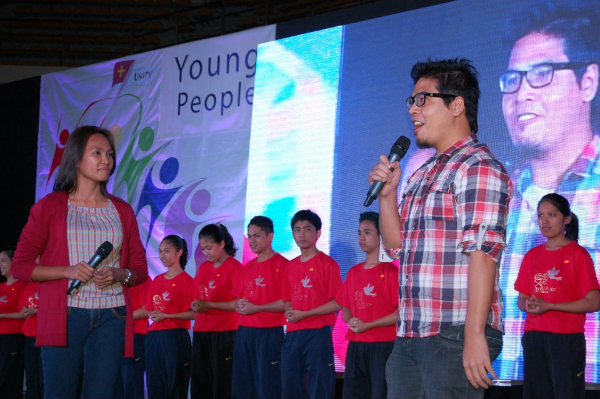 URL. This time it is not Unique Resource Location that allows you to locate the address of an internet site, but United in the Revolution of Love, love that is inspired by the Gospel, the love that thousands of young people throughout the world have drawn from the life and teachings of Chiara Lubich whose fourth anniversary of the departure for Heaven is being remembered during these days.
URL was the title chosen by young people from the Philippines for a gathering on 10 March, the day chosen to pay tribute to Chiara and to the impact of her charism on the young people of today and of yesterday. The venue was also symbolic. The event was held in the 400 year-old pavillion of St Thomas University, the royal pontifical university that had conferred a doctorate of Theology on Chiara in 1997.
During his welcoming remarks, Fr Rolando De La Rosa, ninety-fifth Rector of the university, shared of his personal encounter with Chiara in 1977. He described her as a person worthy of imitation, because she proposes holiness as a goal that is within the reach of everyone.
The Gen – youth people committed members of the Focolare Movement – along with adult members of the Movement witnessed to the “constellation of stars” that Chiara had once intuited would come to exist in the heart of the Movement as a “second generation” that would come after those who had begun. They would be true protagonists of the “revolution of love”.
Among the 2000 young people who filled the pavillion was a group of Buddhists who offered a song about unity. There were also many men and women religious from several congregations and some seminarians who were struck by Chiara’s message to the young. One girl writes: “This is the most beautiful moment I ever lived in my life. Knowing Chiara Lubich is the greatest chance that has ever been given to me becuase, like many others who’ve met her, she made me able to discover God . . . who is Love.”
One young man summarized the two-hour programme in this way: “Celebrating the 4th anniversary of Chiara’s birth to Heaven – the presentations and video-clips about her – evrything spoke of the possibility of giving your life for a revolution capable of changing the lives of thousands of people. The interviews with people of different ages, professional and cultural backgrounds underscored the revolutionary effects of the Gospel when it is put in practice. All the songs, the dances and expriences focused on Chiara’s impact on society, the Church and the world, they gave you an idea of the impact of her Ideal on the lives of so many people of diverse cultures, on interpersonal relationships, vocations, the arts, politics and business. . . on every aspect of life.”
The day concluded with the solemn celebration of the Mass, presided over by Bishop Gerard Alminaza and concelebrated by Bishop Antonio Tobias, in charge of ecumenical affairs at the Bishops Conference of the Philippines. In their closing remarks, the directors of the Focolare in the Philippines offered the words that Chiara used as she imagined what her encounter with God would be like: “If You asked me who I was, I wouldn’t say my name. I’d say THANK YOU for everything and forever!” It was with these words in their hearts that everyone left the pavillion that afternoon.
16 Mar 2012 | Focolare Worldwide
![Guatemala: “A place of many trees”]()
13 Mar 2012 | Focolare Worldwide, Senza categoria
 Roberto and Patrizia live in the province of Naples, Italy. Like many Italian families they have really been put to the test by the economic crisis. Ten years ago they adopted a girl and now their family has grown in size with the adoption of a Chinese boy who is in urgent need of sugery and medical care. This experience of welcoming children into their home has brought them much joy, but also sacrifice. While reviewing the family budget, the question arose whether or not to continue the distance support which they had been providing for a girl in Brazil. “Life isn’t easy,” they write to their friends at Santa Maria di Igarassu School in Recife. “We Italians are losing economic certainty and peace of mind as an advanced industrial society. Many parents are losing jobs, young people can’t find work, people of advanced age are no longer certain of their pension. Health care is no longer completely free and the cost of living has risen so much. Faced with a scenario such as this, many families have begun to reduce cut back, to shorten their holidays – and we have also had to make sacrifices.”
  As the days passed, there was a growing sense of emptiness. Their thoughts kept returning to the “Escola Santa Maria” located, since 1967, in one of the poorest regions of North East Brazil, surrounded by unemployment, alcoholism, drug abuse and violence. Many children living below the poverty line have been rescued over the years thanks to the generosity and perseverance of distance adopters, and even the entire community has benefited from their support. “We looked at each other, spoke some more, and realized that it would be a mistake to turn in on ourselves. We realized that we should rather widen our hearts and continue with the distance support (link http://www.famiglienuove.org/it/sostegnoadistanza.php) for the Brazilian child. She and everyone else at St Mary’s School were our family in Brazil. It would never be justifiable for us to just abandon them.”
  Meanwhile little A.X. will be facing his first surgery, which will last six hours. “We got through it with much serenity and courage. Those who sow love, reap love. Our hope for him, for his sister at home and for the one in Brazil is that they will have a positive future in which the love they’ve received and will one day emanate, may one day reach out to help others.
![Guatemala: “A place of many trees”]()
11 Mar 2012 | Focolare Worldwide
 Hungary has a very clear identity and it is a centuries-old bridge between Eastern and Western Europe. After the fall of communism it now finds itself in a crucial moment of transition. The country is seeking a new equilibrium between maintaining its specific characteristics and openness to the rest of the world. Speaking to the Hungarian community, during her recent visit, Maria Voce, the current president of the Focolare, invited them to ‘be aware of the many talents you have. Give them and welcome those of other peoples, learning always more how to work together.’
 As a result of its geographical location and its past history, Hungary has had an important role also for the Focolare. Already in 1965, following the tragic events of the revolution that year, Pope Pius XII launched an appeal to the faithful throughout the world to ‘bring back God into society.’ Chiara Lubich responded with an exciting initiative: she began the Volunteers of God. In 1996 Budapest hosted the celebrations of their 40th anniversary and in 2006 the city hosted the ‘Volunteerfest’ with 12,000 people who came from 92 different countries.
 In 1961, Chiara Lubich, visiting Budapest, was struck by the Church’s enforced clandestine existence. That year a focolare house was opened in Vienna, and from there, in the 70s and 80s, visits to Hungary took place. Contacts were made with people previously met in Italy and Austria. The first Focolare community in Hungary goes back to the years of communism when, between 1981 and 1982, men’s and women’s focolare houses were opened in Budapest.
The Focolare Movement in that difficult moment of history had an important role in supporting relationships between Catholic individuals and organizations, and so contributing to maintaining and developing the faith. Especially important was the role of several families who, with generosity, moved house and brought the Spirituality of Unity to various towns in Hungary and beyond. Thanks also to the commitment of several priests, the spirituality of the Movement spread further afield, transmitting the freshness and genuineness of gospel life.
 Their shared suffering also strengthened relationships among Christians from the historic Hungarian Churches (Catholic, Reformed and Lutheran). Today they witness together to a fruitful ecumenical dialogue. The result has been two historic youth events: in 2000 the first ecumenical meeting for young people, organized by young people’s movements, with 3000 participants, and a repeat in 2003 with 16,000 participants. The Spirituality of Unity is spreading by means of books and the magazine Új Város.
The Word Life, which has 15,000 printed copies, is published in weekly newspapers and on the internet and is transmitted by radio.
 History, therefore, has prepared the Focolare in this country to do its part in promoting initiatives that witness to the effort to build up fraternity, locally and internationally, run by younger and older people together: ‘72 hours without comprise’, ‘Peace Project Network’, ‘Mission to the City’, ‘Run for Unity’, ‘United World Week’.
In 2011, fifty years on from Chiara’s visit to Hungary, Maria Voce, visited the Movement’s communities, meeting priests, families and young people. She saw the commitment of New Families to work with young couples and how they work together with other associations and with various Churches to support marriage and family life. Maria Voce met with the members of New Humanity, which brings together people active in various worlds: health, economy, politics, sport and education.
 But one of the most important meetings was with young people. Indeed, the Movement in Hungary is currently preparing to welcome 12,000 young people from all over the world between 31 August and 2 September 2012 for the 10th Genfest. Budapest will become a workshop of unity for the world. The event is called Let’s bridge and it will help Eastern European countries to ‘build bridges’ by displaying their specific values and characteristics. ‘It should be a huge celebration,’ Maria Voce said to the young people when they met. ‘It should give huge joy to the young people who come… letting them see for themselves that there is nothing more beautiful than the gospel revolution. We’ve seen revolutionaries of another sort: in the fields of art, of music … but a revolution that changes our lives and that can change the lives of others … the revolution of the gospel, the only one that God has really shown us with such power … let’s give all we’ve got to show it also to others!’
Visit Hungary’s pages on Focolare Worldwide!
Websites: Focolare Movement: www.fokolare.hu
Young People for a United World: www.ujifju.hu
Genfest: www.genfest.org

 In Honduras apparently by a luck. Someone went to Mexico to study Catholic literature and by chance met the focolare. In June of the same year, 1981, the same person went back to Mexico together with two others in order to go to the Mariapolis. In 1982 the focolarine in Mexico started going to Honduras and, in the capital city, a decisive event for the small community living the Word of Life took place with the arrival from Italy of the Turatti family, who stayed 10 years. An key moment was in 1995, when the first Mariapolis, of about 250 people, was held. The bishop Mgr Oscar Andrés Rodríguez, now a cardinal, was present and he encouraged everyone to take the spirituality of unity everywhere. He asked Chiara Lubich several times for a centre of the Movement to be opened and his dream became real in February 2010 when the focolarine set up house in Tegucigalpa. There are now about 900 members of the Movement in Honduras. In December this year Maria Voce, in conversation with the focolarini from Guatemala, during a conference in Castelgandolfo, considering the difficult situation of the peoples where they were living, encouraged them to behave as Jesus did: ‘Jesus did not despair, because he looked within himself. That is, he looked to his relationship with God and knew that God would carry out his plan even in this situation… A plan that passes, perhaps, via the cross, via persecution, that passes today via these catechists who have been killed, via these priests who have been killed, that passes via drug traffickers, but it is part of God’s story that, despite everything, builds up humanity. It is a story with pages of light, pages of pain, beautiful moments, difficult moments, but they are God’s story.’ What needs to be done then? ‘Into this story of God we too enter, as Jesus entered in his time. What do I do in Salvador with such an immense Ideal in the face of these situations? What do I do in Guatemala with this power of Jesus within me, among us, in this situation? I do what he did. I pass though the streets, I look, but my looking is full of God and of what God is doing. So, it seems to me that it is here that our strength lies.’