23 Jan 2016 | Focolare Worldwide
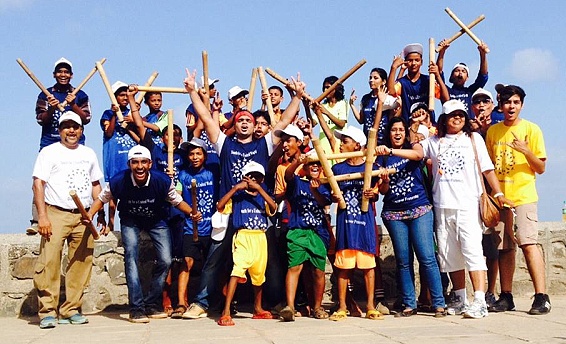
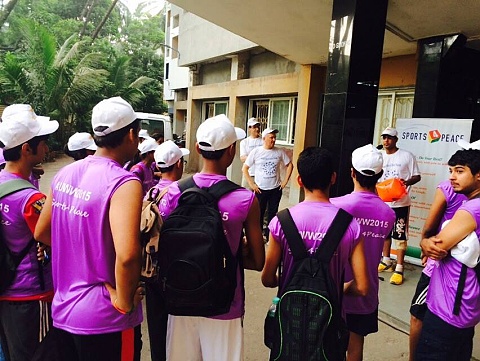 “Sport can really change the world and make it more united”. Patsy Furtado, a hockey coach from Mumbai who once played for the Indian national hockey team, speaks with the strong conviction that comes from an equally strong experience lived with street children in this immense metropolis. She had met the Focolare and the idea of Sportmeet through a Run4unity event in 2005. Her passion for sports and the experience of unity lived that day fuelled her desire to join forces with other like-minded coaches and bring about change in the surrounding area, where children often can be seen living on the streets. She had just got to know a home for destitute children with 240 children, neglected by society. She got the idea to start coaching them in different sports: football, basketball, hockey, athletics … Every morning at 6.30am they started having a one hour training session. Initially there were 20 girls and 30 boys who came for training without shoes and proper sports gear. Today there are a number of teams, all having proper sport shoes, gear and kit bag. In 2007 they entered the inter-school competition at the all Mumbai level and the under-12 football team stood eighth in Mumbai among over 300 schools. This achievement made it to the Hindustan Times, one of Mumbai’s major newspapers, with the heading “United We Stand”. Listing the numerous achievements of this project, Patsy points to the fact that the children’s behaviour improved tremendously: sports taught them to be disciplined and after playing sports all their energy is used in the right way. Whereas it would be natural to be violent and aggressive with a background like theirs, they become confident and have self respect, they look after their hygiene and take responsibilities. Coming from various religions the children come together to play as a team and there are no differences among them. In 2009 the first Sports4Peace workshop was held in Mumbai. Promoting a cube with 6 rules to educate for Peace through sports, the idea of Sports4Peace captured the imagination of various coaches and others engaged in the field of sports in Mumbai and other cities in India. “Play well”, “Hang in there”, “Look out for others”: simple rules which have touched the lives and inspired several youth and sport enthusiasts to apply them with passion in their various disciplines. The idea of Sports4Peace became part of various interreligious cultural college activities as well as diocesan events in Mumbai and in Pune, a neighbouring city known for its numerous colleges. Presented in various Run4Unity editions also in Delhi, it was promoted in the recent United World Week hosted in Mumbai in May 2015, when a permanent Sports4Peace cube was installed in a prominent place in a public garden on Mumbai’s popular Bandstand promenade to remind all that sports, lived and played well, can promote peace and universal brotherhood. Gustavo Clariá
23 Jan 2016 | Focolare Worldwide
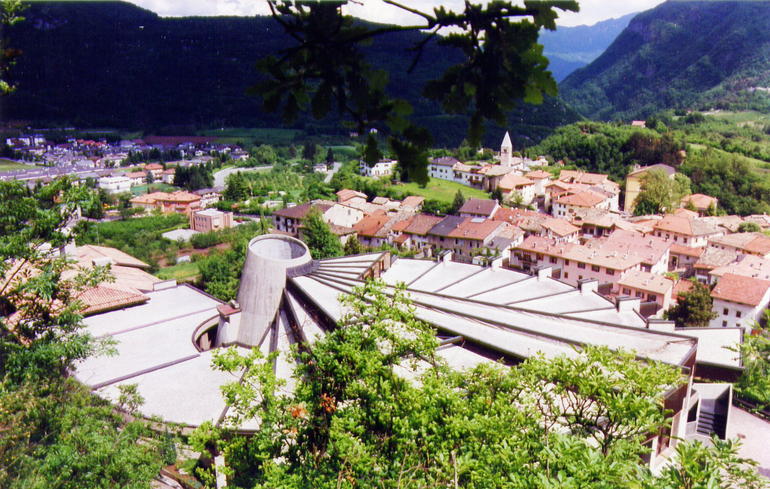 “This the house built on the rocks, (Word of Life) will remind us of the one Jesus spoke about. Winds and storms may blow but it will not collapse,” Chiara Lubich said on 24 May 1986 at the inauguration of the Mariapolis Centre of her birthplace. 23 January 2016: it will be a feast day at the Centre which is today dedicated to her, in memory of 30 years of history, testimonials, dialogue and communion in the light of the charisma of unity. The event will open with the message of Maria Voce and a video that traces almost 30 years of history. Then there will be some testimonials of the local members of the Movement in the civil and ecclesial fields, and the greetings of the Archbishop of Trent, Bishop Luigi Bressan, and the Mayor, Alessandro Andreatta, and other authorities. After 30 years, the Centre of Cadine has been faithful to its own vocation: to be a place of encounter and formation for those who wish to commit their lives to irradiating the life of the Gospel and bringing back through mutual love, the presence of God in the world. Flashback to the past. In the 1970s the Focolare Movement, diffused throughout the region, felt the need for a formation centre. After various futile searches, efforts were focused on Trent. When she was told about this, Chiara responded: “I had always thought of it as a city chosen by God.” A few months later the entire Movement was living the Word of Life: “Sell all you have, and give it to the poor.” The desire to put this Word of the Gospel into practice pushed Nostra Fadanelli, a follower of the Movement, to donate nine hectares of a wood for the construction of the Mariapolis Centre. The design was entrusted to Carlo Fumagalli, a focolarino architect who, with the awareness of having to build a Centre in the city where the Movement was born, traced the stages of her history in Trent and in the Primiero Valley, reproducing some details in the building’s architecture. The project was presented to the Archbishop at that time, Bishop Gottardi who said: “This has to be a ”monument” to Chiara Lubich, of course, when she will be in Paradise. And it will be the best monument if, with regard to the history of Trent, it will be… a Mariapolis with an “ecumenical flair,” and link up to the ecumenical mandate of the City of Trent, expressed by Pope Paul VI in 1964. And he concluded: “You have this mission!” From that moment on, the generosity of each member of the Movement started circulating, each with his own possibilities and the fantasy of those who build their “own” house. In October 1980, while the bureaucratic procedures were underway, news arrived that they were looking for a house for the International Mariapolis Centre. So they all decided to donate the funds collected up to then: a big sum which surprised Chiara herself. It seemed to be a crazy idea, but upon acquiring the permits to build, a new and substantial sum arrived, three times what they had given, which made them experience the promises of the Gospel: “Give and you shall be given.” So in 1982, the day section of the building of the centre started: the foyer, meeting halls, kitchen and dining room. Everyone wanted to help, giving their time and forces, and in the last year of the works, about 800 people alternated with the artisanal works, finishing and workforce. A memorable day was when the road and square were paved with porphyry, which was finished the day before the inauguration. On 24 May 1986, before about 2,000 people, among whom were representatives of the most important churches in Europe, Chiara herself inaugurated the Mariapolis Centre, underlining its ecumenical and formative vocation, and called the centre, “Word of Life.” After Chiara’s death in 2008, on 24 January 2009, with a highly ecumenical ceremony in the presence of Maria Voce who succeeded Chiara as President of the Focolare Movement, and many other civil and religious celebrities, the Centre was dedicated to Chiara Lubich. In these 30 years, tens of thousands of people have been guests of the Centre, mostly members of the Movement but not only them, given that it has also opened its doors to other meetings promoted by the Diocese, Catholic Movements and other lay associations of the territory. The Centre hosts in particular, conventions, formation schools, and various groups of the Movement from all over the world, who come to retrace in Trent and the Primiero Valley, the early days of the movement, when all was just beginning. The Centre bears witness to the dawn of the Movement, and the urgency to keep a “dialogue platform” active among individuals and peoples, and between the churches and great religions, to refocus and give room to fraternity.
20 Jan 2016 | Focolare Worldwide
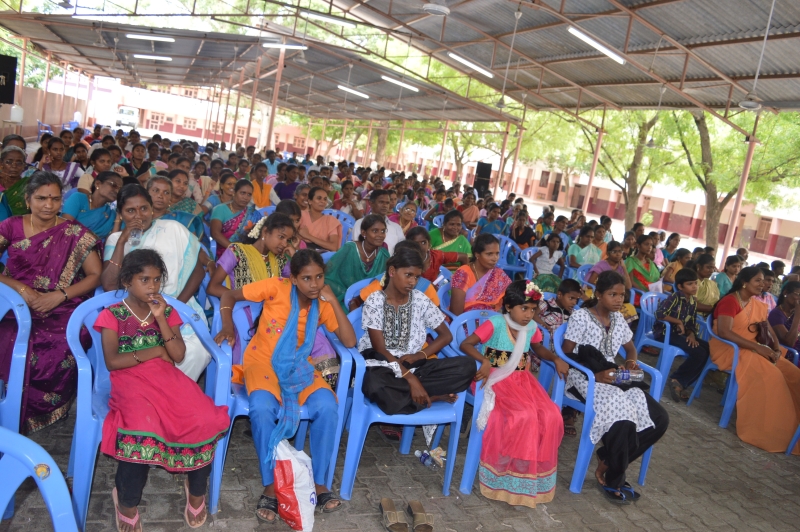
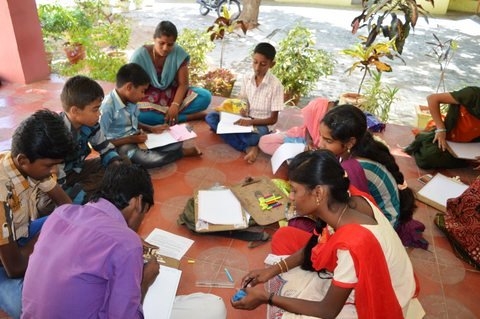 On 2nd February Fr Susai Alangaram celebrates 25 years of priesthood. He had just six years of experience as a priest in Tiruchirapally,Tamil Nadu, the southernmost state of India overlooking the Indian Ocean, when he ventured on the task of setting up a project aimed at alleviating the poverty of the children of his parish. He had encountered the Focolare Movement and committed to live for and give witness to unity with fellow priests in a caste ridden society, and with the help of two other priests he started his support at a distance project with 50 children, naming it Ilanthalir, meaning tender shoots of crops, to remind of the tender care needed for the growth and development of these children. Today poor rural children in various villages of five districts of Tamil Nadu are supported by Ilanthalir in an area stretching 125km further south from Tiruchirapally and 70km to the North. After the 2004 Tsunami children from two coastal villages were also sponsored, and they are presently following their university studies.
 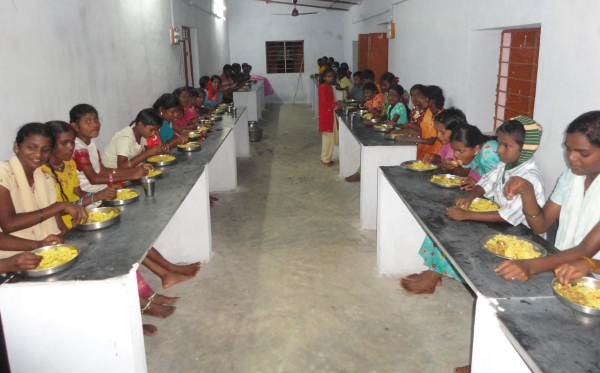 The climate in Tamil Nadu is always hot and the monsoons are unpredictable, disrupting crop cultivation and impoverishing farmers. This year there were floods in the northern part of Tamil Nadu and drought in the centre. Many families below the poverty line are more concerned with earning than educating their children, and this gives rise to illiteracy and child labour. Ilanthalir seeks to provide children with their basic necessities and sponsors their education until they are able to find employment and assist their families. This year 456 children are benefiting from direct support and 300 more are receiving assistance from Ilanthalir. As the children are of different faiths Ilanthalir makes arrangements for all to celebrate together their major festivals of Diwali (feast of light), Pongal (harvest festival), Christmas, etc. October is observed as the month for the protection of the environment, and each centre organizes a programme of tree planting, cleaning up of public places, etc. What is striking about the Ilanthalir experience is the impact of the spirituality of unity in a context which would otherwise lead to a culture of survival and isolation. The Word of Life of the Focolare, a commentary on how to live Gospel phrases, is translated into Tamil and distributed to the children and their parents, and once a month they come together to share how they are striving to live the word of God and to renew their commitment to live it. A one day Mariapolis for around 300 people is held every year in Tiruchirapally promoting fraternal interaction. The effort of the children of Ilanthalir to live in this way and their small acts of love make them agents of unity in the family and in their neighbourhood, bringing new hope to many.
https://vimeo.com/155014979
17 Jan 2016 | Focolare Worldwide
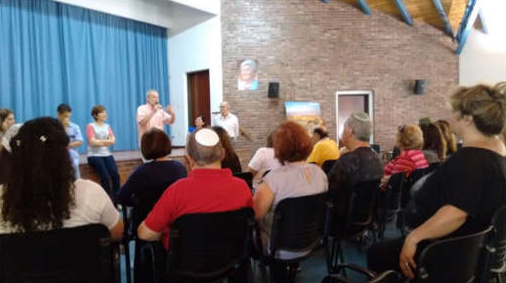
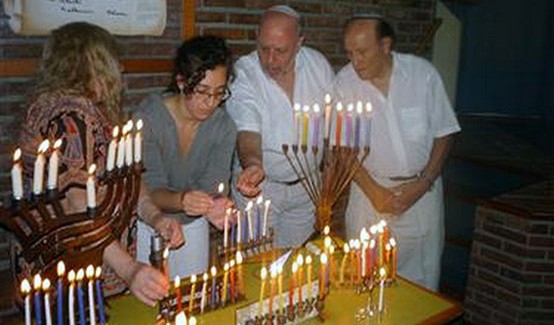 “We wanted to give a testimonial of an experience which has transformed us, and that took place on 11-13 December 2015. On this occasion some members of the Jewish Bet-El Community and the inhabitants of the Focolare town, prayed for one another,” wrote the Argentinean Rabbi, Silvina Chemen and Carlos Becaría and Nanni Espinosa of Mariapolis Lia. A special Shabbath. “We started by gathering bread for the rit,” Silvina recounted, “then we participated and shared this moment in which the Hanuka candles were lit, and we recalled the historical pact celebrated by Chiara Lubich and the Jews of Buenos Aires in 1998. Under the trees, we sang together and waited for the sunset to receive the stars that announced the arrival of the Shabbath. And then hand in hand, we entered the hall which was transformed into a synagogue for the occasion. Together we prayed the Shabbath vespers, and shared the Saturday morning prayer and the reading of the Torah scroll. It was a sacred moment.” Sharing and dialogue. “In the afternoon, there was an equally important event for the Jews –Carlos narrates – which consisted of a preparation for the mass. We had anticipated their request to participate and thus fixed the schedule. During the prayer of the faithful, one special prayer was for peace and dialogue among us (Bet-El Community and the Focolare) we all were deeply moved. This feeling of unity continued all afternoon in a workshop on dialogue, with the participation of all the Christian youth who attend the town’s school. We shared our queries, doubts, expectations on dialogue and our various traditions, with liberty and depth. We concluded by decorating the Christmas tree on which we also hung our secret wishes.” End of the Shabbath. “Then we all gathered in the open air, Nanni continued – to each light our candles until a circle of light was formed. Then the sound of the Shofar horn, as the Bible explains, accompanied the rite since it was another sacred moment.” We did not only pray, but also shared artistic talents in «an evening filled with joy and harmony, where once again Chiara Lubich’s presence was felt through a painting which Sofia of the Bet-El Community offered as a gift to the town. She had also participated in the meeting last year, and felt personally addressed by the message and the figure of Chiara,» Carlos added. On Sunday there was a tour of the town. “After having reflected on some aspects of the history and the spirituality of the Movement – Nanni said – they visited the various sectors of the town and the day ended in the Vittorio Sabbione Auditorium. A new depth and God’s presence among us were felt in the reading of the First Testament. Those of us who remained in the Mariapolis felt that something had changed in us, and those who returned to Buenos Aires departed with the joy of the discovery of new brothers and sisters. And this was confirmed in the impression of one Jewish participant: ‘It is my third time here in Mariapolis Lia. Every time I left it was with the desire to return. Today instead, I feel part of this experience, and this town is now part of me as I am part of it.’ Next year’s schedule has been set!” Gustavo Clariá
16 Jan 2016 | Focolare Worldwide
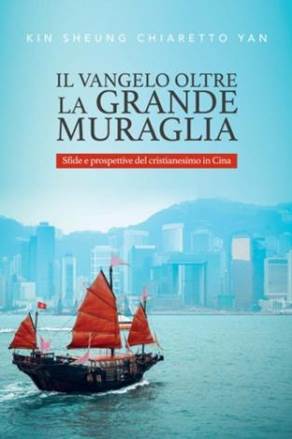
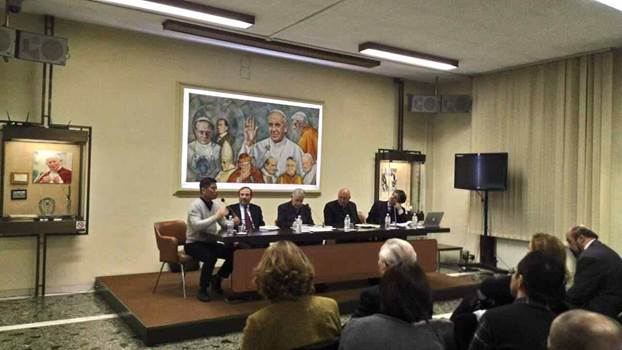 Last 8 January, the presentation of the Italian edition of the book by the Chinese scholar who has worked on this topic for years and is now terminating his Research Doctorate program at the SUI, could not go unobserved due to the location of the presentation – the Vatican Radio Headquarters in Rome. The speeches of the guests aroused great interest and among the guests were: Claudio Maria Celli, President of the Pontifical Council for Social Communications, Fr. Federico Lombardi, the Press Office Director of the Holy See, and of the Vatican Radio, Agostino Giovagnoli, the historian, and Gianni Valente, Vatican expert. But what especially was underlined in the numerous articles released subsequently in the media and network was the theme on the development of Christianity in China, and Chiaretto Yan’s vision in the book, “The Gospel Beyond the Great Wall. Challenges and perspectives of Christianity in China” (Emi 2015), which interpreted the progress of the relationships with the Holy See in the light of fidelity and openness to dialogue. This interpretation was also confirmed by Fr. Lombardi in recalling some very significant expressions of Pope Francis, who publicly stressed on several occasions “his desire to go to China,” saying that “we can freely say that dialogue is being pursued with the authorities” to find solutions to issues that are still open, and that “there is a great desire to make progress.”
 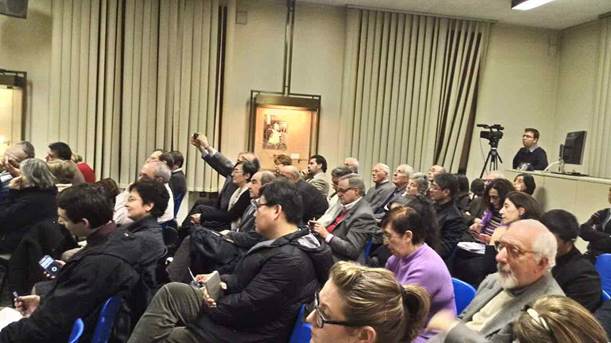 A substantial continuity of perspectives is evident in the actions of the last three Popes, from John Paul II to Francis. Among the cues offered by Bishop Celli was an episode he personally experienced, which conveys more than the many affirmations on the deep attention and participation with which John Paul II had always supported the life of Christians in China. “He was already confined to the wheelchair when he said to me: ‘Do you think I will be able to go to China?” Bishop Celli further affirmed that “Dialogue is not easy – but the pathway is absolutely that of going ahead.” The historian, Agostino Giovagnoli, underlined “the novelty in continuity” consisting in the more liberal approach of Francis in speaking about China. “The Chinese perceive his determination in wanting to change the relationships between China and the Holy See – he observed. This is a source of security that sweeps away the uncertainties of the past.” Also the journalist, Gianni Valente listed a series of recent openings. Chiaretto Yan’s study highlights the transition of various phases, which along with unforeseeable and at times dramatic hitches, reopened old wounds, but also evidenced a progressive slackening of the tensions and the perception of dialogue that is maturing also because of the better means of direct communication after the blackout that had marked the years of persecution. Over the last 20 years, the most felt request has been that of putting an end to the gaps between the various ecclesial communities, in the name of a “sole Church and more communities.” Dating back to 2007 is Benedict XVI’s historical letter to the Chinese Catholics, a top magisterial declaration that requested to end the internal and external conflicts to enhance dialogue. Pope Francis’s full recognition of this document again confirms the intent to pursue this path. “The Challenge the Church is facing – concluded Chiaretto Yan in answering a journalist’s question – remains the same: testifying to unity while remaining distinct. This perspective may also mean giving support to the life of various ecclesial communities within the same solid experience of communion.” Source: www.iu-sophia.org
15 Jan 2016 | Focolare Worldwide
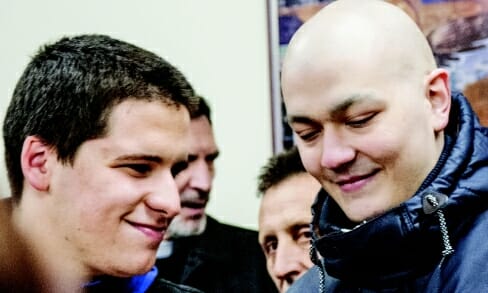 “I love swimming and automobiles; the minute I recover I will get my license. I have a sister whom I love and my elder brother is my model. I listen to almost all types of music, especially techno. I’d love to have a dog… I never used to read but now I find it very interesting, also because it makes time go faster in the hospital .” One evening at the cinema with his sister, he felt pain in a tooth. He would never have imagined that it was the first symptom of something serious. In the following days his left cheek got swollen and he could hardly open his mouth. «It hurt a lot, but instead of going to the dentist, I tried to treat it myself with packs and cream. Nothing helped and it got worse. In the end I went to the dentist who was shocked and immediately sent me to a surgeon who had me hospitalised. I was surprised but did not worry too much, thinking that I could go home in a few days.» The analyses, however, showed that something was wrong in his blood. He was transferred to another ward, and then to another clinic. In the end the diagnosis was severe: leukemia. “I didn’t know anything about this disease,” Nikola recounted, “I could not imagine that I had to undergo chemotherapy and that the treatment would be long. I started the first chemo sessions and I felt as if I was losing my mind. My brain was full of the darkest thoughts. I started to doubt the existence of God and asked myself why this was happening to me. What had I done wrong, or perhaps He had abandoned me? I sought the answer and understood that this illness is a message of God for me. I experienced His presence in a stronger way, He was always by my side and I felt that he wanted something from me, and wondered what it could be. All sorts of things came to mind. Perhaps I had to give myself totally to the others? The disease roused me from an empty life that was moving before my eyes, it made me change my vision of the world and now I see things in a more serene way. One of the things I did was to stop smoking, and I am really proud of this! Here in the hospital I met really nice people and a pair of good friends. One sunny day I opened the window and saw a girl walk by. I looked at her and she smiled at me warmly. Later I discovered that she was a nurse. I understood then that happiness lies in the small signs of care, like this. A boy told me: all that is mine is yours. No one has ever said such a thing to me. I felt a great joy.” “I was lucky, because I was found to be compatible with my brothers for the stem cell transplant. This shortens the treatment time and the probability of a relapse. I am so grateful for all the prayers and messages coming from all over the world through Facebook. In the hospital we keep one another company, and when we are with a group of young people, time flies. Then I have a good brother who left me his PC! So I can watch films, surf the internet… I spent a lot of time in prayer. The conditions we are living in are not easy, but we will get used to it…”. When asked what he would like to say to his peers, Nikola answered: “I would say: learn from the past, go ahead and plan for the future, but most of all, live the present moment. This is what I have learned. Be aware that true happiness can be reached with small signs of attention and do not worry for tomorrow, because when you learn to do this, you will feel much better. When you get negative thoughts, substitute them with positive ones. Do this every time and with time they will disappear. Love those you encounter and always be grateful for all you have.” Fonte: Novi Svet 1-2. / 2015
