13 Jan 2016 | Focolare Worldwide
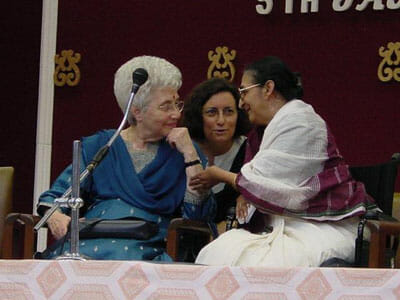
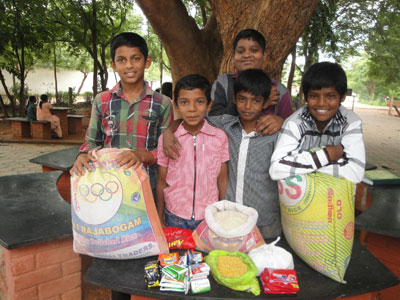 “A society is good when the last and smallest member of society will have the opportunity to produce and earn sufficiently for a decent and dignified living.” This was the ideal of the philosophy which in 1986 pushed Dr Aram and his wife, Minoti, and a group of Gandhian friends, to start up the Shanti Ashram of Coimbatore in Tamil Nadu. Literacy, development of the conditions of women, healthcare, environmental politics, battle against poverty, leadership programs for the youth and projects for children, are the actions promoted by the Ashram, of which the Bala Shanti project is part, and which was created in 1991 to help the very poor children in the surrounding villages. In 2013, Mrs Minoti wrote: “Tagore, the much loved poet and Nobel Prize awardee said: ‘Every boy and girl is a harbinger of the message that God still has not lost hope in man.’ It is in this context that I see the work for our children: to be able to serve one of the most precious gifts of God to humanity.” Initially the Bala Shanti project aimed to offer nutrition, education and healthcare to a small group of children from the ages of 3 to 5. Today the project helps thousands of children in 17 villages, who are in turn directly involved with their families in the battle against poverty, stirring up a proactive social participation.
Chiara Lubich with Minor Aram (2002) – © Centro S. Chiara Audiovisivi

12 Jan 2016 | Focolare Worldwide
“Villa delle Querce was said to be a clinic where people went to die. I knew nothing about this since I was only a 15-year-old boy happily biking around the neighbourhood. Places such as these were kept a secret. But I was curious to find out what went on in there. From the outside it seemed to me as if there were old people walking on trees. In actual fact it was the 7th floor of a psychiatric hospital which was hidden by the trees but which had a balcony around which the patients would often walk. I entered the place out of curiosity, but I was immediately assaulted by five elderly people who started shouting at me. I saw a young man in a wheelchair and with the excuse of visiting him, they let me pass. Among this motley group of patients there was also a highly respected man called Gianni with whom I struck up a friendship. Gianni immediately spoke to me of his illness which he had contracted at the age of 24. Up until then he’d had a career in the navy as well as in the cinema. He had to give up the beautiful girls and the lavish lifestyle; now there was only solitude and the fear of a slow death. He asked me to bring him some poison so as to commit suicide. I returned to see him a week later and at that point he could no longer speak. He had thrown himself down from the 7th floor with his wheelchair, but after a flight of stairs it had stopped. Consequently he was confined to bed. My only answer to his desperation was to tell him to believe that God loved him and I saw this grace had touched his heart when his eyes suddenly started to shine like the sea reflecting the sun. He started to laugh heartily and our conversation continued only through the movement of his eyebrows which I was able to interpret. I asked the questions or made suggestions and he answered with his eyebrows or with a fantastic smile. I started to take to him all sorts of visitors, like for instance a rebellious girl whom he transformed into a perfect nurse through his good humour. Another girl, through contact with him, overcame her own self-hatred because of her body image. Her life changed completely. Other visitors included atheists, religious people and missionaries. He connected with each one of them and this prolonged his life. There was one episode when the medical staff had almost given up on him after an operation only to see him revive and give one of his beautiful smiles. I have a great photo of Gianni with Pope Paul VI who had asked him for prayers. Now that they are together in heaven, they are a source of strength for us, and help us to smile even in pain.” (Fr Marco S. – Italy)
11 Jan 2016 | Focolare Worldwide
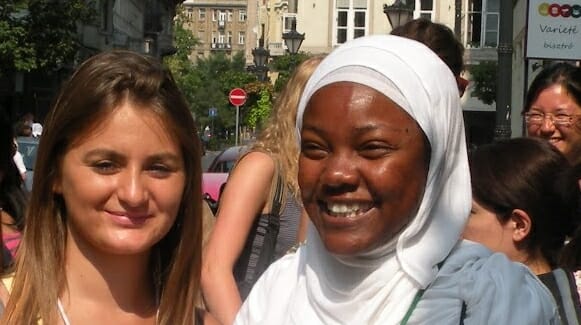
Hermine Schmölz, an Austrian, recounted: “About ten years ago, I realised I had to do something for the integration of Muslim immigrants, especially the women who we are still not very acquainted with, although they have lived and worked here for years now.” He spoke about this with a member of the parish. Even his friends were enthusiastic about it and together they proposed their project to the parish priest and asked him to provide a venue to begin the project. From then on, it has been a really exhilarating adventure for both the Muslim women taking part in the initiative, and the team members who delineated the program: a Lutheran lady, three Muslim women, one of whom declared that she did not have any religious beliefs and three Catholics who are Focolare members. They felt that the immediate focus should be on what the women were really interested in. It was not easy given their difficulties in expressing themselves in the new language. So the organisers tried to make each one feel at ease, creating a cordial and serene atmosphere. “We always publish the date of the meetings on the journal,” Hermine specified, “and so the group continuously expanded. We try to expound on a different and interesting topic every time: inviting different speakers – politicians, educational experts, social workers, an obstetrician, a doctor – asking them to dedicate more time also to dialogue with the women who are encouraged to speak up and express their ideas. The children have a special programme in another room, so they may from a tender age, see the importance of intercultural relationships. Every meeting ends with a buffet to which the Muslim women themselves contribute. Other activities are field trips and get-together activities. As an interreligious group, every Christmas we bring gifts to the homeless, involving the ladies in establishing relationships with people of other cultures. And as in a game, for every person contacted we add a pearl onto a necklace, and in the end we try to guess how many pearls have been added. We also have the great fortune to communicate with and get new ideas from the Focolare members of other countries, who are doing similar intercultural projects. The ladies show their appreciation for this type of reciprocal dialogue and integration, and also their husbands are happy about it.” The Focolare of New York wrote: “On 20 December – we were invited to the Malcolm Shabazz Mosque in Harlem – which Chiara Lubich visited in 1997 – to speak at the Seerah Conference.” This is an annual retreat to reflect on the life and teachings of the Prophet and Imam, W.D. Mohammed, a leader of the Afro-American Muslims. The warm reception given to the two guests invited by Imam Pasha and 200 other people was a tangible sign that the seed of dialogue sowed many years ago, continues to bear fruits. It is thus not surprising that the theme precisely chosen for that day was unity, traced through the thoughts of Imam W.D. and Chiara. The retreat ended with a brief video of Chiara Lubich, followed by a round of warm applause that seemed to express everyone’s commitment to that unity she proposed.
9 Jan 2016 | Focolare Worldwide
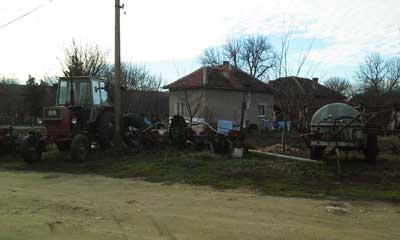 The members of the only Focolare Centre in Bulgaria, M. Lucia, Majda, Julia and Ildiko, from Italy, Slovenia, Germany and Romania, recounted: “Just before Christmas we went to Gostilya, a village to the north of Bulgaria, to visit friends who have been coming to the Mariapolis in Sofia over the last years. We wanted to show our gratitude and warmth by visiting them in their homes.” “We did not expect to find an almost deserted village,” they added. In fact, out of the 1,500 inhabitants at the start of the 1990s, the population now counts only about a hundred people due to the strong migratory phenomenon. There were about 20 young people. The school, nursery, library and other public facilities have been closed. The Catholic Church reopened three years ago, and the elderly deacon who was ordained lives the spirituality of unity.
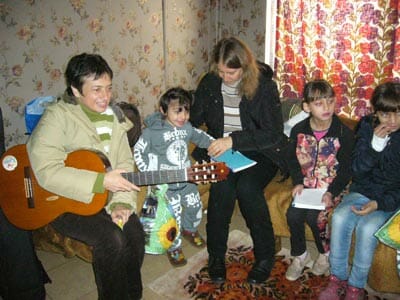
 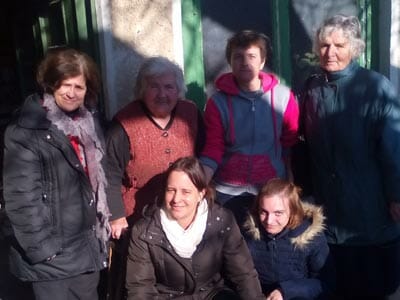 “We had prepared a bingo game with gifts for all and a chalk statue of Baby Jesus produced by children. We couldn’t imagine how much joy this would create: they were so grateful that someone had thought of going to visit them. A family that lived 30 km away also came and so did others who travelled three hours by car. The Mayor brought us on a “sightseeing” tour of the village.” “They vied with one another to give us something: a poor and sickly elderly lady who could not come to the meeting, baked sweet bread for breakfast. Before leaving, we dropped in on her to say thanks and give her a statue of Baby Jesus. She was moved, and listened to our Christmas carols at her doorstep. We also received a huge chicken for Christmas lunch, along with jars of honey and other preserved foods, which they specified to be “ecologically pure.” After Gostilya, we went to the extreme outskirts of the Bulgarian capital. In Sofia, on 24 December, the focolarine visited a Romani family with seven children, their friends for years now and who they try to help as much as possible. Majda had prepared them to receive the sacrament of Baptism, and another stood as godmother. To stress their love and esteem, the mother called the last child Majda, despite the fact that it is a Slovenian name and thus inexistent in Bulgaria. Julia, who instead works in a German school, spoke about this family to her colleagues who then donated clothes, foodstuffs and toys. “So we were able to prepare personalized gifts for each one – they said. A teacher asked them to take along her three children aged 8, 11 and 13 years, so they could see another reality, other than their own environment. Strengthened by such solidarity, we left for Botunetz, the name of the district where this family lives. We bought a small Christmas tree, so we could decorate it together. The mother had cleaned the house and dressed the children well, but there was so much humidity, cold and moulds. We passed a few hours with them, decorating the tree, singing Christmas carols, colouring drawings of the nativity scene, and unwrapping gifts. Everyone was happy and there was a real Christmas atmosphere. ” The same can be said of the traditional Christmas Mass in the jailhouse of Sofia, where a group of the Focolare Movement goes every year together with the Sisters of Charity of Mother Theresa, and for the festivities in a pensioners’ club. They said that this Christmas was one of sharing, in the name of joy, sobriety and solidarity. Maria Chiara De Lorenzo
8 Jan 2016 | Focolare Worldwide
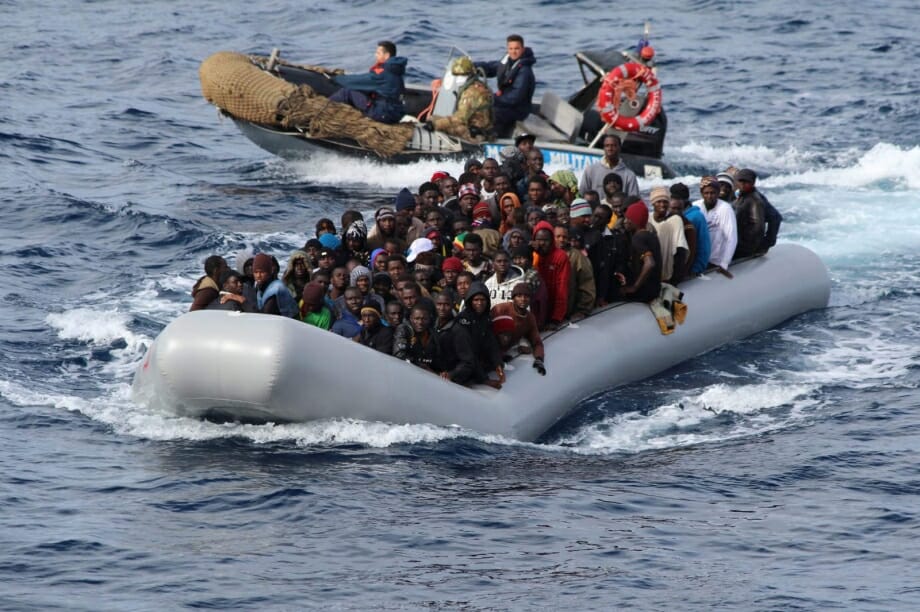
“Fifty exhausted young Africans arrived in our city. After many days at sea, the Italian flag came into sight. They had fled Lybia, some from the religious conflicts between Christians and Islamist fundamentalists, some from the overly exploited territories. They amassed on the seashores, beaten, robbed and constrained to take to the sea on crowded boats. After a stop at Lampedusa, they were spread out over several Italian towns. One of those towns was ours, Pomigliano d’Arco, in the Province of Naples. The oldest was thirty-six, and the youngest eighteen. We young people from San Felice Parish in Pincis ran out to visit them. They didn’t even know us, yet they welcomed us offering us places to sit, and they listened to our words. We had nothing to offer them other than our love. That meeting changed our life. The parish and the quarter adopted them. We got to work, many volunteers from different parish communities, but also many others who are doing as much as they can. The first thing to be done was to collect clothing. The children arrived shoeless and only with the clothes on their backs. We quickly began Italian lessons, organized cultural exchanges in view of gaining citizenship, while not overlooking their spiritual needs. We were very struck to see how the Catholics held on to their Bibles, robbed of everything else, they managed to salvage what they held most dear. They have much to teach us: when everything is lacking, faith in God can never be lacking. The Sunday liturgy, transformed into a trilingual Mass – with Italian, English and French – concluded amidst dance and applause to the rhythm of the bongos. Their singing and dancing not only conveyed their joy, but also made us live it with them as an image of the Resurrection. The Muslims received a visit from the Imam. Young people from Catholic Action organised a prayer vigil: blacks and whites, Catholics and Muslims, a tangible sign of peace amongst peoples and religions! One journalist from the area observed: “Anyone who follows their situation is inevitably overwhelmed by their honesty, values, neighbourliness, their dramatic stories that suddenly dampen even the most solid barrage of prejudice and transform ‘sterile’ solidarity for the needy into fraternal concern and loving closeness.” Such demonstrate show the contagious power of Love.” (Ilaria and Salvatore, Focolare Parish Movement, Pomigliano d’Arco, Italy) Source: Chiara Favotti: “Una buona notizia, gente che crede gente che muove” (Rome: Città Nuova).

5 Jan 2016 | Focolare Worldwide
The star was not deceived when it called those distant ones to walk towards the God who was near to them. The star was not deceived when it showed the desert path, humbler and harder. The star was not deceived when it halted over the house of humble folk: there the great future was born. Your heart was not deceived when it took up the path in search of the unkown. Your heart was not deceived, when it did not give in to meaningless impatience. Your heart was not deceived, when it knelt before the Boy. Klaus Hemmerle: Dio Si È Fatto Bambino (Rome: Città Nuova, 2007) p.11.
