4 Jan 2016 | Focolare Worldwide, Senza categoria
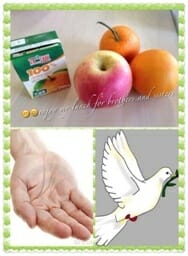
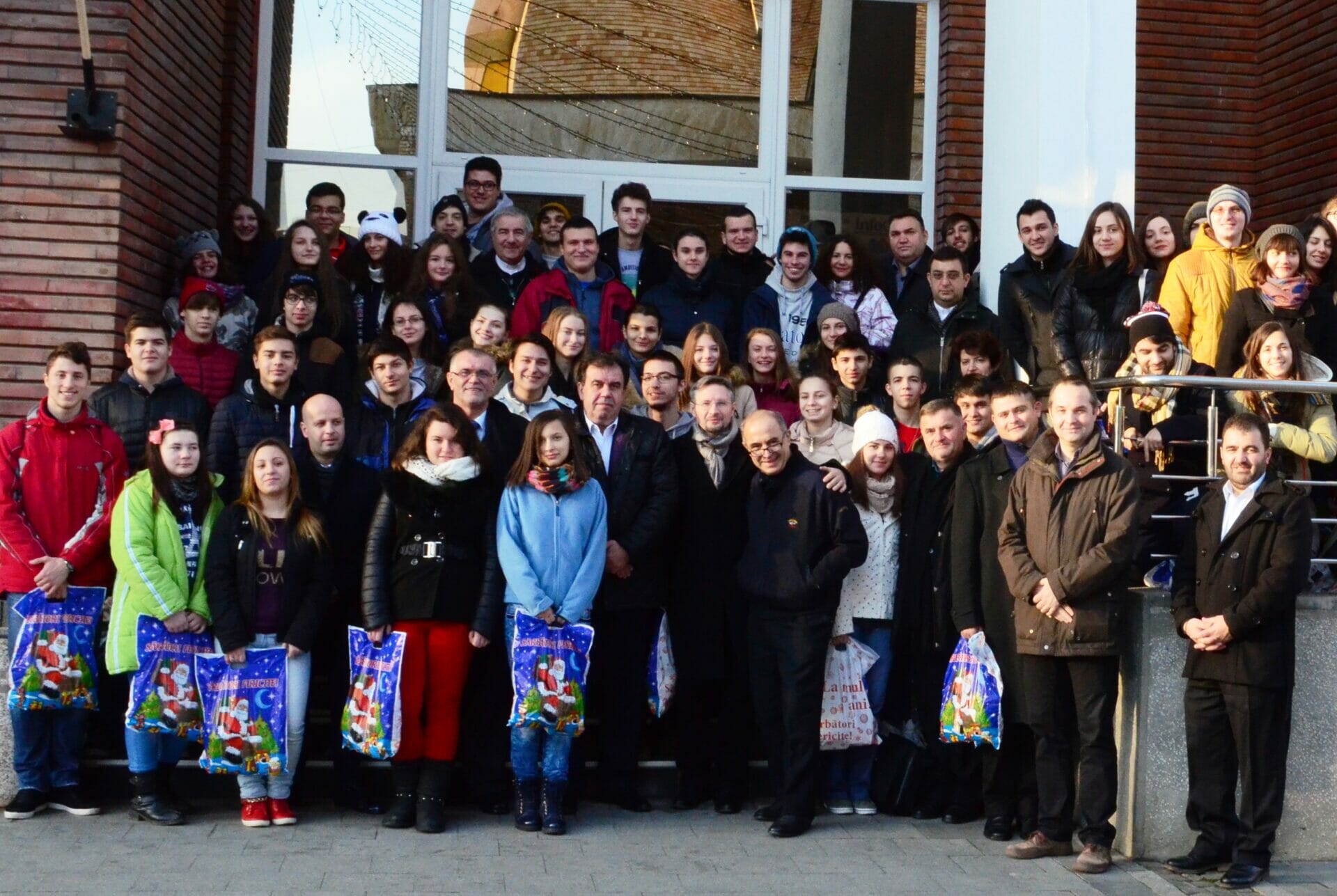 There is a festive atmosphere in Reșița, Romania, a Municipality located on the border with Serbia, population around 90,000. The first young people began to arrive yesterday evening from Italy, Catholic youth who were welcomed at an official ceremony in the most ancient Orthodox church in the city, and they were offered hospitality in the homes of their Romanian peers. Today the Orthodox youth arrive: some by bus, some by car and some on foot. The Municipal Administration held a moment of greeting before the party moved on to Băile Herculane, a tourist town in the southwest of the country where an ecumenical camp will be held. The vice-mayor was pleased and expressed congratulations for the experience of twinning between the Romanian Parish of Our Lady of the Assumption and the Roman Catholic parish of Santa Maria de Borgo in Pesaro, Italy, which has been established for eight years. This was followed by presentations with Italian and Romanian young people. The dominant feeling was certainly the joy of discovering one another as brothers and sisters united in the same Christian faith. This common bond was even more invigorated by their shared goal of building a more united world, and of deepening their own unity through a genuine and sincere exchange during their days at the camp. They are not only Catholics. Gabor, for example, is a Calvinist and others are Evangelicals. But here there are only Christians, accompanied by the wise and caring guides from their parishes. The choice of Resita was not a random one. It is located in the region of Banat that has had a decades-long calling to tolerance and openness. Eighteen different ethnicities live there and belong to several different Christian Churches. Anna attended becuase she believes in the unity amongst Christians and wants to make her own contribution so that it happens as soon as possible. Joseph studies medicine, but at the end of Medical school he wants to pursue the priesthood. Emil wants to be a film director. Matteo does not know what he will study or do in life. He only knows that he wants to be part of this project of building unity at every level. They do not know what the future will be, but they believe in their common ideal. Days of sharing and deep friendship await them based on the same love that each of them has for Jesus and for “his dream” that all be one. In China the project is focused on peace and fraternity. There, the trailblazers are also young people, but they intend to involve people of all ages. Their proposal: Give up a meal, a snack or something else on the 11th day of each month from November until April. Give the money that was saved to the poor. The money can be sent via “red pocket” on the social network. To help remember they have supplied bus identity cards with card-holders stamped with the Youth for a United World logo and six thumbs-up to be coloured every time you participate in the the project. To their great surprise, a large number of “red pockets” arrived in just a few short hours accompanied by messages of gratitude and encouragement. It was like a grapevine that spread peace, generosity and commitment. Up until now 844 euros have been collected, a small amount, but rich in meaning with the messages that accompanied the donations. In China, Novemeber 11th was a day dedicated to the unmarried and to shopping. Some gave up a snack, others a more substantial meal. One girl wrote: “I didn’t find anything to buy, because everything was very expensive. Then, I was glad to hear about your project and I’m pleased to offer this small contribution for someone in need.” Gustavo Clariá
1 Jan 2016 | Focolare Worldwide
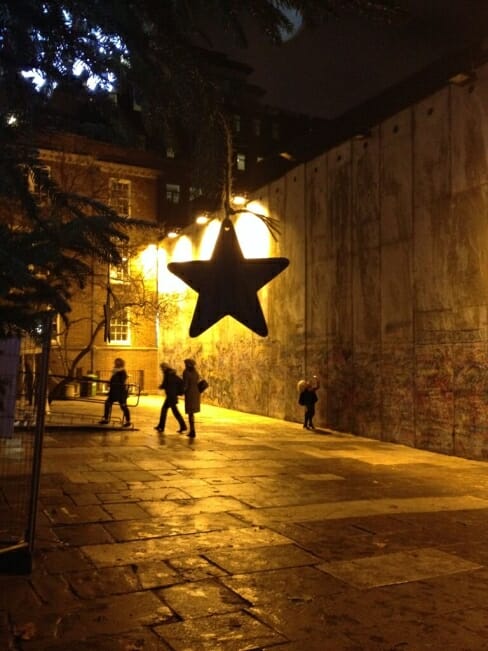
The message of Pope Francis in this Jubilee Year of Mercy urges us more than ever to live the immense gift of Peace. It is a strong plea that shakes our conscience and invites us to convert ourselves. Peace and Mercy: two inseparable elements for coexistence among people and with all Creation, and two words which we have become more aware of today, now that they are absent. A piece of the papal message brought me back to my homeland. It is really moving for me – an Arab-Catholic of Palestinian origin – to study Jesus’ behaviour following the motto, “Overcome indifference and achieve Peace.” In retracing those places, I can affirm that He lived as a Person and narrated divine parables taken from daily life. Sad to say, still today in my homeland, Peace is still not fully known, even if it is where the three great monotheistic religions were founded. Eight million people live in the State of Israel and four million in the Palestinian Territories. In these two localities the Christians make up 2% of the population, and belong to various churches: the Catholic, Orthodox, Armenian, Syriac-Orthodox, Coptic, Lutheran and other churches. It is a tiny land but a vast one for its multi-religious, multi-cultural and multi-confessional dimensions, and one that suffered many invasions, conquests and conflicts that still continue today. The possibility for peaceful coexistence is still a path to be traced, even if here and there, efforts have been made to find a just and enduring political solution. Fear and mutual distrust have raised walls of division between one and the other part of the population, and above all, hostility and diffidence in the hearts of people, which are difficult to demolish. The Pope’s words struck me deeply: “At individual and community level, indifference towards one’s neighbour results from indifference towards God, and assumes the aspect of inertia and non-commitment, that nurtures the prolonging of situations of injustice and serious social imbalance, which in turn may lead to conflicts or, in every case, generate a climate of dissatisfaction that risks turning into violence and insecurity, sooner or later.” In the years I have lived in Jerusalem, together with many others I tried to diffuse the spirit of true and sincere dialogue between the Arabs and Jews, through friendship and affection which only human relationships can instate. In fact, it is not so effective to speak of peace, only in a political sense, if we do not first build relationships with people. Our efforts gave rise to moments of encounter between the youth and families, protagonists of the two parties that effected concrete actions of pacification, solidarity, and mutual respect. “Overcome indifference and achieve Peace” is a message that brings new hope to our hearts. The Pope admonishes by saying: “Some prefer not to seek peace or information, and live in their wellbeing and comfort, turning a deaf ear to humanity’s cry of pain. We have become almost unaware of and unable to feel compassion for others and their dramatic lives. We do not care about them, as if what is happening to them is not our responsibility.” Pope Francis’s message gives us a new impulse towards real change. May 2016 see us all firmly and assuredly involved at various levels, in creating justice and working for peace which is a gift of God, entrusted to all men and women of the world. It is up to each of us to achieve this goal.
31 Dec 2015 | Focolare Worldwide
29 Dec 2015 | Focolare Worldwide
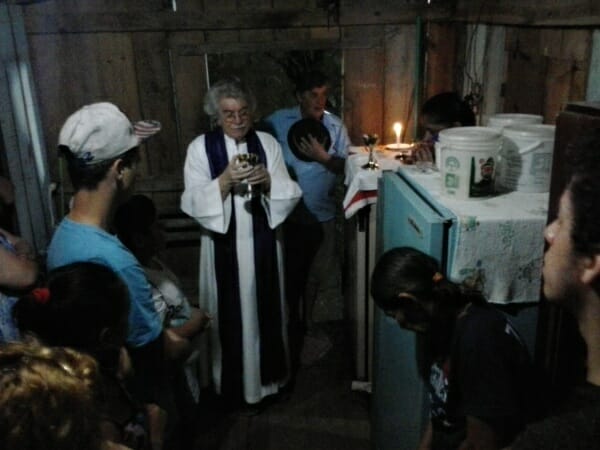
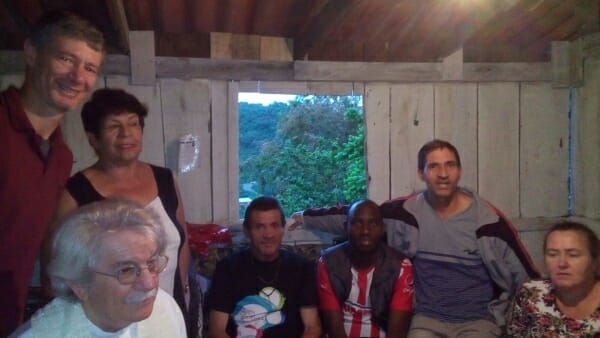 “On April 21, 1964, Chiara Lubich wrote in her diary: “I dreamed of a focolare amongst the mocambos, built like a mocambo because our houses should be like the ones around them, and our house is the place through which we carry out our main apostolate.” Although it would years, the dream came true. A year ago, Brazilians, Lucival, Helson, Keles; Estimable, a Haitan; and Fabrizio from Italy left their house in the capital at Florianopolis, to move to go and live in the morro, one of the many existential peripheries of the world. “How is it going” we asked them. “We mainly try to become inserted in the new environment. Keles works at the Marist school that is very important in the fields of education and social life for the children and teenagers. Lucival, who works at the Fazenda da Esperança, a rehabilitation community for young drug addicts is now involved in the Associação de Moradores “Alto da Caieira, which is an organisation for the protection of the people who live in the morro.” We know that it’s not always easy to be accepted by the people of the favelas. These five young men are trying, with the help of Father Vilson Groh who has been serving in the morro for more than thirty years. “The ideas come by being with the people. That’s what we’ve been doing every Thursday for a couple of months. Every Wednesday men recite the Rosary in a different house, which is a pretty common practice in Brazil. There aren’t large numbers – maybe 10 to 12 people – but is a seed that’s been planted. And it’s already bearing fruits, in the sense that we see it little by little increasing our knowledge and trust of one another, both them towards us and us towards them. A communitarian sense of responsibility is growing, the feeling that the needs of the others are our own needs.” Could you give us some examples? “There was one man who was dependent on alcohol and slept at the dump. Fr Vilson spoke with the community, which then put him on a path of recovery. They literally rebuilt his dwelling, a wood shack, and they furnished it with a stove; someone else brought a bed, a refrigerator, and so on. Two weeks ago there he was, standing amongst the 15 teenagers who were being Confirmed; and last Thursday the Mass was celebrated at his house. We also learnt of the inhuman conditions that a certain woman was living in. Here again, the community got to work in helping her out. They themselves distribute to those in need whatever they are able to procure for them: food and clothing.” And as a sign that relationships really are becoming deeper, they recounted that last Friday twenty people visited the focolare for the confraternização, a Christmas celebration where everyone brings something to share. Also here at the morro, we didn’t only eat food like the famous Brazilian churrasco meat, but we also celebrated Jesus who once again deigned to be born as at Bethlehem in the poverty of a favela.”
28 Dec 2015 | Focolare Worldwide
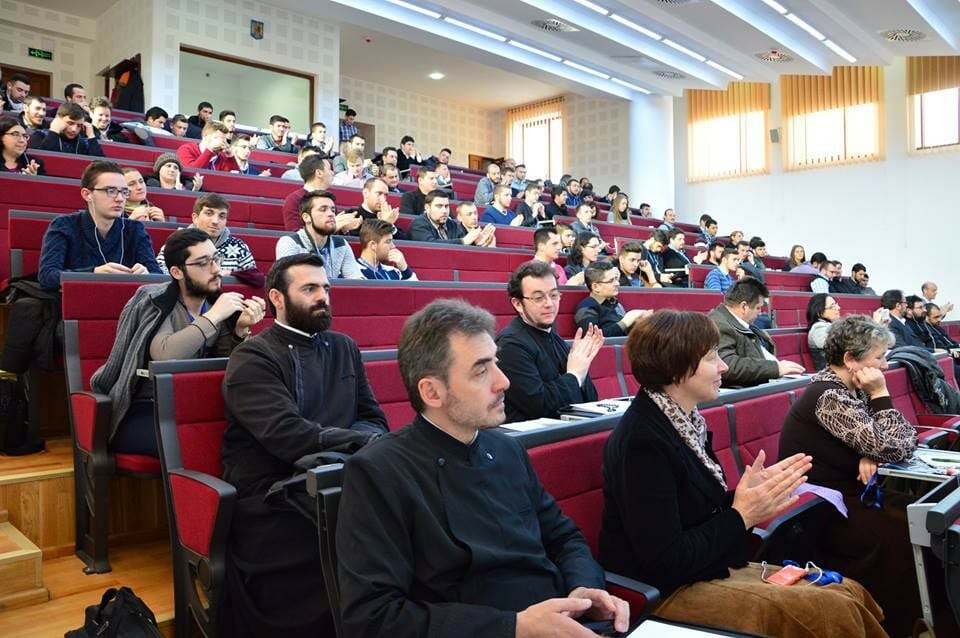
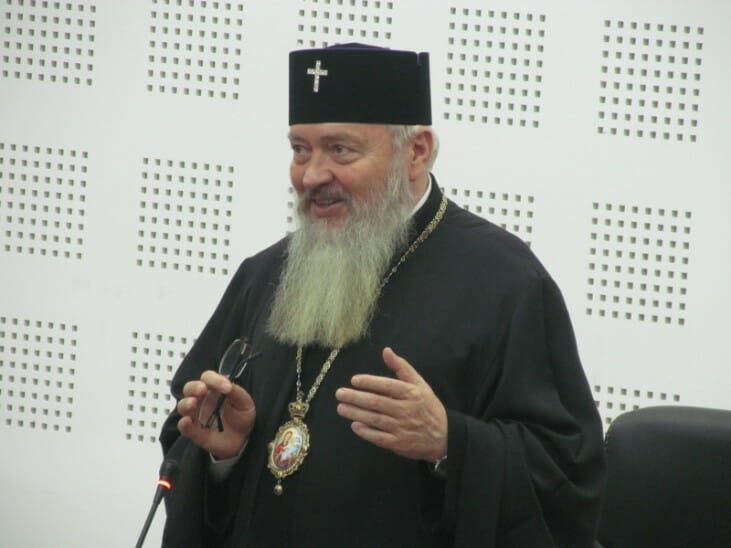 Already in 2004, getting to know each other, establishing dialogue and intensifying the spirit of communion were the objectives that had pushed the Orthodox Faculty of Theology of University Babeş – Bolyai of Cluj-Napoca and the members of the Focolare Movement to start a fruitful spiritual exchange of ideas and experiences. With time, this relationship was enriched by an ecumenical course that led to a dialogue at a theological level especially in recent years. In the common desire to bring Chiara Lubich’s charism of unity to Orthodox theology, this year both parties agreed to foster joint activities between the Romanian Faculty and the Sophia University Institute (SUI) in Loppiano (Florence), in a Symposium between the two academic institutions in Cluj-Napoca from 26 to 28 November. The symposium was opened by the Metropolitan of Cluj-Napoca, Andrei Andreicut who conveyed encouraging words for the precious effort to reach this deep communion. Also present was Bishop Vasile Somesanul, who has been a protagonist for many years in this undertaking. The lessons were entrusted to SUI professors on the part of the Movement, among whom was the Institute’s Rector, Piero Coda. On the Orthodox side, was the Dean of the Faculty, Fr Vasile Stanciu, with three qualified professors of three of the theological faculties in Romania, Cluj, Sibiu and Alba Iulia. Some lessons like those on ecumenism and the sacred scriptures were jointly expounded. The various papers focused on the theme of the Holy Spirit, as expressed in the Symposium’s title: St Basil the Great’s theological writings on the Holy Spirit. The work of the Holy Spirit in the Church and in creation. All felt that “the presence of the Holy Spirit was tangible, and evidenced not only in the luminosity of the papers presented, but also in the communion with God that everyone experienced”. One of the participants said, “We all felt that an encounter was possible since there was the real intent to give of oneself,” while another participant underlined “the great harmony that reigned, and the joy of being able to share the wealth of our single churches”. In the days before the Symposium lessons were given by Piero Coda at the Orthodox Faculty of Theology especially students of the Faculty itself, and also those of the Roman-Catholic, Greek-Catholic and Evangelical faculties of the University. During the week in the town of Sibiu an event focused on the debate on the future of Europe, organised by the Ecumenical Centre of Sibiu, at which among the main speakers were Professor Piero Coda and the writer, Andrei Pleşu, an outstanding Romanian academic. The Symposium was also the occasion to plan future projects and in this regard intense collaboration was foreseen. The next academic year will see an exchange of professors between the Orthodox Faculty and SUI. Prospects are for a joint seminar in Sophia in the first half of 2017.
![Economy of Comunione in Guatemala: the Company Becomes a Family]()
26 Dec 2015 | Focolare Worldwide
 Nine business owners have enrolled in an EoC course in the small Central American country of Guatemala, a land with a strong indigeneous ancestry and sharp social contrasts.They have been delving into the fundamentals of the project on a monthly basis and examining experiences that are currently underway in other parts of the world. “The basic text,” course director, Sandra Macario, explains, “is Il prezzo della gratuità (Bruni), but we often have Skype link-ups with other EoC business owners in Mexico City and other Latin American countries.” An Open Day was held on November 26th for people who might be interested in an End-of-the-Year Breakfast which is customary in this area of the world with its traditional beans and corn dishes. The breakfast was attended by forty people. Maria Luisa Altamirano from Mexico was the guest of honour, who presented her experience as a business owner and responded to questions from the audience. Besides course members, Brazilian business owner, Ismael Yos, who attended the same course in Brazil, also spoke. The testimony of Guatamalen architect, Jose Mario Contreras, was exceptionally moving. He does not always have steady work, so he depends on a pool of workers whom he can call when he needs them. They know that work is scarce and realise that when they are not working for him, they must find whatever work can be found. At times workers are urgently needed, such as the time they had to restructure and fit out a Dyalisis Centre. Due to a cancellation of a contract with another company and susequent suspension of service, it became even more pressing. They were in need of builders to restructure the building and engineers to operate machinery. Contreras presented his bid, and all voted in favour, except for the delivery time which was reduced by half or else forfiet the job. It was an impossible problem. The last card he had to play was dialoging with the workers. Dialogue was a concept that Contreras had been implementing for some time, and he had introduced it as one of the foundations of his work activity, a lifestyle that has proven to be efficacious at such critical times. His proposal to the workers of working double shifts was unanimously accepted, not only because they did not want to lose out on the job, but because they trusted him and one another. Contrary to all technical predictions the job was finished on time, and the patients who were waiting recieved treatment on the date that had previously been agreed on. On another occasion Contreras had received a telephone call from one of his employees. It was early in the morning, too early to disturb the boss. But it was serious: his small daughter was ill and in urgent need of a certain medication that was too costly for the employee. Contreras listened to him like a brother: “For now I’ll begin to pray for your daughter,” he told him. “As soon as the bank opens, I’ll send you the money you need.” Contreras had the feeling that his company “had become a family.”
