30 Sep 2015 | Focolare Worldwide
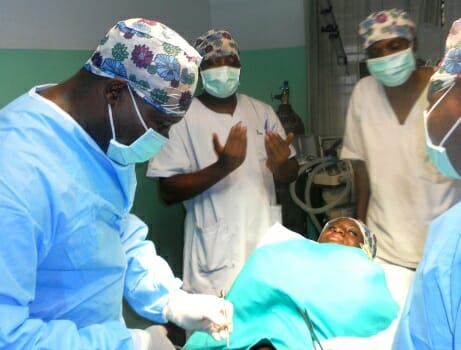
 “One day we were closing, when at 4:30 p.m. a mother with a baby about 8 months old arrived for a blood sample withdrawal.” Aline M. is a nurse and a biologist in the university clinic of Kinshasa. In the Congo/DRC, the birth rate is very high, as is the mortality rate and the infant mortality rate. Life expectancy at birth and the average age of the population are both very low. “My colleagues had already closed the registration books and wanted to leave. But the words of the Gospel, which say to love one’s neighbour as oneself, came to my mind: ‘I have to welcome even this mother,’ I thought. I took a blood sample from the little one, and as I was finishing, the mother said to me with a firm voice, ‘God bless you, ma’am!”
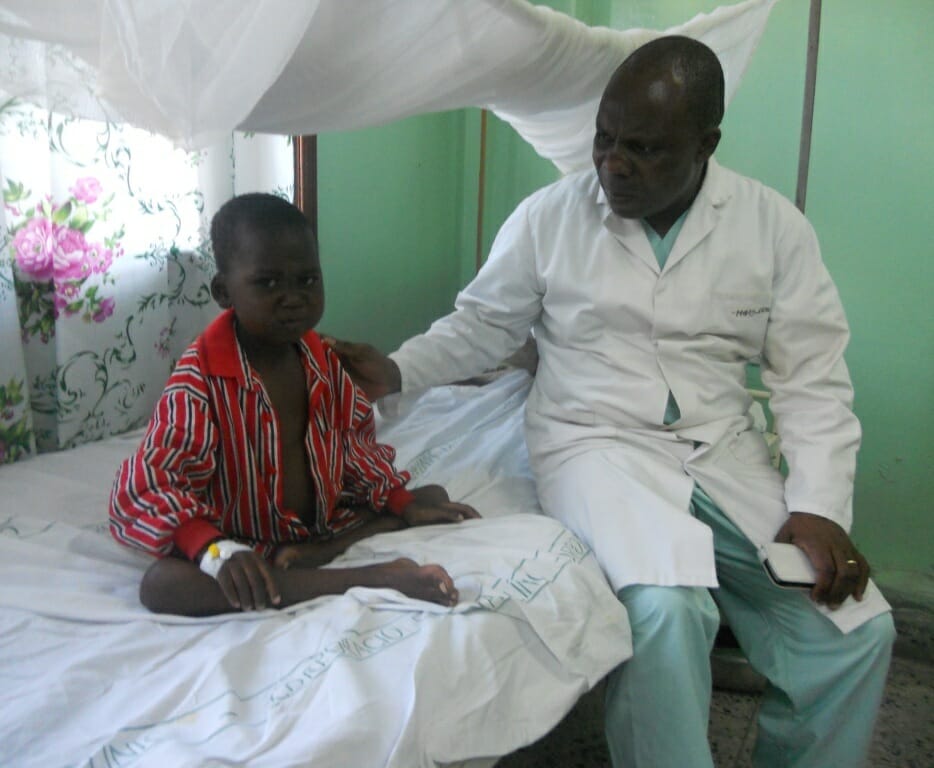
  I was just able to convince a colleague from the blood blank to take this last emergency, when another serious problem presented itself. It was already 5:00 p.m. There was a mother in tears, who could not pay for health insurance, with 4-year-old child in her arms, afflicted by severe anemia. My colleague decidedly told me that it was no longer possible to accept anyone. ‘Otherwise I’ll lose my job,’ she exclaimed. I was moved by this suffering. I took a sheet of paper and attested in writing that I was responsible for the cost of the blood transfusion for this child. My colleague then accepted, and immediately gave the child the transfusion, saving his life. The child’s mother said to me: ‘God will return you the money. I am sure of it!’ Returning home, I asked myself: ‘Why is it that I met two mothers with such suffering children right at closing time?’ I read the Word of Life, a sentence from the Gospel, and I found comfort. The next week, I received an invitation from my health service. From among my colleagues I was chosen for a 3-day professional training course. The financial contribution given to me for my participation was $150 US dollars! There was God’s answer. For having paid $25 US dollars for the blood transfusion, I received two blessings plus this amount which now allows me to also pay the scholastic fees for my children.” A.M. – Kinshasa, Congo/DRC
29 Sep 2015 | Focolare Worldwide
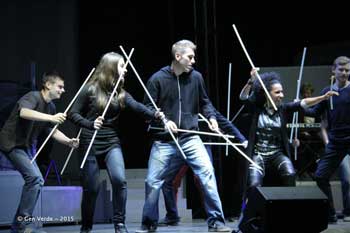
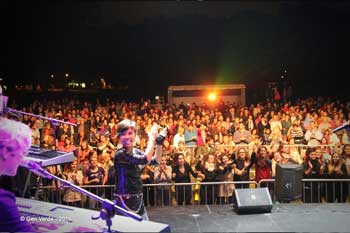 “Start Now!” That is, start here and now, to build authentic relationships and to generate trust. It is an invitation worth its weight in gold, you might say, and it was the title Gen Verde chose for the concert/workshop brought to the stage of the Tágas Tér Festival, on September 25th in Szeged, Hungary. The protagonists in these eight workshops, along with the artists, were 120 teens from two high schools, one of which is a professional institute frequented by many students who have difficult family situations. “Tágas Tér, which literally means, ‘open space,’” explains one of the organizers, “is in fact a big ecumenical meeting which exposes the network of hundreds of activities in the world for civic solidarity. Szeged is 15 km from the Hungarian border with Serbia, and therefore, many people were present at the concert who experience the passage of thousands of immigrants daily, with the sea of questions and sorrow that comes along with it.
 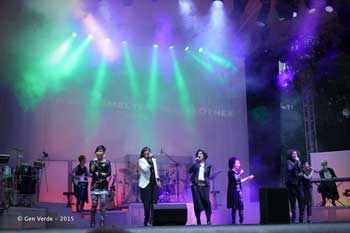 “On the Other Side”: During the concert, many songs were heard from “On the Other Side,” the latest album by Gen Verde, released less than a month ago. But what is “the other side”? is a spontaneous question many ask themselves. “It’s the person I have in front of me, the person who thinks differently than I; the person I don’t admire or even like,” explains Adriana Garcia, the group’s bass player from Mexico. A powerful show, engaging and at the same time capable of questioning positions, opinions and lifestyles as someone has said. Because what emerges from the music and the lyrics is the certainty that the solution to a broken world, divided by walls, comes from understanding the richness inherent in diversity. Among the eleven songs on the album there is the story of the difficult progress of an entire people in the piece “Voz de la Verdad,” about the Salvadorian bishop, Oscar Romero, or the very current and relevant song about the division of the two Koreas, built on K-pop melodies, almost as if to say that even among young Koreans the wound has not yet healed. “They are stories that do not permit us to fall into indifference,” comments one girl, “or to forget our brothers and sisters from whom we are separated by a border. We have felt strongly called even to give our lives for justice.” “Needless to say, the most powerful moment of the concert was the song “Chi piange per te,” (“Who cries for you”) a sweet lullaby dedicated to a baby girl entombed in the waters of the Sicilian Canal, perhaps because of the situation our country is living now with the immigration issue,” confided a friend who works with the media. And a Pastor of the Reformed Church, Gábor Czagány, one of the organizers of the Festival, stated: “What struck me the most were the faces of the young people from the schools that took part in the workshops. There was joy, participation, commitment. You could intuit the weight of the experience they had had: seven days that left their mark. Now it’s up to us to keep all this from getting lost or going to waste.” Young people offer hope for unity—Alessandra Pasquale, actress and singer in Gen Verde, is eager to clarify: “Our job is not to go on stage, sing, show off and then depart: we cannot exclude the building of authentic relationships with people, or exclude feeling what the people who come to our concerts experience, in what waters the teens with whom we do the workshops navigate.” It is for this reason that the video-interviews of the young participants of the workshops are projected before the beginning of the concert at Szeged, and were an integral part of the show, because these young people had in fact helped build it. Here are a few words from the teens: “The project, ‘Start Now!’ opened my eyes: it taught me not to judge foreigners. And this takes work: it takes tenacity and trust.” “I learned how we should pay attention to one another.” “I understood the importance of keeping a community together and that to be a family, humanity needs the collaboration of each one of us.” “I am very happy that my school participated in the project, “Start Now!” with the other school. In the beginning we didn’t know each other; it took time, but then we earned each other’s trust and now I can say that we move as a single person, we are absolutely happy.”
28 Sep 2015 | Focolare Worldwide
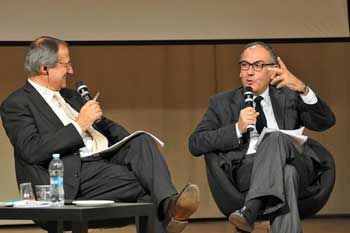
 Ideas such as involvement as the method; the ability to dialogue respecting not only the differing ideas and convictions of others, but also their sufferings; biodiversity that values cultural riches; seeking greater justice; transforming indignation into collective action for changing the world – these were the main values behind the ten projects and initiatives that brought out the vitality of Italian society today. It concluded with a variety of voices, projects and events that started from the bottom of Italian society, including the sixth edition of LoppianoLab. More than 2,000 attendees emphasised the importance of sharing and dialogue amongst business leaders, politicians, educators, citizens, young people, communicators and local administrators – civil society in its diversity of expressions.
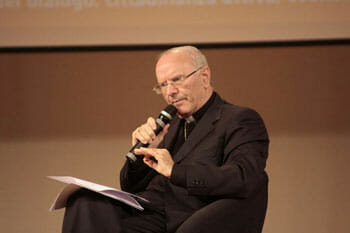
Msgr. Nunzio Galantino, Secretary General of the Italian Bishops Conference
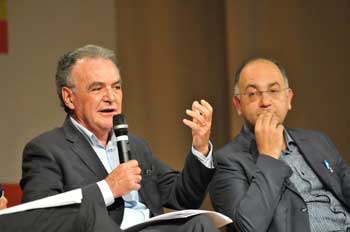
Luigi Bobba, Under Secretary of the Ministry of Social Politics and Work – Luigino Bruni, Economist
Vincenzo Morgante, Director of the TGR RAI – Michele Zanzucchi, Director Città Nuova
23 Sep 2015 | Focolare Worldwide
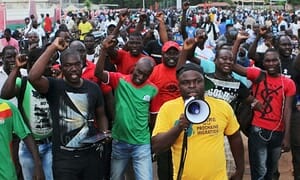
“Ever since the coup d’etat last Thursday, 17 September– we are all still at home: the schools, offices, and shops are all closed. Petrol and food are running out and whatever is available, costs double,” explains Aurora De Oliveira of the Focolare in Bobo-Dioulasso, the second city of Burkina Faso. The protest here is felt, but not as strongly as in the capital, Ouagadougou (population of 1.5 million), where the main events of last week came about and where more than 100 people were wounded and at least ten have died. “These are determined people who do not wish to be crushed. In the big cities of Burkina Faso everyone participated in demonstrations, but peaceful ones. Undoubtedly, all are afraid, since war could explode any time now.” Jacques Sawadogo of the focolare community in the capital wrote: “The activities in Ouaga – where the army came – have slowed down. The banks, shops and stations have closed. Only small self-supporting activities have continued, like those of the Movement’s members in Ouagadougou. We try to keep contact via e-mail or telephone. We are trying our best to be peacemakers in words and actions.” We spoke on the phone also with Fr. Sylvestre Sanou, general vicar of the diocese of Bobo-Dioulasso. The situation is in constant evolution and we fear it may degenerate. “There’s a general strike throughout the country – Fr. Sylvestre continued – In reality it was not really a coup d’etat. It was a raid conducted by a small group of the Presidential Guards headed by General Diendéré, a close ally of former president, Blaise Compaoré, who rose to power in 1987 with a small coup d’etat and was forced to escape after 27 years, and only in October 2014, after days of protests. Since then he has taken refuge in the Ivory Coast. “It seems that Generale Diendéré has tried to negotiate for his immunity, after having been President Compaoré’s right-hand man.” We are, therefore, not dealing with a religious conflict between Muslims (50%), Christians (30%) or Traditional Religions (20%) but with a political situation. “The army seems to side with the population and the governors of the various regions are also against “coups,” and even Diendéré’s house was burnt down. Violence generates violence,” Fr. Sylvestre continued. “On 22 September we were all holding our breaths for the ultimatum of the army which entered the capital from four cities. The political future of the country is uncertain, despite the mediation of the Presidents of Benin and Senegal, on behalf of the Economic Community of West African States (CEDEAO) and the return of the transitory President of Burkina Faso, Michel Kafando and also the Prime Minister, Isaac Zida (arrested and then released).” “I had just returned from a stay in the Mariapolis “Victoria,” the town of the Focolare Movement in the Ivory Coast, and found myself in this situation,” concluded Fr. Sanou. ”They blocked the undergoing process of dialogue between the political parties which had tried to find common ground. But all blew up. Let us pray that a solution emerges without bloodshed and also quickly. In the meantime, we have started with the priests, religious and catechists of the diocese and also with our bishop, the pastoral visits programmed before these events. We feel the importance of going ahead and praying for our people and our country.” “How are we all taking this? At the start we were angry and disappointed– Aurora De Oliveira confided – since after the 2014 events the political situation was coming along well. Just a step away from elections, programmed for 11 October (and now moved to 22 November), and here comes an armed group to spoil it all. This was my first reaction, and we felt the need to protest. The next step was to see in this suffering the countenance of Jesus Forsaken, and thus try to strengthen unity among us all in order to transmit peace and forgiveness. We tried to contact all those who share our spirituality of unity, because love must overcome all.” While the meeting in Rome of delegates of the Movement from all over the world has started, and makes the hopes and sufferings of people all over the world particularly felt, the President of the Focolare, Maria Voce wrote to the community of Burkina Faso: “We shall continue to pray and live in greater unity with all of you, certain that Mary will protect us all.” https://vimeo.com/140074710
19 Sep 2015 | Focolare Worldwide
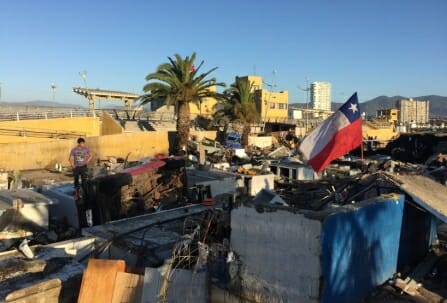
“I’ve lost everything’ tearfully declared a fisherman from Guanaquero – a small village 450 km north of Santiago, on the Pacific. “But we will start again, as we Chileans have always done.” The cameraman embraced him in a supportive manner. These were some reactions after the night of the earthquake. On the evening of Wednesday, 16 September, just before 8 p.m. the series of seismic waves began, with an intensity of 8.4 on the Richter scale. The following secondary waves also exceeded an intensity of 7. The long seismic activity made us run to find refuge in the courtyard of our home. Our neighbours on the street also did so. “How are you all? Is all ok?” “Yes, don’t worry, and you?” we all asked one another. “Do you need anything?” There was no fear, no agitation. Also the children knew what to do. In Chile all are taught on how to behave in the buildings, schools, and supermarkets where the safety zones are all marked out for the protection from possible collapsing buildings. After the experience of 2010 the country was more than adequately prepared. In La Serena, 480 km north of Santiago, the capital, due to the intensity of the quakes we knew that the epicentre was very close. The lights went off and only when we found a radio transistor did we know that it was about a 100 km from here. A triangle of small towns of 20/30 thousand inhabitants, Illapel suffered great damages, but it was not so in the bigger towns. Less than an hour had passed and the radio then confirmed the tsunami alert. Throughout the country, evacuation of the coast of 6,000 km had started, from the desert in the north to the cold south: a million people had to find refuge at an altitude of at least 30 km?? above sea level. The waves arrived in the form of huge masses of water that advanced and raised the sea level to at least four metres. The port of Coquimbo with 150 thousand inhabitants was partly submerged. Then came the news of the victims. All were expecting it. It was just a few hours before our traditional celebrations for the independence of Chile, on the 18-19 September. The 12 victims and five missing would not be celebrating this year’s event. Among these, three died of heart attacks, another three were sucked up by the sea, and the others lost their lives due to falling rocks from the mountains or the collapse of walls. The government had declared a state of calamity in some provinces of the 4th Region. The President, Michelle Bachelet, spoke to the country: the rescue system has been activated. Our thoughts go to those who lost all their possessions: villages of fishermen, the inhabitants of the epicentre zone. It is the eighth emergency in less than two years. The earthquake in the north last year, the floods, and in March the most arid region of the planet, the Atacama Desert, was submerged by floods. Then the volcanoes were next: one last year and an eruption a few months ago. Then there was the tremendous drought from north to south, Valparaiso overwhelmed twice by fires in the surrounding zones, and now the earthquake and tsunami alert… Once the terrible list concluded, we recalled the words of the old fisherman of Guanaquero: “We shall overcome!” In his eyes I saw a reflection of determination and perseverance. The same values explained why on the bare and steep slopes of the mountains of this northern zone, suddenly immense green spots suddenly appeared with avocado and vine cultivations. They were literally pulled out from the soil, exploiting every drop of humidity for their irrigation. Only determination and perseverance can obtain fruits from nature that over here has nothing to offer. This is how we built this nation. It would be impossible not to love it » Alberto Barlocci, from Chile
18 Sep 2015 | Focolare Worldwide
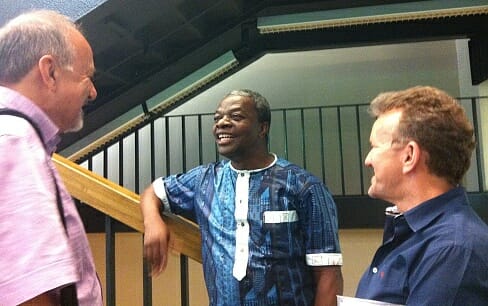
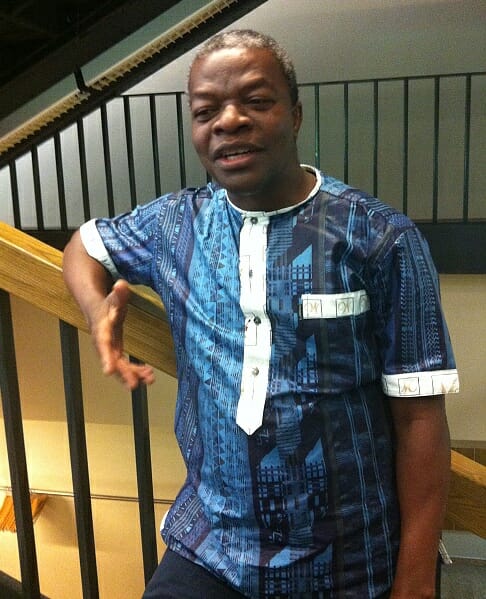 «I have been out of my country for more than 30 years. Every time I would return there was always the chance to meet with one of my brothers or sisters who had gotten married, or witness the birth of a nephew or niece. In my life, our family relationships and above all, the faith of our mother, a simple and brave woman like many African women, have always been the force that has sustained me in all my decisions and choices in life. Ever since I was a child, I had always been impressed by one of my uncles, a Franciscan friar who, at every visit, took care of all the children in the neighbourhood and not only his nieces and nephews, leaving a mark in my heart, and the desire to follow his footsteps in the future. When I just an adolescent – Mandela was already in prison – the massacre of the youth of Soweto happened and upset me so much that I vented out my anger against Fr. Paul, a Belgian Jesuit. I had said him, «If it only depended on me, all the white people would have to return to their own homes.» He answered calmly: «You know, we can fight discrimination with other weapons.» A few months later, he invited me to meet the Word of Life group in my town. Five years later, I found myself in Fontem, Cameroon, in the first testimonial-town of the Focolare in Africa, side by side with young people from Italy, France, Ireland, Belgium and other various African nations like Burundi, Uganda, Kenya, and Cameroon; and together with them I discovered that we are all brothers, despite our differences. This was how in my heart I felt the great desire to shout it out to the whole world, and testify to this fraternity, especially in daily life. In 1986 I was sent to Man in the Ivory Coast, where I remained for eight years. Together with all those who wanted to live the same ideal of fraternity, we nurtured mutual love among us, which drove us to promote concrete initiatives to help the needy in many ways, also through music, to tell the world that the united world is not a utopia. When I was 40 I transferred to Sao Paolo, Brazil, and had to learn a new language. I met a new people, which I fondly call a “population composed of peoples”: indios, native Brazilians and also the descendants of Germans, Italians, Ukraines, Japanese, Chinese, Afro-Brazilians and many other roots, but all Brazilians! It was creative, generous, and full of a contagious joy, which we, Africans are very familiar with. In a short time, I felt like I was one of them, that is, Brazilian. For 15 I worked in the Mariapolis Ginetta as a graphic designer and in the production of books and magazines for the New City publishers, building relationships among the staff, suppliers, printing press workers and security guards who had the task of inspecting all the boots of cars. With others, I also coordinated the activities of the young people of the Focolare Movement: the Gen3 and Youth for Unity. This experience was one of the most important of this period because they taught me to become an “adolescent,” even if I was an adult. Through love for one another kept alive among us, I discovered that I also had the capacity to make big sacrifices, since they had overflowing energy and enthusiasm. I also understood why the hair of many parents start turning white when there is an adolescent in the family. So now I am back again in the Ivory Coast: I have returned to continue building this pathway that started years ago with the youth. I had always been struck by the focolarini in the Focolare town of Victoria during the war, and who could have left the country then, but had decided to stay. Like Chiara Lubich and her first companions, they had sealed a pact of readiness to give up their lives for one another. This testimonial is something I treasure deep inside, and I wish with God’s grace, to live up to this measure with all our people. I do not know if we will achieve extraordinary things, but I would like to live each moment as if it were the last of my life.» Source: African Nouvelle Cité, July 2015

 I was just able to convince a colleague from the blood blank to take this last emergency, when another serious problem presented itself. It was already 5:00 p.m. There was a mother in tears, who could not pay for health insurance, with 4-year-old child in her arms, afflicted by severe anemia. My colleague decidedly told me that it was no longer possible to accept anyone. ‘Otherwise I’ll lose my job,’ she exclaimed. I was moved by this suffering. I took a sheet of paper and attested in writing that I was responsible for the cost of the blood transfusion for this child. My colleague then accepted, and immediately gave the child the transfusion, saving his life. The child’s mother said to me: ‘God will return you the money. I am sure of it!’