
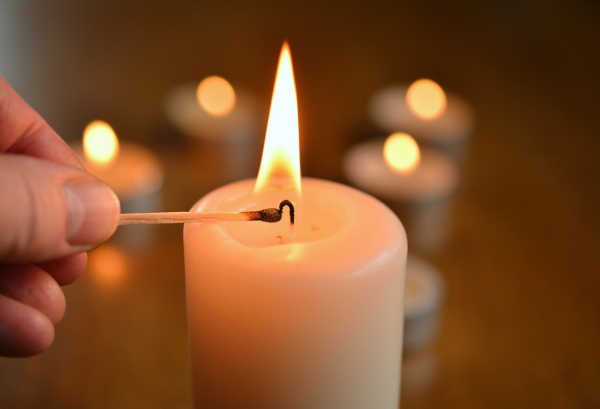
 Since Christmas is considered by most as one of the grand feasts, more sumptuous than sacred, it would be important to reflect on some of the theme aspects of this event, due to which the history of the world was cut into two sections, pre- and post-. Given the infinite importance of such an event, one would expect it to dawn amid grandeur, triumph, sounds and shots, with manifestations of power and the flow of millions of curious people. There is an abysmal contrast between the birth of a powerful figure, as the ancient world dreamt of and the obscure birth of Jesus, ignored by many; it is a contrast which in itself characterises the infinite originality of a Christ-king born of a poor woman in a stable. He really does not seem to be God and neither the most showy of men, but the last among them, immediately set at the most fearful level of degradation. He appears on the lowest rung of the social ladder, in order to immediately see from below all the human beings, and to be able to see with the eyes of the miserable. The start of his revolution does not foresee arrogance, but humility, to draw the sons of God to heaven, starting from those who ate and slept on the ground: the slaves, the jobless, the foreigners, and the scum. Liberty and love were born with that infant: his liberty is liberty of love. This is the immense discovery. Universal love that he taught aims to disperse a system of coexistence made up mostly of political power, abuse of authority, idle usury, despise for work, degradation of woman, and corrosive envy. Logically, for the people embedded in such system that announcement is a folly: good for the prison and the gallows. Blessed are the poor and those who make themselves poor to help the miserable… Just imagine the fury of those who consider money as the utmost good… “It was said to the elders: do not kill. But I say to you; whoever rages against his brother will be judged…” The maxim seemed, and still seems detrimental to the honour of the warfarers and the warfaring industries, while not hating one’s brother means putting an end to brawls, factions and violence. The maxim would picture society as a peaceful coexistence where, instead of shouting and shooting, the people would laugh and eat. Life, in peace, would allow us to make every day, Christmas. And this is the revolution of Christ: to make us be reborn continually against the curse of death. And so the utmost commandment is to love man, which is like loving God. Love the other to the point of giving one’s life for him. This in brief is the meaning of Christmas: a review of the past, and the end of wars, torbid passions, and avarice; the start of universal love which admits no divisions of race, castes, classes, politics…. With his life and death Jesus preached and taught life. And so Christmas can be celebrated also with cake, if it helps to create love, but is celebrated above all with reconciliation, that puts an end to the diseases of the spirit and gives health. It is celebrated in gratitude to Jesus and Mary, who suffered to teach us and help us put an end to our suffering. Igino Giordani, Christmas as a revolution, New City, Rome 1974, n.24, p.18
Take on the suffering of others
Take on the suffering of others
0 Comments