
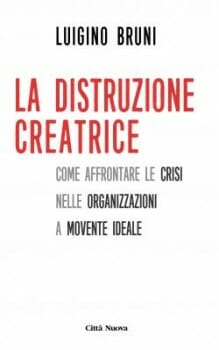
 In his introduction to Bruni’s new book entitled, “Creative Destruction,” Marco Tarquinio, Director of the Catholic newspaper wrote: «Bruni was well aware that this line of thought would lead him to the confines separating the human and the inhuman and regrettably, also beyond, to the complex organisations prevalently driven by material objectives. He perfectly knew that in writing about these issues, i.e., about “production” and “marketing” organisations and thus, of the creativity of relationships and employment, he would eventually have to focus on the organisations driven by ideals and other aspirations of the human spirit,» bringing both fields «to face the same challenge of renewal without losing their roots and driving spirit.» Published by New City Press, the book is a collection of selected articles published in 2015 on Avvenire, taken from the series, “The midwives of Egypt,” and “Regenerations.” In the book’s last chapter entitled, “The periphery is where we learn to resurrect,” Bruni comes to the conclusion of his work and the challenges resulting from his reflection which took him some months to delineate. He introduces his proposals with a phrase of the German poet, Friedrich Hölderlin: “God created man the way the sea created the continents: through withdrawal.” Here are some passages which in a way introduce us to the book proper: «A movement that with time has turned into an organisation can undergo a charismatic renewal, if in some marginal zone of the “Kingdom” some creative minorities start reconstituting the conditions needed to revive the same miracle of the charism’s first foundation: the same enthusiasm, joy, and the same fruits. The true process that brings this very same minority to become the majority is called reform. […] It is a decisive process that has to be undertaken unhurriedly, and should involve and activate the dynamic settings of creativity, going out to them “at the confines of the empire.” All this is certainly and firstly, a gift (charis), but also signifies wise organisation, and deep, spiritual, prophetic, and transformative intelligence. […] Many new “evangelisations” come about upon recounting the good news, and we are able to feel it come alive in us, in a new and diverse manner. This is how a new-ancient love story is reborn – a new eros, new desires, new generativity, and new children. […] The charism may thus flourish again and resume its encounter with people in the streets, forgetting its own organisations so as to tend to the wounds and sufferings of the men and woman today, especially of the poorer ones, […] creatively interpreting their own mission in the present time.»
Peace starts within our hearts
Peace starts within our hearts

0 Comments