
The Focolare Movement in Germany, together with other Catholic organisations, organised an online conference on the search for God in a world where He seems increasingly absent. This contributed also to the Catholic Church’s synodal process in Germany. 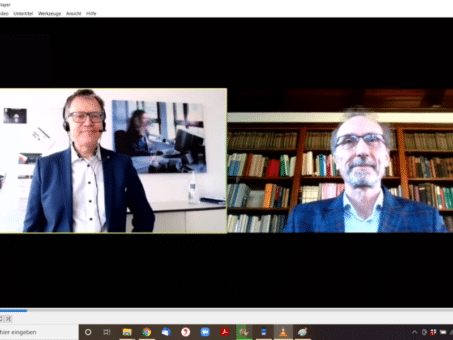 “God disappears – and maybe, could this be necessary? God disappears – is it He perhaps who wants it this way?” These were the provocative questions that guided the programme of an online conference that was held in Germany on February 26-27. It was organized by the Focolare Movement in Germany together with the “Herder-Korrespondenz”, a monthly Catholic magazine, and the Catholic Academy of the Dresden-Meissen Diocese in the former GDR. It was meant to address one of the most urgent questions many Christians ask today: “What do we have to do and how do we have to move in a world where God seems to be no longer present?” 350 participants from Germany, Austria, Switzerland and other European countries were ready to discuss in depth the causes of an ever-increasing absence of God in society and in the lives of individuals. As Heinrich Timmerevers, the Bishop of Dresden said in his opening speech, they were even ready to ask the shocking question, “Is it perhaps the Church itself that is driving people away from God because of the crisis caused by abuse?” In a message sent to the participants, Margaret Karram, President of the Focolare Movement said that the theme of God’s absence touches the core of the Movement’s spirituality, that springs from the figure of Jesus crucified and forsaken by men and God, “the hardest moment for Jesus and at the same time the most divine, the key to contribute towards fraternity wherever it is lacking […] and to reach out to those who suffer most because of this darkness”. During these two days, there were moments of critical and stimulating reflection on all that motivates a firm faith in God, despite a growing tendency towards secularism, and also on new forms of interest – especially in young people – in something transcendent that is passed on through authentic stories, experiences of deep attractiveness and a curiosity to explore new reflections on the meaning of life. During this conference, the awareness that Churches are often no longer able to meet the new religious needs of today’s men and women, was also present. The talk delivered by the German theologian Julia Knop was very strong; it was almost shocking. She started from the debate on the abuse of power and sexual violence by clerics and consecrated persons, and then continued to show that an erosion of trust in the Church is also being felt among its most faithful members. The professor of dogmatics claimed that the Church’s crisis is closely linked to the faith crisis. Stefan Tobler, the Reformed theologian stated that the absence of God could also prove to be an opportunity. While presenting traces of the mysticism in Madeleine Delbrêl, Mother Teresa of Calcutta and Chiara Lubich, he pointed out that the experience of God that vanishes could become precisely the place where God reveals himself. “God is found precisely where he seems furthest away. It is therefore not a question of bringing him to the world, but of discovering him in the world”.
Joachim Schwind

0 Comments