
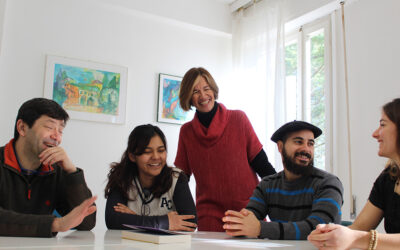
 A new generation in the Catholic Church to whom the Bishops have entrusted the venues for formation: they are young priests (born in the second half of the ‘70s and the first years of the ‘80s), who are well prepared, some of them are finishing their studies in Rome and who will be assigned to the formation in seminaries. 23 priests from eleven Countries – Thailand, Congo, Kenya, Argentina, Brazil, Colombia, Ecuador, Croatia, Hungary, Ireland and Italy – participated in the 2014 Course for Seminary Formators (14-26 July, 2014), organized by the Center of the spirituality of communion for diocesan priests and seminarians “Vinea mea” of Loppiano (FI), together with the Sophia University Institute (Loppiano) and with the Priests Movement of the Focolare Movement.
  “Some spoke of a spiritual retreat, or of a conversion; others spoke of a synthesis of study and life,” stated the director of the course, Fr Silvestre Marques. “Everyone agreed that the communion and the unity in diversity was tangible and became the experience that was lived by all and which they will bring with them as a witness of life in their seminaries.” The course – now on its 9th edition – is made for rectors, spiritual directors and formators who are working full-time in a seminary and proposes pathways and paradigms for the discernment and the formation of vocations to the priestly ministry, that can adequately respond to the challenges of the socio-cultural changes and their effects in the life of the youth.
  This course takes place in a span of two years: two weeks for each year, with talks given by experts, group workshops and plenary sharing sessions, all united to the liturgical celebrations. The course study, which has the approval of the Congregation for the Clergy and the Congregation for Catholic Education, grants credits given by the Sophia University Institute, after the presentation at the end of the course of a written paper. “They were two weeks lived in the atmosphere of Sophia: a well-rounded experience of life, thought and prayer,” Fr Silvestre continued. “Everyone had the joy of having made the experience that they had always longed for and searched for and which they now would like to present to their educational communities.” «I was not able to follow everything well because it was conducted in the Italian language but I understood another language, that of the community», wrote one of the participants. And another: « It is a challenge to live it; we saw our difficulties in a new light». The appointment was set for 2015 for the second part of the course, where they will study in-depth the 4 fundamental dimensions of the priestly life: human, spiritual, intellectual and pastoral. For the seminary formators, see you again in Loppiano in July 13 to 25, 2015, at the “Vinea mea”.
Learn from everyone
Learn from everyone

0 Comments