
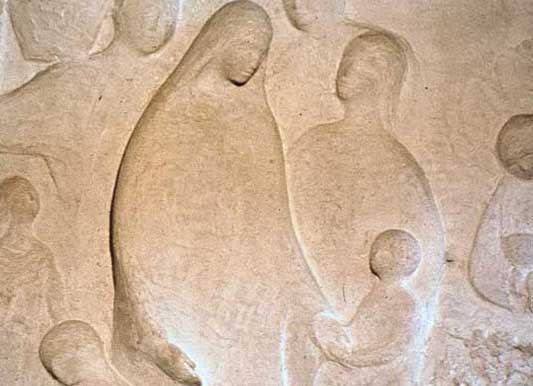
 “When it comes to Mary the universal Church bursts into song. In midst of greyness and boredom, her name appears, the atmosphere clears and endless lights are lit. She is the sun in which God placed his dwelling.” This is how Giordani writes of the Mother of God, singing along with the Church as he places himself amongst the many artists, theologians and holy people who have competed in portraying the virtues of the Virgin Mary: her beauty, the greatness of her role in the economy of the Salvation. His book, Maria modello perfetto, (Città Nuova, Rome, 2012) marks the conclusion of a journey: the progression of Giordani’s understanding of the mystery of Mary and of his attitude towards her. He had often written of her in articles and in the many pages of his books. He had already dedicated a previous book to her in 1944: Maria di Nazareth. But up to then, the theme was always contemplation, praise and invocation. In Maria modello perfetto there is a difference, which reveals the maturation accomplished in Giordani. There is the same contemplation, but above all imitation of Mary. The intellectual and life relationship of Giordani with the Mother of Jesus enters into a deeper dimension following his encounter with Chiara Lubich, in 1948, and with the Movement that was begun by her, popularly known as the Focolare Movement, but whose real name is Work of Mary. Right from the start, the experience of Chiara Lubich and of those who had entered into communion with her centred on the Word, especially Jesus’s prayer for unity: that spirituality had a strong “Marian stamp” that became clearer and developed further through successive stages. Some of these included: total willingness to germinate the presence of Mary in one’s personal and communitarian spiritual life; to repeat inasmuch as that is possible, the life of Mary, following her path – the Via Mariae (the Way of Mary) – as it emerges from the Gospel and Tradition; and a very distinctive choice of her as one’s Mother. This reality is what lies behind Giordani’s discourse on Mary. He offers it enriched by his cultural, theological and literary background, and with that characteristic zeal that made him a singular and enthusiastic witness of love towards the Mother of God. “Mary incarnates strength because she incarnates love: and love is stronger than death. Only in this does the desperation of the world melt away as new life is given, on this Calvary where we are all assembled by universal guilt (. . .) Poetry, science, wisdom and love become condensed in Mary, who is the refuge in desolation, loadstar in the storm and beauty in the horror. She marks out the way that leads to the Son, so that, through her, He comes more lovingly to us. We’re never alone: the Mother is there. We only need to enkindle her name in the desert night. (. . .) Every saint, every attentive Christian, is on a cross like Christ, but with the Mother beside him. In the most horrendous moment, he sees her imploring eyes, feels the unity with her, and trustingly places his soul in the hands of the Father.” The “Imitation of Mary” is presented as a valid goal for women and men, for consecrated virgins, priests and lay people, and it can have social as well as spiritual applications. “This is Mary’s hour,” Giordani writes, this hour when she wishes to live again in souls that mystically “become” her and are able to generate Jesus again in the midst of today’s people who are more and more in need of Him. Giordani sees her especially in the abysmal depths of her Desolation where she becomes the Mother of the Redeemed, the soul of those who know how to welcome her in. He sees her beginning to appear as a viable path of holiness for each one of us. Tommaso Sorgi www.iginogiordani.info
Share the burdens of others
Share the burdens of others

0 Comments