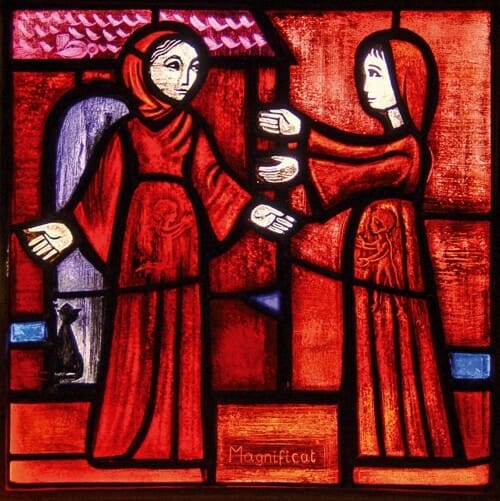
“The Magnificat” Stained Glass Window, Community of Taizé
which gathers momentum from the prophets with the promise of salvation, there is a mention of Divine Mercy that could seem like a rhetorical addition. It seems to me that the reference to the
mercy of the Father, at the centre of Mary’s song, is of capital importance and contains the concise explanation for all the exuberant divine facts that give unheard of beauty and steady immediacy to the poetic outburst of the fifteen year old girl who carried and grew Jesus in her womb. In the first part, Mary exalts “the Almighty who has done great things” to His “servant” so that all generations shall call her blessed. God had done the miracle of the Incarnation of the Word, through a poor and humble girl from an obscure village of Israel; an act that will lead to the salvation of humanity of all times. Thus she observes:
“His name is holy – and his mercy extends from generation to generation …”. Redemption originates in an act of compassion by the Heavenly Father towards his children. If He accomplished that prodigy of love, which only a God could accomplish, of his Son being born of a woman of the people and have him die for the sake of the people, it is all due to an act of mercy, a miracle of mercy that is love raised to its peak. This demands that we pardon our brother not only seven times, but up to seventy times seven time; that is, always, all the way to infinity; that we love him to the point of giving up our life for him. God
“has helped his servant, Israel – ever mindful of his mercy. . .” Everything in the divine government everything leads back to mercy. This will be clarified and confirmed in the demeanour of Jesus – out of love for whom Mary speaks – when He will feed the crowds and cure the sick; when he will drive the sellers from the Temple and raise his voice against the Pharisees and the proud.
The Magnificat is the anthem of the Christian revolution. But its most revolutionary aspect lies in its origin:
mercy. This is why it does not destroy, but creates; because love for God and man does not produce anything else but good. The
Magnificat gives the directives of the evolutionary process, mutation and rebirth, in which the Gospel ideal is translated socially and politically, as well as spiritually; a mutation that originates in love and is embodied in mercy. There is a new urgent need for such an ideal today. Ideologies and protests, guerrilla warfare and revolt are breaking out everywhere. They call for greater and beautiful aspirations while they introduce hateful programs of destruction. Mary teaches how to orient and construct this revolution. She is a woman, the Mother of God, who teaches both with word and life: the life of the Mother of Mercy. Her example is worth even more today, as it revalues femininity.
Mary teaches us the path of mercy. By now the absurdity and uselessness of wars is acknowledge, that is, hatred, and the need for rational systems focused on dialogue, negotiation and, above all, of intervention and gifts from those who have, in favour of those who have not. We can see it: sending arms and money to help this or that population serves only to increase the conflicts in which people suffer, agonise and die; and to plant seeds of hatred against the very givers. The perspective of that young woman, who sang her
Magnificat, the method of mercy, amongst the poor, is the perspective of the divine and human intelligence, the only one capable of resolving the problem of a world threatened by the ultimate definitive catastrophe, provoked by the stupidity of hatred and the drug of suicide. To have peace and wellbeing again, we need to take care of the material and moral wounds of those who suffer, from whatever side of the ocean, in Europe and in Asia, in America and in Africa, using a compassion that is the fruit of understanding; a charity that was not grow weak, but abolishes injustices and selfishness, to transform coexistence into community, and nations into a family. Jesus, the Son of Mary wants it to be so, as Mary his Mother assures.
Igino Giordani, in
Mater Ecclesiae, 4, 1970.
www.iginogiordani.info




0 Comments