
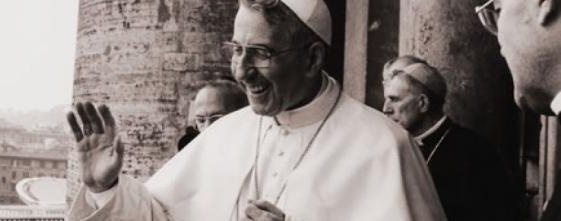
 “The “Smiling Pope,” John Paul I, rose to the chair of St. Peter on 26 August, 20 days after Pope Paul VI’s death. Though his brief pontificate lasted only a month, there was time enough for us to receive a smile from him, along with words of benediction.» This is what Chiara Lubich wrote in the book, “The Cry” (1), where she highlighted the uninterrupted rapport established with the successors of Peter, and also with Albino Luciani in the brief stretch of his pontificate. “The new pope has the gift of making himself immediately understood by all – even by children – wrote Guglielmo Boselli (2), then the director of Città Nuova. His language, like that of Jesus, is normal and straight to the point. It is this wisdom coming from the heart that gives the capacity to immediately create a spontaneous relationship: the wonderful gift of one who came from a long pastoral experience, was always in touch with the people, and did not need any difficult speeches typical of professionals of the trade. He is a man of extensive humanistic and theological culture, who has overcome the phase of those still studying Christianity in a laboratory: his words are immediately and exactly what they should be. He just has to open his mouth and there is already communication, real communication.” He was elected after a brief conclave of only 26 hours, and as they said, “an apostolate of the Council” was elected. In fact, at the audience with the cardinals on 30 August, when reference was made to the Lumen gentium 22, he broached one of the key points of the Vatican II ecclesiology. “The Bishops – he said, speaking off the cuff – have to also think of the universal Church… behind you I see your bishops, and the Conferences which in the atmosphere established by the Council, have to give strong support to the Pope… So this is true, but today it is vital that the world sees us united… Have pity for this poor new Pope, who really didn’t expect to rise to this role. Try to help him and let us try together to give the world a show of unity, even sacrificing some things at times since we have so much to lose if the world does not see us firmly united.” On 28 September, after only 33 days, came the bewildering news of his death. “John Paul I – again wrote Guglielmo Boselli (3) – maybe had the task of bringing down the last external evidences of every type of “distance” between the pope, the bishop of Rome, “president of charity” and the people who still could resist: this was by carrying out dialogue as a man among many in a church, in which all is credible, and authentic. Pope Luciani did his share, which he perhaps shouldn’t have and couldn’t have done… The clear continuity with Pope Francis is very evident.”
- Chiara Lubich, The Cry, New City ed. 2001
- Città Nuova, 17/1978, p. 8
- 19/1978, p. 9
0 Comments