
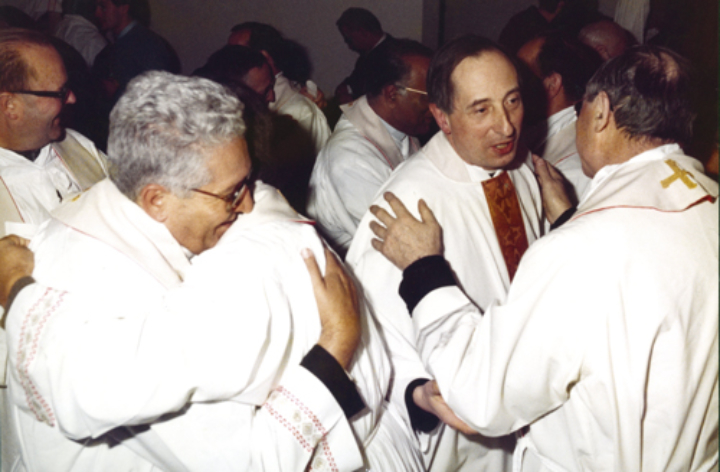
 Klaus Hemmerle played an essential part alongside Chiara Lubich in introducing the life of communion among the bishops who follow the spirituality of unity. We present some passages taken from his book, Klaus Hemmerle, La luce dentro le cose (The Light Within Things,) published by Città Nuova (Rome, 1998). “Even after the radical conversion of our life that takes place once and for all in Baptism, all of us are unceasingly in need of converting. Even in those cases where the baptized does not separate from God, the claims that life makes on him and the temptations of daily life are likely to chain him to his own ego so much that the unique Word that the baptized has become thanks to the grace of Christ, sails along and is modified and cracks. The wound inflicted on God’s life in us is in constant need of healing” (p 82). “Forgive us our debts as we forgive our debtors.” Jesus is a realist. He knows our weaknesses. He never judges, nor does he ever say: Whatever way you live is the same. He calls us to repentance, to conversion, to constantly begin again. He forgives us and invites us to forgive others. Our friendship with him runs aground if our life is not this constant conversion” (p 73). “For each one of us, today, a cross is waiting that we are to carry along with us.” But it has to be carried this very day! Otherwise it is the cross that carries us, and then we feel totally oppressed, tormented and annihilated, and we never realize that it was the cross that carried us away. But if we ourselves have the courage to take up the cross, then it becomes the most precious thing in the world” (p 89). “When the disciples see the great and powerful God in Jesus, they are not able to find him. They have to bow down to the ground, to look into the dust: Jesus is there, washing the feet of those who are his own. Self-giving, abasement, service, mature awareness of the banality of human needs, becoming little, renouncing, the endurance of total giving, not appearing, hiddenness – all of these qualities that have absolutely nothing to do with the radiant splendour of God, lie at the deepest central core of the cult and worship we offer to God – the Eucharist” (p 101). “Someone like me who continues to fail every time, cannot but live on God’s forgiveness. But this forgiveness proves itself in fraternal pardon. This is the underlying substance of God’s forgiveness, it rebounds onto the community in which we link up to that mercy that makes us ever free and new so that we can be sons of the Father with the Lord, the only Lord – in the midst of them” (p 74).
Keep hope alight
Keep hope alight


0 Comments