
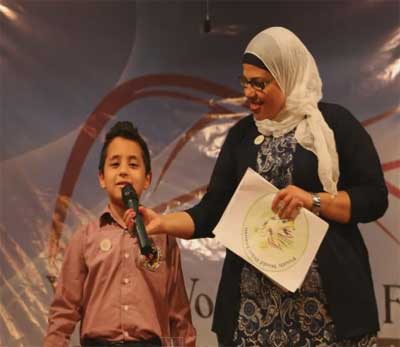
 “The Peace Forum was a unique experience. I enjoyed every moment of the programme. Such a meeting (. . .) makes one hope that better days are coming and that one day poverty, hunger discrimination and violence will see their end.” This is how Rasha, an English teacher at Rowad American College, describes Living Peace 2015 which was held in Cairo on May 4-6, 2015, following a three-day congress in Alexandria, Egypt that provided the young people with the necessary background knowledge. In Alexandria there were moments of sharing and mutual understanding, sharing the joys and sorrows that they brought with them from their own countries. In Cairo, there was a beautiful welcome, with festivities along the Nile on a large boat, with games, dancing and song. Then came the actual World Forum of Students for Peace. The project was promoted by New Humanity, an NGO, through the Cayrus project approved by the European Union. Various partners and sponsors from different countries adhered to the project and sent youth representatives to Egypt. For three days 1300 students and professors from more than 20 schools and 8 Egyptian universities shared testimonies of their common commitment to peace: best practices, more than 50 educational projects for peace, workshops, seminars, exhibits and artistic performances. Also present were ambassadors and diplomatic representatives from Argentina, Brazil, Uruguay, Guatemala, Cuba, Democratic Republic of Congo, Cameroon, Pakistan, Portugal, Croatia, Mexico, Germany and Sudan. Begun in 2011 by an English teacher at El Rowad American College of Cairo, as an educational project for peace, today, Living Peace involves more than 2500 students from around the world. A main feature of the project is the way it directly engages the students and teachers in the creation of an educational peace initiative, involving a global network of people and institutions. Membership in the project enables each school to develop projects in accordance with their own possibilities, favouring the creativity of the students along with the awareness that they are contributing towards a common goal. This creates a dynamic of participation that motivates the different components of the school, reinforcing solidarity amongst students, teachers, directors and families, with repercussions in civil society. The 2015 Forum was the occasion for presenting Scholas Occurrentes, the large global network that the Pope wished to see when he was still archbishop of Buenos Aires, and that now connects more than 400,0000 schools around the world. The presence of Dominicus Rohde from Germany, President of the World Peace Forum, raised the tone of the events. Since it was the first world forum held by young people, it opened the doors to a new road. The worldwide forum on peace has awarded the Luxemburg Peace Prize to New Humanity. The prestigious Nelson Mandela Medal was consigned to Cecilia Landucci who represented the NGO in Cairo. See video: Living Peace 2015 https://www.youtube.com/watch?v=nugDbxgoccg&feature=youtu.be Source: ONG New Humanity, AMU e Umanità Nuova. Updated May 27, 2015
Be generously available!
Be generously available!
0 Comments