
This focolare little town in Switzerland has two schools for young people: one for the formation and training of focolarini and the other for young people who wish to deepen their understanding and experience of the spirituality of unity. Dialogue and exchange between generations and cultures are distinguishing features of life in Montet. Michael, a boy from Mali, described life in this little focolare town as follows, “It is a community that works together – body and soul – to show to the whole of humanity that diversity is not a fault or failure but a grace from God to unite the world.” He was a part of a group of thirty young people from thirteen different countries who followed a year long course of human, spiritual and professional formation. Gospel teachings and Chiara Lubich’s charism of unity underpinned this time of study, work and communitarian life during which people experienced that it is possible to build deep relationships with people of different ages, cultures, traditions and ways of thinking. 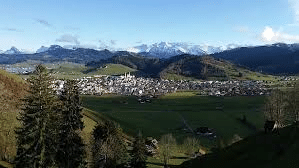 Montet began in 1981 and is situated in a peaceful location, surrounded by green hills and three beautiful lakes, Bienne, Morat and Neuchatel. It is extremely international: its population of about one hundred people comes from thirty-five different countries. About half are young people who stay for a year and the other half are adults who live there permanently and guarantee the continuity of the life of the little town. It is a meeting place for people from five continents, coming from different cultures, religions, Christian Churches and of all generations. It was in Switzerland in the 1960’s that Chiara Lubich first began to envisage and understand what would eventually become the focolare little towns. There are now twenty- five in the world and they are places of witness to the unity of the entire human family. “In Einsiedeln, looking down from the hillside at the basilica and the surrounding area, I understood that the Movement should have a town but that it should not have an abbey and guesthouses but should be made up of homes, work places, and schools like ordinary towns.” There are two formation schools for young people in Montet. One is for the focolarini who are preparing for consecrated life and the other is for young people who want to spend a year living in community and are searching for their vocation. Alejandro from Cuba said, “Being at the school in Montet with people from so many different countries is like the confirmation that, irrespective of our diversity, a united world is possible if we all want it. It means learning from each other every day and trying to build unity with love. It’s a marvellous adventure.”
 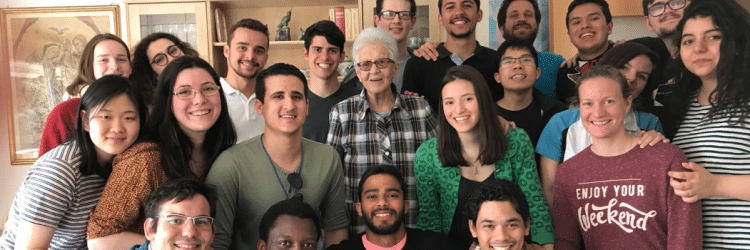 Andre from Brazil explained, “In the little town, young people can study ethics, sociology, theology, intercultural dialogue and deepen their understanding of the spirituality of unity. This study can form the basis of their attitudes in the work they do now but is also a preparation for professional life. It will help them show responsibility and consistency in all areas of society in the future.” He continued, “In addition, thanks to the respect between generations, you understand that no one is superior to anyone else but you are actually responsible for one another. As a consequence, older people become younger in their outlook on life and younger people become more responsible.” For Gloria from Argentina, the intercultural aspect – namely, dialogue, exchange and cultural enrichment – is the distinctive feature of the little town. “We have had to learn to do something really important with our diversity. It was difficult because it seemed that we couldn’t understand one another but by loving we came to a solution regarding practical matters and we understood one another in transcendent things. Living with other people has enabled me to discover the best in them but also what is really good in my own culture. I’ve discovered how important other people are in my life and I think we shouldn’t be afraid to open up and discover their ‘world.’” In Montet “there are the answers to the questions we ask every day” said Ivona from Serbia. The little town is “a gift from God.” And as Larissa left for Brazil, she said, “It is a multicultural, multigenerational family.”
Claudia Di Lorenzi

0 Comments