
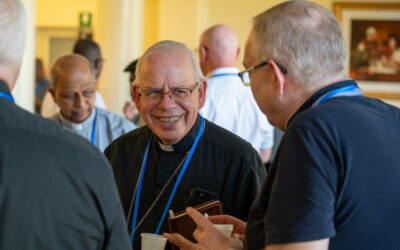
05/10/2005  Rumanian Orthodox Patriarch Teoctist, who invited and hosted the annual international meeting of 40 bishops, friends of the Focolare Movement, at the Patriarch’s Palace in Bucarest, also attended some of the sessions. The bishops’ reflections centered on the title and theme: “The presence of the Risen Lord in the midst of his people: center of ecclesial life and heart of our shared witness,” as a contribution to full communion among the Churches. Two video-taped conversations of Chiara Lubich developed the theme of the meeting, particularly characterized by the warm brotherly relationships among the participants. The Patriarch gave the welcome address at the beginning of the meeting and attended the last day, where also representatives of different Churches and of the civic society were present. During the conclusion, Focolare members of different ages and vocations offered their experiences of living out their commitment among the youth, in the family, in the parish and in the sphere of economy and of politics. Among the 300 people present, there were also some members of the Catholic Bishops’ Conference of Rumania. In his closing remarks, the Patriarch said: “We see the world moving ever farther away from Christ; love is lacking (…). Unfortunately, I also have to note that we are still far from that moment when we can give a shared witness that we are totally at the service of the Word of Our Lord Jesus Christ. Let us love one another so that we can give the witness of being one mind: it is a word which always warms our hearts. During these days I had the chance to listen to special things (…). Hearing the young people share their experiences, I thought how advantageous it would be if we bishops and our Churches would try to see together, as the young people do, the problems that embitter us (…). I say this with all sincerity, because I see here before me the Catholic bishops of the Bizantine rite. We of the Rumanian Orthodox Church recognize that in our relationships with them, we are far from justice and truth, and above all, from the love of Christ. Let us also try – following the example of these young people and of these our brothers – to find ways of solving the problems that we still have. We can do it if we want.” Conscious of the unsolved issues between the Catholic Church of the Bizantine Rite in Rumania and the Rumanian Orthodox Church, problems linked to the confiscation of ecclesiasial property during the communist regime, Patriarch Teoctist’s words deeply struck those present and brought back to mind the people’s cry of “Unity! Unity,” which in 1999 accompanied the embrace between the Patriarch and John Paul II, then on his visit to Rumania. The Divine Liturgy on Sunday, celebrated by Patriarch Teoctist was a very solemn moment. After his homily, he invited Cardinal Miloslav Vlk, Archbishop of Prague and main promoter of the meeting, to say a few words. The convention also included an encounter with the entire Catholic Bishops’ Conference of Rumania, made up of the Catholic bishops both of the Latin as well as the Bizantine rite.
 The Catholic Mass concelebrated in St. Joseph’s Cathedral, where the hymns of the Catholic choir alternated with those of the Orthodox students of the Faculty of Theology of Cluj, was an eloquent sign of communion. The Catholic bishops and those of other Churches entered together in procession in the crowded cathedral. The Catholic Archbishop of Bucarest Joan Robu said in his homily, “This week you have lived among us as a spring of life, of new ideas. This offers me true hope of unity.” Also included in the programme of the meeting was the possibility to get to know the monastic life of Curtea de Arges, Bistrita and Horezu and the very rich liturgy and iconography of the Rumanian Orthodox Church. Visits were also made to the different Christian communities (Lutheran, Reformed and Anglican) present in Bucarest and there was participation in their respective liturgical celebrations.
 The Orthodox Church was represented by bishops of the Ecumenical Patriarchate of Constantinople, of Rumania, Serbia, and the Orthodox Church of the Czech and Slovak Republics. Also present were members of the Syrian-Orthodox Church from Syria, India and the Netherlands. The Anglican Church of England was also represented, as well as the Lutheran Churches of Germany, Rumania, Sweden, Norway, Great Britain, and the United States. The Mar Thoma Syrian Church of India was represented by a bishop. A Bishop of the Methodist Church of Brazil also participated, and there were 14 Catholic bishops from different countries present.
0 Comments