
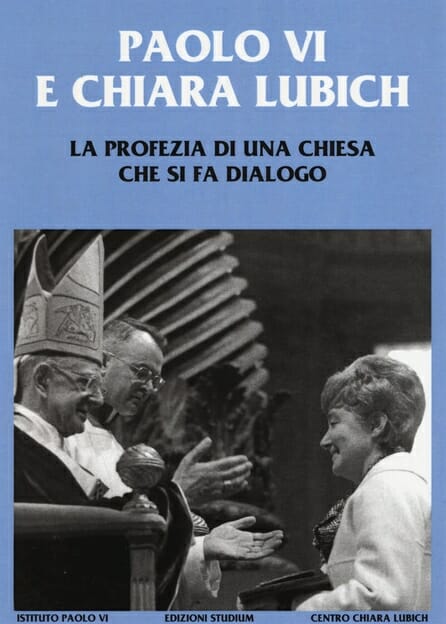
 «Along the years, there have been studies and in-depth reflections on the Foundress of the Focolare Movement and Paul VI, the “helmsman of Vatican II.” But the time was not ripe for the deepening of the providential weft of relationships established between Giovanni Battista Montini and Chiara Lubich traced precisely to that period. A Pope and a lay woman: what could they have had in common? History never fails to surprise us, and the works carried out by the Paolo VI Institute and the Chiara Lubich Centre resulted in the two study days of 7/8 November 2014, centered on Paul VI, Chiara Lubich and the prophecy of a Church that impersonates dialogue. All these activities have contributed to this long-awaited publication. The book, published in July 2015, traces those events that had revealed under a historical, social, ecclesial, ecumenical and theological profile, the relationship that began in 1952 between Chiara Lubich and Montini, then the special deputy of the Secretary of State, and which continued up to the death of Paul VI in 1978. The path highlighted important moments for both the Church and the Focolare Movement, with the charismatic drive which distinguished it from the very beginning when it made its first steps in the city of Trent. As seen in the studies of the 1950s, the ecclesiastical authorities nurtured strong doubts with regard to the novelty the Movement represented, and the overcoming of this stance towards the start of the 1960s with the first approvals. At this stage, Paul VI played a fundamental role through his personal commitment in the progressive, juridical and institutional configuration of the Movement. Still quite an unknown but a highly interesting topic, it related to the presence of the Focolare in the Eastern European countries from the start of the 1960s, at the height of the Cold War, along with the intensification of contacts in the ecumenical field that came about in the same period. This account is extensively documented by an intense exchange of letters between Chiara and Paul VI, and of what Lubich wrote in her diary after the audiences with Pope Montini. The events also highlighted, alongside these two figures, the role of Igino Giordani. He was a personal friend of Paul VI who, when still a young bishop in Rome, used to frequent his home. In those times Giordani was the Vatican librarian, and future member of the Constituent assembly and Cofounder of the Focolare Movement with Chiara Lubich. Maria Voce, President of the Focolare, stressed that «there is a profound consonance which particularly reveals Pope Paul’s extreme sensitivity and capacity to see in the charism God endowed to Chiara Lubich, the work of the Holy Spirit at the crucial moment of the celebration of the Second Vatican Council that opened out to dialogue beyond frontiers. Upon meeting Chiara, he listened, appreciated, and encouraged. In 1964, struck by the ecumenical feature of the Movement, he exhorted: ”In the same way as you have started a dialogue with the non-Catholic Christians, do the same also with those who do not profess a faith.”» «This was underlined by Don Angelo Maffeis, president of the Paul VI Institute: “the beginnings of this story traces back to long before the Second Vatican Council and deserves to be reconstructed so as to highlight the background of personal contacts and ecclesial experiences that gradually led to the full development of the orientations set by Paul VI in the course of his pontificate.» The other works by Andrea Riccardi, Alberto Monticone, Lucia Abignente, Paolo Siniscalco, Joan Patricia Back, Alberto Lo Presti, Adriana Cosseddu and Piero Coda – have focused under various aspects, «the grandeur of the prophecy of a Church that became the personification of dialogue.» Two charisms met, recognised one another, and worked together to make the Church a “house of communion,” which sets itself in dialogue with the world. The volume on Paul VI and Chiara Lubich, the prophecy of a Church that personifies dialogue, was curated by Paolo Siniscalco and Xenio Toscani, and edited by ‘Studium.’» Caterina Ruggiu
Peace starts within our hearts
Peace starts within our hearts

0 Comments