
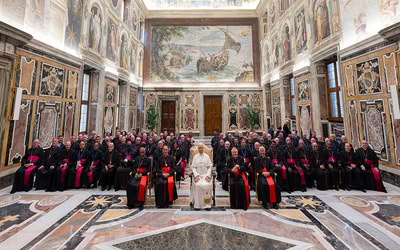
 News of the Pope’s visit to the Italian Government on November 14, 2013, where he was welcomed by Giorgio Napolitano, has filled the headlines of news agencies around the world. The meeting which took place in the Quirinale Palace was cordial and simple and marked by the shared values that were expressed in their speeches. There was a noticeable presence of leaders from the civil sector, as well as hundreds of Italian citizens who were in front of the presidential palace to welcome the papal automobile. Inside, to welcome Pope Francis, there was a government delegation and representatives from the business and academic world, as well as several representatives from the world of solidarity who are actively involved in projects for the poor, suffering and least. Maria Voce and Giancarlo Faletti also attended, representing the Focolare Movement. Maria Voce recounts: “Everything took place within an official and at the same time cordial atmosphere. I especially liked the President’s opening remarks, both for how he cited the Pope for his particular ability to reach people’s hearts and for t
 hat personal dimension that he brings to the relationships he establishes. The president felt that he had to underscore also the Christian heritage that can be seen in the values that have formed Europe, and the situation that Italy is undergoing in overcoming the tragic situation that is overwhelming politics. He expressed his expectation that a message of the Pope would help to move beyond particularisms in view of the common good. Both men spoke of the fact that we find ourselves in front of questions that call on us to work together and for which there are also common answers, even if in different frameworks and through different methods.” Co-President Faletti mentioned his impression of finding himself inside “a page of human history,” which is certainly linked to the history of Italy. It was evident from the words and testimonies of Napolitano and Pope Francis that having an impact on history will fundamentally depend on the ability to enter into dialogue with others.”
  As he cited the “distinctive characteristic” of the Pope’s pastoral approach, the Head of State stated: “See each person one at a time.” Pope Francis invites us to “a strong consideration of the human person,” knowing how to “communicate with simple people,” transmitting to “each individual and to all the values of Christ’s message, “above all, love for others” to prevent the “spreading of egoism.” The Pope concluded with wish for Italy: That the country “drawing on its rich patrimony of civil and spiritual values,” would find “the creativity and the unity necessary for its harmonious development, to promote the common good and the dignity of each person, and to offer on the international stage its own contribution to justice and peace.”
Give generously
Give generously
0 Comments