
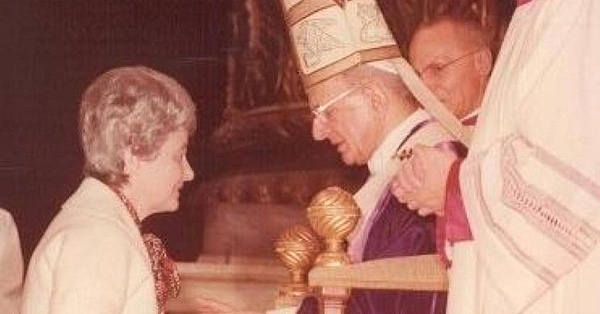
 Catholic Church leaders, representatives of the Islamic world, civil authorities, representatives of associations and the people of Brescia and neighbouring cities filled the cathedral of the Italian city on the 23rd of September, for the conference on “Paul VI, a Spiritual Portrait“. The event included the testimony of Maria Voce, President of the Focolare Movement, in a speech read on her behalf by Rosi Bertolassi. Her speech touched on three aspects of Giovanni Battista Montini’s life and work as: prophet, apostle and mediator. The President of the Focolare first of all expressed the deep gratitude that bound the Movement she represents to Blessed Paul VI, who was “…one of the gifts God wanted to make to humankind in our time.” She recalled the time when the Church was studying the emerging Movement, saying, “When he became Pope he played a key role in discerning the charism of Chiara Lubich and in making possible what, at the beginning of the sixties, still seemed” impossible,” expertly identifying juridically appropriate ways to express the specific character of this new movement in the Church.” “Therefore”, she stressed, “Because he was “imbued with the Word, we saw the figure of Giovanni Battista Montini – Paul VI – in this triple dimension of prophet, apostle and mediator.” In the prophetic dimension, Maria Voce highlighted “his ability to open new paths with courage and wisdom, to break down walls and express the renewal of the Church which his soul craved for,” Examples were Pope Paul VI’s historic embrace of peace with Patriarch Athenagoras in January 1964 in the Holy Land; or when, in 1970, through an historic decision he raised two women, St Teresa of Avila and St Catherine of Siena, to the status of Doctor of the Church – a title previously only given to men; or when, in the 1975 Holy Year, he knelt to kiss the feet of the Orthodox Metropolitan Meliton. “Paul VI was truly the Pope of dialogue. This is how Pope John Paul II described him in Concesio during his pastoral visit in 1982, emphasizing his predecessor’s ability to dialogue with the whole of humanity.” Maria Voce also emphasized his apostolic dimension saying, “In Ecclesiam Suam (…) we perceive the thought and mind of the apostle whose name he had chosen, the name of the missionary apostle and the first theologian of Christ, the one who made himself all things to all people. Pope Paul VI did not spare himself so that the announcement of the Gospel could reach all nations.” In this respect, Maria Voce recalled his apostolic journeys “that brought him closer to the peoples of the world, making the Church more one and more ‘catholic’, as Paul VI liked to emphasize, in the etymological sense of the word. Particularly significant and universal in outlook was his historic and profoundly human speech delivered at the United Nations. I am pleased to recall once more his innovative inclusion of the laity in key areas of work of the Church; his confidence in the contribution of lay people’s ideas; and his recognition, in Octogesima adveniens, of the legitimacy of a variety of political opinions while remaining faithful to Gospel principles.” Finally, his ability to be a “mediator of the One Mediator“. After recalling his surprising letter to the Red Brigade which “flowed from his soul at the painful time when his friend Honourable Aldo Moro was kidnapped” Maria Voce affirmed his role as mediator and added, “Paul VI – in the footsteps of his Master – took upon himself the anguish and torment of the world, feeling it deeply as if it were his own. He bore the sin of the world, perceiving truly the weight of it and suffering profoundly, as could sometimes be seen in his face. In that way he manifested clearly the fatherhood of God, bridging the distance between heaven and earth, healing wounds, wiping away tears, bringing peace and unity.”
Give generously
Give generously
0 Comments