
The primacy of listening, a shared journey open to dialogue and encounter, the challenges of secularization, of lasting peace, of welcoming the many diversities of humanity are at the centre of this phase. Margaret Karram, President of the Focolare is one of the participants at the European Synodal Continental Assembly. “We gather in Prague, a city that can be considered a bridge between East and West, but which also expresses a warning for Europe. Today, just over thirty years after the fall of the Berlin Wall which marked the end of the world divided into opposing blocs, we have another war in the heart of Europe. We feel close to our Ukrainian siblings, in the hope that Russian aggression will end and that true peace and reconciliation will be found on our continent.” 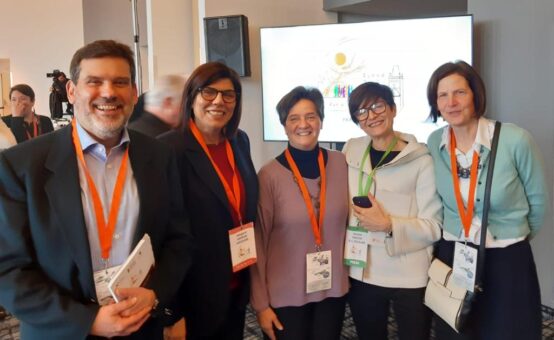 These are the words of Gintaras Grušas, Archbishop of Vilnius (Lithuania), President of the Council of European Episcopal Conferences (CCEE), in his opening speech at the European Synodal Continental Assembly. Solidarity with the Turkish and Syrian populations affected by the terrible earthquake was also expressed immediately. The meeting is taking place in the capital of the Czech Republic, from 5th-12th February, with the participation of 200 delegates from the 39 European Episcopal Conferences, from 45 countries. There were also 44 “guests” including Margaret Karram, President of the Focolare Movement. Cardinal Mario Grech, Secretary General of the Synod, offered a realistic perspective of this phase of the journey saying, “We are all learners in synodality.” The Church in Europe met to experience a journey of sharing, more necessary than ever today, to get to know each other and to break down prejudices.
 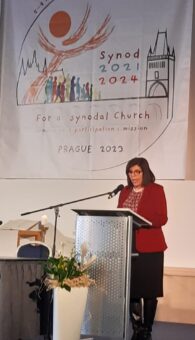 The Voice of the Churches in Europe The sessions dedicated to the experience of the synodal journey of the various Episcopal conferences gave a glimpse into the life of the Churches in Europe. From Albania where today Christians are confronted with the need to learn to dialogue with people of different religions to Belgium, where secularization has reached every social sphere. The invitation is to know how to grasp the signs of the times, giving space to the laity, avoiding every form of clericalism, every yielding to attitudes of abuse and power. In Belarus, the synodal journey brought to light the need for formation in dialogue for both the clergy and the laity in order to have a greater impact on society. Bulgaria, a country with a very small percentage of Catholics, told of a synodal path animated by a strong ecumenical spirit. This was shared by several countries of Eastern Europe, while from France came a resolute invitation to listen, to the centrality of the victims of abuse in the Church and to a path of purification in spiritual life to rediscover fidelity to Christ and to be a welcoming Church for all. The Churches of Great Britain and Wales emphasized the need for ongoing formation in the life of faith and evangelization. Transversal issues
 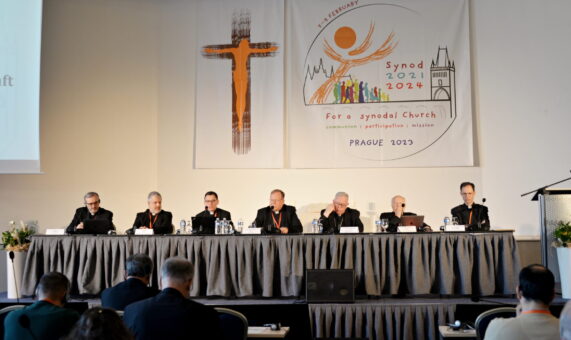 There are many transversal issues for the Churches of the old continent: from the scourge of abuse, to the formation of the clergy so that they regain the trust of the people of God and rise to the challenges of today’s de-Christianized and secularized society, to the question of women in the Church, to the urgency of the transmission of the faith today, but with a language and modality suited to the times. But there is one common question for all: what does it mean for the Church in Europe to be “inclusive”? How can it also embrace those people who live complex moral situations with respect to Church doctrine, such as divorced people or LGBTQ+ people? The answers can only come from a patient journey of communion. In her input, Margaret Karram said, “I believe that the response that the Church in Europe can offer today is the gift of that evangelical love that comes to us from Christ himself and is at the heart of dialogue and encounter. As a Focolare Movement we commit ourselves to this path to which the Pope is calling us.” For the Church in Europe, the synodal days in Prague are a real life experiment in synodality, which highlight the need to continue on this path. The final document, the result of these working days, will include all the requests, challenges and proposals and, together with those of the other 6 continental assemblies, will be sent to the central commission of the Synod.
Stefania Tanesini
0 Comments