
The news came suddenly and unexpectedly, on the morning of 10th August. Kala Acharya had just died on the campus of Somaiya University where she lived and where, at the behest of its founder, Shri Karamshi Jethabhai, she had spent forty years of her life. As Samir Somaiya, grandson of the founder and current President of this prestigious academic institution, defined her, Kala had become an institution in her own right through her presence and personality. In agreement with Dr. Shantilal Somaiya, who in the meantime had succeeded his father in the management of the Trust of the academic institution, she had established the Somaiya Sanskriti Peetham, an institution for the training of formal and informal teachers of moral and religious values. At the same time, she became deeply involved with Dr. Somaiya in interreligious dialogue, collaborating in the mid-1990s, with the St. Pius X Catholic Seminary in Mumbai and with various foreign professors and institutions, including some in Italy.
In September 2000, a few months before Chiara Lubich’s first trip to India, Msgr. Felix Machado, Undersecretary of the then Pontifical Council for Interreligious Dialogue (today the Dicastery for Interreligious Dialogue), asked Marina Pracchia and Roberto Catalano, the co-responsibles of the Focolare Movement in India, to get in touch with Professor Kala Acharya. He considered her a sister and hoped she might be able to take part in some moments during Lubich’s visit. The first meeting in Vidhyavihar, on the vast campus of Somaiya University, was immediately very warm. Kala readily accepted the invitation to attend the award ceremony of the Gandhi Peace Defender Award, which Chiara Lubich received from the Shanti Ashram in Coimbatore, in early January 2001. It was in Coimbatore, just before returning to Mumbai, that Lubich met the Indian academic personally. They immediately understood each other. The next day, the founder of Focolare wrote in her diary: “Yesterday, on the feast of the Epiphany, I had a rather special meeting, perhaps with a person who has a design of God, Kala Acharya. […] she is an expert, she has explored Hindu-Christian dialogue, knows the Pontifical Council for Interreligious Dialogue well and has been personally received twice by John Paul II. When she came into the sitting room, she immediately said that she felt blessed…: “It is the love of God that comes to me. I’ll work along whatever line you give me. That’s a promise.” […] She wants me to meet a group of highly qualified people of various religions in Bombay: she said, “Your word must go directly to all religions. The meaning you give to love is extremely important”. There will be professors, students, “we all want to become the vehicles of this word of yours” ”.
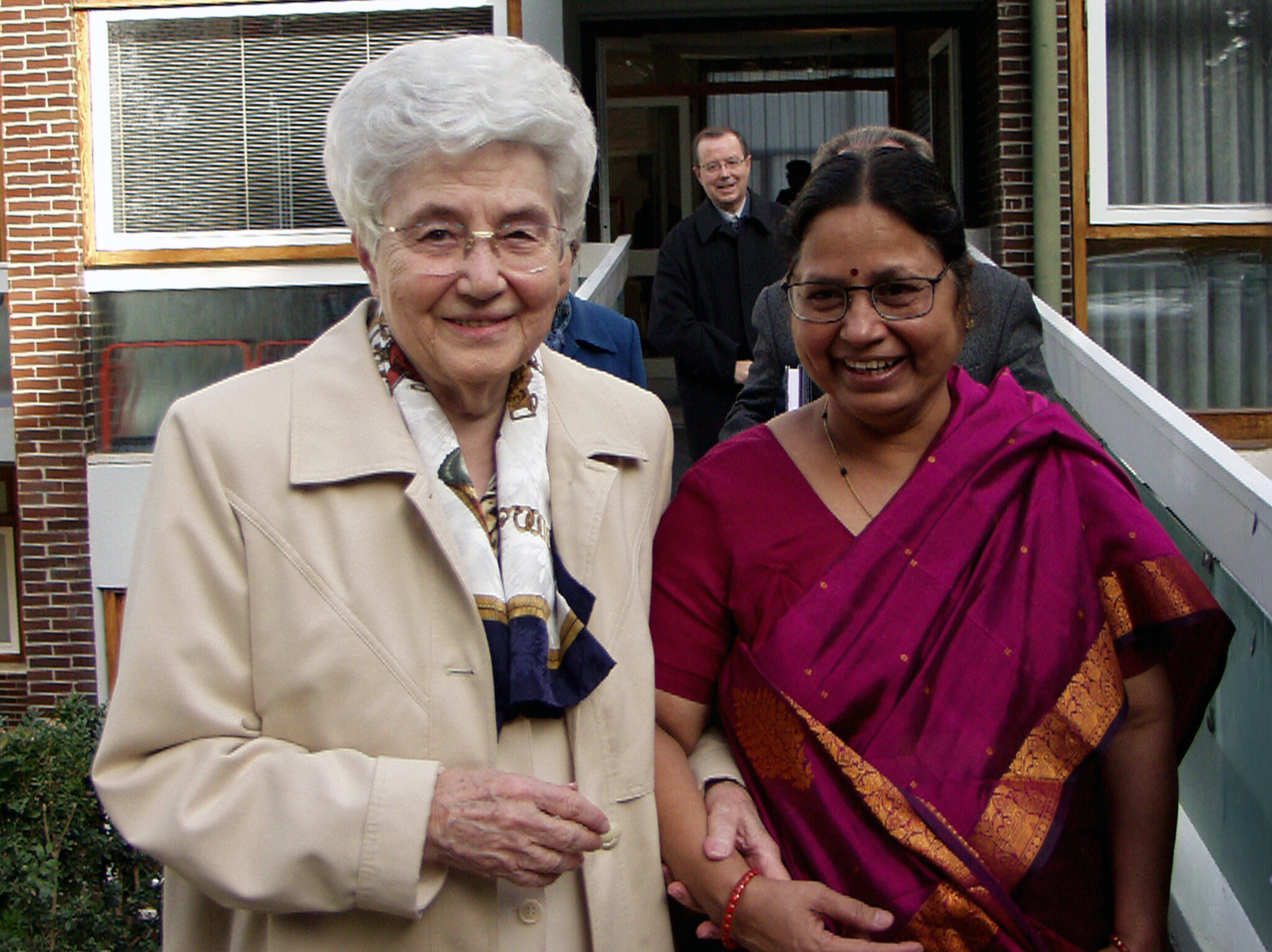
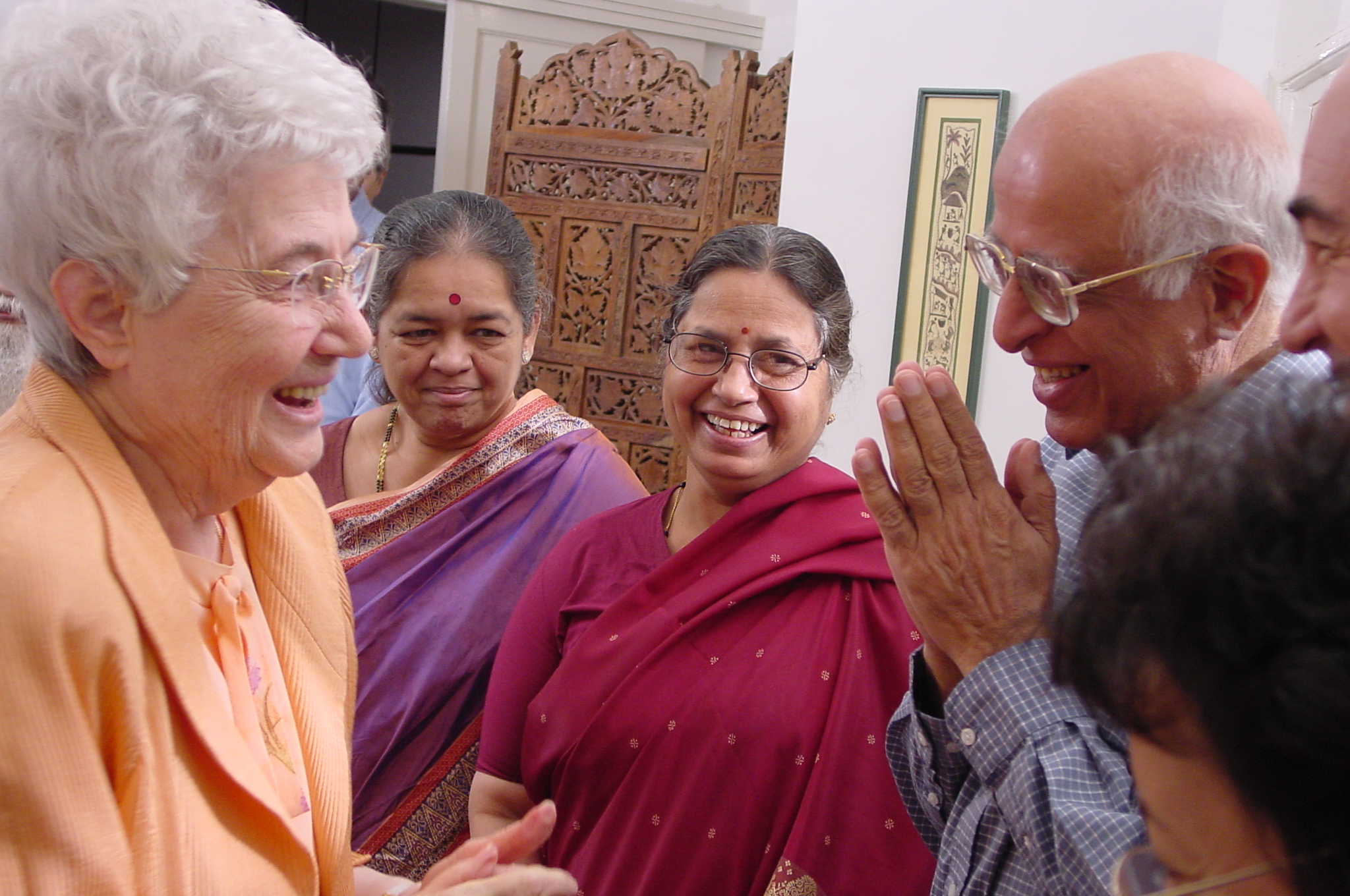
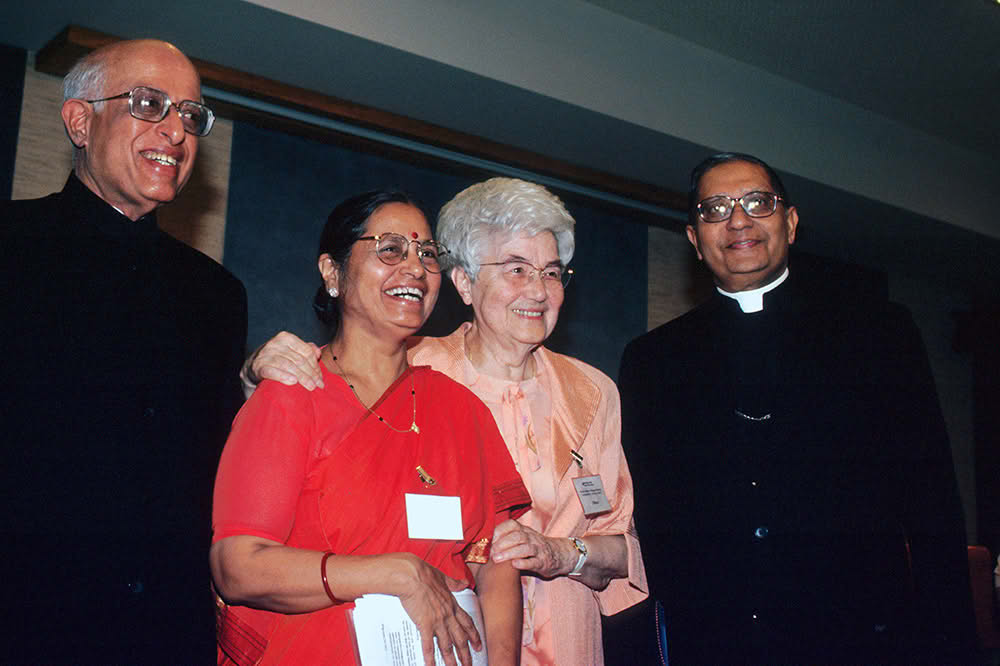
In the photos: From left: Chiara Lubich and Kala Acharya. In the second photo, between Chiara and Kala is Prof. Shubada Joshi, and on the right is Dr Shantilal Somaiya. In the third photo: Dr S. Somaiya, Kala Acharya, Chiara Lubich and Cardinal Ivan Dias of Bombay.
A few days later, in Mumbai, under a shamiana (a decorated tent) in the esplanade in the center of the large university campus, 600 people gathered to hear Lubich speak. She recounted her Christian experience and her yearning and commitment to dialogue. Shortly beforehand, Dr. Shantilal Somaiya had assured Chiara that he wanted to become a soldier at her command, to bring the spirit of unity and dialogue everywhere. It was the beginning of a unique season in the Focolare experience –not only because everything was always organized together with the new Hindu friends and the Vatican Dicastery for Interreligious Dialogue and with the Diocese of Mumbai. The Movement, for the first time in its history, opened itself up to interreligious dialogue at the academic level. This was largely due to Professor Kala Acharya who suggested that Chiara continue the friendship together with a series of symposia to reflect on shared themes. It was during the first of these that Lubich felt the inner urge to share her most intimate spiritual experience. The resonance among the Hindus was surprising and Chiara continued this experience of communion during her second visit to India in 2003, when she spent a morning together with about twenty of these academics to share very deep spiritual realities in an atmosphere of communion difficult to describe.
Chiara and Kala have always considered themselves spiritual ‘sisters’ and Kala continued, as much as she could, with great fidelity, to carry on the interreligious dialogue born from her relationship with Chiara. Along with other Hindus such as Minoti Aram and Suresh Uppadhyaya, she had grasped the prophetic significance of the charism, expressing it in these terms: “In Hinduism we have three ways to get to God: bhakti yoga leads us to pray, Karma yoga leads us to act and jnana yoga leads us to think and meditate in order to come to know self and God. Chiara Lubich offers us a fourth way, the Prem yoga, the path of love for our brothers and sisters and among ourselves ”.
Roberto Catalano
Photo: © Anna Paula Meyer – Horacio Conde – Archivio CSC Audiovisivi


0 Comments