1 Jan 2026 | Idea of the Month
The world today lacks unity. To give just a few examples, we see this in the divisions that sometimes exist within families, among neighbours and between Churches and communities. It seems that polarisation prevails over understanding. This is a consequence of the growth of individualism that drives people to decide and act on their own behalf in a way that benefits their interests and personal prestige. This gives little value to the needs and rights of others.
And yet, it is possible to experience unity. It is a journey that always begins by taking small steps and with a “yes” that we say within: yes to welcoming, yes to forgiving, yes to living for others. It is not about grand projects but about small but faithful actions that, over time, transform a life, a community or an entire environment. And when that happens, we realise that fraternity ceases to be an ideal and becomes a visible reality and hope for all.
Martin Buber considers unity to be relationship. He states that it is the space of encounter, that exists between You and I, a sacred place where differences do not disappear but are mutually recognised. For him, unity arises when two realities allow themselves to be touched and shaped by the other and not when one imposes itself. This “between” can be understood as a space that welcomes diversity and, precisely for this reason, becomes a source of communion. Hence, for Buber, “All true life is encounter” (Ich und Du, 1923).
Therefore, in other people – whether friends, family members or just someone we meet along the way – we can discover the great ‘opportunity of relationship’. Other people ‘save us’ and enable us to go beyond our fears when we feel overwhelmed by a difficult situation.
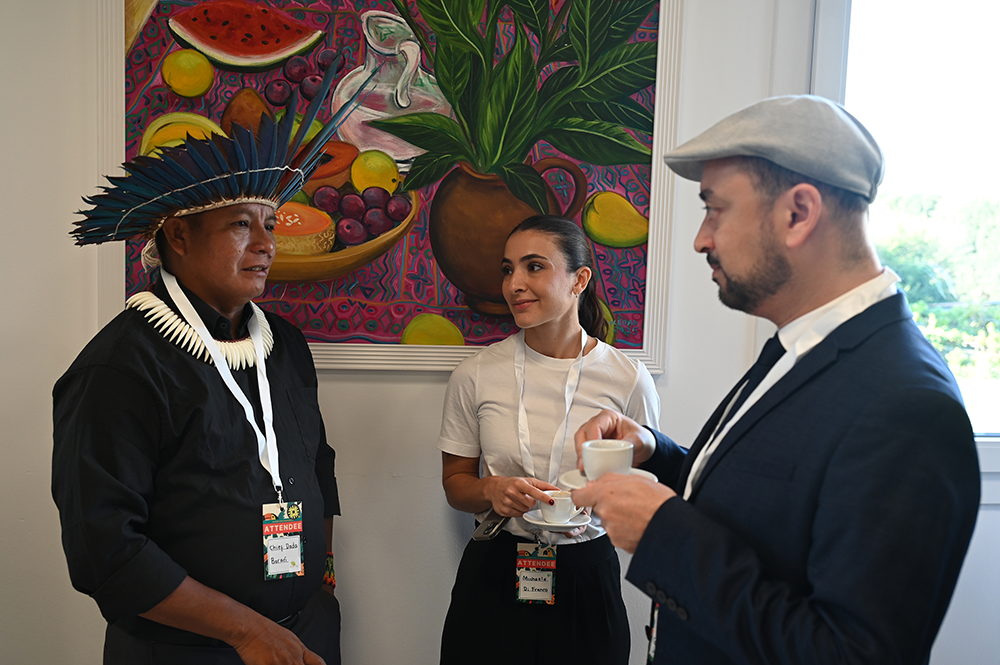
Living for unity means walking together despite our differences, transforming them into treasures rather than obstacles. It is an invitation to move from simple coexistence to encounter, where reciprocity enables what belongs to each person to become new because the relationship means it is shared. Unity, understood in this way, is not the sum of the two nor is it fragility that causes us to lean on others: it is strength that generates the hope that there is still a tomorrow. Diversity is no longer disunity, but mutual richness. It is feeling that what happens to others also resonates in me. ‘Union does not consist in equality, but in harmony,’ Rabindranath Tagore reminds us.
This month, may we experience the joy, light, life, peace and hope that come from unity that is lived
If we are one, we see things differently.
Photo: © JGC-CSC Audiovisivi
THE IDEA OF THE MONTH is currently produced by the Focolare Movement’s “Centre for Dialogue with People of Non religious Beliefs”. It is an initiative that began in 2014 in Uruguay to share with non-believing friends the values of the Word of Life, i.e. the phrase from Scripture that members of the Movement strive to put into practice in their daily lives. Currently, THE IDEA OF THE MONTH is translated into 12 languages and distributed in more than 25 countries, with adaptations of the text according to different cultural sensitivities. dialogue4unity.focolare.org

1 Jul 2024 | Cultura
Our daily lives are never free from problems and challenges – health, family, work, unforeseen difficulties, etc. In addition, we are aware of the immense suffering experienced today by so many of our brothers and sisters due to war, the consequences of climate change, migration and violence. We may often feel overwhelmed by these situations.
It is normal to feel concern and to want to find security. We may not find a solution to the problem but the closeness of true friends comforts us and gives us strength. Facing difficulties together is a daily reminder to continue believing in those values of fraternity, reciprocity and solidarity that make the journey through life possible. Fraternal relationships help us experience the same security that children feel when they trust in the love of their parents. This helps them live with a sense of freedom and drive.
For Chiara Lubich and for so many who followed and follow her vision of life, this security comes from the faith of having a Father. Chiara said: “…the person knows he or she is loved and believes with all their being in this love….. abandons themselves to it trustingly and wants to follow it. The events that make up our lives, whether sad or joyful, are enlightened by the belief that everything happens because love has willed or permitted them all.” Her words can be applied to all those who have experienced true love at least once in their lives.
The characteristic of a good travelling companion is someone of service, someone who brings a personal dimension based upon knowledge and deep sharing in respect for everyone. This means living transparently, consistently, without a hidden agenda and with a pure and unconditional love that brings peace, justice and fraternity.
When this happens, it produces a new type of leadership that is so necessary nowadays. This leadership fosters a communitarian dynamic and enables us to recognise the unique contribution of each one without losing our individual identities. On the contrary, we know that it is when we are alone we experience disorientation and lack vision.
We ourselves will only be able to be ‘guides’ for those who are living through difficult times if we, in turn, have experienced trust in others. As the Brazilian educationalist and philosopher, Paulo Freire, says: ‘No one educates anyone; no one educates his or her self; people educate each other through the mediation of the world.’ 1 In other words, in the educational community, no one teaches anyone anything, but everyone learns from everyone in a context of dialogue and critical reflection on reality.1. We ourselves will only be able to be ‘guides’ for those who are living through difficult times if we, in turn, have experienced trust in others. As the Brazilian educationalist and philosopher, Paulo Freire, says: ‘No one educates anyone; no one educates his or her self; people educate each other through the mediation of the world.’ 1 In other words, in the educational community, no one teaches anyone anything, but everyone learns from everyone in a context of dialogue and critical reflection on reality.
1 Freire, Paulo (2012)”Pedagogía del oprimido” Ed. Siglo XXI
Photo: © Lâm Vũ en Pixabay
THE IDEA OF THE MONTH is currently produced by the Focolare Movement’s “Centre for Dialogue with People of Non-religious Beliefs“. It is an initiative that began in 2014 in Uruguay to share the values found in the Word of Life with friends who do not have religious beliefs. Currently, THE IDEA OF THE MONTH is translated into 12 languages and distributed in more than 25 countries, with adaptations of the text according to different cultural sensitivities.
