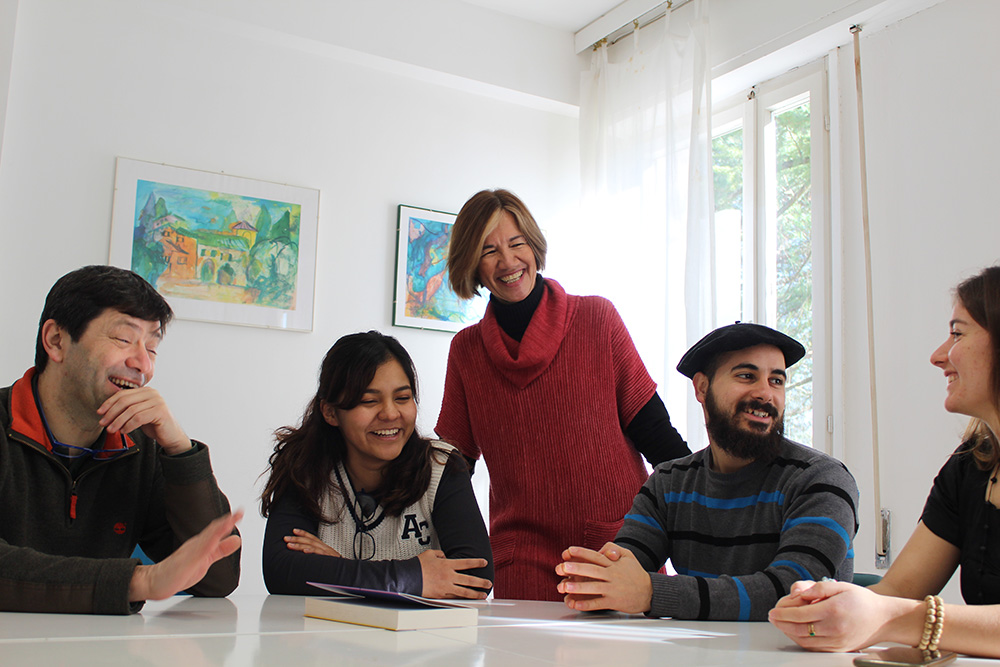
The Sophia University Institute is launching a new academic offering for the 2026/2027 academic year, marking a decisive step in the growth of the institution and in the expansion of its international academic project. The new proposal provides a complete university pathway (3+2) integrating two fully structured cycles of study: the Baccalaureate in Philosophy and Human Sciences (Bachelor’s Degree, interclass L-5/L-24) and the Master’s Degree in Philosophy, Economy of Communion and Environment (Master’s Degree, class LM-78).
The new academic proposal of the Sophia University Institute stems from a simple and radical conviction: knowledge is not merely a collection of information but a concrete tool for changing the world.
Rector Declan J. O’Byrne says, “In this time of epochal change characterized by uncertainty and fragmentation with this new academic offering, Sophia confirms its mission, assuming a strategic role in the forming people capable of combining critical thinking, interdisciplinary skills, planning and responsibility towards the common good, to lay the foundations of a different future, acting in the context of integral sustainability, the economy, social and territorial planning and innovation”.
Thanks to the institutional collaboration with the University of Perugia (Italy), both programmes allow the achievement of a double academic degree – ecclesiastical and state-recognized, with full validity in the Italian university system and international recognition.
The Baccalaureate and the Master’s
The Baccalaureate in Philosophy and Human Sciences – Bachelor’s Degree (L-5/L-24) – is a degree course that offers interdisciplinary training focused on understanding the person in their cognitive, emotional, relational and social dimensions. It prepares students to continue their studies, to access teaching paths and to take on educational, social, design and cultural roles.
The Master’s Degree in Philosophy, Economy of Communion and Environment – Master’s Degree (LM-78) – develops Sophia’s interdisciplinary method within the fields of economics, integral sustainability and governance. It forms professionals capable of understanding and guiding economic, social and organisational processes. The degree program promotes a critical reflection on contemporary economic models and encourages the search for ethical and sustainable solutions, in particular, in the fields of ecology, urban development, organizations and communities.
The focus on Economy of Communion and Civil Economy makes this path unique in the Italian and international academic landscape, offering students tools to understand and transform contemporary economic systems, to contribute concretely to the construction of sustainable, inclusive and generative economies. The proposed training prepares professionals capable of guiding corporate social responsibility processes, of developing sustainable innovation projects, of working in the regeneration of territories, of assuming roles in companies, public bodies and the third sector oriented to human development and integral sustainability.
Doctoral programmes in Human Sciences and in the Culture of Unity are also offered, completing the Institute’s academic provision.
In The Heart of Tuscany
With the next academic year, Sophia will inaugurate a new educational center in Florence (at the Institute affiliated with the Theological Faculty of Central Italy), which will host the activities of the Baccalaureate. The choice of Florence allows access to the academic, professional and cultural opportunities of one of the most prestigious university cities in Europe.
The Master’s Degree remains rooted in the international campus of Loppiano, which offers an international and intercultural environment in which students from numerous countries have the opportunity to share study, daily life and educational experiences.
The strength of the academic relationship: one teacher for every five students
One of the distinctive elements of academic life at Sophia is the student-teacher ratio, which is approximately 1:5. This allows a personalized accompaniment, ongoing dialogue and a study environment that values relationships as an integral part of the learning process. The Sophia model moves beyond large, lecture-based teaching and promotes an interactive, person-centred approach focused on the quality of content and the development of critical, relational, and project-based skills.
A network of valuable partners
The quality of academic life at Sophia is further enriched by opportunities for personalised and globally oriented study experiences, thanks to a selected network of partners that support teaching activities and offer concrete opportunities for internships and professional placement in international contexts. These include: ASCES-UNITA, Sophia ALC (Latin America), Together for a New Africa, Economy of Communion Korea, Ethos Capital and Consulus.
Christian hope is not an escape from reality. It is born in a dark place, in the narrow confines of a sealed tomb, where God has already overturned the judgment of this world. Precisely for this reason, it dares to speak in a time of wars (Gaza, Kyiv, Darfur and Tehran) and of hundreds of millions of people who do not know how they will make it to tomorrow.
Our days are woven with justified expectations: health, a secure job, a measure of peace, a justice that is more than words. But when these become our entire horizon, we either treat them as idols or, at the first serious fracture, we take refuge in cynicism and resignation.
Easter does not erase these hopes; it re-centres them. It roots them in Another and in doing so, preserves them. A love stronger than death does not remove the burden of action; rather, it breaks the anxiety of having to save the world through our own efforts alone.
The final word on history is not ours, nor that of the victors of the day. It is the word spoken over the body of Jesus. And the word of Easter already refutes every claim of death to be definitive. For Paul, the resurrection of Christ is not an isolated episode in Jesus’ biography. It is the opening of a new scene into which all humanity is drawn: “For as in Adam all die, so in Christ all will be made alive” (1 Cor. 15:22). The Church Fathers followed this insight without attenuating it: the resurrection is the fulfilment of human nature in its entirety, not the privilege of a fortunate few. In Christ, God already contemplates the fullness of the human family: the faces of refugees in the Mediterranean, of those crossing the Sahara, of civilians hiding in basements in Darfur. For this reason, every wound to human dignity, every discarded body, is not only a social injustice; it is a profanation of a humanity that was conceived and loved within the very light of the Risen One.
Paul widens the horizon further: “the whole creation has been groaning as in the pains of childbirth” (Rom 8:22). It is not only human conscience that groans, but the soil, the air and the seas. In 2026, the language of “labour pains” no longer sounds like pious symbolism: we read it in floods, in uncertain harvests, in villages forced to move because the water has run out. This groaning takes the form of protest; creation refuses to be treated as disposable material and Easter gives it a voice. In the risen Christ, every exploitation of the earth already appears for what it is: a choice against the future of all.
How, then, are we to live between a fulfilment already begun and a history still marked by too many failures? Not with paralysis, nor with superficial optimism. We live knowing that nothing authentically good is lost: a gesture of welcome, a choice to renounce something, honest work carried out under adverse conditions. Pope Benedict XVI reminds us that “every serious and upright human action is hope in action,” and includes among these efforts working for a more humane world, sustained by the great hope grounded in God’s promises (Spe Salvi, 35). We can say even more: it is not an external addition to the Kingdom; it is already a visible fragment of it. Fulfilment belongs to God and yet God insists on passing through us as well. When we commit ourselves to refugees, to disarmament, to more humane working conditions, to a concrete and not rhetorical peace, we are not simply “preparing” something for later. We are allowing the life of the Risen One to take shape—humbly and fragilely—within our time.
Easter hope does not remain an idea or a feeling; it takes flesh. The resurrection teaches us that the logic of death has no power to determine the final outcome. For this reason, every war, every system of exploitation, every calculated indifference is already unmasked and stripped of ultimate meaning by the empty tomb. In the tomb of this world, something has already changed forever: life has begun to rise up through the cracks of history. Not as vague consolation or as a “reward” in some undefined elsewhere, but as a reality that, in Christ, has already been entrusted to humanity and to all creation. In the judgement of God revealed at Easter—a judgment that liberates, not crushes—it is decided once and for all that death will not have the last word over anyone or anything.
This is the great hope.
Happy Easter: a hope that does not remain closed within the church, but engages in history.
The year 2025 has been a year full of ecumenical anniversaries and events. The meeting of Pope Leo XIV and Patriarch Bartholomew in Nicaea with the leaders of Churches and ecumenical bodies, followed by various appointments in Istanbul, bore witness to the desire and commitment of the Churches to continue on the path towards unity. Another ecumenical event of great importance, whose 60th anniversary was commemorated, was the revocation of the excommunications between Rome and Constantinople by Pope Paul VI and Patriarch Athenagoras I, which took place on 7th December 1965. It was an event that ushered in a new season of relations between Catholics and Orthodox. Paul VI and Patriarch Athenagoras, holy men of broad vision and devoted solely to the will of Christ for his Church, had the courage to break the spiral of hostility and enmity by meeting as brothers in Jerusalem in January 1964, thus preparing the ground for the revocation of those excommunications exchanged between the legates of the Pope and the then Patriarch of Constantinople in 1054. This event marked the beginning of a dialogue of charity that saw the two pioneers engaged in a continuous and increasing commitment so that the two Churches, Catholic and Orthodox, might once again recognize each other again as sister Churches.
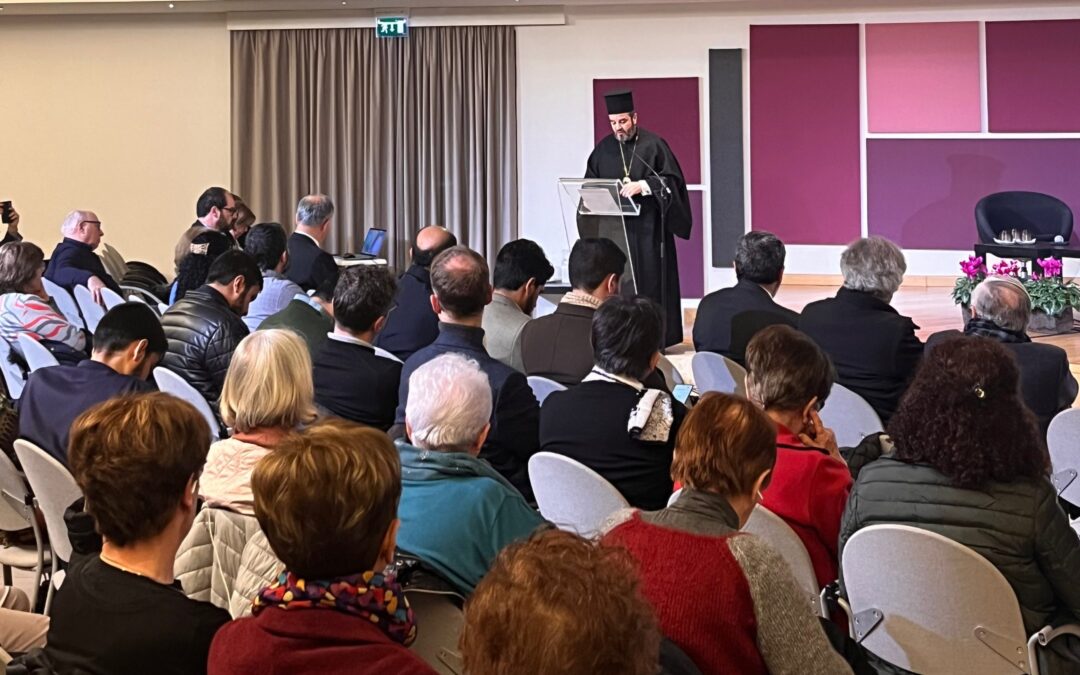
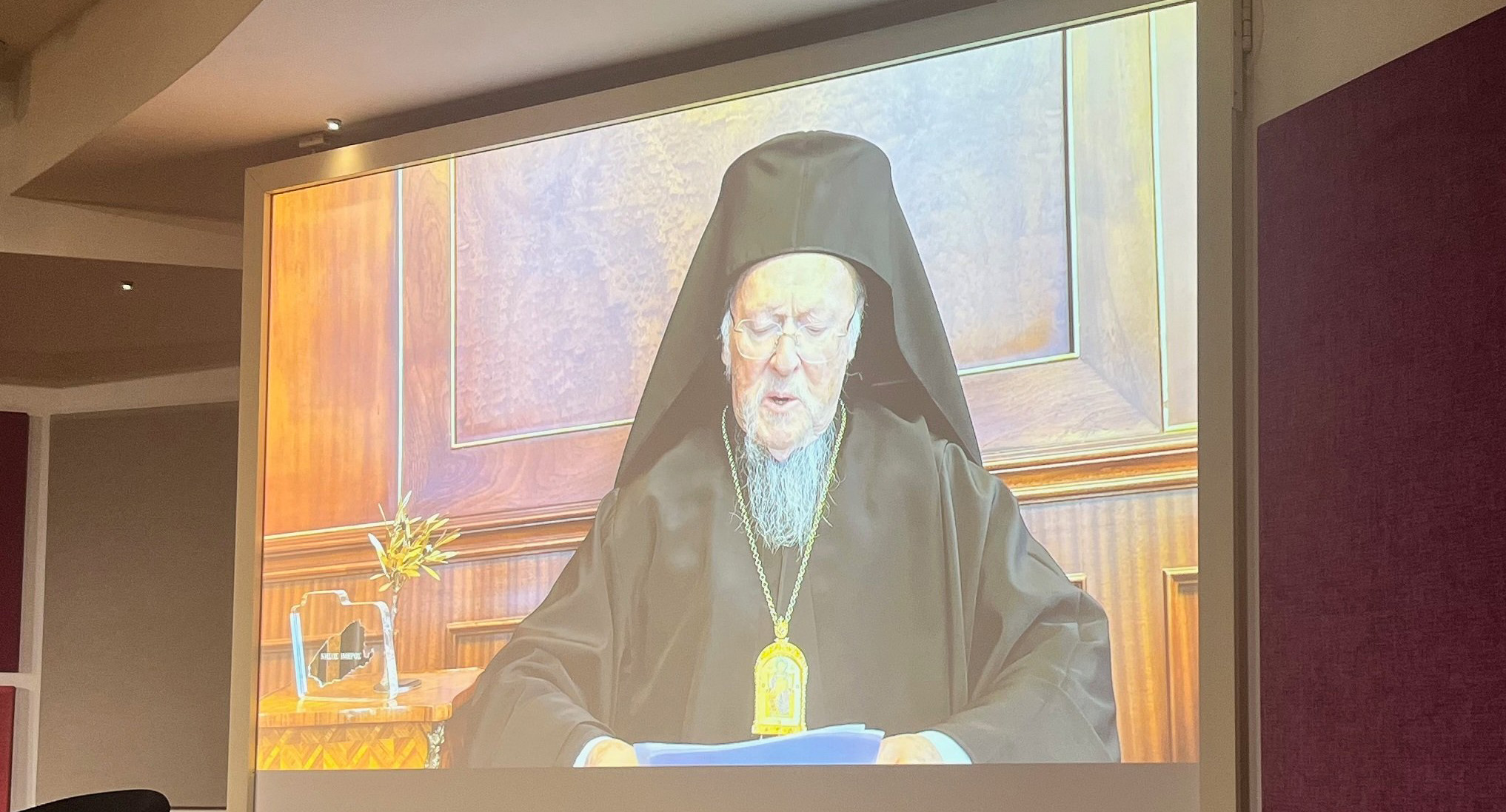
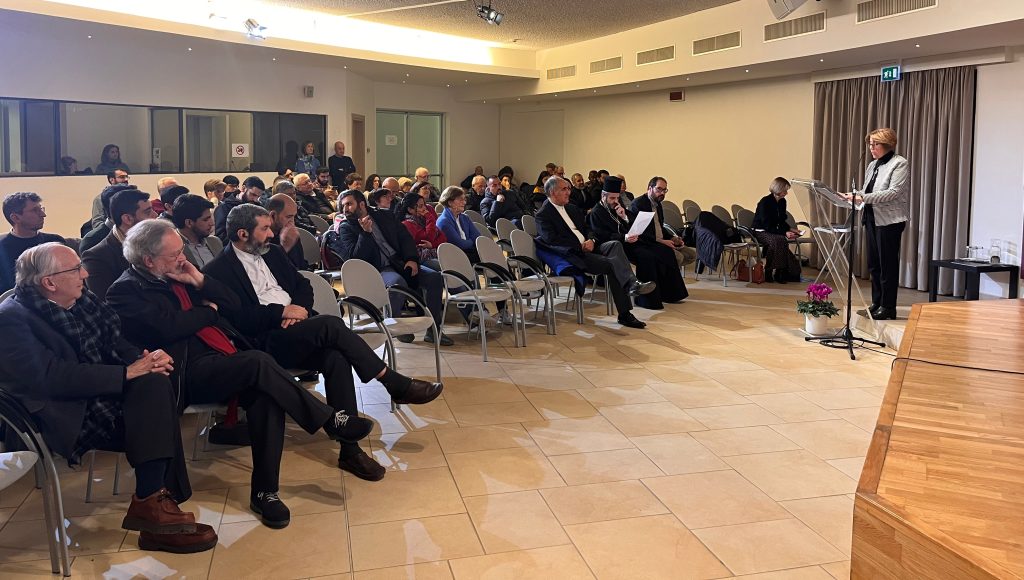
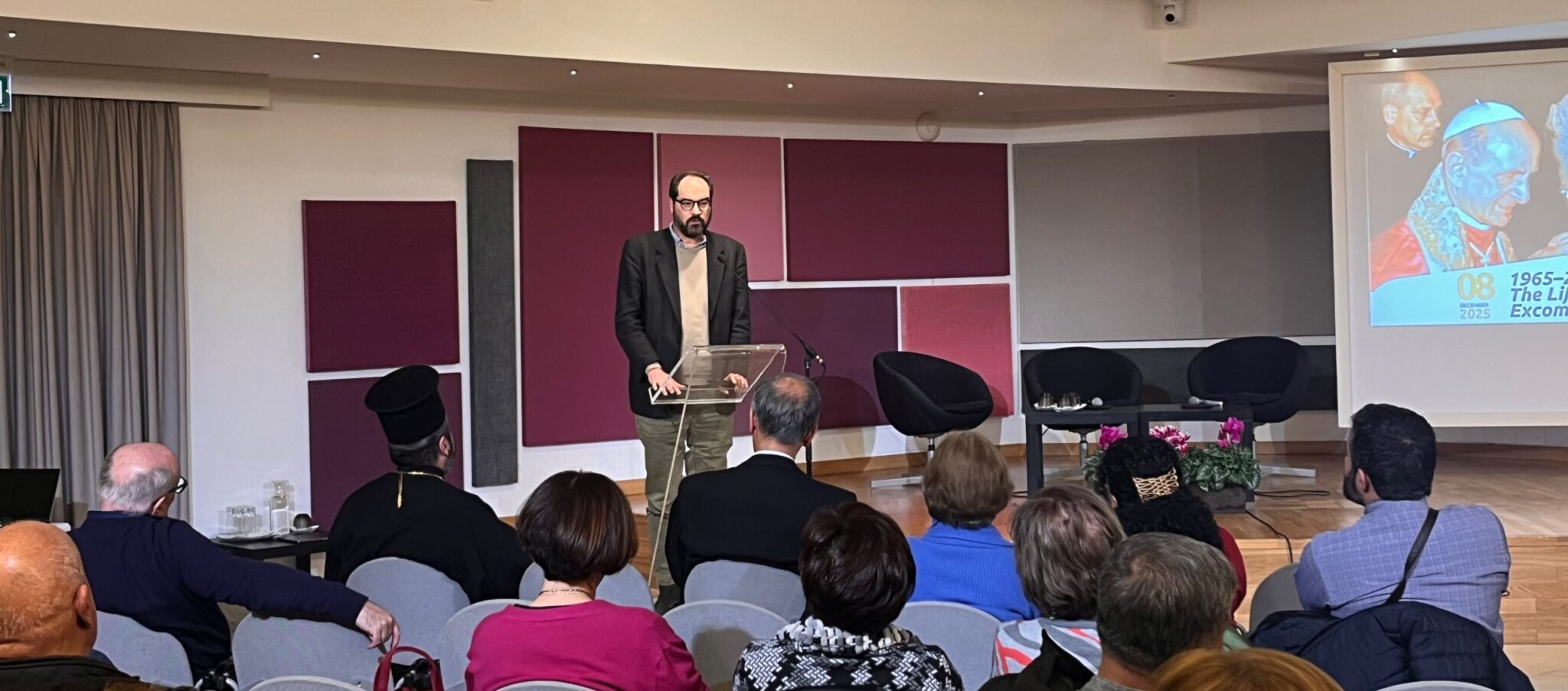
Given the importance of this anniversary, the Patriarch Athenagoras – Chiara Lubich Ecumenical Chair of the Sophia University Institute in Loppiano held a Seminar. The proceedings opened with messages from Patriarch Bartholomew of Constantinople, Pope Leo XIV (signed by the Cardinal Secretary of State, Pietro Parolin) and Margaret Karram, Vice Grand Chancellor of the Sophia University Institute and President of the Focolare Movement.
Pope Leo XIV stressed the importance not only of “reflecting on what happened in the past”, but also of “suggesting new concrete steps that we can take together”.
Patriarch Bartholomew, recalling the centrality of Christ’s Resurrection for the Christian faith celebrated at Easter, lamented the fact that we rarely celebrate this feast on the same date and noted how much he and Pope Francis have done to resolve the question of the common date of Easter.
Margaret Karram, in her video message, while looking back at history and thanking God for the miracles accomplished, invited everyone to look ahead and to renew our hope that the unity between the Churches will come in God’s time and in the way known to Him, echoing the thought of Patriarch Athenagoras: “Union will happen. It will be a miracle. When? We do not know. We must prepare ourselves because, like God, a miracle is always imminent ”.
The various inputs illustrated the historical, spiritual, theological and canonical aspects of this journey. Mons. Piero Coda, professor and Secretary General of the International Theological Commission; member of the Joint Commission for dialogue between the Catholic Church and the Orthodox Church and of the Commission of theologians for the synodal journey, emphasized that that prophetic gesture of the revocation of excommunications exhorts us to live, think, dialogue and act in that light and love in which together, we can all prepare for and welcome the blessed day when, through a miracle of his love, the Holy Spirit will enable us to transcend, under the tender and strong gaze of Mary, full of grace and the ‘Theotokos’, everything that still separates us from the overflowing fullness of our shared communion in Christ..
Sandra Ferreira Ribeiro, an ecumenist theologian and co-director of the “Centro Uno” centre of the Focolare Movement, outlined the historical context that preceded and prepared for the revocation of the excommunications and the acts that implemented it in 1965, inaugurating a new climate of dialogue.
Declan O’Byrne, professor and rector of the Sophia University Institute, co-holder of the Sophia Institute ecumenical chair, stressed the importance that the profession of faith proclaimed at Nicaea becomes a lived reality through charity among Christians and the pursuit of theological clarity.
Metropolitan Maximos Vgenopoulos of Selyvria, co-holder of the Ecumenical Chair and member of the International Joint Commission for Theological Dialogue between the Catholic Church and the Orthodox Church, explored the theme of Primacy and Synodality in the second millennium and today, the theme of the most recent document of the Joint Dialogue Commission which met in Alexandria, Egypt in June 2023, concluding that while the two Churches are moving “in love and in truth” towards unity, the document opens up positive paths and perspectives for the future with regard to the authentic understanding of Primacy and Synodality, especially in the context of the ongoing official discussions on Synodality within the Roman Catholic Church.
Dimitrios Keramidas– professor of ecumenism and Orthodox theology at the Angelicum Institute in Rome, recalled that the sharing of the common blessing of the Pope and the Ecumenical Patriarch at Phanar, the recitation of the Our Father and the ecumenical prayer held in Nicaea were further signs of the recognition of the ecclesial nature of the two Churches: a true and visible spiritual sharing.
Augustinos Bairachtaris, Associate Professor of Ecumenical Studies at the Patriarchal Ecclesiastical Academy of Crete, emphasized the need for a theology of the cross and a spirit of metanoia that must always accompany ecumenical dialogue.
Highlighting the harmony that the unity sought among the Churches represents, the pianist Fr. Carlo Seno offered an exceptionally beautiful musical piece.
The seminar highlighted the indispensable role that the Patriarch Athenagoras – Chiara Lubich Ecumenical Chair can play in promoting ecumenism and the growing mutual knowledge and appreciation of Christians for one another, taking into account the exhortation of Pope Leo XIV and Patriarch Bartholomew in their Joint Declaration: “We strongly urge all the faithful of our Churches, and especially the clergy and theologians, to embrace joyously the fruits that have been achieved thus far, and to labour for their continued increase “.
Sandra Ferreira Ribeiro (Centro “Uno” per l’unità dei cristiani)
The Evangelii Gaudium Centre’s (CEG) fourth course on Synodality will soon begin. What’s new this year?
We are in a new phase of the synodal process. After the first 3 years which culminated with the Assembly of October 2024, we have now entered what is called the implementation phase. On 15th March, 2025, Pope Francis approved the start of a process to accompany the implementation phase, led by the General Secretariat of the Synod. This process involves everyone, from dioceses to lay associations, ecclesial movements and new communities.
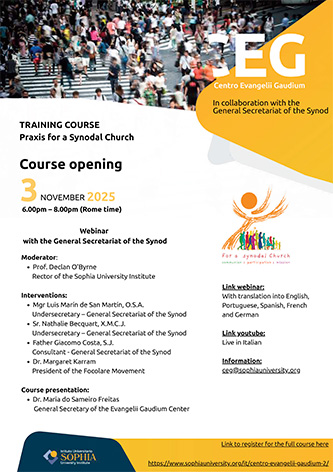
Click on the image to download the poster
This is why we decided to launch a new course, entitled Practices for a Synodal Church as a concrete contribution to the implementation of the synodal process. We are convinced that the practice of synodality is much more than an attempt to make the Church more participatory – it is a new paradigm for ecclesial life. Moreover, we believe that this is not just a religious matter. Our societies are changing radically and, we all see this, truth, core values and mutual commitment are giving way to the law of the jungle. On the other hand, at local and regional levels, new ideas are emerging that reveal parallels with the synodal process in civil society. We believe that the synodal process in which the Church is engaged could offer a valuable contribution in this historical moment for the whole of society.
This year we want to explore these aspects, offering aa closer look at the ongoing process, seeking to discover new pathways and tools to embody synodality in the realities in which we live, as we are invited to do by the Final Document of the Synod and the subsequent document of the Secretariat last July, Pathways for the Implementation Phase of the Synod. We are certain that this is a journey in which the true protagonist is the Holy Spirit and that above all we must open ourselves to Him and let Him guide history, our personal history and that of the Church and humanity.
The theme of “Synodality” was central during the years of Francis’ pontificate. How are we continuing on this path with Pope Leo XIV?
Maria do Sameiro Freitas
On 8th May, in his first message to the people of God, on the day of his election, Pope Leo drew up a programme: “To all of you, brothers and sisters in Rome, in Italy, throughout the world: we want to be a synodal Church, a Church that moves forward, a Church that always seeks peace, that always seeks charity, that always seeks to be close above all to those who are suffering.”
And in several other circumstances, in particular on 26th June, to the members of the Ordinary Council of the General Secretariat of the Synod, he reiterated: And the legacy that he (Pope Francis) left us seems to me to be above all this: that synodality is a style, an attitude that helps us to be Church, promoting authentic experiences of participation and communion.
It seems clear that his approach follows that of his predecessor, in the conviction that synodality is intrinsic to the Church. The upcoming Jubilee of Synodal Teams and Participatory Bodies that will take place from 24th-26th October in the Vatican is another significant occasion. Over 2,000 participants are expected, to whom the Pope will address a message on the afternoon of the 24th. It will be a further decisive step forward, journeying together throughout the world.
How the course will be structured? What is its target audience?
The Course will once again be online, in Italian with simultaneous translation into three languages: English, Portuguese and Spanish. With regard to content, it will draw on the Final Document of the Synod and the Pathways for its Implementation, trying to discover new paths for a synodal practice and how to apply them in each participant’s own context.
It will also offer practical tools for carrying out the synodal process, such as methods of facilitation, accountability, evaluation and verification.
Good practices already underway will be highlighted, and shared at international level. All this with the firm conviction that the synodal process is not a technique but an experience of openness to our brothers and sisters, a space for the presence of Jesus among his people (cf. Mt 18:20) which in the light of this presence, enables us to listen to the Spirit.
Each session will include the opportunity for students to share good practices, reflections or suggestions.
The Course will end with a workshop in April where the participants will be able put into practice what they have learned during the year.
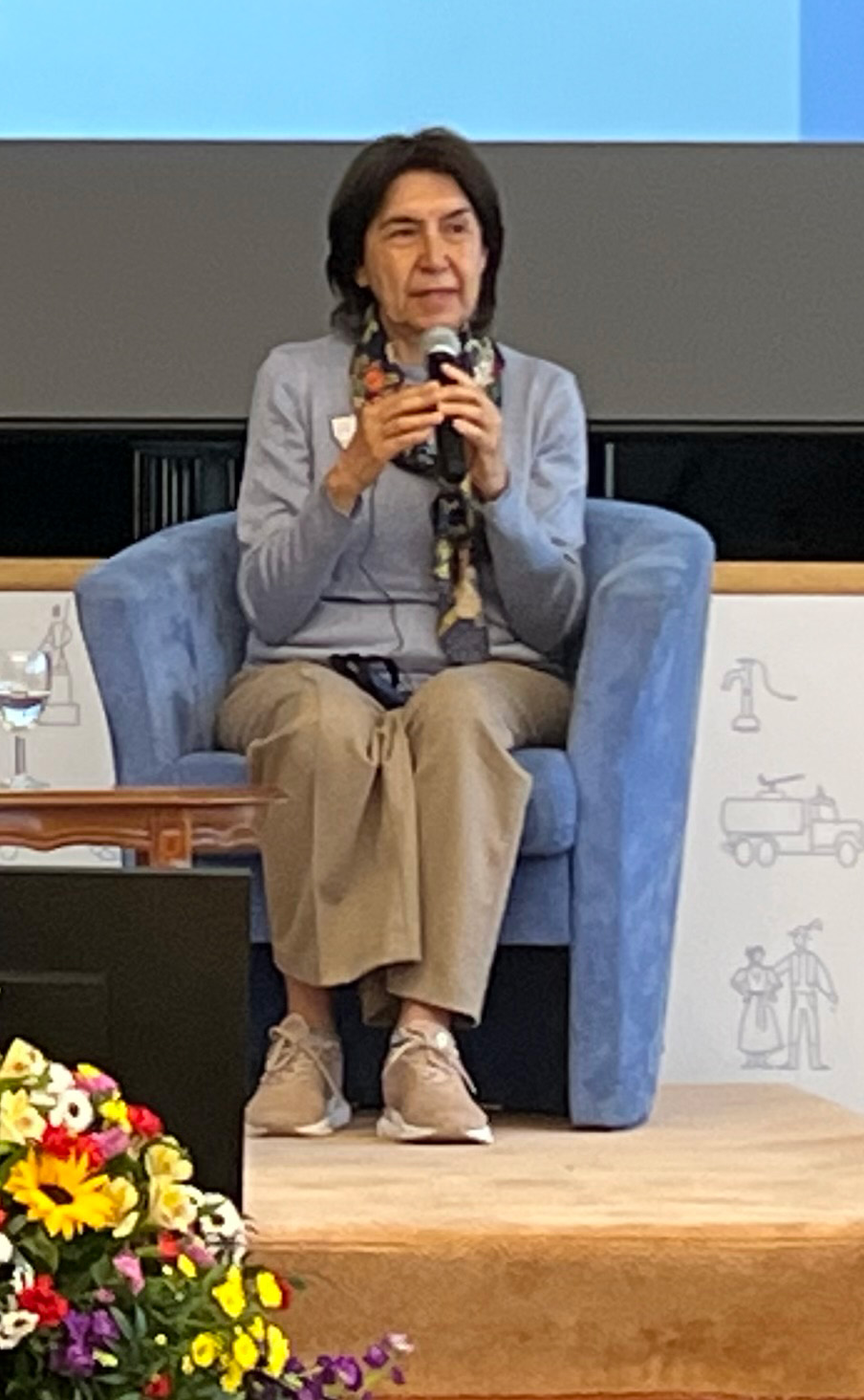
The opening session on 3rd November will feature a special lecture by the General Secretariat of the Synod and a contribution from Margaret Karram, President of the Focolare Movement who participated in both Synodal Assemblies. The opening event is open to all.
Participants include people of all vocations, many lay people and also priests, religious and consecrated persons, engaged in both ecclesial and civil contexts. Several are students from previous years but we also have many new registrations from different countries.
In light of previous years, what are your hopes?
We hope that this Course will contribute to the implementation of the synodal process in the various environments where the participants live and work.
In previous years we have seen that several students have become involved at diocesan, parish and association levels, putting into practice what they have learned; others have become multipliers of ideas in universities and schools.
We have a wide range of participants from different countries, from the Philippines to Canada, from South Africa to Sweden. The exchange of good practices may inspire new ideas and decisive stimuli to advance the synodal process, for the good of the Church and society alike.
The third synodality training course organized by the Evangelii Gaudium Center of Sophia University Institute will soon begin its third edition. What kind of assessment can one make?
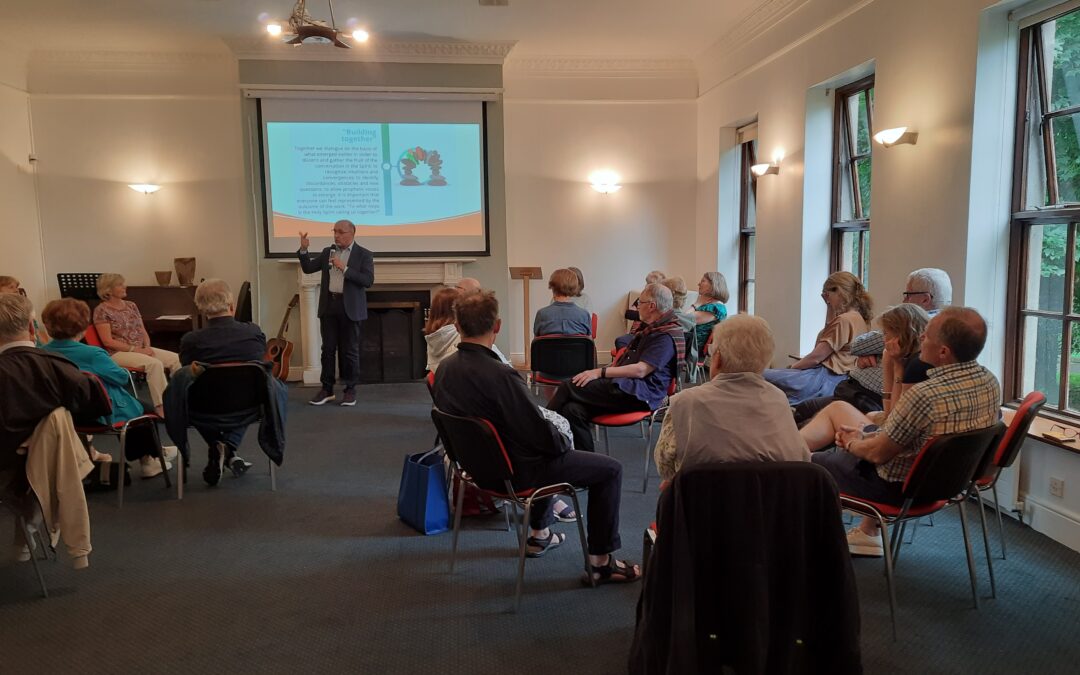
We are on our third edition, and so far this course has seen hundreds of participants from all over the world and dozens of faculty from various disciplines. It is an intercultural, interlingual and interdisciplinary course. The classes themselves are mini-workshops because an integral part of them are group meetings.
Thanks to online platforms, it is possible to take the course from anywhere in the world. The time for Europe is in the evening (6 p.m. to 9 p.m. Rome time) but some people connect at 3 a.m. from Singapore and Malaysia; some at lunchtime from the Americas.
We have had good participation. A total of 380 enrolled. Students can either just attend the lectures or engage with final papers and get academic credits from Sophia University Institute. We work in conjunction with the General Secretariat of the Synod, which is among the sponsors of the course.
It was interesting for us and a nice encouragement that during the press conference presenting the Instrumentum Laboris for the phase of the Synod Assembly that just began on October 1, 2024, Cardinal Hollerich said: “I would like to recall the many initiatives of formation on synodality (…) At the international level we recall the MOOC of Boston College that has seen the collaboration of many experts of the Synod or again the university course proposed by the Evangelii Gaudium Center of Sophia University here in Italy.” (Press conference 09-07-20249)
After two years, what are the prospects for this third edition?
It seems to us that the course has made a small contribution to help create communities of people committed to living and spreading synodality where they are. There are those who propose it to their diocese, organizing formation actions; those who live it in their parish or religious community… Very important is the multiplier effect of the course and the networks that are being created. Networks that are intertwined with many others from different church movements, universities or the Church itself.
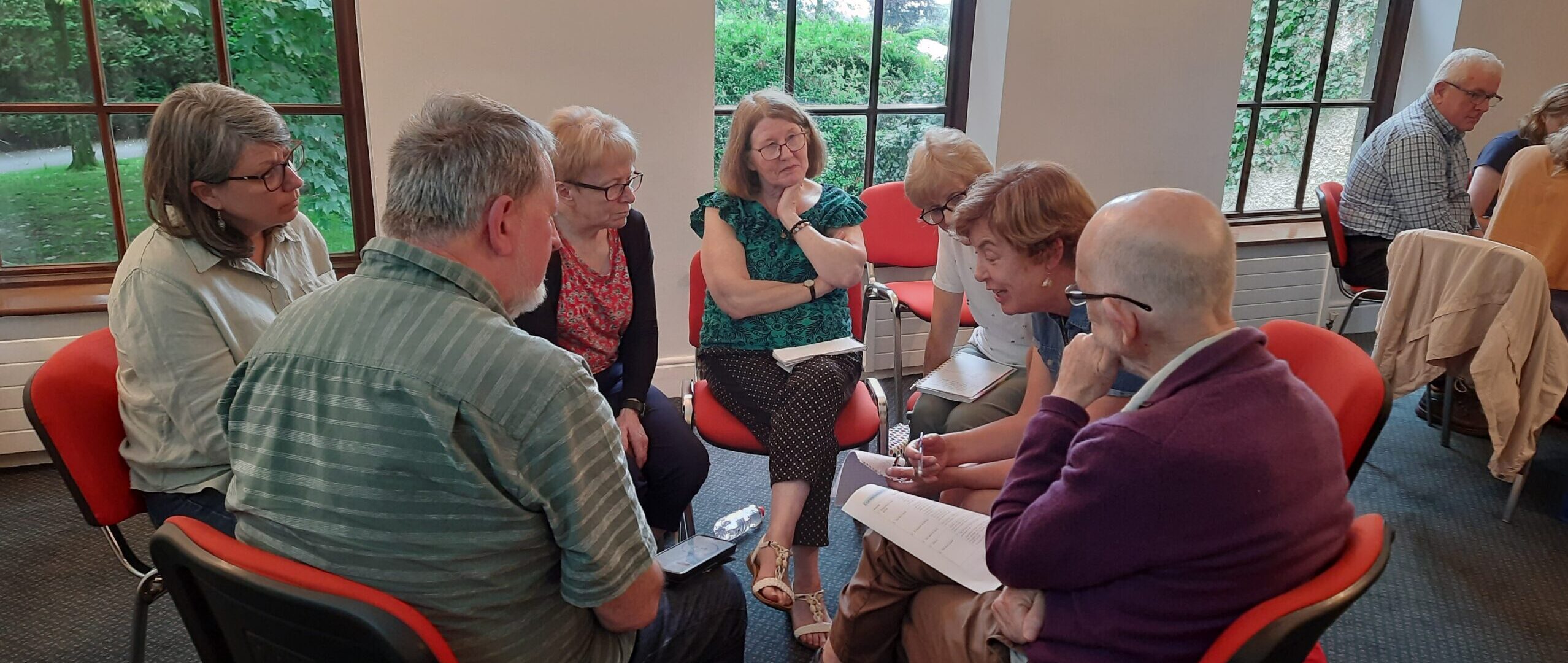
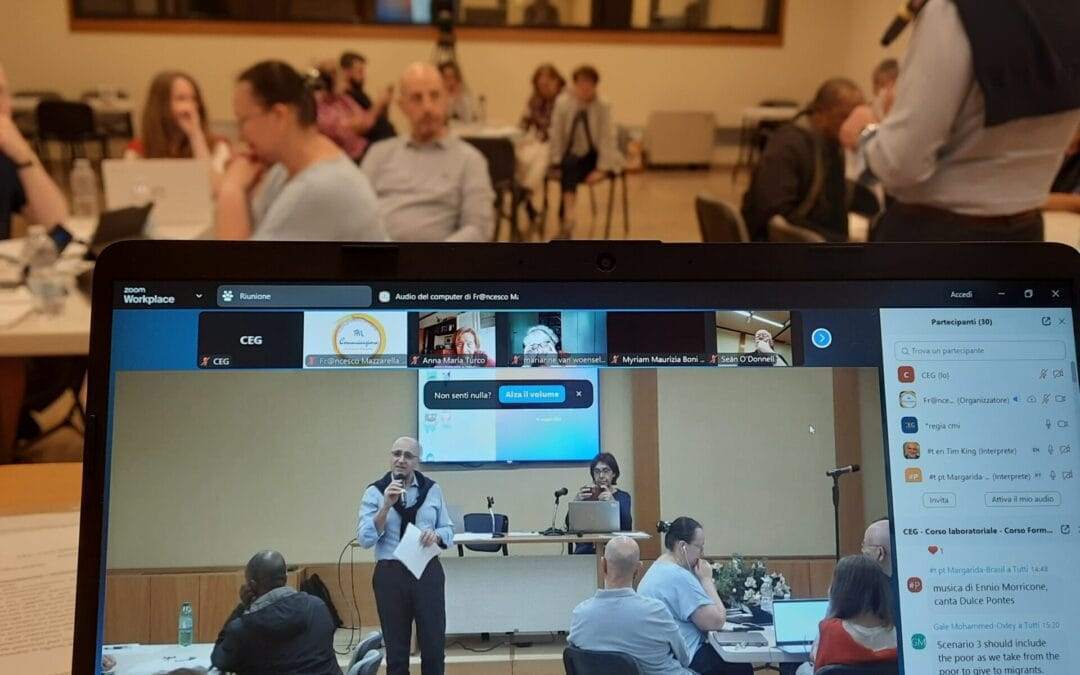
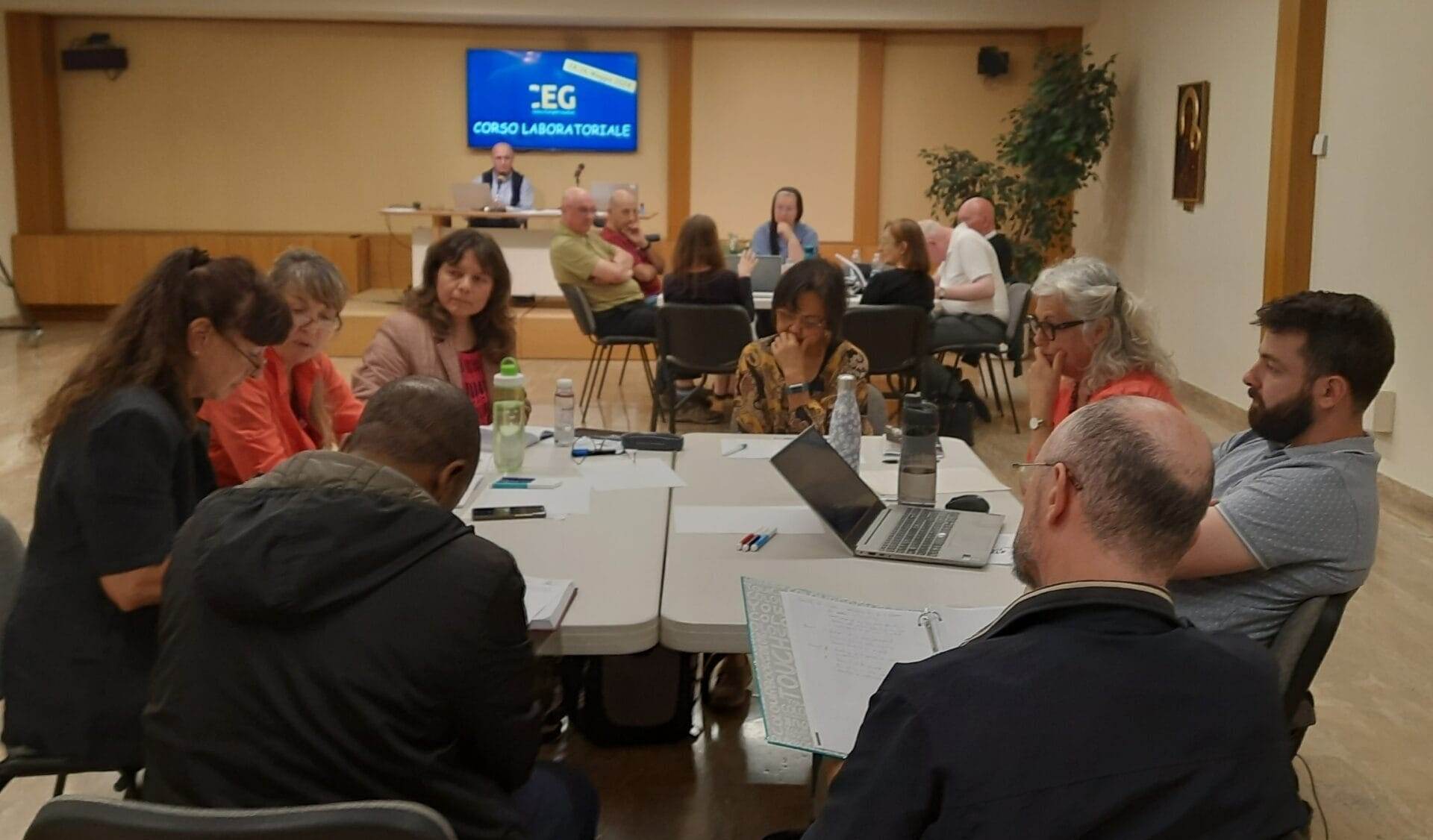
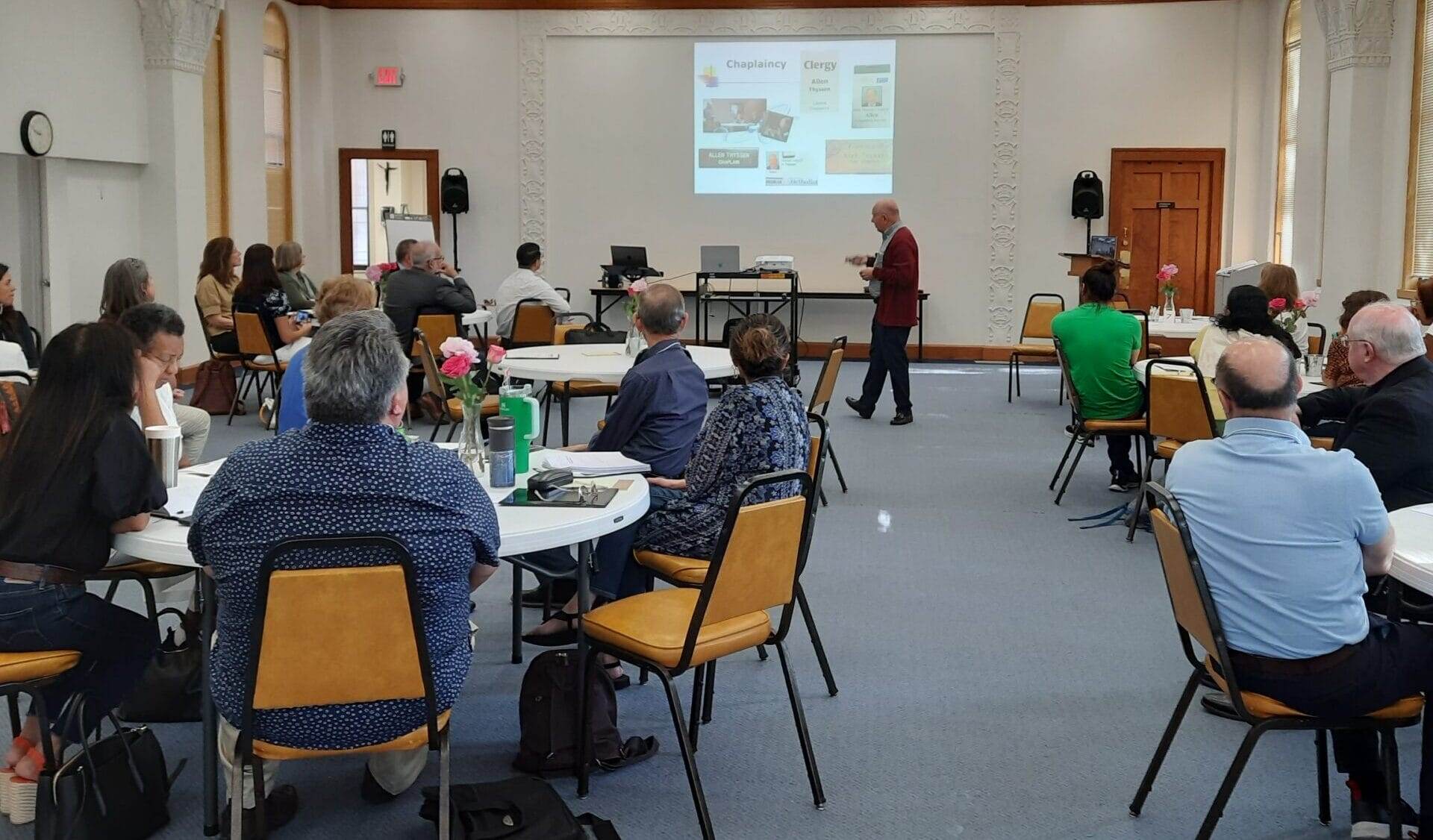
Particularly interesting are the workshops that take place during the course, which can be joined via zoom or in-person.
Castel Gandolfo (Italia)San Antonio (USA)
After the first year, a student from the U.S. proposed in her parish to take the course the following year: 12 signed up. At the end of the year, they asked to do the in-presence workshop in San Antonio. Forty people from various dioceses and the Oblate School of Theology in San Antonio participated.
The number of formation actions carried out are countless because they are done by the students themselves using the content and method of the lessons: in Ireland for an entire parish, in Italy in several dioceses as well as in Australia, in Sydney; while in the Democratic Republic of Congo recently an action was done for more than a hundred priests from 8 dioceses, and in Angola for all the clergy of the diocese of Viana.
Viana (Angola)Democratic Republic of Congo
What will be the themes of the course that will start soon?
The next course will begin on Nov. 4, 2024, in the aftermath of the Assembly, with speeches by the Synod’s Secretary General himself, Msgr. Mario Grech, and the subsecretaries, Msgr. Luis Marin and Sr. Nathalie Becquart, theologian Piero Coda, and Margaret Karram, President of the Focolare Movement and special invitee to the Synodal Assembly.
The themes of the course will be those that emerged from the Assembly itself: paths opened by the 16th Ordinary Assembly of the Synod: new practices in a synodal and missionary Church; Christian initiation and transmission of faith in synodal style. It will conclude with an in-person workshop.
Why this commitment of the Evangelii Gaudium center to synodality? In the past you have devoted yourselves to other issues, such as training on abuse or training pastoral workers.
It seems to us that synodality is not a slogan destined to pass away. Synodality has always been part of the Church’s being, as is well understood even when reading the Acts of the Apostles. On the other hand, it is also the actualization of those reforms that the Second Vatican Council indicated for the Church but which, as can be understood, have struggled and are struggling to be implemented.
Pope Francis himself said in the celebration of the 50th anniversary of the establishment of the Synod of Bishops on Oct. 17, 2015: “The journey of synodality is the path God expects from the Church of the third millennium.”. And on October 9, 2021, he himself initiated the process of synod that today seeks to make its way throughout the Church.
From that point, we have been engaged in the formation and promotion of synodality through scholarships, seminars, trainings and networking around the world with other faculties and associations.
Synodality is also a style that is very much in keeping with the spirituality of communion that inspires the Sophia Center and Sophia University Institute. Card. Petrocchi, president of the Evangelii Gaudium Center’s Scientific Council, says we must come to “synodalize” our minds, both as individuals and as a church group, but also as a civil society group. Let us try to do our part, small but, we hope, effective.