
Amine Mohammed Sahnouni, a young Algerian sociologist, sees education as a process. “We need to give the children more responsibility, trust in them and guide them so that their leadership abilities develop from an early age.” “Children are the pillar of our work, and we dedicate ourselves to them with the aim of helping them grow up strong, since they are the future.” For an education conference promoted by the Focolare Movement in Italy on 2 March, Amine Mohammed Sahnouni, a young Algerian sociologist, spoke of her commitment to education that benefits young people. To build a better world, she said, we need to start with the children. 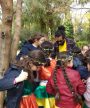 Amine, you said that in order to get results it is important to have a vision, long-term objectives, and if possible, share them with others. What is your vision for the field of education? I believe that we sociologists are doctors for society, and as such we need to go into the field and take on social phenomenon of all kinds. With that perspective, my vision is to “make the world a better place,” not only for us, but for future generations. We all can do this, but only if we start by changing ourselves, even by starting with the small things. If we hope to build a more just society, it’s essential that we dedicate ourselves to training young people. What are the main resources, competencies and methods you propose? My parents always encourage, support and guide me. Ever since I was young, they gave me a sense of responsibility. I still remember the words of my father: “Amine, make us proud of you.” He was always saying to put “Allah,” “God,” in the first place in everything I do; only by doing so would I be able to be a successful person. So to me the first pillar of education is family. There are also various competencies to work on: we need to give the children more responsibility, trust in them and guide them so that their leadership abilities develop from an early age. We need to give them our trust, support and use positive words in a way that they can develop their self-esteem, hopes and objectives. We need to encourage critical thinking in children and teach them to share their opinions in front of others. All these competencies can be acquired by working in the field, through exchange programs where they meet young people from different countries, and by changing traditional teaching methods to make learning easy and enjoyable. Religious leaders, institutions and non-profit organisations call for safeguarding the environment, but their efforts are not enough. Meanwhile it is said that the young Swede Greta Thunberg, who called for young people marching in all of Europe, may be nominated for a Nobel Peace Prize. Does this mean that we need young people to awaken the old? I truly admire the courage and determination of that girl, who, despite being quite young, is completely aware of environmental issues, and this is extremely rare today, even among adults. This great “battler” is sending a strong message to the world, and I have a lot of respect for her. We all need to take inspiration from her example. I believe, in fact, that great victories begin from the small things. Getting on a bicycle and crossing Algeria from the Moroccan to the Tunisian border seems a way to inspire commitment for the environment. Can you tell us how it went? We were a group of friends, passionate and motivated, hoping to inspire young people. Since 2012 our philosophy has been: if you want lasting change, start by changing yourself. In time our goals expanded, and we decided to take up a new challenge: cycling across Algeria from east to west over 15 days. It was a project aimed at raising awareness for safeguarding the environment, promoting the values of citizenship, and educating through sports. My two friends, Elhadi and Naim, and I created a video about our activity, and in just one week the video spread so quickly that people started to contact us offering their help. We received so much support during the trip itself in August 2017, and the results were incredible: two million followers on social media and television. We collaborated with more than 15 associations, children’s organisations and cycling clubs. We felt “Allah,” “God” with us each day and we asked him for courage, support and strength to complete our mission. It was a spiritual experience, and we received prayers from many Algerians and support from our families. Just in two weeks we were able to spark other awareness campaigns, and after the initiative many people followed along our same path.
Claudia Di Lorenzi
0 Comments