
29 Aug 2017 | Focolare Worldwide
New flowering “As Christians, my wife and I decided to adopt two sisters. Unfortunately, due to bad company, both have ended up in the drug cycle. Since then, a Calvary began for us: abortions, undesired children, problems with the law. We undertook to make our home a place of peace where they are welcomed. Now, the elder one is slowly recovering and not only wants to take care of her baby girl but also the son of her sister who is still in the drug tunnel. We are witnessing life blooming again.” (M and D. H. – Switzerland) An innocent absolved «I am a lawyer by profession. Some months ago I took the defence of a Sudanese citizen accused of being a transporter of immigrants and even a member of a criminal organization. He was seen at the helm of a boat that was transporting 119 migrants, among which were women and children. In the interviews held with him in jail, I realized that he was a refugee like the others, and had been abandoned by the transporter, and had taken the courage to take the helm of the boat despite his lack of experience, to save himself along with the others. Unfortunately they did not believe his recount. On taking the defence of this youth’s suffering, I decided to demonstrate his innocence despite the fact that, due to his poverty, he couldn’t have paid my fees. Of course, I could have made use of the sponsorship of the State, which however, does not always pay and if ever, the payments are inadequate. But he was a brother, and during the trial I did my best to defend him. In the end, he was absolved.” (S. – Italy) The “agreement” «As always, dad had drunk more than necessary and there was tension at home. Since nobody said a word, I took the courage, and looking him straight in the eye, told him of the suffering and dismay he was causing us due to his vice. Then also the other brothers spoke up. Things then changed and in the family a sort of agreement was made and now dad is doing his best to be faithful to his promise not to drink. Closing our eyes had not been a way of helping him, and we had to tell him the truth, with love. And together we succeeded.” (N.N. – South America) A son’s gratitude «As time passes my gratitude towards my mom grows. After dad had abandoned us, she had continued to work hard so that we, the four children, wouldn’t lack in anything. One day she went to the funeral of her brother-in-law and returned with an eight-month-old baby in her arms. Her sister was not in the condition to care for him. This was how we were raised. I think that the goodness which now reigns in our families is a fruit of the grandeur of my mother, who did not think of herself, but always of the others.” (C. A. – Poland)
28 Aug 2017 | Non categorizzato
A fourth interfaith summer school is underway from August 25th to August 30th in Tonadico, Italy. The title of the course is “Interfaith Engagement in Theory and Practice.” It os promoted by Sophia University Institute (SUI) in collaboration with the Islamic Institute of England and the Risalat Institute in Qum, Iran. Forty two Christian, Muslim and Shiite students have come together for the school, and instructors include SUI president, Dr Piero Coda and Mohammad Shomali, Director of the London Islamic Centre. The goal of the school is to provide a space for sharing and reflection on the cultural and religious patrimony of Christianity and Islam, as well as future plans for dialogue and mutual collaboration in the light of current challenges.
28 Aug 2017 | Non categorizzato, Word of
Jesus was in the midst of his public life, proclaiming the kingdom of God was near, and he was preparing to go to Jerusalem. His disciples had some insight into the greatness of his mission. They realized he was the one sent by God, whom the whole people of Israel was waiting for. They looked forward to being freed from Roman rule, to the dawn of a better world where there would be peace and prosperity. But Jesus did not want to encourage these illusions. He said clearly that his journey to Jerusalem would not lead to triumph but rather to rejection, suffering and death. He also revealed that he would rise again on the third day. Those words were so hard to understand and accept that Peter protested and opposed such an absurd idea. He tried, in fact, to dissuade Jesus. After a firm rebuke to Peter, Jesus turned to the disciples with a shocking invitation. “If any want to become my followers, let them deny themselves and take up their cross and follow me.” (Mt 16:24) With these words, what was Jesus really asking from his disciples both then and now? Does he want us to despise ourselves? Does he want us to devote ourselves to a life of austerity and discipline? Is he asking us to seek out suffering so as to be more pleasing to God? This Word of Life exhorts us rather to walk in Jesus’ footsteps, to accept the values and demands of the Gospel in order to be ever more like him. This means living all of life fully, as he did, even when the shadow of the cross appears on our path. “If any want to become my followers, let them deny themselves and take up their cross and follow me.” We cannot deny it: each of us has our own cross. Suffering in its various forms is part of human life. Yet it seems beyond our understanding, the opposite of our desire for happiness. But it is precisely in this that Jesus teaches us to discover an unexpected light. It is like those times when you go into a dark church and discover how the stained-glass windows look so wonderful and bright, rather than dull and dreary as they did from the outside. If we want to follow him, Jesus asks us to reverse our value system, shifting ourselves away from the center of our world and rejecting the logic that seeks our own good. He suggests that we pay more attention to other people’s needs than our own, spending our energy in making them happy, as he did. He did not miss a chance to comfort and give hope to those he met. Following this path of liberation from egoism, we can grow in humanity, we can win the freedom that allows our personality to be completely fulfilled. “If any want to become my followers, let them deny themselves and take up their cross and follow me.” Jesus invites us to be witnesses to the Gospel, even when this faithfulness is tested by little or big misunderstandings within our social environments. Jesus is with us, and he wants us to be with him in staking our lives on the boldest of ideals: universal brotherhood and sisterhood, the civilization of love. This radicalness in love is a deep need of the human heart. We see it in key figures of non- Christian religions who followed the voice of their conscience right to the end. Gandhi wrote, as preserved in his secretary Pyarelal’s book, Gandhi: The Last Phase, vol. II: “If someone killed me and I died with prayer for the assassin on my lips, and God’s remembrance and consciousness of his living presence in the sanctuary of my heart, then alone would I be said to have had the non-violence of the brave” Chiara Lubich found, in the mystery of Jesus crucified and forsaken, the remedy for every personal wound and every disunity among persons, groups and peoples. She shared her discovery with many people. “Each one of us experiences sufferings in life that are at least a little like his,” she wrote in 2007 for an event organized by movements and communities from various churches held in Stuttgart, Germany. “When we feel these sufferings, we can remember that he made them his own. They are almost his presence, a sharing in his suffering. “Let us do what Jesus did. He was not paralyzed by suffering, but added these words to his cry, ‘Father, into your hands I commend my spirit’ (Lk 23:46), re-abandoning himself to the Father. Like him, we too can go beyond suffering and overcome trial by saying: ‘I love you in this, Jesus forsaken. I love you; it reminds me of you and is an expression of you, one of your faces.’ “And, if in the next moment we throw ourselves into loving our brother or sister and doing what God asks of us, we will almost always experience that suffering is transformed into joy… “In the small groups where we live … we can experience greater or smaller divisions. Even in these sufferings we can recognize his face, overcome the pain within ourselves, and do everything possible to become brothers and sisters again … The pathway and model of the culture of communion is Jesus crucified and forsaken.” Letizia Magri 1 M.K. Gandhi, Antiche come le montagne, Ed. di Comunità, Milano 1965, pp. 95-96. 2 C. Lubich, Per una cultura di comunione – Incontro Internazionale “Insieme per l’Europa” – Stoccarda, 12 maggio 2007 – sito web http://www.together4europe.org/
28 Aug 2017 | Focolare Worldwide
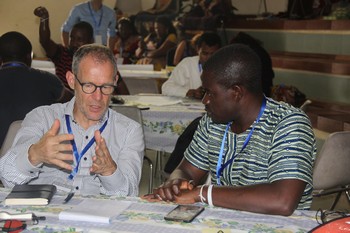
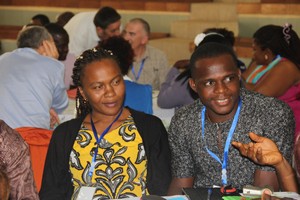 They were from a variety of countries: the Democratic Republic of the Congo, Angola, Uganda, Nigeria, Ivory Coast, Cameroon, Burkina-Faso, Madagascar, Benin and Holland. The fifty five entrepreneurs wanted to put their 30 innovative entrepreneurial projects to the test, with an international force of “mentors” (seven African, five European and one South American). The first African StartUp Lab 2017 was held last June, in the heart of the African forest in Fontem, Cameroon. It consisted of five days of learning how to practice the values of the Economy of Communion that are already being implemented by many entrepreneurs connected with the Economy of Communion around the world. The idea of a week for project development had been conceived two years earlier. In Nairobi, in 2015, during the international assembly of the EoC, several young people had shared with the first generation of EoC entrepreneurs their own dream of realizing several projects. This led to the launch of a two-year incubation period for those projects. In June 2017, during the StartUp Lab held at Mafua Ndem Mariapolis in Fontem, several of those dreams already began to move forward produce.
 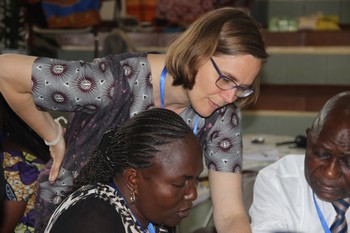 The workshop began with Anouk Grevin, French member of the faculty of the Polytech University of Nantes, and of the Economy and Management course at Sophia University Institute, who presented the fundamental values of the Economy of Communion. Argentinean, Forencia Locascio, expert in social communication, explained the “elevator pitch” that helps to present one’s own entrepreneurial approach to any possible client or investor, in a clear and succinct manner, and in a shor time. French entrepreneur, Pierre Chevalier, presented a workshop on innovative ideas and project analysis, as well as the resources required. The image of an iceberg is perhaps the best way to explain all the effort, work and sacrifice that lies hidden beneath the surface of any successful entrepreneurial project. Topics such as budget, cash flow, sales, production cost and financial reporting were presented by Giampietro Parolin, business strategy instructor at SUI. The practical exercises on product and cost helped in understanding financial components such calculating and sales forecast. Markus Ressl, a consultant from Ressolution and an entrepreneur from the EoC, analyzed different business models with the young people. Markus Ressl, “Ressolution” consultant and EoC entrepreneur, analyzed the theory and practice of different EoC business models with young entrepreneurs. On the last day everyone was back with Locascio for a discussion on communication strategies: company names, logos, slogans and the use of communication tools with different groups of clientele. A symbolic image was presented to each person along with a certificate at the conclusion of the workshop. The symbol showed a network of people gathered around the Mafua Ndem Mariapolis in Cameroon, with a new to do economy. Their arms are raised and linked by a small cord that represents a pact of reciprocity.
27 Aug 2017 | Non categorizzato
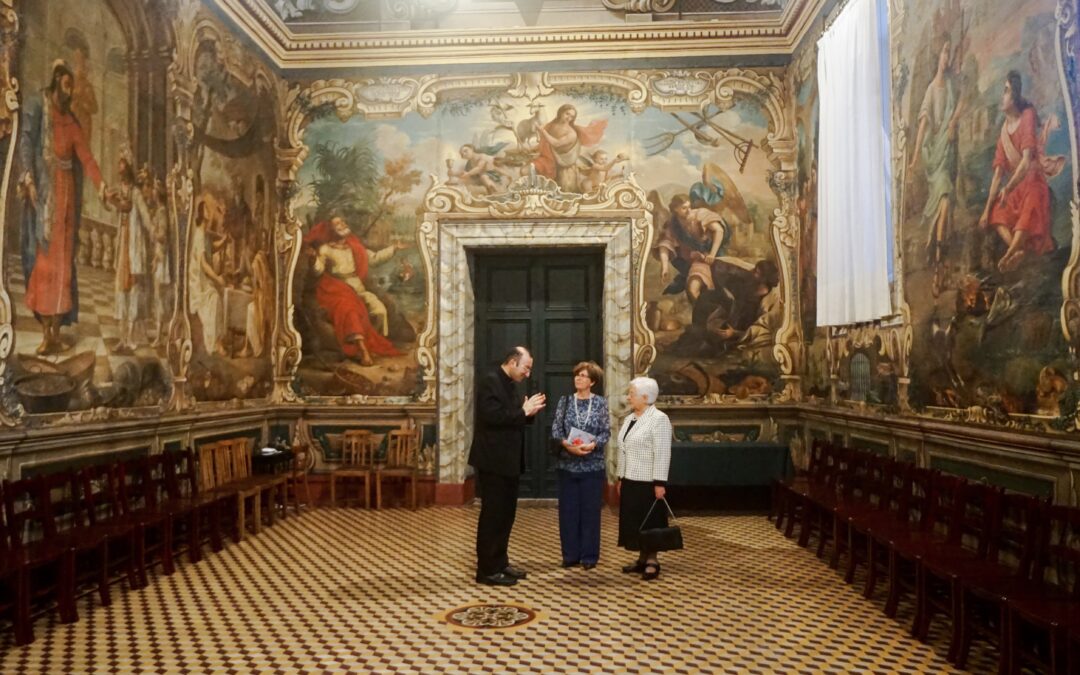
 After describing the points of the Art of Loving, with the expressions that Chiara Lubich was fond of using, Maria Voce asked: “But how do you live this art which is not based on feelings or good intentions, but is practiced according to the measure intended by Jesus, which is to lay down one’s life? Is there a key, a secret that would help in making us more and more capable of living up to that measure?” Then she talked about the “culminating moment” of Jesus’s passion when he felt abandoned by the Father (Mt 27:46). Nevertheless, he placed himself in the Father’s hands (Lk 23:46), overcoming “that immense pain and with that he brought humankind into the bosom of the Father and into communion with one another.” “How can we live this mystery of the Forsaken-Risen Jesus? How are we to progress on the ecumenical journey when we clash over questions about truth? The Apostle Paul writes to the Philippians: ‘Have the same sentiments as Christ Jesus who even though he was in the form of God, did not consider equality with God something to be grasped at, but emptied himself and took on the form of a slave, being made in human likeness’ (cf Phil 2:5). With this attitude we are able to convey the truth of Christ in a way that is credible. Christ emptied himself of everything, as a gift of love.” She quoted from Pope Francis at the conclusion of the Week of Prayer for the Unity of Christians, on January 25th: “If we live this death to ourselves for Jesus, out old lifestyle is relegated to the past and, as happened to Paul, we enter into a new manner of life and of communion.” “Chiara Lubich calls this new manner of life: Jesus in our midst. She refers to Jesus’s promise to be in the midst of any who are united in his name, which means in his love (Mt 18:20). This presence of the Risen Lord amongst his own is determining for ecumenism.” From 1996, following an encounter with a thousand Anglicans and Catholics, Chiara began to talk about an “ecumenism of the people”. It was on that spirit that the journey of Together for Europe was begun, communion and collaboration among more than 300 movements and communities from different Churches. “Without authentic reconciliation,” Maria Voce affirmed, “we’ll never progress on the way towards unity. And this reconciliation characterizes the communion among the movements still today.” Finally, the president concludes: “In the light of the events in Lund on October 31, 2016 when Pope Francis and the President of the Lutheran World Federation, Bishop Dr Munib Younan, commemorated the beginning of the 500 years of the Reform, I felt I had to give a new push to the ecumenical involvement that marks our Movement.” The Declaration of Ottmaring was drawn up in the ecumenical community near Augsburg to “help us to think ecumenically, to remember that any brother or sister I meet, be they from my own Church or another Church, belong to the Body of Christ, to that body for which Christ gave his life. This is an absolute commitment we take on as Focolare Movement, and which can make us enter today into every aspect of human life. Ecumenism is a necessity of the times. It has to go forward. Because it corresponds to the need for God that everyone has, even unknowingly. If people are given the opportunity of an encounter with Jesus in the midst of Christians who love one another, their faith will be enkindled in them and their way of acting will change, they will seek justice and peace, and will work for solidarity among peoples. Only if we Christians are united will the world encounter God. See the full Italian text
