30 Mar 2017 | Senza categoria
On 18 March 2017, the Youth for a United World Movement was awarded the 7th edition of the prize entitled: “Chiara Lubich: Manfredonia, City of Universal Brotherhood”, promoted by the New World Association (Italy). The award was given on the following grounds: “The Youth for a United World Movement is spread over five continents and includes people of different races, nationalities, cultures, Christian denominations and religions, as well as persons of no religious conviction. It is commended for giving witness that a united world is possible, for striving to make humanity one family through social and cultural actions which respect one another’s identity. The commitment to work and spread the UNITED WORLD PROJECT has been greatly praised.”
30 Mar 2017 | Non categorizzato
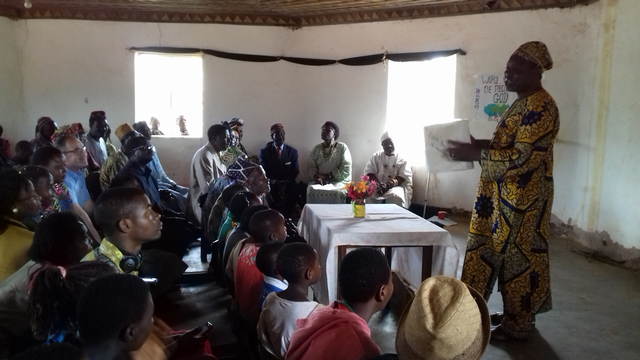
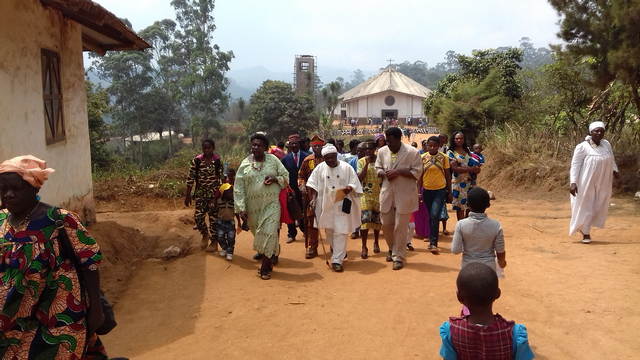 “We have renewed the pact and promise to continue living in the spirit of love, unity and peace which have changed our lives.” These were the words that the Chiefs of the Kingdom of Fonjumetaw wrote to Maria Voce, President of the Focolare Movement, when they gathered together with their communities last 5 March in said Kingdom, a village in the Cameroon forest. About 200 people participated in the event which took root in the history of these people. A strong bond unites the vast tropical region around Fonjumetaw to Fontem, where for the first time, in 1966, two focolarini doctors arrived to help the local population to overcome the diseases that were causing the high infant mortality rate. Fifty years ago, the Bangwa people were saved from the risk of extinction. Last September the Fons (traditional chiefs of the villages in the African region) went to Rome for the Jubilee of Mercy and to pay homage to Chiara Lubich (“Mafua Ndem,” Queen sent by God, as they named her), before her tomb at the International Focolare Centre in Rocca di Papa. The African delegation participated also in St. Peter’s Square in the meeting with Pope Francis and met the current President of the Focolare Movement, Maria Voce, and the Co-President, Jesús Morán.
 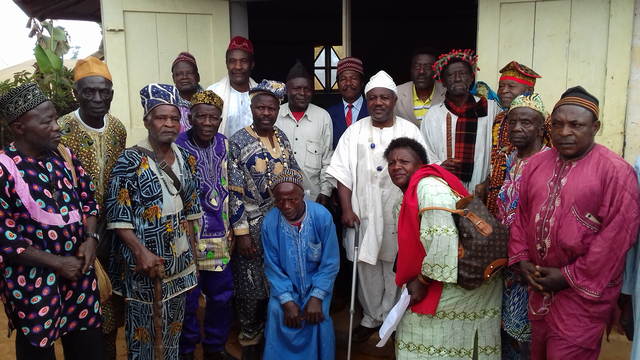 The Jubilee gave a new impulse to the New Evangelisation, strengthening the bonds of fraternity which these villages today are trying hard to live. The meeting of 5 March took on this meaning. The Fon recounted the “pilgrimage” to Rome with the other Fons of the zone, with Bishop Andrew Nkea Fuanya, and Bishop Emeritus, Francis Teke Lysinge. Upon inviting all to take a new step in the life of fraternity, he announced a “year of reconcilement.” Everyone agreed with joy. And in a celebrative atmosphere the youth, adults and children hugged one another to seal this commitment. One of the Chiefs presented the “dice of love”. Then he cast it in the air. The phrase that appeared was “love one another” and it was a confirmation also through a game, of the commitment each one wanted to undertake. Then followed the experiences and staging of six points of the art of loving. One of the Chiefs recounted a strong experience: for many years he had not forgiven someone for an episode in which he had felt offended, but after hearing the invitation of the Pope to forgive and forget in the year of reconcilement, he was able to do so. At the conclusion, a festive moment ensued with the Fon and Mafua (Queen), and all the Chiefs, VIPS and focolarini. The Mafua talked about her encounters with Chiara in 2000 on the occasion of her visit to Cameroon, the “pilgrimage” of the delegation of 40 people to the Centre of the Focolare Movement in Rome, and the desire to spread the life of “Mother Chiara” amongst her people. The Chiefs’ letter to Emmaus, 17 years after Chiara’s last visit in these regions, sealed the commitment and the desire of all. These New Evangelisation meetings will continue. This is why the Fon of Fonjumetaw assigned one of the Chiefs to take charge of them. The next is set for 2 April.
29 Mar 2017 | Non categorizzato
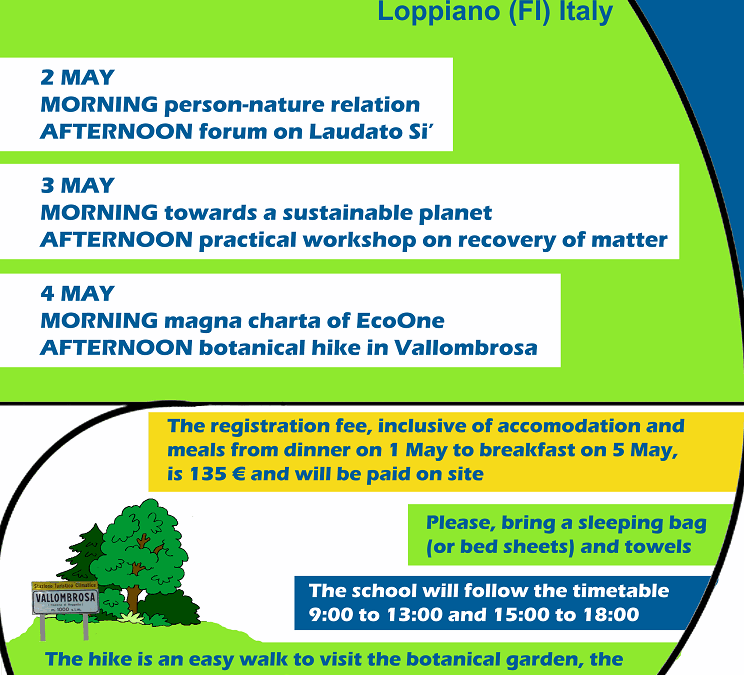
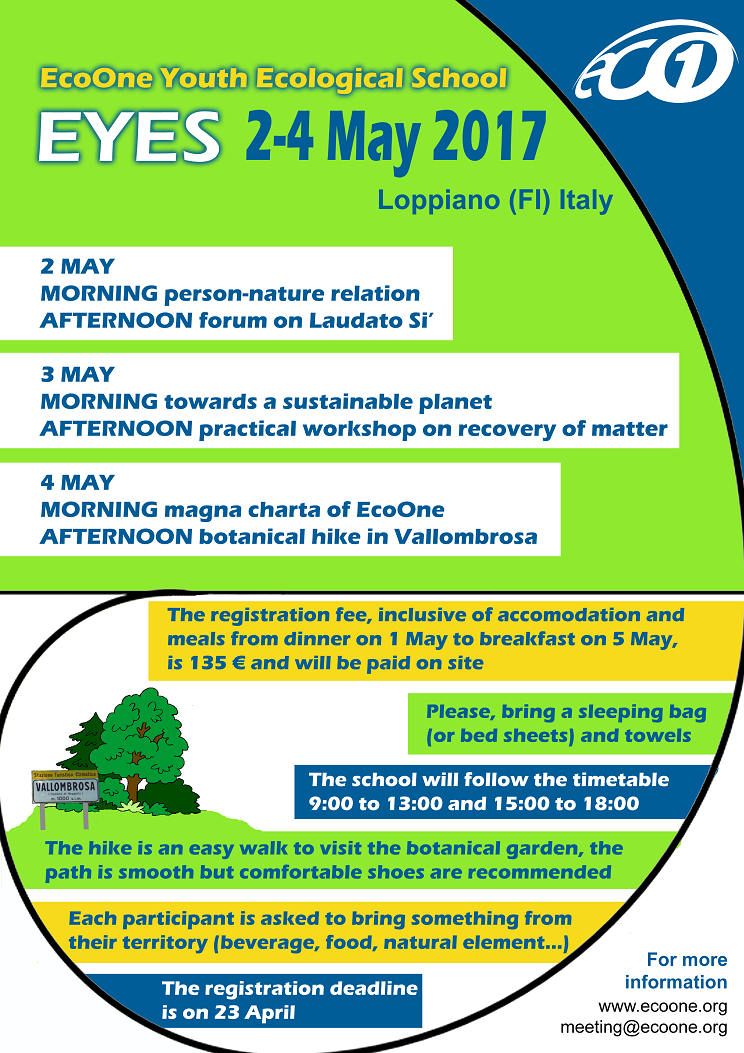 The Earth, our common home, is protesting. It seems to be turning more and more into a huge garbage dump. Its temperature is dramatically increasing and the depletion of natural resources makes it impossible to sustain the current level of consumption by the richest countries. Bio-diversity disappears and the quality of human life deteriorates. What is happening calls for an urgent need to undergo a bold cultural revolution. No one wants to regress to the neanderthal era, but it is essential to change direction and to work out a new model of development. The International EcoOne cultural initiative invites you to an ecological school to be held 2-4 May 2017 in Loppiano, Italy. It is aimed at young people, but open to all those who wish to look with new eyes at the relationship between human beings and nature. To subscribe please fill out the online form You can find more information in the attached flyer. The EcoOne Committee

29 Mar 2017 | Focolare Worldwide
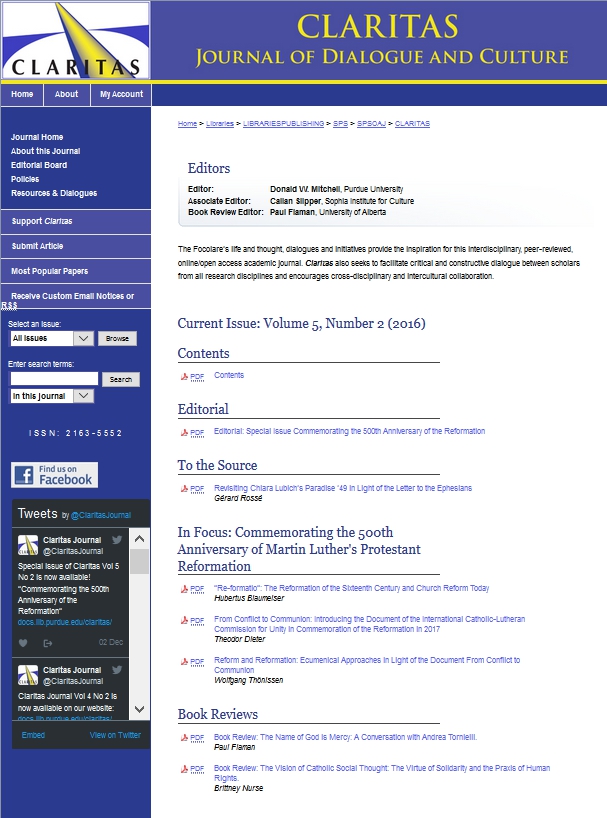 Courageous impulse towards ecumenical commitment. Catholics and Lutherans can walk together on a path towards a full reconciliation. 500 years have passed since Luther’s Reformation movement, the commemoration of which will last a year, starting from 30 October last year to 31 October 2017 (a symbolical date that recalls the publication in 1517, of the Ninety-Five theses of Luther on indulgences and justification, in Wittenberg). Inauguration events started with a meeting in the Lutheran Cathedral of Lund in Sweden, between Bishop Munib Younan, President of the World Lutheran Federation, and Pope Francis. On that occasion, the Pope had invited all Christians united by baptism, to announce together the Word of God, putting an end to all the century-old theological disputes that had separated the two Churches, and underlining the common gifts received thanks to dialogue and mutual listening. The Italian journal Nuova Umanità (New Humanity) dedicated its 221st edition to this event, focusing on the work entitled, “Half a millennium after Luther” (published in March 2016). Curated by Hubertus Blaumeiser, it presents the essays of a Lutheran theologian, Theodor Dieter, and a Catholic theologian, Wolfgang Thönissen. The historically important Lund event was preceded by the document, “From conflict to communion,” published in 2013 by the Lutheran–Catholic Commission for Unity, which works on behalf of the World Lutheran Federation and the Pontifical Council for the promotion of unity among Christians. The text indicates five “ecumenical imperatives” to definitively overcome the causes of disagreements and live a season of common commitment in mutual trust. The First imperative: Catholics and Lutherans strongly united by baptism should start always from the perspective of unity and not from the point of view of division, to strengthen what they have in common, instead of underlining and experiencing differences. The Catholic and Lutheran Churches, in the course of history have defined themselves through disagreements. Now there is need of the contrary, of the experience of encouragement and reciprocal criticism. Then comes the second imperative: continually letting oneself be transformed by the encounter with the other and the reciprocal witness of faith, through dialogue that opens to various ways and degrees of communion. The Third: renewed commitment of oneself to seek visible unity and elaborate and develop together the concrete steps this implies, and constantly strive towards this objective. The Fourth: rediscover together the power of the Gospel of Jesus Christ for our time. And lastly the fifth: the missionary task of ecumenism becomes greater inasmuch as our societies become pluralistic from the religious standpoint, and this is why together we have to bear witness to God’s mercy in the Gospel announcement and service to the world. The report ends by saying: «The beginnings of the Reformation will be remembered in an adequate and just manner when Lutherans and Catholics will listen to the Gospel of Jesus Christ together, and will once again let themselves be called to form a community together with the Lord.» The genesis and development of such a document was deepened in edition 223 of New Humanity, dedicated specifically to this decisive step for ecumenism. Following the trail of the Lund event and as a logical consequence of the “theoretical” answer given by the Ecumenical Council of Churches, at the end of February in the town of Ottmaring and characterised by an outstanding ecumenical calling, the President and Co-President of the Focolare, in the name of the entire Movement undertook the commitment to testify to and work for communion between the Churches beyond all divisions. «As a global movement with many members who are Christians of many Churches, and which is thus already living the experience of a people united by mutual love […] we recognise in the Lund meeting a true and proper kairos, a sign of God for our time, which pushes Christians to commit themselves even more, to make the testament of Jesus – that all may be one – a reality. »
28 Mar 2017 | Non categorizzato
The University Institute will be organising two open days at its international campus during which courses are presented in managerial skills in a changing world. Loppiano (Italy), 31 March and 30 April 2017
