7 Dec 2018 | Non categorizzato
In a letter to the whole Focolare Movement, dated 7th December 2018, the 75th anniversary of the day when Chiara Lubich consecrated her life to God, Maria Voce, Focolare President, has announced that during 2020 the centenary of Chiara Lubich’s birth will be celebrated. “We are getting closer to the year 2020 when we will celebrate the centenary of Chiara Lubich’s birth”, Maria Voce wrote. “This anniversary will of course be a unique opportunity; first of all to thank God for the gift that Chiara was for us and for many people across the world. In fact, all of us were won over by the charism God gave to her and that changed or is changing our lives in a deep way. It will be a favourable time in which many other people will be able to meet Chiara who is living today in her Work”. The President ended her letter saying, “From now on, let’s ask for the abundance of the Holy Spirit, for us and all that we want to achieve, but above all for all the people who will have the chance to get to know Chiara and her charism.” In the coming months, the Focolare communities around the world will be planning ways of celebrating this anniversary. A commission has been set up at the international centre of the Focolare Movement, which can be contacted (centenario.chiara (at) focolare.org) to share plans, ask for advice or receive information. Our website, too, will dedicate an area to Chiara’s centenary, where the various activities being held around the world during the anniversary year will be made known.

6 Dec 2018 | Non categorizzato
An approach to dialogue amongst Churches that values reciprocity . 2017 marked the 500th anniversary of the Reformation. It was not just a time to recall what happened in the past but an opportunity to reflect upon the progress that has been made in the field of ecumenism. But what is going to happen now? This question was the starting point for the ninety participants at a seminar that took place in the Mariapolis Centre in Zwochau, Germany. It was entitled “Brennpunkt Okumene” (Focus on Ecumenism) and its starting point was “receptive ecumenism.” Paul D. Murray, a Catholic theologian from the University of Durham, England, outlined the ideas that lie at the heart of this approach. He said that it’s not a matter of “what the others can learn from us” but rather a question of “what we can learn from other people.” It is ecumenism based upon listening and reciprocity. Dr. Callan Slipper, an Anglican theologian in London, explained that this approach enables people to learn from one another without hiding the wounds and hurt from the past. In fact, it creates awareness that other people help healing to take place. He and Peter Dettwiler, a theologian from the Reformed Church of Switzerland, gave a presentation that allowed listeners to penetrate the “inner life” of their respective Churches without avoiding the blows and suffering experienced. They then participated in a round table with the woman Pastor Seehafer from the community of the Free and Evangelical Church and Fr. Marcellus Klaus, a Catholic priest, offering those present the opportunity to practice “receptive ecumenism”. The day concluded with reflection upon an extract of a talk given by Chiara Lubich in the Memorial Church in Berlin which outlines the roots of the reciprocity proposed by “receptive ecumenism”. “Before being nailed to the cross, before suffering the abandonment of the Father, in a long prayer for unity, Jesus said, ‘May they all be one.’ (Jn.17:21) We could say that when we live in unity it makes an impact: it is a powerful element of living ecumenism. It is the presence of Jesus among the members of the community. Jesus said, ‘Where two or more are gathered in my name, there am I in the midst of them’ (Mt.18:20). In this magnificent church, why do we Christians not unite in this idea and so contribute to the fulfilment of Jesus’ words? Maybe we entered the church as individuals, distinct from one another but we can leave as one Christian body, ready to die for one another.”

5 Dec 2018 | Non categorizzato
There are many ways that each of us can make this choice our own, from changing our lifestyle to choosing ethical finance that avoids fossil fuels or weapons. The Global Catholic Climate Movement contributes to the Catholic Church in order to take better care of our planet. Begun after the encyclical Laudato si: on the care of our common home was published, today the network includes close to 1,000 Catholic organizations, including parishes, schools, NGOs. Among these is the Focolare Movement. We spoke with Luca Fiorani, a physicist and coordinator for EcoOne. So Luca, what’s EcoOne? It’s the international network that started in the Focolare Movement that brings together people who are expressing their ecological awareness in a new way. What does the partnership with the Global Catholic Climate Movement mean for the Focolare Movement? It means that the Focolare becomes a part of this global initiative that is committed to fighting against climate change. In Italy, for example, it has checked its accounts and can say that it does not invest a single cent in funds that support the fossil fuel economy. Can you explain more about the link between climate change and fossil fuels? When we use coal, oil or natural gas, we produce carbon dioxide, a gas that contributes to the greenhouse effect and heats up the atmosphere. This brings a number of negative effects that we can observe, from desertification, which is one of the causes of migration, to extreme weather events, which cause flooding. What can people in the Focolare Movement do to participate in this partnership? We look at nature and humanity with new eyes: those of the heart. And then we use our heads and hands to act in favor of humanity today and future generations. We change our lifestyles: we don’t waste water, we use energy efficiently, we improve recycling, and we “vote” through the things we consume. For example, if we discover that our bank invests money in fossil fuels or weapons – all you need to do is go online and quickly search to see – we choose a more sustainable bank. The pope, and many with him, are concerned because the cry of the Earth is the cry of the poor – and we can’t just sit back and do nothing!
Lorenzo Russo
30 Nov 2018 | Non categorizzato
The Focolare contributes in the complex path of integration and dialogue between Christians and Muslims in Belgium, a land that was also wounded in the 2016 terrorist attacks. “The time of the ‘we’ has arrived”, “we are a community, a ‘prophetic minority’”. This was what Maria Voce, President of the Focolare Movement, and Jesús Moràn, its Co-President, have expressed during their meeting in Brussels. An appointment that convened Christians and Muslims in the said country, who for years have been trying to live fraternity in diversity, as well as the respect for each one’s cultural and religious identity. Present were about 50 persons, half of whom were Muslims and the other half Christians, but all actors of dialogue. It has begun with festive greetings over a cup of Moroccan tea, creating a family atmosphere. “We experienced profound unity—said Jesús Moràn—because God is so great and is present everywhere in our life.” The story of Islam in Belgian land started fifty five years ago with the arrival of immigrants from Morocco and Turkey, followed later by those from other countries. Today, it is enriched by the new generations born in Belgium. After the Brussels attack on March 2016, dialogue with Muslims has become a political priority. There is a new awareness about the problems related to integration, or rather, of the non-integration of a minority of Muslims. Oftentimes, the accent is placed on diversity, on the “we” and the “you” that is fostered by the fundamentalist current. In the said country are living a minority of believing and practicing Muslims, who manifest their identity even in public spaces, and a majority of citizens who refuse their Christian heritage, most of whom are agnostics or are indifferent to the faith. This materialistic and strongly secular society often confuse fundamentalism with the essence and beauty of Islam. The friendship between the Focolare and the Muslims in Belgium started years ago when a focolarina came to teach in a predominantly Islamic district. A profound rapport was born with many of the inhabitants. Bit by bit, some of them wanted to know the inspiration behind this generous teacher’s life. Thus, a nucleus of persons desiring to walk along with the Focolare was born, and they also participated in the international meetings of interreligious character. The dialogue that begun is, and remains to be, a “dialogue of life”, weaving a network of fraternity that is lived, renewed, and appreciated, especially in this difficult time of widespread fear.
Chris Hoffmann
28 Nov 2018 | Non categorizzato
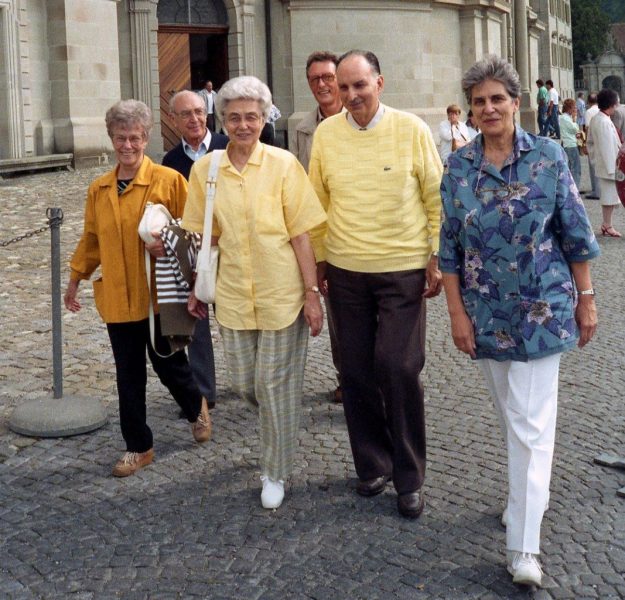
Eli Folonari was Chiara Lubich’s personal secretary for over fifty years. In a series of interviews in 2012, she described many episodes of daily life with Chiara. These interviews were published in a book entitled “The Score Written in Heaven” edited by Oreste Paliotti and Michele Zanzucchi. From your perspective, what was it like to see the birth and development of a movement that is now in 180 countries?  It felt like living in a divine adventure. At the beginning, Chiara always used to say that she never intended to found a movement: the last thing on her mind was to draw up a schedule or an action plan. So what was it like to live beside her? It was like one long race to catch up with her. With Chiara, there was one surprise after another – all the work of the Spirit whose actions are always unpredictable. I am not going to say that there was a surprise every day every day but they often happened. God led her to discover a new “reality” through circumstances, an act of love or a meeting (…) Every meeting had a meaning. She felt that the people she met were waiting for something and she used to tell us this. “Let’s begin to dialogue with these people, let’s do something for them.” Her ideal was ut omnes unum sint (Jn.17:21), the fulfilment of Jesus’ testament. The whole world, beginning with the people closest to us, was contained in that “may they all be one.” What is your life like now after Chiara’s death? When she was alive, if we were dealing with rather complicated situations, just one word from her would help us understand what to do. Now we have to find the answer to these challenges ourselves, with the President, Co-president and the General Council. This encourages us to live so that we are aware of the presence of Jesus among us who enlightens us: we try to listen to one another carefully because what each person says is important and may be inspired. Now that Chiara is no longer here, there has to be an even deeper unity of thought at the heart of the Movement. If you could speak personally to Chiara now, what would you say? I would say, “Thank you Chiara for this divine life into which you drew me – this life of peaks and abysses! Thank you because not only have you satisfied my longing to give myself totally to God and to rebuild society but also because, through you, I have been surprised in ways I could never have imagined. I hope this experience will continue with others in paradise.” (da Giulia Eli Folonari, The Score Written in Heaven, Città Nuova, Roma, 2012, pp. 7-8; 167; 171-172)
