16 Apr 2015 | Non categorizzato
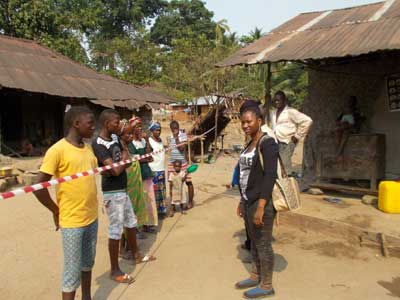
Antonette, a young woman who volunteers for an NGO, in a village named Rosanda
More days of quarantine in Sierra Leone. From March 27-29 several regions of the capital Freetown and other points in the north of the country were once again isolated, following more registered cases of Ebola in previous days. Trained groups went house to house in the most at risk areas, educating and identifying the infected and possibly infected people.
“There was hope of arriving at zero cases by the end of February,” writes Father Carlo from Sierra Leone, “The schools were ready to open, but that was then postponed to the middle of April. So there is uncertainty, the people want to begin normal life, but the virus is still lurking.”
“At the beginning of the epidemic I was in Makeni for my studies,” says Antonette, a young woman who volunteers for an NGO. “The crisis appeared serious from the start, and that’s how I thought of returning to my home town where I would be safe from the virus. But then I decided to stay on as a volunteer helping the people who were infected. I was assigned to a village named Rosanda,” where there are 54 registered cases and 42 deceased. “It was sad during that first period. Around 15 people died every day. I had to inform the families and, even though I tried to put as much love into it as I could, it wasn’t an easy experience. Two children continued to ask me when their parents would return. I just couldn’t bring myself to tell them the truth. I tried my best to console them with my presence and some small gifts.” “Every day, for one month, I went all the way to that village,” Antonette continues, “learning to expand my heart to those who were in need, even if they were not members of my family or circle of friends. Now Rosanda has finished its 21 days of quarantine. There have been no new cases and I am thankful to God that I was able to be an instrument of His love which I received each day in the Eucharist, for all those people.
Like Antonette others have also given of themselves to fight this great cause of so much suffering and pain. Families have adopted children who were left orphaned, priests and religious held nothing back. Amongst these is Father Peter who worked in several villages. Thanks to his stormy intervention it was possible to block the contagion and reduce the number of victims.
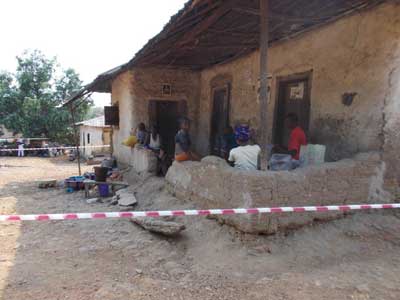 His story is connected to Small Bumbuna, a village in the Diocese of Makeni, 200 miles from Kailahum where the epidemic began. “The illness spread like the fire in dry season, in Sierra Leone. With the first victims we thought of cholera, evil spirits or other superstitions. The response from the medical team was slow: it took weeks to confirm that we were dealing with Ebola. We would have wanted to visit the people from our parish in another village, but the fear was too strong. The district medical team was not able to monitor the situation and send supplies. It was difficult to access roads.” Faced with so many difficulties, Father Peter, followed by his parishioners, made: “a radical decision that brought us face to face with the Ebola,” he recounts. “We found the city deserted when we arrived. The village chief described the terrible situation. The loss of hope was clear on his face, along with impossibility of doing anything.” From there we stepped into non-stop action that involved the highest levels of authority. Father Peter was invited as “guide” to deal with the population, explaining how to stem the spreading and allow themselves to receive medical treatment. “I took on these risks,” Father Peter concluded, “because these people are my community. How could I desert them in such a moment of painful suffering? This question helped me to identify with them, to bring the problem before the authorities, and to offer myself as a guide. I learned that nothing is too small to be offered, nor too heavy to be taken up. Let us continue to pray that the epidemic may be totally eradicated and we can return to normal life.” In the course of two weeks, the danger came under control and people were able to return to their farming activities.
12 Apr 2015 | Non categorizzato
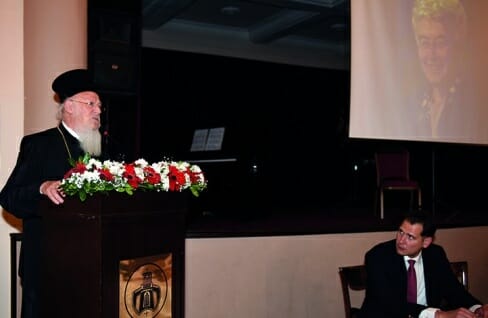
Patriarch Bartholomew
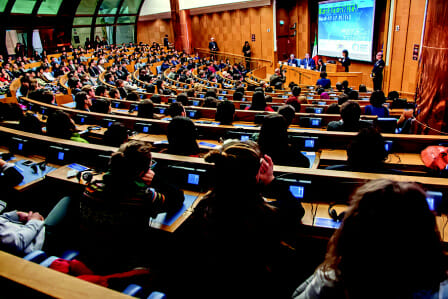
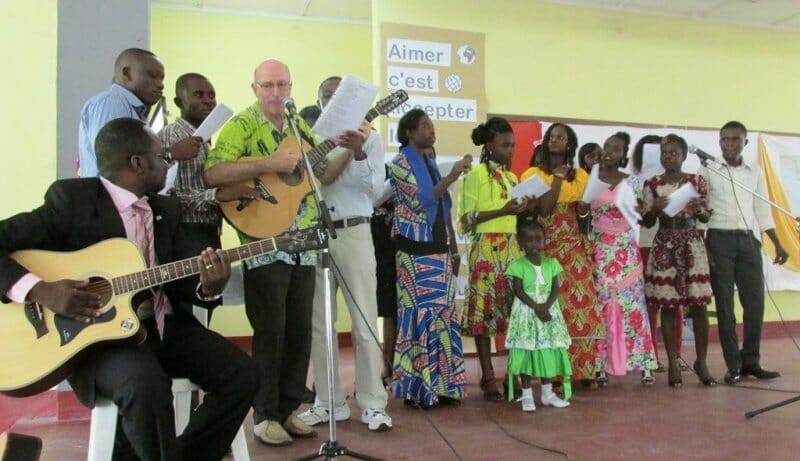 Within crisis situations – An answer to the political crisis going on in Congo appeared as the theme of two meetings held in that land. In Lubumbashi 370 people came forward, both Christian and Muslim. Young people from the Focolare presented an artistic rendition of Chiara’s love for the poor; her encounter with Igino Giordani; and her ‘dream’ for the unity of the human family. The Mass was animated by over fifty seminarians. Four hundred people attended the event in Goma, including a large group of politicians from the province of North-Kivu and representatives from civil society. Following the event, RTNC broadcasted the event in four local languages. Some events were held in a few of the world’s hotspots. In Nigeria, for example, there were several events: in Yola to where many refugees have fled. The bishop celebrated Mass for Chiara, praying for peace. In Abuja and Lagos young people held a two-day preperation event for other young people. In Onitsha there was a meeting with more than 300 adults, young people and children. In Jos, where it was not possible to hold a large gathering because of an explosion a few days earlier, the Focolare groups paid a visit to a Penal Institute for Minors. Peace was also the main topic at a day-long event organised in Bujumbura, Burundi, with over a thousand people. The programme included many testimonies that highlighted the possibility of living in harmony with others and building peace in places where that is not easily done. The Archbishop Evariste Ngoyagoye attended the morning portion of the programme. In Central America, politics is a hot topic. From Honduras they write: “tired of corrupt politics and bombarded by violent news that generates discouragement in the popultiaon, we organised this event in order to share what the charism of unity has to offer both in testimony and in thought.” In Salvador that awaits the Beatification of Oscar Romero, we asked how unity could be lived in the midst of violence. Amongst the testimonies was that of Francesco, who was assaulted by a pair of armed youngsters. He was able to dialogue with them and speak to them about God. The boys were completely blown away; putting down their weapons they walked away. In Pakistan, in Karachi, Lahore, Rawalpindi, Dalwal, over a thousand people held four celebrations, with hopeful expectancy following the tragic events of March 15 in Yohannabad. In institutional fora – In Seoul numerous deputies and people working in public adminstration met at the Parliament to take stock of the journey begun ten years ago towards a politics of brotherhood. In Madrid it was the Seat of the European Parliament to host a seminar on “One world, many peoples embracing diversity;” whereas, in Strasbourg, France, Seats of European Institutes hosted three-day events on the theme of fraternity as a political category. In Rome, a meeting titled “Chiara Lubich: Unity and Politics” was held at the Hall of the Palace of Parliamentary Groups of the Chamber of Deputies. Several politicians gave presentations at the roundtable organised in Toronto, Canada, which focused on Chiara’s vision of politics. In Solingen, Germany, the central theme of the event was the culture of fraternity in three specific areas: refugees, peace, and dialogue with other cultures. Over a hudred people attended from various confessions, religions and nationalities. “The political thought and action of Chiara Lubich” was the main theme of another project that was dedicated to Chiara at an event dedicated to her: the conference of Curitiba, Brazil, where commemorative postal stamps was also printed in her honour. The Parliament of the Province of Córdoba, Argentina, remembered Chiara by approving the decree of posthumous recognition of her work. Other political events were held in Italy, Hungary, Czech Republic, Portugal, Sweden, USA, Honduras, Mexico, Colombia, Tanzania, and Kenya. In other environments – Politics is not the only thing that was discussed on Chiara’s anniversary. Culture and the arts were at the centre of many quite original events. In Durban, South African Republic, the third edition of the “Chiara Lubich Memorial Lecture” was held with the participation of the niece of Mahatma Gandhi, Ela Gandhi. In Maracaibo, Venezuela, the Catholic University Cecilio Acosta (UNICA) held the Fourth Biannual Chiara Lubich Art Contest. It provided professional artists, art students and art lovers with the opportunity of displaying their work at the nations Republicj Square. In other countries March 14th events were opportunities to come together. One such event took place in Cuba at L’Avana with more than 200 people, and in Santiago de Cuba with 150 people. The local Focolare communities prepared the events and presented the Focolare Movement with their own testimonies and the impact of the spirituality of unity in many areas of their personal life and in society.In Cochabamba, Bolivia, there were 120 people. In Mexico City and in the territoryof Nezahualcoyotl Chiara was remembered during the Mariapolis. In Vietnam, both in Ho Chi Minh City to the south, and in the tiny village of Ngo Khe, Ha Noi in the north, people gathered around the altar to renew “before God and before Chiara, our commitment to be forever faithful to her legacy.” In Myanmar, at Yangon, where the majority of Focolare members never knew Chiara personally, they feel very drawn by her charism. Also in Thailand, both in Bangkok and in Chiang Mai, the Focolare Family gathered to celebrate. Six hundred people in the Slovack Republic, from Kosice and Bratislava. They write: “The testimonies from people of other Churches and from people with no religous reference, made us see how Chiara belongs to everyone. The Rector of the University of Trnava, Dr Peter Blaho, who in 2003 had conferred upon Chiara the honorary doctorate in Theology, shared his memory of meeting her. In Fontem, Cameroon, 500 people from all the surrounding villages joined with Fontem to remember “Mafua Ndem,” Chiara Lubich. The theme was “The impact of the ideal of Unity in areas of social life.” The young people from the college presented their experiences with the “cube of peace:” “From when we introduced the cube in our classes, theft and truancy have decreased; academic performance has improved, each student cares for the other student’s property; there’s more tolerance and we forgive one another more easily; and the sharing has grown amongst students. . .” Moments of prayer – Many civil and religious leaders attended Euchariastic celebrations that were held around the world. From the many interventions of Bishops and Cardinals at these celebrations, we present that of Cardinal Angelo Scola from Milan, Italy, who said among other things: “Our task today is to grasp with renewed awareness the dream that had animated the life and thought of Chiara, creating environments of brotherhood everywhere, wherever we find ourselves, and giving priority to the needs of the neighbour that is beside us, as well as the one that is far and living in lands where there is violence and war. This is how we want to become authentic witnesses of the charism that God gave to Chiara, being at the service of the Church and of humanity.”

6 Apr 2015 | Non categorizzato
Like the Prodigal Son
“Our eldest 17 year-old son didn’t come back home one night. What were we to think? He had never caused us worry before. All we could do was pray. The next morning, through the parents of two of his friends, we found out that the three of them had gone to Florence. Somebody wanted to call the police, another insisted he would have nothing more to do with his son. My wife and I, instead, tried to remain calm; we had put everything in God’s hands. Every so often, we would receive some news of them.
While it was a big suffering, we felt very united as a family. There was one thing we all agreed on: we would have welcomed him back with joy, just like in the parable of the prodigal son, without laying on the guilt for his childish behaviour. A week later, the three of them came back home. Our son, having felt our love, was truly sorry for what he had done and assured us he would never do anything like that again. When he found out that his mates had been treated somewhat differently, he was all the more grateful for having a family where everyone tries to live the Gospel.” F.A. – Rome
A Shared Suffering
“The father and sister of my daughter’s friend died in an accident. I had lost my father in similar circumstances. Even though I only knew her mother by sight, when I heard what had happened, I felt compelled to visit her. But I didn’t want it to be just a simple visit. Knowing that she was in financial difficulties, I took her various food items and I tried to console her. I visited her quite often. I even gave her some money I had set aside for us. As time went by, she felt much stronger, more reassured and grateful for the friendship which had blossomed among us, thanks to the suffering that we shared.” B.G. – Bolivia
The beanie
“It was winter time and my friends and I were playing in the school yard. It was very cold. At one stage, a little girl started crying. Her woollen hat didn’t quite cover her ears and they were so cold they hurt her. I wanted to love Jesus in her so I gave her my own beanie which kept her warm.” J. – Belgium
Morning tea
“I was having a snack in the playground. I saw a friend of mine pull another girl’s hair. I left my snack on the wall and I went up to her to say not to do that because Jesus said that we had to love all the time. But then, since both of them started crying, I went to get my snack and I shared it with both of them. It’s true that I was quite hungry, but I was happy because I was able to love.” Valentina – Italia.
Source: “The Daily Gospel” April 2015, Città Nuova publishing house
31 Mar 2015 | Non categorizzato
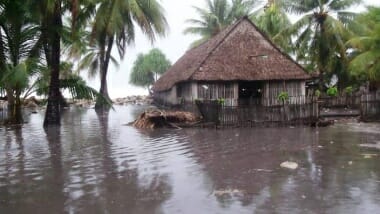
The main causeway connecting the capital and the port with the rest of the Island of Tarawa, the largest in the archipelago of Kiribati, situated in Oceania, has been destroyed. Seawalls have broken down and many of the traditional houses close to the water are gone. Cyclone Pam, one of the most violent cyclones registered in the South Pacific region, hit the island nations of Vanuatu, Solomon Islands and Kiribati. Massive waves were whipped up by winds of 250/300 km per hour. The local Red Cross says there is a lack of emergency housing, food and drinking water for most of the 253,000 inhabitants and people living in the most affected areas are being evacuated.
Mary Cass, coordinator of the AMU project, writes from Perth, Australia: “We have received emails from our Focolare community there. The people are safe and joining in the work to re-build and find food and water for the families of Buota (the village where the project is administered), which is also cut off at this time due to inaccessibility, since the road and bridge connecting them to the rest of Tarawa are down. They have very much in mind the Word of Life for this month which encourages everyone to ‘take up their cross’, and hope to meet together to share experiences and to reinforce their unity during this difficult time.”
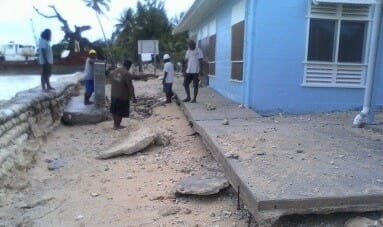 “The weather is getting back to normal,” a member of the local community writes. “The waves are smiling again. We are thankful that everyone is okay.”
But while the spirit and the dignity of the inhabitants of Tarawa is admirable, the situation is indeed very serious: contamination of drinking water wells and tank; shortage of food due to the destruction of crops and the hindrance of travel; shortage of diesel fuel; 80% destruction of local native housing…
Furthermore, the Republic of Kiribati has another huge problem. The increased sea levels have had an impact on agriculture with negative effects on nourishment and employment. Only 10% of the population has regular work. Cited as the first country that will disappear as a result of global warming and increased sea levels, the Kiribati Government have been preparing for mass evacuation of the islands to other countries within a few decades.
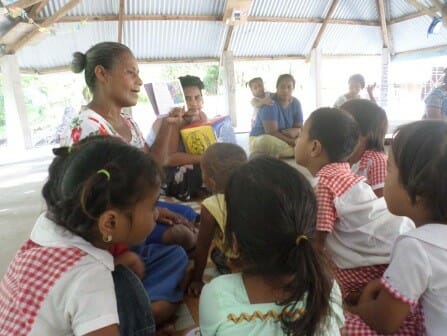 The project administered by AMU (an NGO of the Focolare Movement) aims to improve the education and living standards of the local people of Buota, considered one of the poorest villages on the main Island of Tarawa, through initiatives particularly for woman and children. There is also assistance for the development of craft activities and small business ventures.
“One such activity,” continues Mary Cass, “is the production of ice blocks due to the acquisition of a freezer; another is sewing and craft-making where handicrafts are sold at the Tarawa airport twice weekly. The purchase of a sewing machine through AMU funding has made this possible. The bread making activity is also doing well with bread and buns being sold in roadside shops in surrounding areas.
The proceeds from these activities, other than giving work to the women involved, go to the pre-school called ‘Love and Unity’ and provides basic food and nourishment for children and their families.”
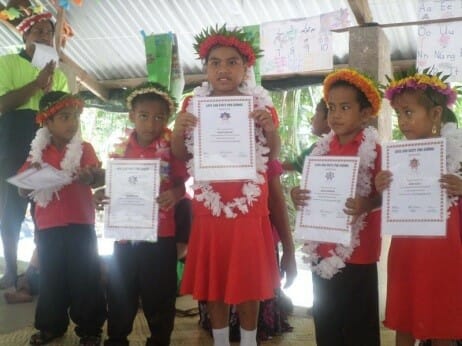 How does one live in a nation which has no future? “The life of the local Focolare community in Buota is forging ahead. “The Word of Life groups,” they write, “unite the people spread across the whole stretch of land. The Bishop of Tarawa, through the help of priests, translates the commentary on the Word of Life in the local Gilbertese language. The families help each other to re-build their homes destroyed by natural calamities and they come together to share their experiences once they manage to put a roof over their heads. The community has named their formation centre (which encompasses a little school) Loppiano Centre of Unity and Love – in reference to the first little town of the Focolare in Italy – with the desire to be a witness of love and unity for everyone.”
See also:
AMU Project Description (Italian)
AMU Newsletter n. 1/2015 (Italian)
Video on Facebook
![Word of Life April 2015]()
29 Mar 2015 | Non categorizzato, Word of
 Audio of the Word of Life
Paul offers us a superb way of being truly love for one another, by ‘making ourselves one’ with them.
In his first letter to the community in Corinth, from which the Word of Life for this month comes, Paul has to defend himself against the scant regard some Christians show for him. They called into question or denied that he was an apostle. After demonstrating fully his qualifications as an apostle because he had ‘seen Jesus Christ’ (see 9:1), Paul explained why he acted with humility and deference to the point of even giving up any payment for his work. While he could have asserted his authority and his rights as an apostle, he preferred to make himself ‘the servant of all’. This is his evangelical strategy.
He enters into solidarity with every kind of person, to the point of becoming one of them, with the aim of bringing the freshness of the Gospel. Five times he repeats ‘I made myself’ one with the other: with Jews, out of love for them, he puts himself under the Mosaic Law even though he said he was not bound by it; with non-Jews, who did not follow the Law of Moses, he lived as someone not under the Mosaic Law, because he had instead a more demanding law, Jesus himself; with those who came to be called the ‘weak’ (probably scrupulous Christians), who worried about whether they should eat the flesh of animals sacrificed to idols, he too became weak even though he was ‘strong’ and experienced a tremendous liberty. In a word, he made himself ‘all things to all people.’
Every time he repeats that he acts like this to ‘win’ each for Christ, to ‘save’ by any means at least someone. He has no illusions, is without triumphalist expectations, knows well that only a number will respond to his love. All the same he loves everyone and puts himself at the service of all according to the example of the Lord, who ‘came not to be served but to serve, and to give his life as a ransom for many’ (Mt 20:28). Who has made himself one with us more than Jesus? He who was God ‘emptied himself, taking the form of a slave, being born in human likeness’ (Phil 2:7).
‘I have become all things to all people.’
Chiara Lubich made this word one of the key points of her ‘art of loving’, summed up in the expression ‘to make yourself one.’ She saw in it an expression of the ‘diplomacy’ of charity. She wrote, ‘When someone weeps, we must weep too. And if someone laughs, we too rejoice . Thus the cross is divided and borne by many shoulders, and joy is multiplied and shared by many hearts…. Making ourselves one with our neighbour for love of Jesus, with the love of Jesus, so that our neighbour, sweetly wounded by the love of God in us, will want to make himself or herself one with us, in a mutual exchange of help, of ideals, of projects, of affections…. This is the diplomacy of charity, which has many of the expressions and features of ordinary diplomacy; hence it does not say all that it could say, for this would displease others and would be disagreeable to God. It knows how to wait, how to speak, how to reach its goal. It is the divine diplomacy of the Word who becomes flesh to make us divine.’
With the skill of a teacher, Chiara also discerns the daily difficulties we have in ‘making ourselves one’: ‘At times we are distracted, at times we have the unfortunate desire to be hasty in saying what we think, in giving our advice at the wrong moment. On other occasions, we are not really open to making ourselves one with our neighbour because we reckon that they do not understand our love, or we are held back by other kinds of judgements. In some cases we are hampered by a hidden wish to conquer the other person to our cause.’ For this reason ‘it is really necessary to cut with or set aside all that fills our minds and our hearts so that we can make ourselves one with others.’ It is thus a love that is constant and tireless, which carries on through thick and thin and is not on the look-out for anything for itself, and that in turn entrusts itself to the greater and stronger love of God.
These are useful ideas that can help us to live the Word of Life this month, by listening sincerely to the other person, understanding the other from within, identifying with what he or she is living and feeling, sharing his or her worries and joys:
‘I have become all things to all people.’
We cannot interpret this invitation of the Gospel as a request to renounce our convictions, as if we approved uncritically of any kind of behaviour in other people and did not have our own life-choices and our own way of thinking. If we have loved to the point of becoming the other, and if what we have shared has been a gift of love and has created a sincere relationship, we can and we must express our own ideas, even though perhaps they may cause pain, all the while remaining in an attitude of profound love. Making ourselves one is not a sign of weakness, nor of looking for a calm and easy way of living together. Instead, it is the expression of a person who is free who chooses to be at the service of others; it demands courage and determination.
It is important to bear in mind the purpose of making ourselves one.
Paul’s words that we are living this month, as we have already hinted, go on to say ‘by any means save some.’ Paul justifies his making himself one with the desire to bring people salvation. It is a way of entering into the other, to draw out the good and the truth within them, to put an end to any errors there may be and set down a seed of the Gospel. It is a task that for the apostle admits of no limits or excuses, that cannot be ducked because it has been entrusted to him by God himself, and he must do it ‘by all means’, with that creativity which only love can bring.
This is the intention that, in the end, motivates our ‘making ourselves one’. Politics and commerce also wish to come close to people, to enter into their way of thinking, to understand their longings and needs, but they always want some kind of return. Instead, Chiara would say, ‘Divine diplomacy has this greatness and this property, perhaps a property of it alone: it is moved by the good of the other and is therefore devoid of any shadow of selfishness.’
‘Making ourselves one’ therefore, to help everyone grow in love and so contribute to making people universally brothers and sisters, God’s dream for humanity, the reason that Jesus gave his life.
Fabio Ciardi
