Where will I end up?

Sister Mariella Giannini (second from left) at the Centre of the Religious of the Focolare Movement in Grottaferrata, Rome.

Sister Mariella Giannini (second from left) at the Centre of the Religious of the Focolare Movement in Grottaferrata, Rome.
 “We prepared ourselves for marriage certain that we would commit ourselves for the rest of our life. But already after the birth of our daughter, he started to go out alone and I, who was always exhausted due to work and maternity, aside from still being in love with him, I did not realize at once that something was wrong. What followed were 13 years of lies and quarrels, alternating with false clarifications which were followed by continuous delusions. I was exhausted and on the verge of a nervous breakdown (my weight dropped to 36 kilos) and so finally I surrendered, and gave my husband his freedom. After three years I met one of my former classmates, he too was a father and separated from his wife. Initially I tried to resist the sentiments that I felt were growing within me because, if on one hand the fact of feeling myself loved gave me much joy, on the other hand I had to face the problem of my Christian faith. They were very difficult moments. But then the doubts disappeared because, I told myself, it is true that when I got married I thought that it would be ‘forever’ but if love is no longer reciprocated, why can’t I continue with another person in that vocation of family life which I have always felt as mine? Certain of our love for one another we decided to join our two broken lives. After around two years of living together, we had a son, whom we had baptized and who we try to educate in a Christian way. For my partner – a person who is very honest and upright who considers himself as a non-believer – the problem of belonging to the Church does not exist. I, instead, continued to go to Sunday Mass and, even in suffering, I accepted the standpoint of the Church by abstaining from receiving the sacraments of Reconciliation and the Eucharist. I could have gone to a church were no one knew me, but out of obedience I didn’t do it. But after awhile, this self-exclusion began to weigh on me and so I stopped going to Mass and participating in the life of the community. In fact, I felt a strong discomfort in seeing the others going to the altar while I had to remain in my seat. I felt abandoned, rejected, guilty. After a few years, thanks to my closeness to the Focolare I started once again my journey of faith. ‘God loves you immensely’, they repeated to me. Together with them I understood that Jesus died for me too, and that He, in his infinite love, had already filled up that abyss into which I had fallen and all that he was waiting for was for me to follow Him for the rest of my life. And so I discovered that, aside from the Eucharist, there were other sources through which I could meet Jesus. He hides himself in every neighbour of mine, he speaks to me through His Gospel and is present in the community united in His name. Above all, I can find Him whenever I am able to transform the suffering of not being able to approach the Eucharist, into love. I remember when our son made his first Holy Communion. I was the only parent who did not go to the altar with him: it was a suffering that I cannot even describe. In exchange I can say that it was precisely when I lost the Eucharist that I discovered the great gift that it is, just like how you discover the value of good health when you lose it. On the day that I will present myself to the Father I hope that He will look not at my failures but rather at all my small efforts to love the others as Jesus had taught us.”
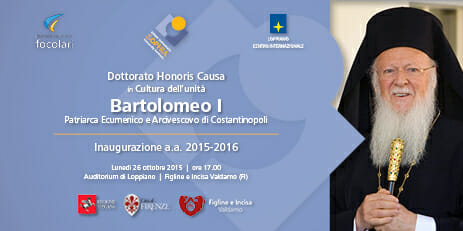
Live streaming from Loppiano, 26 October, 5.00pm (Italian time) IUS president Piero Coda explained the official reason for conferring the doctorate saying that the Patriarch is well known as a convincing and active protagonist of the ecumenical journey toward full unity among Christians, and in the dialogue with people of different religions and convictions. Moreover, he has distinguished himself in his promotion of peace and justice, respect for the natural environment, in conformity with the vision of humanity, history and the cosmos that is guarded and actualised by the spiritual and theological tradition of the Christian East. The history of the fraternal relationship between the Focolare Movement and the Orthodox had its origin in the extraordinary encounter between Chiara Lubich and Patriarch of Constantinople Athenagoras I. “It was June 13, 1967,” Chiara recounted, “He welcomed me as if he had always known me. ‘I’ve been waiting for you!,’ he exclaimed, and he wanted me to tell him about the Movement’s contacts with Lutherans and Anglicans.” Chiara and Athenagoras had twenty-five meetings. The relationship continued with Patriarch Demetrius I, and the contact continues in the same spirit with the current Ecumenical Patriarch Bartholomew I. Meanwhile the spirituality of the Movement was also welcomed by Christians of the Ancient Oriental Church, and dialogue was developed with Syro-Orthodox, Coptic Christians, Ethiopians, Armenians and Assyrians. The honorary doctorate adds another important piece to relationship of harmony and friendship with the Focolare Movement, and will be part of the events celebrating the 50th anniversary of the Focolare town of Loppiano. download invitation www.loppiano.it
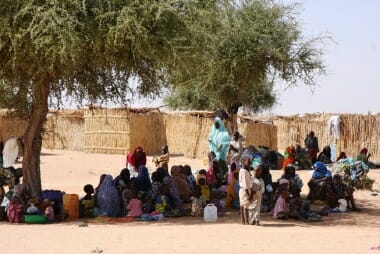
According to the United nations, there are 700 thousand people who are forced to leave their homes due to the violence in the northeastern states of Nigeria. Precisely during the days of the massacre in Paris, Nigeria was again in the news, with the criminal escalations in the State of Borno due to the actions of the extremist group of Boko Haram. They even spoke of kamikaze children who were made to explode in two markets of the Country. The population is defenseless, while contradicting politcal analyses are given and very few reveal the heavy economic interests linked to the exploitation of the petroleum resources of the country. There is great expectations for the presidential elections in February. In Nigeria the Focolare Movement is present with two centers, one in Onitsha (in the south of the Country) and one in Abuja, the capital: «After the first trip that we made to meet the people who were displaced by the internal warfare, we realized what the true situation is: the misery, diseases, hunger, lack of clothing, lack of shelter but especially the children with no hope for a future», George and Ruth, the persons responsible for the Movement in that African nation wrote to us. And so they organized a second trip, during the Christmas season inviting their friends, relatives, co-workers to join in: «We truly experienced the generosity of our people, in Focolare all kinds of God’s bounty arrived: money, food, clothes, medicines. We even received a car with a driver who was an expert and knew where to pass to avoid the dangerous areas». Three of us went on the trip: a focolarina who is a nurse, another person and the driver. Bearing many gifts «so as to bring the joy of Christmas to those people who more than anyone else resembled the Baby Jesus who did not even have a suitable place to be born». The situation was precarious: the medicines were not enough for their many needs: «I am a professional nurse – Imma shared – I treated hundreds and hundreds of sick people: malnutrition, anemia, malaria and various illnesses. Then we helped the bishop to distribute food to more than 5000 refugees. It is a very painful situation, and everyday other refugees arrive». «May this be the year of the Yes», Maria Voce wished for us in 2015, «a yes that is repeated an infinite number of times: yes to God who asks us for something unforseen, yes to that neighbour who needs our concrete love , yes to an unexpected suffering, yes to Jesus who is waiting to be welcomed by us in humanity, transforming suffering into joy, into life and resurrection». But what does this mean in situations of darkness, that seem to be without hope, like in Nigeria? «For us this is the everyday reality – Ruth and George continue – in the difficult circumstances in which we find ourselves in our Country. There are so many sources of Evil. In front of this situation we cannot remain indifferent. When we arrived there, where the people are suffering the most, we touched concretely that which Jesus repeats to us even today: “you did it to me”». And, on behalf of the whole Focolare community of Nigeria, they would like to convey to us their gratitude for the prayers and support that has reached them in many ways, «above all in this moment, and also before and after the presidential and legislative elections».
Pope Francis is putting all his energy into his travels, as he has always done. But this trip to Asia is forecasted to be a really demanding one. Besides institutional types of events such as the interreligious meeting in Colombo upon his arrival in Sri Lanka and the canonization of the Indian Missionary, Joseph Vaz, the Pope will have to face the sultry tropical climate, but above all, an entire population that is expecting a strong message of hope from the visit.
This will be for Francis, a full immersion in one of the many peripheries of the world, so dear to his heart and marked also recently by natural calamities that have inexorably impacted on the difficult social support path in those lands.
Expectations are high and the Pope Francis excitement is building up especially in Manila where more than the five million people who officially attended the Mass of the World Youth Day celebrated by Pope John Paul II in 1995 are expected to participate. The Filipinos have been snapping their selfies beside his life-size cutout image in churches and malls, while the children are preparing to dress up as Swiss guards to welcome the Pope.
During the Christmas preparations, the youth of the Focolare went to the Tacloban and Palo regions, where the Holy Father will pay a visit on day 17, to celebrate with the schoolchildren with games, songs and gifts for the typical ”Noche Buena” or Christmas Eve vigil. This initiative was conducted also in cooperation with the youth from various parts of the world, who are living a concrete community experience in the small town of the Focolare in Tagaytay.
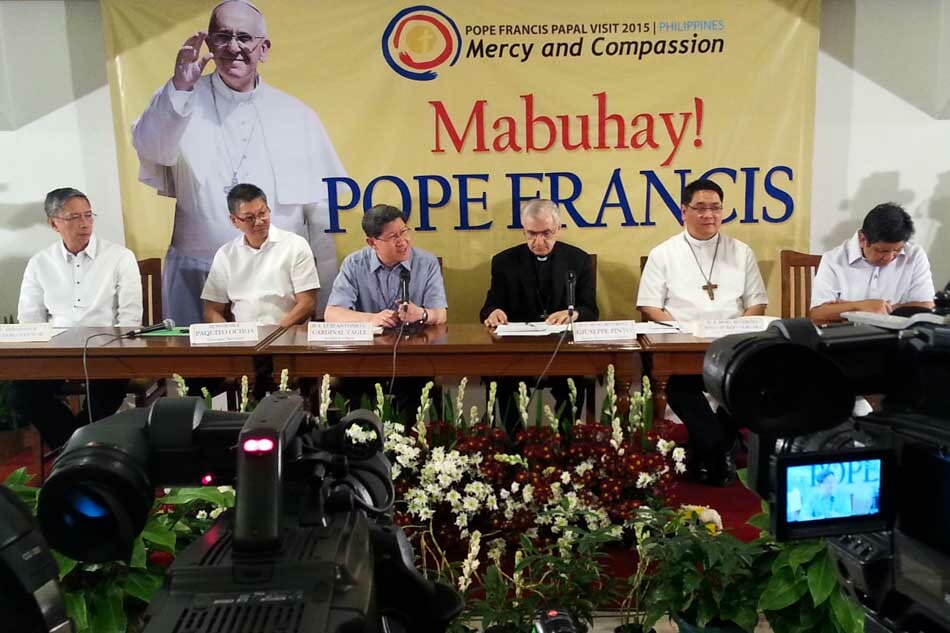 This was their concrete answer to the invitation of the Archbishop of Manila, Card. Tagle, and the President of the Philippine Bishop’s Conference, Bishop Villegas, to prepare for the Pope’s visit by intensifying the works of mercy towards the poor and outcasts. This gesture was not something new for them. Since November 2013, that is, when the country’s historically strongest typhoon Haiyan (Yolanda) wreaked its havoc, the Focolare has been organising a series of action aids for the struck population: from first aid to the distribution of food, clothing and prime necessities, repair of homes, moral support to families and those who had lost their loved ones, to the rebuilding plans with the construction of about 40 small houses. The specific program of the ”Start Again” project to help the schools, is still underway.
Besides this, the Focolare undertook to prepare the Holy Father’s visit to the Philippines through a word-of-mouth action and all the communities of Manila agreed to line the streets on January 15 from the airport to the city, to be with all the others in welcoming the Holy Father in person.
The community of Leyte took part in the Commission organizing the visit to the places where the typhoon had struck: to help in the security services during the Papal Mass in Tacloban, and also during the meeting at the Pope Francis Center for the Poor of Palo with about 200 aged people and poor children. A young Focolare member will entertain the participants before the Pope’s arrival.
But for the moment, the happiest are the survivors. Here’s what Farah says: “I am offering all my sufferings for the Pope’s safety and health.” Mark adds: “I am happy to be able to have a close view of the Pope. I feel so privileged. We are very grateful for his visit.”
About ten members of the Movement have been chosen as group leaders for the works of the New Evangelization Convention to be held from 15 to 18 January at the Pontifical University of Santo Tomas, with 5,000 enrolled delegates whom the Pope will meet on the 18th, before his departure.
Also on the last day, Pope Francis – who will start his trip to Manila with an encounter with families – will meet the youth gathered at the University’s sports field – and in the afternoon – will conclude his visit with a solemn Mass at Rizal Park.
Happy Trip Holy Father!